What Are the Stages of Nicotine Withdrawal?
Understanding the stages of nicotine withdrawal is one of the most practical things you can do before quitting smoking. When you know exactly what symptoms to expect and precisely when they will peak and subside, the experience becomes far less frightening — and you are far less likely to relapse because you mistake a predictable phase of healing for something going wrong. This guide maps each stage with clinical precision, based on NHS, CDC, and peer-reviewed research, updated for 2026.
Withdrawal is not punishment for smoking. It is the physiological evidence that your brain is adapting — becoming free of its chemical dependence on nicotine. Each symptom, however uncomfortable, marks a step toward a new, healthier neurological baseline.
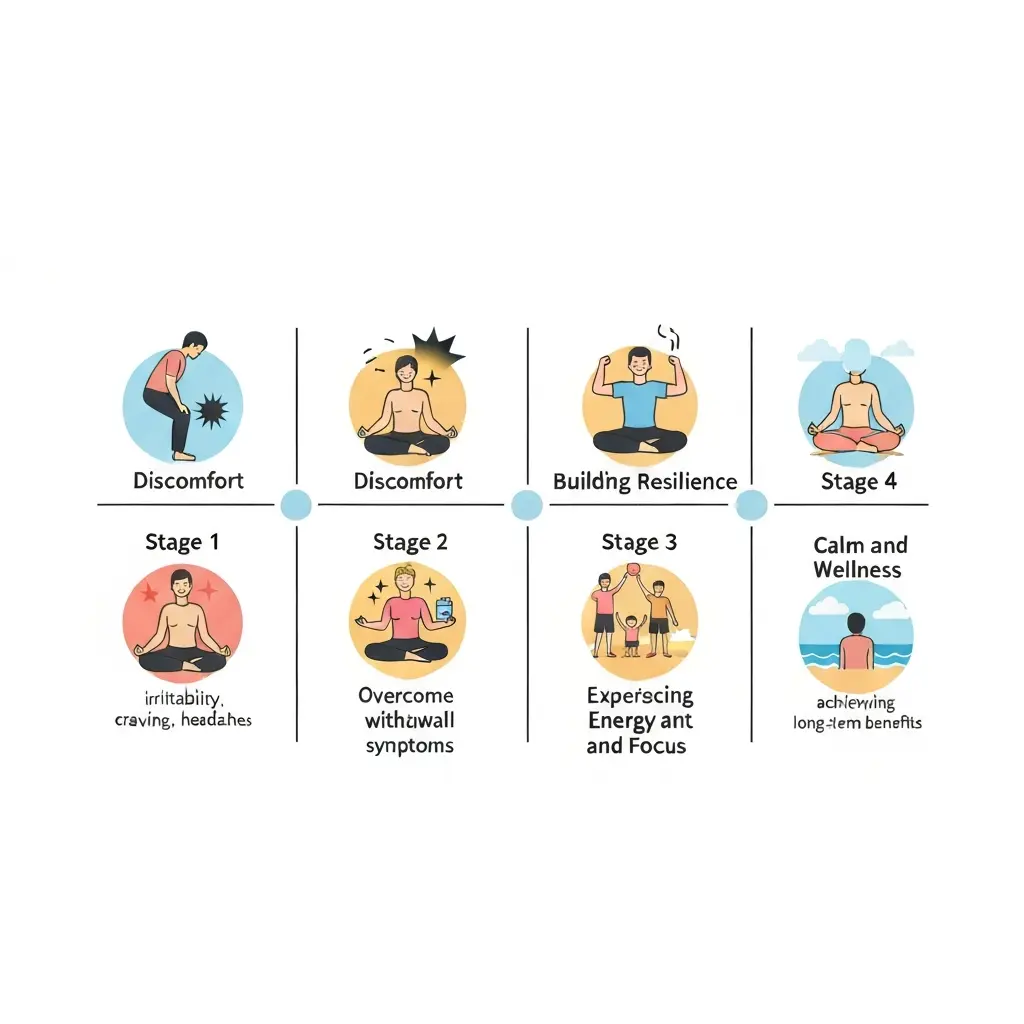
Stage 1: What Happens in the First 24 Hours of Nicotine Withdrawal?
The first stage of nicotine withdrawal begins within 30–60 minutes of your last cigarette for heavy smokers, or within 2–4 hours for lighter smokers. This initial phase is characterised by the onset of symptoms as blood nicotine levels begin to fall.
What you will feel in Stage 1:
- Cravings: The first and most prominent symptom. Initial cravings are intense but short — typically peaking at 3–5 minutes and rarely lasting longer than 10 minutes. However, they occur frequently throughout Day 1.
- Irritability and agitation: The dopamine drop caused by falling nicotine levels creates mild to moderate mood disruption. You may feel edgy, short-tempered, or restless without clear cause.
- Anxiety: Generalised anxiety is common as the brain’s stress-response system, which nicotine has been modulating, begins operating without its chemical buffer.
- Mild headache: Related to increased cerebral blood flow (as nicotine-induced vasoconstriction reverses) and to lowering CO levels. Typically mild and transient.
- Difficulty concentrating: Nicotine upregulates acetylcholine receptors in the brain, which influences attention and cognitive processing. As nicotine falls, focus temporarily deteriorates.
- Increased appetite: Nicotine suppresses both appetite hormones and metabolic set-points. Within hours of quitting, appetite regulation begins normalising, and hunger signals return.
The physiological backdrop to Stage 1 is the reversal of some acute nicotine effects: within 20 minutes, heart rate and blood pressure begin to normalise; within 12 hours, carbon monoxide is cleared. These are positive changes that run simultaneously with withdrawal symptoms. For the full healing picture, see what happens to your body when you stop smoking.
Stage 2: What Happens at Peak Withdrawal on Days 2–3?
Days 2 and 3 are almost universally acknowledged by both ex-smokers and clinical researchers as the hardest phase of the quit journey. This is the biological crescendo of withdrawal, and understanding why it happens helps you get through it.
Nicotine is virtually fully cleared from the body by 72 hours. The brain’s nicotinic acetylcholine receptors — which have been upregulated in response to years of nicotine stimulation — are now receiving almost no input. The dopaminergic reward system is operating at a significant deficit relative to its nicotine-adapted baseline. This chemical nadir produces the following:
- Peak cravings: Most intense and most frequent on Day 2–3. Each craving lasts 3–10 minutes. Most people experience 15–30 craving episodes per day during this stage.
- Peak irritability and anger: The most emotionally disruptive phase. Many people describe feeling disproportionately angry or tearful without obvious triggers. This is biochemically driven, not a personality change.
- Insomnia: Nicotine has mild sedative effects at some receptor subtypes while also being a stimulant. The brain’s arousal system is recalibrating, causing disrupted sleep onset and early waking. Vivid dreams are common.
- Difficulty concentrating: Peaks at Days 2–3. Tasks that normally require modest mental effort may feel unusually demanding.
- Constipation: Nicotine stimulates colonic motility. Its absence slows gastrointestinal function temporarily, causing constipation in a significant proportion of quitters.
- Increased appetite and sweet cravings: The brain’s reward circuitry, deprived of its usual dopamine source, may compensate by seeking reward through food — particularly high-sugar foods that briefly elevate dopamine.
- Depressed mood: A transient low mood or emotional flatness is extremely common. For most people it resolves within 1–2 weeks. People with a history of depression should be monitored during this phase.
If you are in Stage 2 right now, the most important thing to know is this: it is the peak, not the beginning of a longer decline. From Day 4 onward, these symptoms begin to measurably improve for most people.
Stage 3: What Happens During Acute Recovery (Days 4–14)?
Stage 3 brings meaningful relief. While withdrawal symptoms continue, they begin to decline in both frequency and intensity. The brain is actively adapting — downregulating the excess nicotinic receptors that were upregulated by years of smoking, and recalibrating its dopamine production toward a new, healthy baseline.
- Craving frequency declines: Many people report a noticeable drop in craving frequency from Day 4–5. Individual cravings remain short (3–5 minutes) but occur less often.
- Mood stabilises: The worst of the irritability and depressed mood typically passes by the end of Week 1 for most quitters. Energy levels begin to return.
- Sleep improves: By Week 1, most people report improved sleep compared to the Days 2–3 nadir, though sleep quality may not fully normalise until Week 4–6.
- Lung changes: Cilia in the airways are recovering and may produce an increase in coughing and mucus. This is a positive healing sign, not a cause for concern.
- Taste and smell sharpening: Many people notice significant improvements in taste and smell by Day 5–7. Foods taste different (often better). The smell of cigarette smoke on others’ clothes can become unpleasant.
- Physical energy returning: As CO clears and oxygenation improves, physical endurance often increases noticeably by Week 2.
The psychological challenge in Stage 3 shifts from intense physical discomfort to managing habitual triggers — the morning coffee craving, the after-meal smoke, the work-break cigarette. Behavioural therapy and structured habit replacement strategies are most valuable at this stage.
Stage 4: What Happens During the Post-Acute Phase (Weeks 2–12)?
From Week 2 onward, most physical withdrawal symptoms have resolved or become manageable. What persists in Stage 4 is primarily psychological and habitual:
- Conditioned cravings: Certain situations, places, emotions, or sensory cues (the smell of smoke, alcohol, stress) can trigger cravings weeks or months after physical withdrawal is complete. These are conditioned responses — learned associations between a situation and the act of smoking — not chemical withdrawal.
- Background anxiety or restlessness: Some people experience a low-grade anxiety or sense of “something missing” for several weeks. This reflects ongoing neuroadaptation and is normal.
- Weight gain: Appetite continues to be elevated as the metabolic suppression of nicotine reverses. Average weight gain is 4–5 kg, concentrated in the first 3 months.
- Improved lung function: By Weeks 2–4, the NHS documents measurable improvement in lung capacity of up to 30%. Most people notice they can exercise with substantially less breathlessness.
Stage 4 is where long-term success is determined. People who relapse in this phase are typically responding to trigger-based conditioned cravings rather than physical withdrawal. The iQuit app’s craving log and intervention tools are specifically designed for Stage 4 trigger management.
The nicotine clearance timeline covered in our article on how long nicotine takes to leave the body helps explain why Stage 4 cravings are psychological rather than chemical.
Complete Nicotine Withdrawal Symptom Reference Table
| Symptom | Onset | Peak | Duration | Relief |
|---|---|---|---|---|
| Cravings | 30 min | Days 2–3 | Weeks to months (reducing) | NRT, exercise, delay tactics |
| Irritability | Hours 1–4 | Days 2–3 | 1–2 weeks | NRT, exercise, CBT |
| Anxiety | Hours 2–6 | Days 1–3 | 1–2 weeks | Mindfulness, exercise, NRT |
| Difficulty concentrating | Hours 4–12 | Days 2–4 | 1–3 weeks | Time, NRT |
| Insomnia | Night 1 | Days 2–5 | 1–4 weeks | Sleep hygiene, remove patch at night |
| Headache | Hours 1–12 | Day 1–2 | 2–7 days | Hydration, paracetamol |
| Increased appetite | Hours 4–12 | Weeks 1–4 | Several months | Regular meals, exercise |
| Depressed mood | Day 1 | Days 2–5 | 1–4 weeks | Exercise, social support, bupropion if indicated |
| Constipation | Day 1–2 | Days 2–5 | 1–4 weeks | Fibre, hydration, exercise |
| Increased coughing | Days 3–7 | Week 2–4 | 4–8 weeks | Hydration (this is a sign of recovery) |
How Do You Manage Each Stage of Nicotine Withdrawal?
Evidence-based management strategies differ by stage:
Managing Stage 1 and Stage 2 (Days 1–3):
- NRT: Starting a nicotine patch plus fast-acting gum or lozenge from Day 1 reduces the severity of symptoms in both stages by preventing the full abrupt nicotine drop. The NHS recommends combination NRT for the first 8 weeks.
- Varenicline: If started 1–2 weeks before quit day, partially prevents the dopamine deficit that drives Stage 2 intensity.
- Exercise: A 15-minute brisk walk reduces craving intensity for up to 30 minutes by acutely elevating dopamine and endorphins.
- Delay and distract: A craving that is not responded to with a cigarette will pass in 3–10 minutes. Distracting activities that occupy the hands and mind (cold water, deep breathing, a phone game) bridge the gap.
- Mindfulness: Observing a craving without reacting to it — noting its rise and fall — is a clinically validated approach that reduces craving-driven relapse.
Managing Stage 3 (Days 4–14):
- Continue NRT for the full recommended duration (usually 8–12 weeks) even as symptoms improve.
- Identify and plan responses to your top 3–5 trigger situations.
- Increase exercise gradually as lung function improves.
- Enrol in or continue behavioural support — this is when CBT and trigger-response work has the highest value.
Managing Stage 4 (Weeks 2–12):
- Continue using NRT until you have completed the full recommended course.
- Use a quit smoking app like iQuit to log conditioned cravings and build awareness of their triggers.
- Plan ahead for high-risk situations (alcohol, social smoking situations, high-stress events).
- Reframe “I can never smoke again” as “I choose not to smoke today” — reducing the psychological weight of permanence.
For resources on managing specific trigger situations, see how to deal with cigarette cravings.
How Does NRT Change the Nicotine Withdrawal Stages?
NRT does not eliminate withdrawal — it attenuates it. By providing a controlled, steady-state dose of nicotine, NRT prevents the sharp blood-nicotine crash that drives the most severe Stage 2 symptoms. The practical effect:
- Stage 2 peak is less intense — cravings are present but less overwhelming
- Irritability and mood disruption are measurably reduced (Cochrane data)
- Sleep disruption may be reduced (though nicotine patches can cause vivid dreams in some people when worn overnight)
- Stage 3 transition is smoother
NRT does not remove the need to work through the withdrawal stages — it makes them manageable enough that you can get through them without relapsing. The decision of whether to use combination NRT or a single product, and which products to choose, is reviewed in our guide to the most effective ways to quit smoking.
When Does Nicotine Withdrawal End?
There is no single moment when withdrawal “ends,” but there are meaningful clinical thresholds:
- By Week 2: Physical withdrawal symptoms are substantially resolved for most people. Cravings are less frequent. Mood is largely stabilised.
- By Week 4: Most people report that physical symptoms have cleared. Conditioned cravings may continue but are shorter and less intense.
- By Week 12: The vast majority of ex-smokers report withdrawal symptoms as absent or negligible. Occasional cravings in specific trigger situations may persist.
Research from the University of Pittsburgh found that 80% of ex-smokers who remained abstinent at 3 months reported no significant withdrawal symptoms. The first 3 months are the window that matters most.
For heavy smokers (20+ cigarettes per day, smoking for 10+ years), symptoms may last somewhat longer, and the timeline from nicotine withdrawal to full normalisation can extend to 3–6 months. Understanding the nicotine withdrawal timeline week by week is covered in our dedicated resource on the 12-week nicotine withdrawal recovery calendar.
Frequently Asked Questions
What are the stages of nicotine withdrawal?
Nicotine withdrawal unfolds in four stages: Stage 1 (Early Onset, Hours 1–24) with rising cravings, irritability, and mild anxiety; Stage 2 (Peak Withdrawal, Days 2–3) with the most intense cravings, mood disruption, and insomnia; Stage 3 (Acute Recovery, Days 4–14) with declining symptoms and improving energy; and Stage 4 (Post-Acute Phase, Weeks 2–12) with primarily conditioned psychological cravings rather than physical symptoms. Most physical withdrawal resolves within 2–4 weeks.
When is nicotine withdrawal at its worst?
Nicotine withdrawal is most intense on Days 2 and 3 after quitting. This peak corresponds to the final clearance of nicotine from the body, when the brain’s dopamine system is at its lowest point relative to its nicotine-adapted baseline. Cravings, irritability, anxiety, insomnia, and difficulty concentrating are all most severe during this 48-hour window. Symptoms decline meaningfully from Day 4 onward.
How long do nicotine withdrawal symptoms last?
Most physical nicotine withdrawal symptoms — cravings, irritability, insomnia, headaches, difficulty concentrating — resolve within 2–4 weeks for average smokers. Conditioned psychological cravings triggered by habits and situations can persist for several months but become progressively shorter and less intense. By 3 months, the majority of ex-smokers report withdrawal symptoms as absent or negligible.
Is it normal to feel depressed when quitting smoking?
Yes, feeling low or flat when quitting smoking is very common and normal. Nicotine stimulates dopamine release in the brain’s reward system. When nicotine is removed, dopamine falls below the brain’s adapted baseline, causing a temporary depressed or flat mood. For most people, this resolves within 1–2 weeks. If depressive symptoms are severe, persistent beyond 2 weeks, or concerning, consult your doctor — bupropion is a cessation medication with antidepressant properties that may be particularly appropriate in this situation.
What is the best thing to do when you have a nicotine craving?
The most evidence-based craving management technique is “delay and distract.” A craving that is not responded to will peak and pass within 3–10 minutes. Effective distraction tactics include: drinking a glass of cold water, taking a brief brisk walk, deep breathing exercises, chewing gum, calling a friend, or using a craving-response exercise on a quit smoking app. Using NRT (gum or lozenge) at the onset of a craving directly reduces its intensity through nicotine replacement.
Does everyone experience nicotine withdrawal?
Almost all daily smokers experience some degree of nicotine withdrawal when they stop. The severity varies considerably based on nicotine dependence level, genetics (CYP2A6 enzyme variants), how long and how heavily you smoked, and whether you use cessation support. Occasional or social smokers who are not physically dependent may experience minimal withdrawal. The Fagerström Test for Nicotine Dependence (FTND) can help estimate your likely withdrawal severity before you quit.
Why is sleep affected during nicotine withdrawal?
Nicotine has complex effects on sleep architecture — it is both a stimulant (disrupting deep sleep) and it modulates certain sleep-promoting neurotransmitter systems. When nicotine is removed, the brain undergoes a temporary dysregulation of sleep-wake control, leading to difficulty falling asleep, more frequent waking, and vivid or disturbing dreams. This typically improves significantly within 2 weeks. If using nicotine patches, removing them before sleep (if using 16-hour patches) or switching to 16-hour patches can reduce dream disruption.
Can you get nicotine withdrawal from vaping too?
Yes. Because vaping delivers nicotine, regular vapers develop physical nicotine dependence and experience withdrawal when they stop. The symptoms are identical to those of cigarette withdrawal — cravings, irritability, anxiety, difficulty concentrating, insomnia — and follow the same timeline. The severity depends on the nicotine concentration in the e-liquid and how frequently and heavily the person vaped. NRT and cessation medications are equally effective for vaping cessation as for cigarette cessation.
What symptoms should prompt me to see a doctor during withdrawal?
Contact your doctor if you experience: severe or persistent depressive symptoms (beyond 2 weeks), suicidal thoughts, severe anxiety that is preventing normal functioning, chest pain or irregular heartbeat, or symptoms that significantly worsen rather than improving after Day 3. If you have a history of depression, bipolar disorder, or serious mental illness, it is advisable to involve your doctor in your quit plan from the start, as withdrawal can temporarily destabilise mood disorders.
Get Through Every Stage with Support
The iQuit app tells you exactly which withdrawal stage you are in, what symptoms to expect today, and delivers craving-response exercises the moment you need them. Turn the hardest days into your strongest ones.