How to Deal With Cigarette Cravings: 12 Evidence-Based Strategies That Actually Work
A cigarette craving arrives fast. One moment you’re fine; the next, your brain is entirely focused on the idea of smoking. If you’re in the process of quitting, knowing how to deal with cigarette cravings is the most practically important skill you can develop — because cravings are where quits are won or lost. The encouraging truth is that cravings are time-limited: most nicotine cravings peak between 3–5 minutes and rarely last longer than 10 minutes. The problem is that 10 minutes can feel like an hour when you’re in the middle of one.
The strategies in this guide are drawn from Mayo Clinic, the NHS, NIDA, Smokefree.gov, and peer-reviewed cessation research. They work across different craving triggers — stress, boredom, social situations, post-meal habits — so you can build a personal toolkit rather than relying on a single technique that fails when conditions change.
Understanding What a Craving Actually Is
A cigarette craving is not a signal that you need a cigarette. It is a conditioned neurological response — your brain, trained over months or years of smoking, firing a reward-seeking pattern because a trigger has appeared. The trigger might be a smell, a time of day, an emotion, a situation, or another person smoking nearby. The craving that follows is your brain predicting the dopamine reward it associates with smoking in this context.
This matters because it changes how you relate to the craving. You are not weak when you have a craving; you are experiencing a predictable, involuntary neurological event. Your job is not to fight it — it is to ride it out. And with the right techniques, riding out a craving becomes progressively easier as the neural pathway weakens from lack of reinforcement.
According to the CDC’s guidance on quitting, cravings are most intense in the first few days after quitting and become less frequent and less intense over the following weeks and months.
The 5Ds: A Core Framework for Any Craving
The 5Ds are recommended by Robert Wood Johnson Barnabas Health and endorsed by a broad body of cessation research as a simple, adaptable framework for dealing with any cigarette craving:
- Delay: Make a commitment to wait at least 10 minutes before doing anything. Most cravings have passed by then.
- Distract: Switch to a completely different activity. Change rooms, pick up a specific object, start a task. Breaking the physical pattern of the craving disrupts its neurological grip.
- Drink water: Sipping cold water creates a sensory interruption and is particularly effective for the oral component of cravings.
- Do something else: Physical movement — even walking to another room — activates different neural pathways and reduces craving intensity. Research shows even a 10-minute walk significantly reduces cigarette cravings.
- Deep breathe: Slow, controlled breathing activates the parasympathetic nervous system, directly counteracting the stress response that often accompanies a craving.
Physical Craving Management Strategies
Exercise — Even in Short Bursts
Mayo Clinic notes that physical activity, even in short bursts, can help boost energy and beat a craving. A 10-minute walk, 20 jumping jacks, or simply climbing a staircase can interrupt the craving cycle through multiple mechanisms: increased endorphin release, changed physical environment, redirected attention, and increased blood oxygen levels that partially address what smoking was providing neurochemically.
Keep Your Hands and Mouth Busy
A large component of cigarette cravings is habitual: the hand-to-mouth action, the oral satisfaction of drawing and exhaling. Substitute activities that address the same physical loop: chewing sugarless gum, holding a pen, using a stress ball, chewing a cinnamon stick or a piece of vegetable, or handling a fidget device. These may seem trivial but they address the physical dimension of craving that pure mental strategies miss.
The Cold Water Technique
Drinking a large glass of cold water slowly — not gulping — during a craving is recommended by NHS Inform and Medline Plus. The cold sensation provides a physical anchor, the act of drinking occupies the oral pathway, and the physical feeling in the stomach creates a competing sensory experience that partially displaces the craving.
Mindfulness-Based Urge Surfing
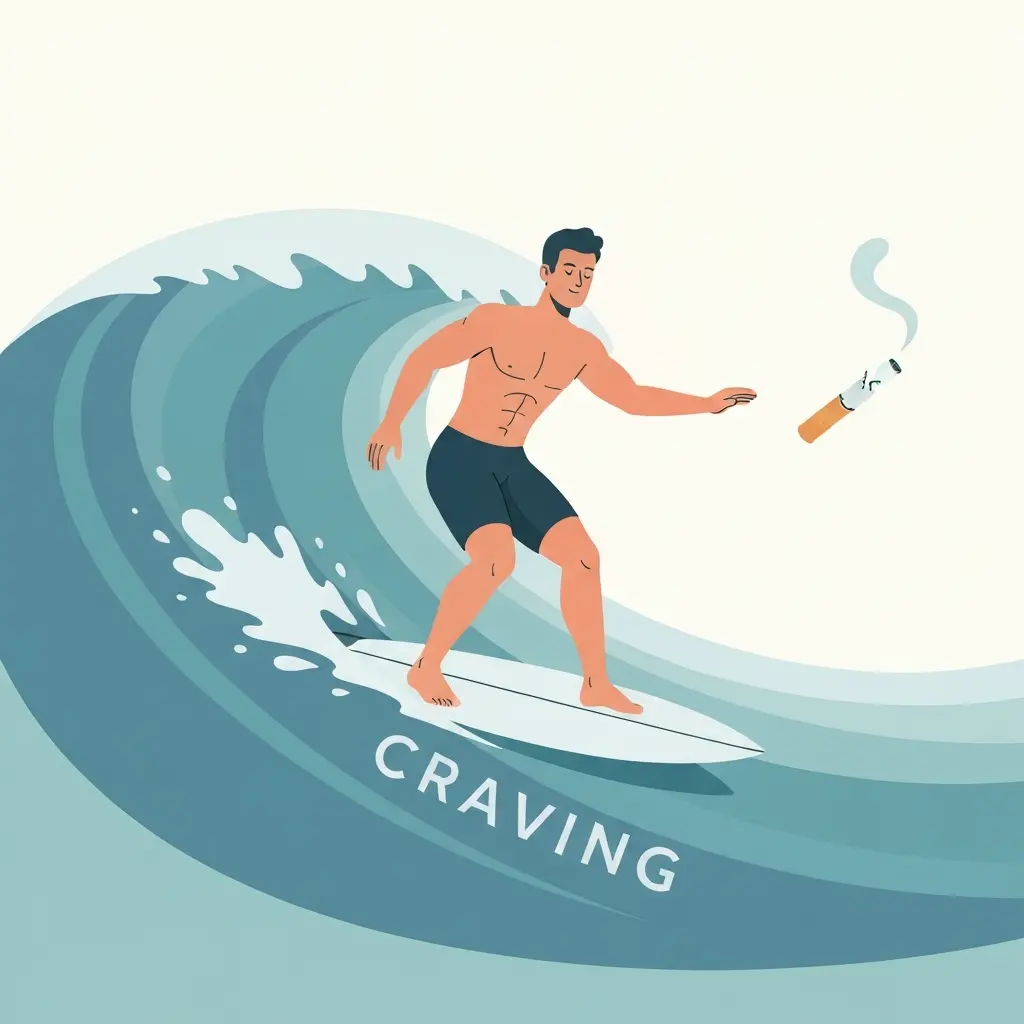
Mindfulness-based smoking cessation treatments — as documented in NIDA’s treatment guidance — teach patients to increase awareness of and detachment from sensations, thoughts, and cravings. The core technique is called urge surfing:
- When a craving arrives, instead of fighting it or trying to distract from it, turn your full attention toward it.
- Observe it curiously: Where in your body do you feel it? What does it feel like physically — tightness, heat, restlessness?
- Watch the craving as if you were observing a wave in the ocean. It rises, peaks, and falls — it always falls.
- The goal is not to eliminate the craving but to let it complete its cycle without acting on it.
Research finds that urge surfing reduces craving intensity and, over multiple practice sessions, changes how the brain responds to craving triggers. It is particularly powerful for people who struggle with distraction techniques when cravings are severe.
The iQuit AI coach can guide you through a brief urge surfing exercise in real time — open the app when a craving hits and select the craving support tool. For the mindfulness approach specifically, the article on mindfulness for quitting smoking covers the full evidence base and practical techniques.
Trigger-Specific Strategies
Different triggers need different responses. Here’s a quick guide:
| Trigger | Most Effective Response |
|---|---|
| Stress / anxiety | 4-7-8 breathing, brief walk, cold water, urge surfing |
| After meals | Brush teeth immediately, replace with tea or herbal drink, get up from the table |
| Boredom | Prepare a specific “boredom activity” list in advance (podcast, short game, call a friend) |
| Social / seeing others smoke | Physically move away, have NRT ready, tell someone with you that you’re quitting |
| Alcohol | Avoid high-risk drinking situations in early weeks, sip a non-alcoholic drink slowly, tell the group you’ve quit |
| Morning coffee | Switch to tea temporarily, change where you have your morning drink, hold the mug with both hands |
When to Use NRT or Medication
Nicotine Replacement Therapy (NRT) — patches, gum, nasal spray, lozenges, inhalers — directly addresses the physical component of a craving by supplying a controlled, tobacco-free dose of nicotine. NIDA recommends NRT as first-line support for most quitters, either alone or in combination with prescription medications like varenicline (Champix/Chantix) or bupropion.
NRT is most effective when used correctly:
- Patches provide a steady background level of nicotine — good for managing baseline cravings throughout the day
- Fast-acting NRT (gum, spray, lozenge, inhaler) addresses breakthrough cravings — use at the first sign of a craving, before it peaks
- Combination NRT (patch + fast-acting) consistently produces better outcomes than single NRT
Using iQuit’s Craving Tracker as a Craving Tool
iQuit’s craving tracker serves a dual purpose: it records your craving data for pattern analysis, and the act of opening the app and logging a craving creates a critical pause between stimulus and response. That pause — even 30 seconds of deliberate engagement with the app — is often enough to break the automatic reach for a cigarette.
When you log a craving, the AI coach offers a context-specific intervention based on the trigger and intensity you report. Over time, the craving tracker builds a map of your highest-risk moments, letting you plan proactively — scheduling a walk at your peak craving time, for example, or having NRT ready at your most vulnerable moment of the day.
For the broader motivational context that sustains you through repeated craving management, the article on quit smoking motivation covers the full psychological toolkit. And for success stories of people who managed cravings and quit for good, quit smoking success stories provides real-world examples that show what’s possible.
Frequently Asked Questions
How long do cigarette cravings last after quitting?
Individual cigarette cravings typically peak and pass within 5–10 minutes. The overall frequency of cravings decreases over time — they are most intense and frequent in the first 3–7 days after quitting, significantly reduce by weeks 2–4, and become less frequent and less intense over the following months. Occasional cravings can persist for months or years, but they become far easier to manage with time.
What stops cigarette cravings immediately?
Fast-acting NRT (nicotine gum, nasal spray, or lozenge) can reduce craving intensity quickly by addressing the physical nicotine need. Behaviourally, the fastest craving interruptions come from physical movement (a brisk walk), cold water, and the 4-7-8 breathing technique. Opening iQuit’s craving support tool immediately also creates a pause that often allows the craving to pass before it peaks.
Why are cravings strongest after meals?
Post-meal cravings are driven by conditioned association — your brain has learned to expect a cigarette after eating. The dopamine reward of smoking was repeatedly paired with the post-meal context, creating a strong conditioned response. Breaking this requires replacing the conditioned habit: brush teeth immediately after eating, have a herbal tea, or leave the table quickly to break the association.
Does iQuit help with cigarette cravings?
Yes — iQuit’s craving tracker logs your cravings and delivers context-specific support through the AI coach. Opening the app at the start of a craving creates a critical pause that often allows the craving to pass, and the coach provides specific techniques based on your reported trigger and intensity. The craving log also builds a pattern map that lets you plan proactively for your highest-risk moments.
Beat Every Craving With iQuit
The next time a craving hits, open iQuit first. The AI coach is there with a specific technique for your specific situation — every time, day or night. Download iQuit and build your craving management toolkit today.
Start at iquitnow.life