
Why Is It So Hard to Quit Smoking? The Neuroscience of Addiction Explained
If you have ever tried to quit smoking and failed — or if you are preparing for a quit attempt and terrified by the thought of it — the first thing you need to hear is this: it is not a character flaw, a lack of willpower, or weakness that makes quitting hard. Nicotine is one of the most addictive substances ever studied, and the difficulty of quitting is primarily a biology problem, not a willpower problem. Understanding why quitting is hard is the foundation of actually succeeding — because once you understand the mechanisms, you can choose tools that work with your brain rather than against it.
The CDC states clearly that nicotine changes the way the brain works, creating a physiological dependence that makes quitting smoking genuinely difficult. This is not a moral judgement — it is a neurological fact. And it is a fact that also points directly to why the right support makes such an enormous difference.
How Nicotine Rewires the Brain
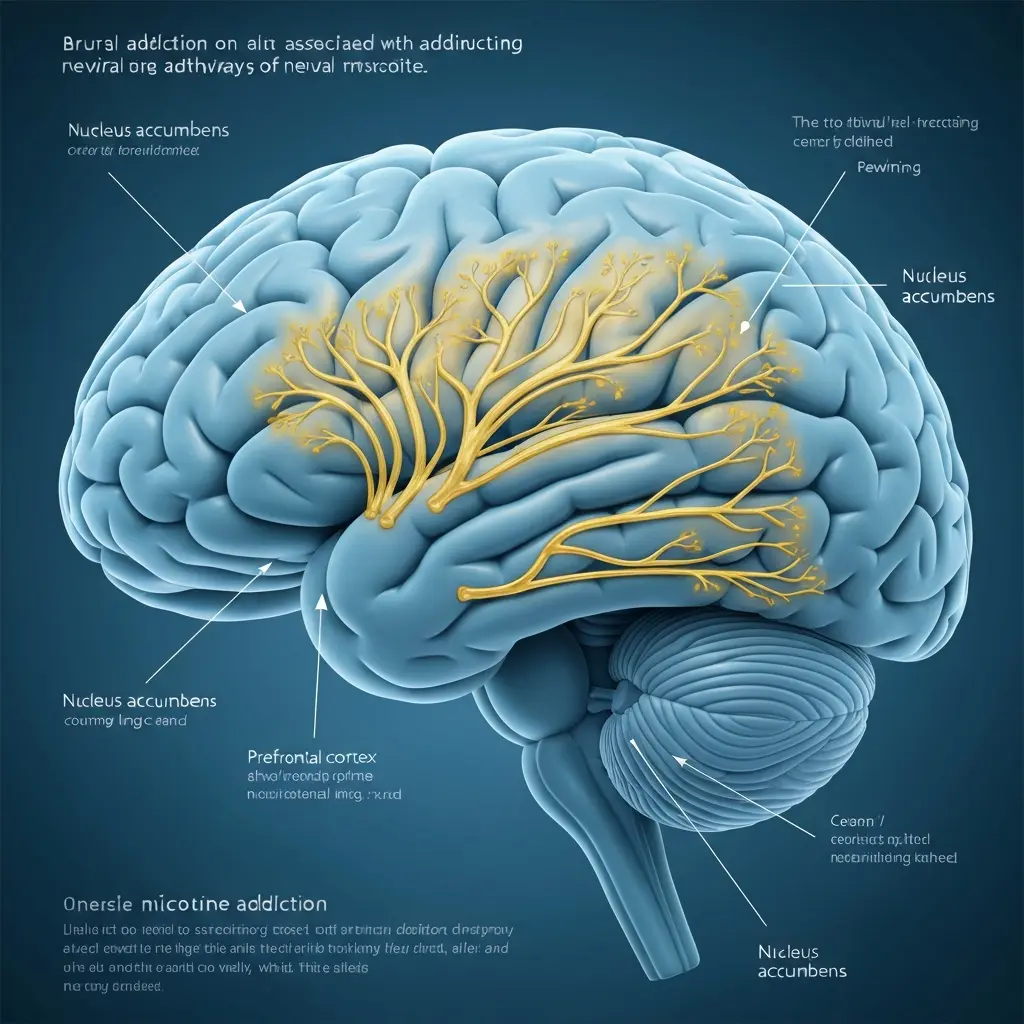
Nicotine reaches the brain within 7 seconds of inhalation — faster than an intravenous injection. It binds to nicotinic acetylcholine receptors (nAChRs), which are found throughout the brain in regions governing reward, attention, stress response, and memory. This binding triggers a cascade of neurotransmitter releases that are, in the short term, genuinely pleasurable and functional: enhanced focus, reduced appetite, mild euphoria, stress relief.
The brain is designed to learn from rewarding experiences — it is the mechanism by which evolution has kept organisms seeking food, social connection, and safety. Nicotine hijacks this system with pharmacological precision. After every cigarette, the brain records: “this action led to reward.” Over hundreds or thousands of repetitions, the neural pathways connecting smoking to reward become deeply entrenched.
But adaptation is a two-way street. As the brain receives regular nicotine stimulation, it compensates by reducing the number and sensitivity of its own nicotinic receptors. It recalibrates its baseline to a nicotine-present state. The result: without nicotine, the brain is no longer operating at its old “normal” — it is in withdrawal, experiencing the distress signals that drive the seemingly overwhelming need to smoke.
The Dopamine Trap: Why Cravings Feel Irresistible
Dopamine is the brain’s primary reward and motivation molecule. Nicotine triggers dopamine release in the nucleus accumbens — the brain’s reward centre — at levels comparable to other highly addictive substances. Research from the National Institute on Drug Abuse confirms that this dopamine response is central to why nicotine is so addictive.
Over time, with chronic nicotine use, the brain’s dopamine system downregulates — it becomes less responsive to all natural rewards. Food, exercise, social connection, and achievement all produce less dopamine than they would in a non-smoker. The result is that, for a regular smoker, smoking feels like one of the few things that works to make them feel good — because the addiction has reduced the effectiveness of everything else.
This is why quitting feels so bleak in the first few weeks. The brain’s reward system is operating at below-baseline capacity, and the person does not yet have the internal neurochemical resources to feel pleasure from normal daily activities. Research from Penn State University found that the strength of a smoker’s neural reward response is a significant predictor of their ability to quit — and that this response recovers fully after successful cessation.
The Good News About Dopamine Recovery
The dopamine system is not permanently damaged by smoking. Within 3–4 weeks of quitting, receptor density begins to normalise. By 3 months, the brain’s reward response to natural stimuli has largely recovered. Many former smokers describe discovering that food tastes better, exercise feels more rewarding, and social interactions feel more genuinely satisfying — once the dopamine system has had the chance to heal.
The Psychological Side: Decades of Deep Conditioning
The neurochemical dimension of nicotine addiction is only half the story. The other half is conditioning — the learned associations between smoking and virtually every significant context in a smoker’s life.
Most smokers smoke after coffee. They smoke after meals. They smoke when stressed. They smoke when bored. They smoke when drinking. They smoke when driving long distances. They smoke on breaks. They smoke when they feel sad, happy, anxious, or celebratory. Over years of regular smoking, every one of these contexts becomes a conditioned trigger — a stimulus that automatically activates craving through learned association, independently of any physical nicotine need.
This is why people who have successfully quit for months can experience a powerful craving when they walk past a pub where they used to smoke, or smell a specific brand of cigarette, or go through a stressful period at work. The conditioned associations persist long after the physical addiction has resolved. Each trigger-without-smoking experience weakens the conditioned response — but it takes many repetitions, and it takes time.
The Identity Problem: “I Am a Smoker”
For many long-term smokers, smoking is not just a behaviour — it is part of their identity. It is how they relax. It is part of their social ritual. It is how they manage stress. It is, in some cases, how they define themselves in relation to others. “I’m a smoker” is an identity statement as much as a behavioural description.
Quitting smoking, for someone who has smoked for 10, 20, or 30 years, involves not just breaking a physical habit but redefining a significant part of who they are. This psychological dimension — the loss of a ritual, a social identity, a coping mechanism — is a genuine and often underestimated barrier to successful cessation.
Effective cessation approaches address this by helping people build a new identity as a non-smoker, rather than merely helping them resist the urge to smoke. Apps, peer communities, and milestone tracking all contribute to this identity shift.
Why Most Quit Attempts Fail — and What That Tells Us
The statistics on quit attempts are stark. Most people require 8–30 attempts before achieving long-term cessation. Unaided quit attempts have a success rate of only 3–7% at the 6-month mark. These numbers are not evidence of weak character. They are evidence that unaided willpower is an insufficient tool for a neurobiological problem.
Relapse is most common in specific high-risk situations: stress, alcohol, social exposure to smoking, and negative mood states. These are the situations where conditioning is strongest, withdrawal effects are worst, and the social and emotional case for smoking is most compelling. Understanding this — and having a specific plan for each high-risk situation — is what distinguishes successful quit attempts from unsuccessful ones.
What Actually Works: The Evidence
The evidence on effective smoking cessation is among the most robust in all of preventive medicine. The following approaches have the strongest evidence base:
Pharmacological Support
- Nicotine Replacement Therapy (NRT): Doubles or triples quit rates at 6 months. The Cochrane Collaboration’s meta-analysis of 136 RCTs (64,000+ participants) is unambiguous about NRT efficacy.
- Varenicline (Champix/Chantix): The most effective single pharmacological agent. Partially activates and partially blocks nicotine receptors, reducing both withdrawal discomfort and the reward from any cigarettes smoked during the quit attempt. The EAGLES trial (8,000+ participants) confirmed its safety and superiority.
- Bupropion: An antidepressant with significant cessation efficacy, particularly effective for people with comorbid depression.
Behavioural Support
- Individual or group counselling more than doubles quit rates when combined with medication
- Telephone quitlines (1-800-QUIT-NOW in the US; 0300 123 1044 in England) provide free evidence-based support
- Digital behavioural support through quit smoking apps is evidence-based and accessible 24/7
Combining Approaches
The highest quit rates — approaching 35–40% at one year — are achieved by combining pharmacotherapy (ideally varenicline or combination NRT) with intensive behavioural support. This combination addresses both the neurochemical and psychological dimensions of addiction simultaneously. Read our guide on smoking cessation methods comparison for a full breakdown.
The iQuit app is designed as a comprehensive behavioural support tool — providing craving tracking, trigger identification, AI coaching, progress milestones, and a financial savings calculator. It works best as part of a broader quit strategy that includes NRT or prescription medication.
Never Too Late: The Success Stories
Despite the statistics on failed quit attempts, the statistics on eventual success are encouraging. Studies consistently show that most smokers who want to quit eventually succeed with sufficient support and attempts. Many of the people who read our article on quit smoking success stories smoked for 20–40 years before finally achieving permanent cessation. The defining characteristic of success is not how many times someone tried — it is that they kept trying.
The biology of addiction does not change how much you are worth as a person, or how possible it is to quit. It simply tells you which tools will help and which will not. For more on staying motivated through the process, see our quit smoking motivation guide and guide on dealing with cigarette cravings.
Frequently Asked Questions
Why is quitting smoking so much harder than quitting other things?
Nicotine reaches the brain within 7 seconds of inhalation — faster than most other addictive substances — and triggers dopamine release comparable to heroin and cocaine. It is also taken dozens of times per day, reinforcing the addiction with extreme frequency. On top of the physical addiction, smoking becomes deeply conditioned to virtually every aspect of daily life over years, creating layers of psychological as well as neurochemical dependence that make it uniquely difficult to quit.
How many attempts does it take to quit smoking?
Research suggests that most people who achieve long-term smoking cessation do so after 8–30 attempts. Unaided attempts have a 3–7% success rate at 6 months. With proper support (NRT + behavioural counselling), success rates rise to 30–40% per attempt. Each previous attempt, even if unsuccessful, provides information and experience that improves the next attempt’s odds of success.
Does willpower work for quitting smoking?
Willpower alone has very low success rates (3–7% at 6 months). This is not because people lack willpower — it is because willpower is insufficient for a neurobiological problem. Using pharmacological support (NRT, varenicline) alongside behavioural strategies dramatically improves outcomes. Willpower is still necessary — but it works much better when supported by tools that address the biochemical dimension of addiction.
Why do cravings happen even after quitting for months?
Cravings after months of quitting are conditioned responses — not physical nicotine withdrawal. The brain has learned deep associations between smoking and specific contexts (stress, coffee, social drinking, certain places). These conditioned triggers can activate craving impulses long after the physical addiction has resolved. They decrease in frequency and intensity with each smoke-free exposure to the trigger, and most former smokers find them negligible after 12 months.
What is the hardest part of quitting smoking?
For most people, the hardest part is the first 3–7 days — particularly Days 2–3, when nicotine blood levels hit zero and withdrawal symptoms peak. High-risk situations — stress, alcohol, social environments where others smoke — are the most common relapse triggers. Many former smokers also cite the loss of the social ritual and the emotional coping mechanism of smoking as underestimated challenges alongside the physical withdrawal.
Don’t Fight Biology Alone — Use the Right Tools
iQuit is designed to address both dimensions of nicotine addiction: physical cravings and psychological triggers. AI coaching, craving tracking, trigger analysis, and daily motivation — everything you need to work with your brain, not against it.