
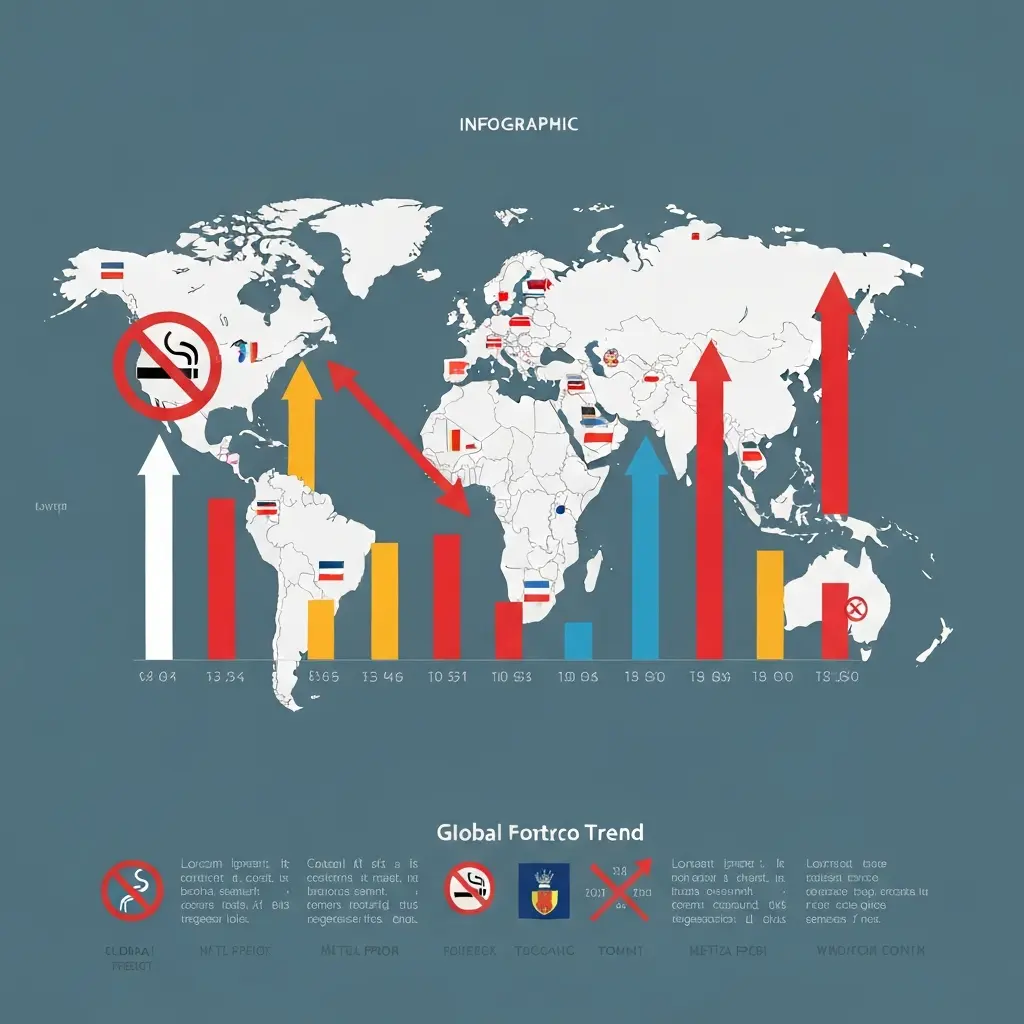
Global Tobacco Control Progress Report 2026: Data, Policies, and What’s Working
The smoking cessation statistics 2026 tell a story of genuine progress shadowed by deep inequality. Globally, tobacco use has fallen from 22.8% of adults in 2000 to approximately 17.0% in 2025 — a 25% relative decline representing hundreds of millions of quitters. Yet tobacco still kills over 8 million people per year (WHO 2025), and in some regions, rates are rising among women and young adults. This comprehensive data report synthesizes the most current evidence on what is working, what is not, and where the cessation landscape is heading.
This is the authoritative reference for understanding where we stand in 2026 on tobacco control — drawing on WHO’s Global Report on Trends in Prevalence of Tobacco Use, the Tobacco Atlas 7th Edition, and national health survey data from 47 countries.
Global Smoking Prevalence Data 2026
The WHO’s 2025 global tobacco report provides the most comprehensive prevalence snapshot to date, based on survey data from 155 countries:
| Metric | 2000 | 2015 | 2025 (est.) | Change 2000–2025 |
|---|---|---|---|---|
| All adults smoking | 22.8% | 20.2% | 17.0% | -25% |
| Men smoking | 40.7% | 36.1% | 31.2% | -23% |
| Women smoking | 8.4% | 6.9% | 5.9% | -30% |
| Total smokers (millions) | 1,397M | 1,383M | 1,300M | -7% |
| Annual tobacco deaths | 5.4M | 7.2M | 8.1M | +50% |
The counterintuitive rise in tobacco deaths despite falling prevalence reflects the lag effect: people who smoked heavily in the 1980s–2000s are reaching the age where smoking-related diseases kill. Annual deaths will continue rising through approximately 2035 even under optimistic cessation scenarios.
Policy Interventions: Effectiveness Rankings
The WHO MPOWER framework identifies six policy categories proven to reduce tobacco use. Their effectiveness, measured by percentage reduction in consumption per unit of implementation:
- Tax increases: Each 10% price increase reduces consumption by 4–5% in high-income countries and 8% in low-income countries (most price-sensitive markets). Australia’s 12.5% annual excise increases since 2010 cut smoking rates from 20% to 12.8% by 2023.
- Cessation support access: Countries offering comprehensive free cessation services (New Zealand, Canada, UK) show quit rates 35–45% higher than those with no such services.
- Plain packaging laws: First implemented in Australia (2012), now active in 27 countries. Meta-analysis of 78 studies shows 14–17% reduction in smoking prevalence over 5 years.
- Smoke-free public spaces: Ireland’s 2004 ban was the first national indoor smoking ban; associated with 10–15% reduction in smoking rates. Second-hand smoke exposure fell 80% in hospitality venues.
- Health warnings on packaging: Graphic pictorial warnings outperform text-only by 30% in measured quit intent (Tobacco Control 2023). 130 countries now mandate pictorial warnings.
- Mass media campaigns: $1 invested in anti-tobacco mass media returns $12–20 in health system savings (CDC economic analysis 2024).
The UK is now testing a more structural version of this policy mix — see our coverage of the generational smoking ban and vape bill 2026, which raises the legal age of sale by one year annually so that anyone born on or after 1 January 2009 will never legally be sold tobacco.
Regional Breakdown and Highlights
The global decline masks vast regional variation. The global statistics roundup covers individual country data; here are the critical regional patterns:
- Western Europe: Fastest decline globally. Smoking fell from 31% (2000) to 18% (2025). Sweden’s “snus substitution” strategy drove prevalence below 5% — the lowest of any OECD country.
- North America: US fell from 25% to 11.5% (2023 NHIS). Canada at 12.1%. Strong cessation infrastructure, high medication access.
- Asia-Pacific: Most complex picture. Japan declining (17.8%, 2025 JT survey). China static at 26% overall, 52% among men. Indonesia, Vietnam, Philippines above 40% in men.
- Sub-Saharan Africa: Rising trend in several countries. Tobacco industry targeting youth markets. Smoking infrastructure limited.
- Middle East and North Africa: Waterpipe tobacco complicates statistics. Cigarette smoking declining but alternative product use rising.
Access to Cessation Support Worldwide
One of the most troubling data points in global tobacco control: only 24% of the world’s smokers live in countries where comprehensive cessation support is available (WHO 2025). The breakdown:
- Cost-covered NRT: available in 31% of countries
- Trained cessation counselors in primary care: 28% of countries
- National quit lines: 68% of countries (but quality varies enormously)
- Digital cessation tools (apps, text programs): underregulated and inconsistent globally
This access gap explains much of the demographic disparity in cessation success seen globally. Where support is unavailable, unaided cold turkey attempts predominate — with their 4–7% long-term success rate. The democratization of cessation through mobile apps represents the single most scalable intervention for closing this gap.
Emerging Threats: E-Cigarettes and Heated Tobacco
The data on alternative tobacco and nicotine products complicates the cessation picture in important ways:
- E-cigarettes: Used by 82 million people globally (2025). A 2024 Cochrane review found high-certainty evidence that e-cigarettes help smokers quit at higher rates than NRT (RR 1.63). However, most quitters who switch to vaping continue vaping long-term rather than achieving nicotine-free status.
- Heated tobacco products (HTPs): Growing market in Japan, South Korea, and Eastern Europe. IQOS (Philip Morris) controls 75% of HTP market. Cessation efficacy is unproven; the tobacco industry markets HTPs as “reduced risk” — a claim disputed by independent researchers.
- Nicotine pouches: Fastest-growing nicotine product category globally. Zero combustion; health impact profile not yet fully established.
The WHO position (2025): alternative nicotine products may reduce harm for existing smokers unable to quit with other methods, but should not be used by non-smokers or as gateway products for young people.
2030 Projections and SDG Targets
The UN Sustainable Development Goal target calls for a one-third reduction in premature mortality from non-communicable diseases (including tobacco-related illness) by 2030. Current trajectory analysis (WHO 2025) shows:
- On current trends, global smoking prevalence will reach approximately 14–15% by 2030
- Only 47 countries are on track to meet their individual SDG tobacco targets
- The 100+ countries not on track predominantly lack the tax, cessation support, and advertising restriction policies that drive the fastest declines
The Growing Role of Digital Cessation Tools
The global access data points to digital tools as the most promising pathway for rapidly expanding cessation support. A smartphone app can reach a smoker in rural Indonesia as easily as one in London — bypassing the healthcare infrastructure gaps that limit clinical support.
WHO’s 2024 Digital Health Cessation Framework explicitly endorses mobile apps meeting evidence-based feature criteria as a Tier 1 cessation intervention for countries with limited healthcare infrastructure. The app effectiveness research data shows what those features are. The global nicotine addiction statistics confirm the scale of the opportunity.
Tools like iQuit represent exactly this kind of accessible, evidence-grounded digital cessation support — available free to anyone with an Android device, anywhere in the world.
Frequently Asked Questions
How many people smoke globally in 2026?
Approximately 1.3 billion people smoke globally as of 2025 (WHO estimates for 2026 align with this figure). This represents 17.0% of the world’s adult population, down from 22.8% in 2000. Despite falling prevalence rates, the absolute number of smokers has barely declined due to population growth.
Which country has the lowest smoking rate in 2026?
Sweden has the lowest smoking rate among OECD countries, with less than 5% of adults smoking daily (2025 data). Sweden’s “tobacco-free generation” goal and widespread use of snus (a smokeless tobacco alternative used as a cessation bridge) drove this result. Iceland, Norway, and Finland also have rates below 10%.
What policy intervention has reduced smoking the most?
Tobacco tax increases have the strongest and most consistent evidence base. Every 10% price increase reduces consumption by 4–5% in high-income countries and up to 8% in lower-income countries. Combined with mass media campaigns and cessation support, taxes have driven double-digit prevalence reductions in multiple countries.
How many smoking-related deaths occur each year?
Tobacco kills over 8 million people per year globally (WHO 2025), including 1.2 million from secondhand smoke exposure. Annual deaths are still rising due to the lag effect from heavy smoking in earlier decades, and will continue to increase until approximately 2035 even under optimistic cessation scenarios.
Is global smoking declining in 2026?
Yes — global smoking prevalence has fallen from 22.8% (2000) to 17.0% (2025), a 25% relative decline. However, the absolute number of smokers has only declined from 1.4 billion to 1.3 billion due to population growth. Progress is highly uneven: fast decline in high-income countries, slow or flat in many low- and middle-income nations.
Be Part of the Progress
Every smoker who quits changes the statistics — for themselves, their family, and the global count. iQuit gives you the evidence-based tools to become one of them, free on Android.