Quit Smoking One Week Timeline: What to Expect Day by Day
The first week after quitting smoking is the most intense — and the most important. Understanding the quit smoking one week timeline in detail removes the fear of the unknown and gives you a concrete plan for every stage. What feels unbearable at hour 48 becomes manageable at day 5, and the science behind why is genuinely remarkable.
Your body begins recovering almost immediately after your last cigarette. By the end of just seven days, nicotine is completely cleared from your bloodstream, lung function has begun improving, and the worst of withdrawal is behind you. The first week is not just a trial to endure — it is a week of measurable, documented healing.
This guide covers the quit smoking timeline hour by hour and day by day, with targeted strategies for each phase. Pair it with our evidence-based quit smoking tips guide and the nicotine withdrawal relief guide for maximum support.
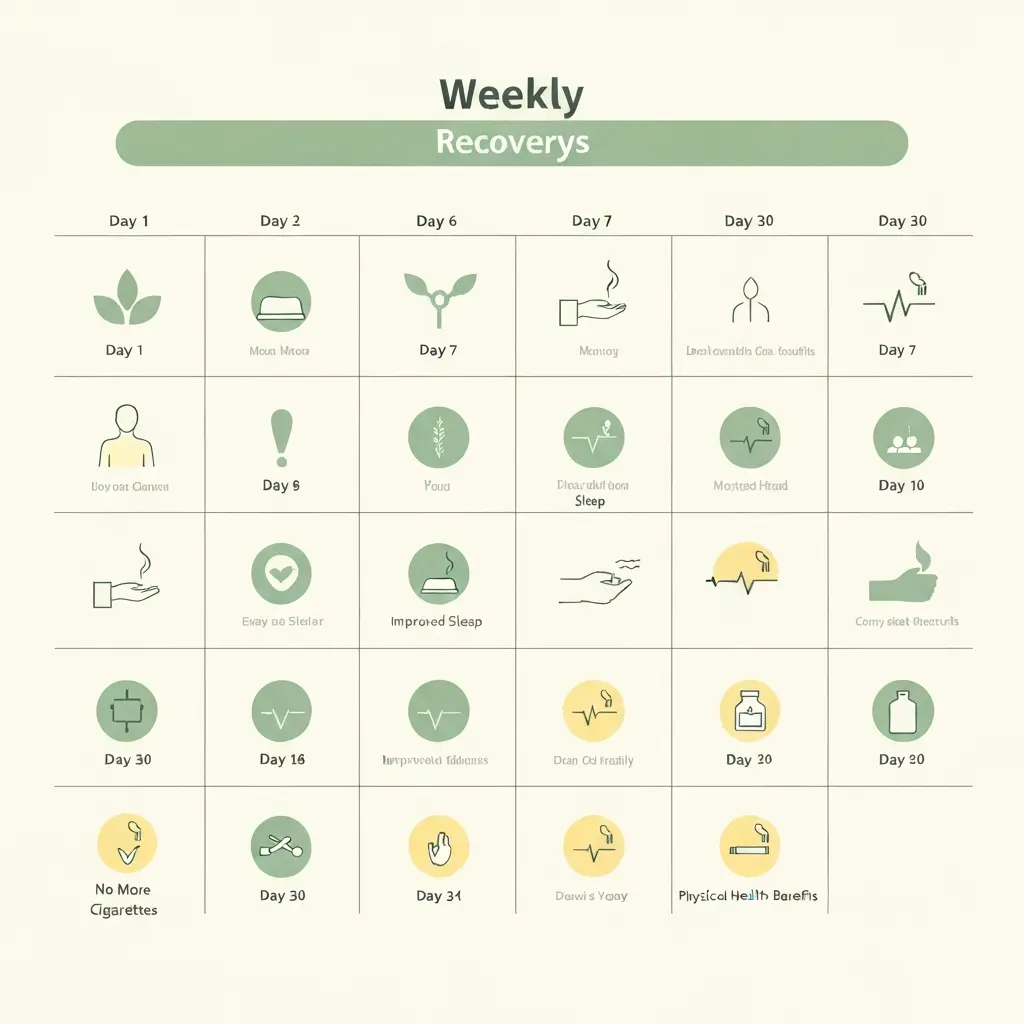
Within 20 minutes, heart rate drops. By 12 hours, carbon monoxide levels normalize. Days 1–3 are the most intense for withdrawal (irritability, cravings, difficulty concentrating). By day 4, the worst is over. By day 7, nicotine is fully cleared from your bloodstream and taste and smell are significantly improved.
First 20 Minutes: Your Body Starts Healing Immediately
Within 20 minutes of your last cigarette, your heart rate and blood pressure begin dropping toward a healthier baseline. This is not a metaphor — it is a documented physiological response that happens in every person who quits, every time. The cardiovascular system responds almost immediately when cigarette-induced stimulation stops.
You may not feel this change. In fact, you might feel the opposite — a mild anxiety or restlessness as your brain begins signaling for nicotine. But inside, healing has already begun. Remember this moment when the first craving hits.
Hours 1–12: Carbon Monoxide Clears
Within 8–12 hours, the carbon monoxide in your blood — which blocks your red blood cells from carrying oxygen efficiently — drops to normal levels. Oxygen levels in your blood normalize. Many ex-smokers report feeling slightly more energetic and clear-headed within the first half-day, alongside the withdrawal symptoms.
Cravings typically begin within 30–60 minutes of your last cigarette. In hours 2–8, they will come in waves, each lasting 3–5 minutes. This is the time to deploy your instant craving relief techniques — breathing exercises, cold water, brief walks.
Day 1: The Launch — Intensity and Intention
Your first full smoke-free day will test your resolve. Withdrawal symptoms are building but have not yet peaked. Expect:
- Cravings: Frequent (every 30–90 minutes), triggered by habitual cues — morning coffee, after meals, work breaks
- Irritability: Mild to moderate; brain chemistry is adjusting to reduced dopamine stimulation
- Restlessness: Difficulty sitting still; fidgeting
- Increased appetite: Nicotine suppresses appetite; without it, hunger increases
Day 2: The Peak — The Hardest Day for Most Quitters
For most people, Day 2 is the most challenging day of the entire quit journey. Withdrawal symptoms peak between 24–72 hours, and Day 2 sits squarely in that window. What to expect:
- Intense cravings: More frequent and more urgent than Day 1
- Significant irritability and anxiety: Dopamine levels are at their lowest as the brain recalibrates
- Headaches: Caused by increased blood flow as carbon monoxide clears completely
- Sleep disruption: Nicotine normally acts as a mild sedative — without it, sleep patterns shift
- Difficulty concentrating: “Brain fog” is real and clinically documented
Day 3: The Turning Point — Nicotine Leaves Your Body
Around Day 3, nicotine is fully eliminated from your body. This is both a physical and symbolic milestone. The physical dependency is chemically broken — what remains is psychological and habitual, which is harder to quantify but more within your conscious control.
Symptoms may still be intense on Day 3, but many quitters report a subtle shift — a sense that the worst is happening right now, and therefore the worst is almost over. Chest tightness may increase temporarily as cilia in your airways begin recovering and moving trapped mucus. This is a sign of healing, not harm.
Taste and smell improvements often begin on Day 3. Food may taste noticeably different — better. This is one of the most rewarding early milestones and worth pausing to appreciate.
Day 4: The Shift — Cravings Begin Declining
Research consistently shows that craving frequency and intensity begin to decline after 72 hours. Day 4 marks the start of the easier phase for most quitters. The pattern of improvement is not linear — you will have good hours and bad hours — but the overall trajectory is downward in terms of withdrawal intensity.
Energy levels often improve on Day 4 as the cardiovascular system continues to function more efficiently without carbon monoxide. Some quitters report a significant mood lift. This is a great day to do something enjoyable and specifically smoke-free — reinforce the association between feeling good and not smoking.
Day 5: Building Momentum — New Habits Take Shape
By Day 5, you have survived the worst of the physical withdrawal. The cravings that remain are increasingly psychological and situational rather than purely chemical. This is the day to start actively replacing old smoking rituals with new, healthy ones.
Identify the one or two daily routines most strongly associated with smoking for you (morning coffee, after-work decompression, whatever it is) and deliberately create a new ritual for each. This is not about white-knuckling past the urge — it is about giving your brain a new groove to run in.
Day 6: Finding Your Rhythm — Confidence Builds
Six days smoke-free is a genuine achievement. Many quitters report that Day 6 is the first day that smoke-free begins to feel normal rather than forced. Cravings continue to decrease in frequency. Sleep often improves noticeably compared to Days 1–4. Physical energy continues to improve.
If you are using the gradual reduction method, Day 6 at zero cigarettes is proof the plan works. If you went cold turkey, you are demonstrating that you can do hard things. Either way, acknowledge the accomplishment.
Day 7: One Full Week — A Milestone Worth Celebrating
Seven days smoke-free. Nicotine is completely out of your bloodstream. Taste and smell are significantly improved. Lung function is beginning to improve. Carbon monoxide has been gone for nearly a week, and your blood oxygen levels are optimized.
Research from the University of Wisconsin shows that smokers who reach the 7-day mark without a single cigarette are significantly more likely to achieve long-term abstinence than those who have a slip in the first week. You have passed the most critical threshold.
- Heart rate and blood pressure: normalized
- Blood carbon monoxide: cleared within 12 hours, gone all week
- Blood oxygen: at healthy levels all week
- Nicotine in blood: zero
- Taste and smell: measurably improved
- Lung cilia: actively regenerating
What Comes After the First Week
The first week is behind you — and the trajectory from here is consistently positive. Over the next three weeks, withdrawal symptoms continue to fade. At one month, lung function improves by up to 30% — see the full one month benefits guide. At three months, circulation and exercise capacity improve significantly — see the three month milestone guide. By one year, heart disease risk is halved — details in the one year benefits article.
The journey is not over at Day 7 — the psychological habits and social triggers need continued attention. But the hardest physical battle is definitively won.
Frequently Asked Questions
What is the hardest day when quitting smoking?
Day 2 and Day 3 are consistently reported as the most difficult by quitters and confirmed by research. Withdrawal peaks between 24–72 hours after the last cigarette, when nicotine is being eliminated from the body and dopamine levels are at their lowest. After Day 3, symptoms progressively improve.
How long does nicotine stay in your system after quitting?
Nicotine itself is eliminated from the bloodstream within 1–3 days. Its metabolite cotinine takes 1–4 days to clear. By Day 7, both are undetectable in blood. However, nicotine’s effects on brain receptor density take several weeks to normalize, which is why cravings can persist beyond the first week.
Is it normal to feel worse on Day 2 than Day 1?
Yes, completely normal. Day 1 often has momentum from the decision to quit, and some nicotine is still present in your system. Day 2 is when nicotine is falling rapidly and brain chemistry is most disrupted. Feeling worse on Day 2 is a sign that the process is working correctly.
When does the cough get worse after quitting smoking?
Coughing often increases in Days 2–5 as the cilia (tiny hair-like structures in airways) recover and begin sweeping trapped mucus out of the lungs. This is a positive sign of healing. The productive cough usually peaks around Day 3–5 and improves significantly within 2–3 weeks.
How do I survive the first 72 hours of quitting smoking?
The most effective strategy is: use NRT consistently (patch for baseline, gum or lozenge for acute cravings), exercise daily (even a 20-minute walk significantly reduces withdrawal intensity), stay well-hydrated, avoid alcohol and other triggers, have a support person available, and use a quit app to track and celebrate every hour.
What happens after the first week of quitting smoking?
After week one, nicotine is fully cleared from the body and the worst physical withdrawal is behind you. Weeks 2–4 focus on managing psychological triggers and building new habits. By one month, lung function improves noticeably. At three months, circulation and breathing capacity see significant gains. Each subsequent month brings measurable health benefits that compound over time.
Track Your First Week with iQuit
The iQuit app shows you exactly where you are on the quit timeline — with real-time health milestones, craving relief tools, and a countdown to each recovery marker. See your body healing in real time.
Your first week is the hardest. iQuit makes sure you don’t face it alone.