
What Happens When You Quit Smoking: The 2026 Health Recovery Guide
If you’re wondering what happens when you quit smoking, the answer will surprise you: your body begins healing within the first 20 minutes of your last cigarette. The recovery process is faster, more dramatic, and more measurable than most people expect — and understanding it can be one of the most powerful motivators to keep going on hard days. This guide maps every milestone, from the first hour to the first decade, using the latest data from the World Health Organization, NHS, CDC, and peer-reviewed clinical research.
You are making one of the bravest decisions of your life. Whether this is your first quit attempt or your tenth, every hour smoke-free is your body working hard to undo years of damage. The science is unambiguous: quitting smoking at any age produces measurable health gains, and many of those gains begin before you even make it to the end of your first day.
Below you’ll find a complete hour-by-hour, day-by-day, month-by-month, and year-by-year breakdown — plus practical guidance for managing the symptoms that make quitting feel hard.
What Happens in the First 24 Hours After You Quit Smoking
The first 24 hours contain some of the most dramatic physiological changes in the entire recovery journey. Your body does not wait to start repairing itself.
| Time After Last Cigarette | What Happens in Your Body |
|---|---|
| 20 minutes | Heart rate and blood pressure drop toward normal levels. Circulation in hands and feet begins to improve. |
| 2 hours | Heart rate and blood pressure have normalised significantly. Peripheral circulation continues improving. Nicotine cravings begin — this is normal and manageable. |
| 8–12 hours | Carbon monoxide levels in your blood drop to normal. Oxygen levels rise to healthy ranges. You may feel tired as your body adjusts. |
| 24 hours | Carbon monoxide has fully cleared. Your heart attack risk begins falling. Many people notice an improved sense of smell and slightly sharper taste. |
According to the NHS, the carbon monoxide clearance at 12 hours is a critical milestone — your red blood cells can now carry oxygen more efficiently, which is why many ex-smokers report feeling subtly more energetic even in the first day despite withdrawal discomfort.
Days 2–7: The Hardest Week of Quitting
Days two through seven are physiologically and psychologically the most challenging period for most people quitting smoking. Nicotine withdrawal peaks between 48 and 72 hours after your last cigarette. Understanding this peak not as failure but as evidence that your body is recalibrating can make a meaningful difference.
At 48 hours, your nerve endings begin regrowing and the senses of taste and smell improve noticeably. Many quitters report that food tastes genuinely different — and better — by day three. This is one of the first tangible rewards of quitting.
| Day | Physical Changes | What to Expect |
|---|---|---|
| Day 2 | Nerve endings regenerating; taste and smell sharpening | Irritability, strong cravings, headaches, anxiety — peak withdrawal begins |
| Day 3 | Bronchial tubes relaxing; airways opening slightly | Withdrawal at its peak — mood dips, sleep disruption, increased appetite |
| Days 4–5 | Mucus in airways clearing; coughing may increase temporarily | Cravings become shorter and less frequent; energy slowly returning |
| Days 6–7 | Lung cilia (tiny cleaning hairs) actively regenerating and clearing mucus | Breathing feels marginally easier; mood stabilising for many people |
The increased cough in days four to seven is actually a positive sign: your lungs’ natural cleaning system (the cilia) is reactivating and pushing out accumulated tar and debris. If you’re experiencing severe withdrawal symptoms, read our detailed guide on how to deal with nicotine withdrawal symptoms for hour-by-hour coping strategies.
Weeks 2–4: Physical Stabilisation
By week two, the acute physical phase of nicotine withdrawal is largely over for most people. The intense cravings, headaches, and irritability that characterised the first week begin to subside. What remains in weeks two through four is primarily psychological — the habit loops, the situational triggers, the moments when smoking was a ritual.
Physical gains in this phase are real and measurable:
- Circulation improves throughout the body, including to the extremities
- Skin tone begins to brighten as oxygen delivery improves
- Coughing and wheezing decrease as bronchial tubes clear
- Energy levels increase for most people, particularly in the morning
- Resting heart rate continues to normalise
Research from the NHS shows that by the end of month one, lung function has already begun improving in a measurable way. The body is remarkably resilient. Many smokers believe the damage is permanent — the evidence says otherwise, at every age.
1–3 Months: Lung and Circulation Recovery
Between weeks four and twelve, the recovery curve steepens considerably. This is when many ex-smokers notice for the first time that physical exertion — climbing stairs, walking briskly — no longer leaves them breathless in the same way.
According to the WHO and NHS data, lung function improves by up to 10% during this period. That may not sound dramatic, but it translates to real-world improvements in exercise tolerance, sleep quality, and immune function. The number of respiratory infections also tends to drop noticeably within the first three months of quitting.
Circulation in the gums and teeth improves, which is why dentists often notice faster healing in patients who have recently quit. Wound healing improves generally. Sexual function improves in both men and women due to better vascular health.
For a stage-by-stage map of the withdrawal experience alongside this physical recovery timeline, see our guide to the stages of nicotine withdrawal explained.
6 Months to 1 Year: Heart Disease Risk Halved
One year after quitting smoking, your risk of coronary heart disease is approximately half that of a person who continues to smoke. This is one of the most significant health milestones in the entire quit-smoking journey, and it arrives within a single year.
By the six-month mark, many ex-smokers report that cravings have become rare and manageable. The psychological dependence — the habit loops and situational triggers — is largely dismantled by this point, though high-stress situations may still trigger urges for some people.
Other notable changes by year one include:
- Lung cilia are fully regenerated and functioning normally
- Risk of heart attack continues declining sharply
- Energy levels are consistently higher than during smoking years
- Blood pressure is stable and improved
- Skin has visibly improved in texture and tone
- Sense of taste and smell fully restored
If you’re tracking your recovery journey, the iQuit app maps every health milestone in real time so you always know exactly what your body is experiencing. Available free on Google Play.
5–15 Years: Cancer Risk Reduction
The long-term risk reductions from quitting smoking are profound. The American Cancer Society and WHO both document what happens to cancer risk over the 5–15 year window after quitting.
| Years After Quitting | Risk Reduction | Source |
|---|---|---|
| 1 year | Heart disease risk halved vs. continuing smoker | NHS / WHO |
| 5 years | Stroke risk reduced to that of a non-smoker (5–15 years); mouth, throat, oesophagus, and bladder cancer risk halved | American Cancer Society |
| 10 years | Lung cancer death risk falls to about half of a continuing smoker’s; risk of pancreatic cancer significantly reduced | CDC / American Cancer Society |
| 15 years | Heart disease risk equivalent to someone who has never smoked | American Cancer Society / NHS |
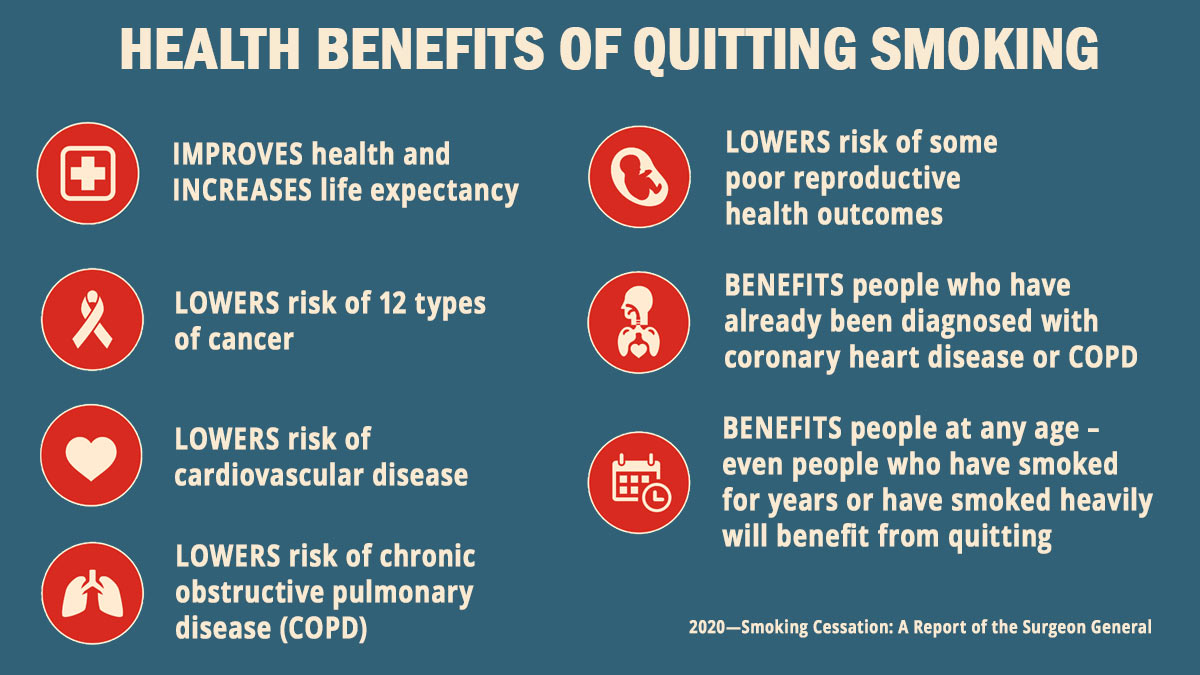
People who quit smoking before the age of 40 reduce their risk of dying from smoking-related illness by approximately 90%. Even quitting at 60 adds meaningful life expectancy. The WHO reports that quitting at any age can add up to 10 years to life expectancy compared to continuing to smoke.
Managing Withdrawal Symptoms When You Quit Smoking
Understanding what withdrawal symptoms feel like — and why they happen — takes the fear out of quitting. Nicotine is a highly addictive substance that alters dopamine pathways in the brain. When you stop supplying it, your brain needs time to recalibrate its natural reward chemistry. This is why withdrawal symptoms are real, physical, and not a sign of weakness.
The most common symptoms include:
- Irritability and frustration — usually peaks days 2–3, fades by week 2
- Strong cravings — typically last 3–5 minutes; frequency drops sharply after week 1
- Difficulty concentrating — typically resolves within 2 weeks
- Sleep disruption — usually improves by weeks 3–4
- Increased appetite and weight gain — managed with exercise and dietary awareness
- Headaches — common in days 1–4; resolve as carbon monoxide clears
- Coughing and throat irritation — can intensify temporarily as lungs clean themselves
Clinical evidence consistently shows that combining behavioural support with pharmacological aids (nicotine replacement therapy, varenicline, or bupropion) dramatically improves quit rates. Our pillar guide on how to deal with nicotine withdrawal provides a symptom-by-symptom playbook if you want to anticipate what’s coming.
Weight After Quitting Smoking: What to Expect
Weight gain after quitting smoking is real but manageable, and the health trade-off strongly favours quitting. Most people who quit gain between 4 and 10 pounds (2–5 kg) in the first weeks. This happens for several reasons:
- Nicotine suppresses appetite and slightly raises metabolic rate — both effects reverse on quitting
- Improved taste sensation makes food more appealing
- Oral habit substitution (eating when you’d have smoked) adds calories
Research from the BMJ confirms that even a modest weight gain of 5 kg post-quitting is associated with far lower cardiovascular risk than continuing to smoke. Exercise is the single most effective strategy for managing post-quit weight gain, and it carries the additional benefit of reducing cravings and improving mood through endorphin release.
Mental Health Changes After You Quit Smoking
Many smokers worry that quitting will worsen anxiety or depression. The research shows the opposite is true. A landmark 2014 meta-analysis published in the BMJ covering 26 studies found that quitting smoking is associated with significantly reduced anxiety, depression, and stress — with effect sizes comparable to antidepressant treatment.
The short-term mood dip during the first 2–3 weeks of withdrawal is real and temporary. Long-term, ex-smokers consistently report better mood, lower stress levels, and improved quality of life. The nicotine relief that smokers feel from a cigarette is largely the relief of returning to baseline after withdrawal-induced discomfort — a cycle that ends when you quit.
For the full science on the mood–nicotine connection, see our guide to quit smoking and depression.
Tools That Accelerate Your Recovery Journey
Understanding the timeline is powerful, but having tools that track your progress and coach you through hard moments makes a measurable difference to your quit success rate. Research from the Cochrane Collaboration confirms that structured support — whether from apps, counsellors, or combination methods — more than doubles quit success rates compared to willpower alone.
The iQuit app (available on Google Play) was designed specifically to support every phase of the recovery timeline described in this guide. It tracks your smoke-free days, calculates your health recovery milestones in real time, and provides personalised coaching for cravings as they occur. Rather than just showing you a timer, it connects each milestone to the specific health benefit your body is experiencing at that moment.
For a step-by-step quit plan to pair with your recovery tracking, see how to quit smoking step by step: the complete 2026 plan.
Ready to track your recovery?
iQuit — Quit Smoking App maps every health milestone from your last cigarette in real time — so you always know exactly what’s happening inside your body right now.
Frequently Asked Questions: What Happens When You Quit Smoking
How quickly does your body heal after quitting smoking?
Healing begins within 20 minutes of your last cigarette. Blood pressure normalises within 20 minutes, carbon monoxide clears in 12 hours, lung function starts improving within 2–12 weeks, heart disease risk is halved within one year, and lung cancer risk falls to roughly half of a smoker’s within 10 years. The body’s capacity for recovery is extraordinary at every age.
What are the first signs your body is recovering from smoking?
The first noticeable signs typically arrive within 24–48 hours: improved sense of taste and smell, reduced resting heart rate, and better peripheral circulation (hands and feet feeling warmer). By week one, breathing during mild exertion often feels slightly easier, and energy levels begin to lift.
How long does it take for lungs to fully recover after quitting smoking?
Lung function begins improving within 2–12 weeks of quitting, with a roughly 10% improvement in lung capacity by the three-month mark. The lung cilia — the tiny cleaning hairs — are fully regenerated by about one year. Complete recovery from structural lung damage (such as in COPD) may not be fully reversible, but progression is slowed and function measurably improves at every stage.
Does quitting smoking affect your mental health?
Long-term, quitting smoking significantly improves mental health. A BMJ meta-analysis found that quitting is associated with reduced anxiety, depression, and stress — with effects comparable to antidepressant treatment. The short-term mood dip during withdrawal (days 2–14) is real but temporary, and resolves as brain chemistry recalibrates.
How much does quitting smoking reduce heart attack risk?
Within one year of quitting smoking, your risk of coronary heart disease drops to approximately half that of a continuing smoker. After 15 years, your heart disease risk is equivalent to that of someone who has never smoked, according to the American Cancer Society and NHS data.
Will I gain weight when I quit smoking?
Most people gain 2–5 kg (4–10 lbs) after quitting smoking. This is temporary and manageable with exercise and mindful eating. Even a weight gain of 5 kg is associated with far lower cardiovascular risk than continuing to smoke. Regular exercise is the most effective strategy for managing post-quit weight.
Why do I feel worse when I quit smoking before feeling better?
Feeling worse initially is nicotine withdrawal — your brain’s dopamine system recalibrating after years of nicotine input. Symptoms peak at 48–72 hours and typically resolve within 2–4 weeks. The increased cough many people experience is actually a positive sign: your lungs are actively clearing themselves. Symptoms are a sign of healing, not damage.
Does quitting smoking reduce cancer risk at any age?
Yes. Quitting at any age reduces cancer risk. People who quit before 40 reduce their risk of dying from a smoking-related illness by approximately 90%. Quitting at 60 still provides meaningful risk reduction. After 10 years, lung cancer death risk falls to roughly half that of a continuing smoker regardless of the age at which you quit.
How long do nicotine cravings last after quitting?
Individual cravings typically last 3–5 minutes at their peak and then fade. During the first week, cravings are frequent — often every 30–60 minutes. By week two, frequency drops significantly. By month three, most people experience only occasional cravings in high-stress or situationally triggered moments. By one year, cravings are rare for most ex-smokers.
What is the best way to quit smoking for long-term success?
Cochrane Review evidence consistently shows that combining behavioural support with pharmacological aids (such as nicotine replacement therapy) more than doubles long-term quit success rates compared to willpower alone. Having a quit plan, using a tracking app like iQuit, and accessing support during craving moments are the most evidence-backed approaches.