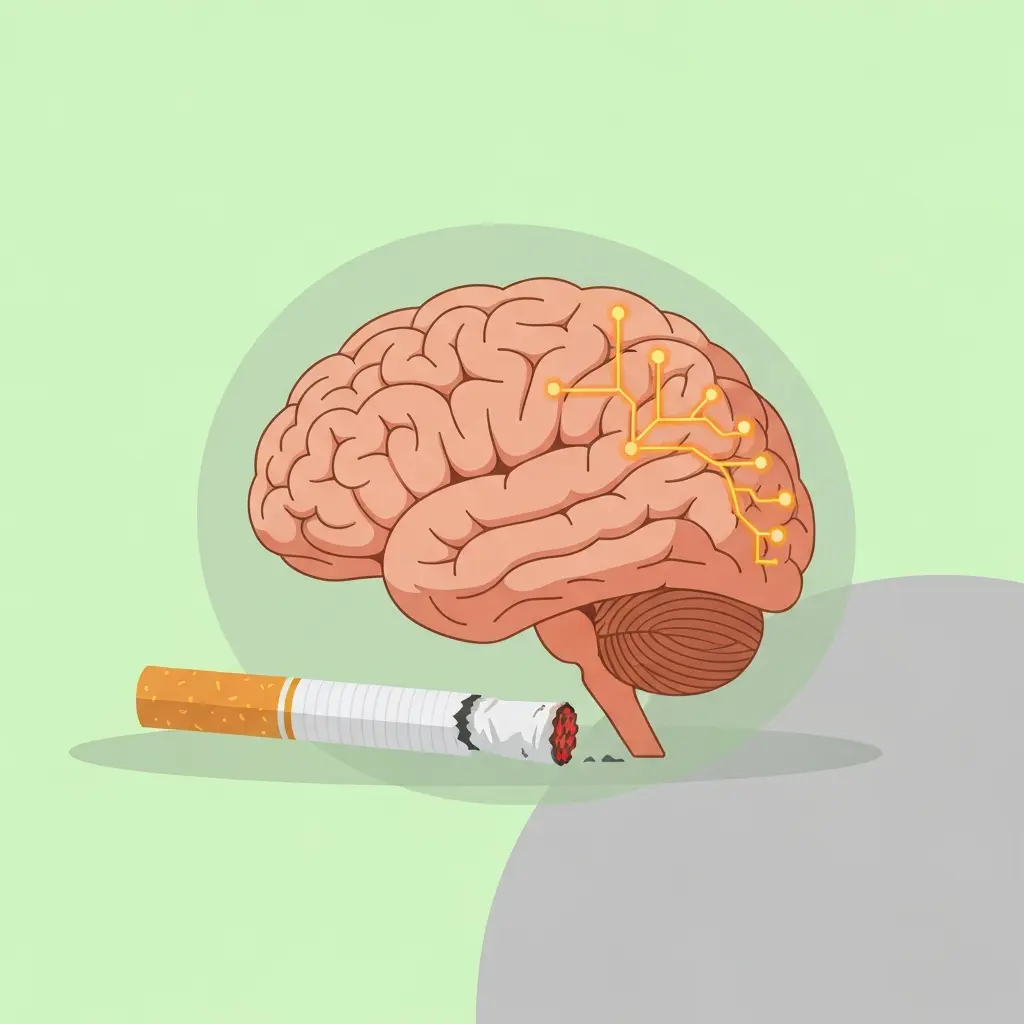
Why Is It Hard to Quit Smoking? The Neuroscience of Nicotine Addiction Explained (2026)
If you’ve tried to quit smoking and struggled, you are not weak. You are experiencing one of the most potent forms of chemical dependency known to medicine. Understanding why it is hard to quit smoking — at a neurological and psychological level — is not just intellectually interesting; it is practically transformative. When you know what you are actually fighting, you can choose the right tools to fight it.
The CDC estimates that 68% of adult smokers want to quit, yet only 7–8% succeed in any given unassisted quit attempt. That gap is not a failure of character. It is a reflection of the fact that nicotine addiction is a complex brain disorder involving neurochemistry, memory, behavior conditioning, and social environment — all working together against you. The good news is that each of these systems can be addressed with specific, evidence-based interventions.
This guide explains the neuroscience of nicotine addiction in plain language, identifies every mechanism that makes quitting hard, and maps each barrier to its corresponding solution.
Quitting smoking is hard because nicotine physically changes your brain — increasing the number of dopamine receptors and making normal pleasure feel impossible without nicotine. You also face conditioned behavioral habits, social triggers, and physical withdrawal. These are neurological and psychological challenges, not moral failures. Medication, behavioral support, and quit apps address all of these factors simultaneously.
The Dopamine Trap: How Nicotine Hijacks Your Brain
Every cigarette delivers a carefully timed dose of nicotine to your brain in approximately 10 seconds — faster than most intravenous drugs. Once there, nicotine binds to nicotinic acetylcholine receptors (nAChRs), particularly in the ventral tegmental area (VTA), the brain’s primary dopamine-generating region.
This triggers a dopamine surge into the nucleus accumbens — the brain’s reward center. Dopamine is the neurotransmitter of motivation, pleasure, and “do that again.” In evolutionary terms, it exists to reinforce survival behaviors like eating and social bonding. Nicotine hijacks this system by producing a dopamine response stronger than most natural pleasures, creating a powerful neurological association: smoking = reward.
But nicotine does more than just release dopamine. It also:
- Releases glutamate, strengthening the neural pathways associated with smoking (making the habit more entrenched with each cigarette)
- Releases endorphins, producing calm and mild euphoria
- Releases serotonin, modulating mood and appetite
- Inhibits monoamine oxidase (MAO), the enzyme that breaks down dopamine — meaning dopamine stays active longer in smokers
This multi-system activation is why smoking feels so powerfully rewarding and why nothing else seems to quite replace it during early withdrawal.
Receptor Upregulation: The Physical Brain Change
Here is the core neurological reason why quitting is hard: your brain adapts to nicotine by growing more nicotinic receptors to handle the constant stimulation. Heavy smokers have billions more nAChRs than non-smokers.
When you stop smoking, these extra receptors are suddenly unstimulated. The result is a profound neurochemical deficit. Research published in the Journal of Neuroscience found that recently abstinent smokers show significantly less dopamine release in the ventral striatum compared to non-smokers — and this dopamine deficit is directly correlated with worse mood and greater craving intensity.
This is not a temporary discomfort. It is a measurable neurological state. The brain, wired through months or years of smoking, has recalibrated its entire baseline dopamine function around the expectation of nicotine. Normal activities — exercise, food, social connection — feel muted or flat in early withdrawal because the dopamine system is under-activated relative to what it has been conditioned to expect.
The good news: receptor density normalizes over 4–8 weeks of abstinence. The brain recovers. But you have to get through that window first.
Conditioned Triggers: Why Environments Drive Cravings
Beyond neurochemistry, quitting smoking is hard because nicotine addiction is also a deeply learned behavior. Through a mechanism called classical conditioning, your brain has formed thousands of associations between smoking and specific stimuli: the smell of coffee, the end of a meal, the feel of stress, a particular social setting, or even a specific time of day.
These conditioned cravings do not require nicotine in your system to fire. You can be 3 weeks smoke-free with no physical withdrawal symptoms and still experience an intense craving when you walk past a bar or sit down after dinner — because the neural pathway connecting that cue to the smoking response has been strengthened with years of repetition.
Neurologically, these triggers activate the anterior cingulate cortex and prefrontal cortex in ways that are remarkably similar to drug cue reactivity seen in other substance dependencies. fMRI studies show that showing cigarette-related images to ex-smokers activates reward circuitry even months after cessation.
This is why quitting requires behavioral strategies, not just pharmacological ones. You cannot medicate away a learned association — you have to replace it with a new one through deliberate practice.
The Withdrawal Barrier: Physical and Psychological
The physical and psychological symptoms of nicotine withdrawal create a massive barrier that most unassisted quitters cannot cross. The National Cancer Institute identifies the first 3 days as the most critical, with symptoms including:
- Intense cravings (occurring every 1–2 hours, each lasting 3–5 minutes)
- Irritability and anger that affect relationships
- Anxiety and restlessness that impair daily functioning
- Insomnia and sleep disruption
- Difficulty concentrating — a major issue for people in knowledge-work roles
- Increased appetite and weight gain
- Headaches, mouth ulcers, and digestive changes
Each symptom, individually, might be manageable. But they arrive simultaneously, at peak intensity, creating a compounding experience that overwhelms willpower-only approaches. Research consistently shows that people who try to quit without any support — no medication, no behavioral tools, no quit app — succeed in only 3–7% of attempts.
For a detailed breakdown of how these symptoms progress over time and when they resolve, see our complete nicotine withdrawal timeline guide.
The Mental Health Connection
One of the most important and often under-discussed reasons why quitting smoking is hard is the relationship between nicotine and mental health. According to the CDC, approximately 3 out of 10 cigarettes smoked by U.S. adults are consumed by people with mental health conditions. WHO data shows that 2 in 3 people with severe mental health conditions are current smokers.
This is not coincidence. Nicotine has genuine short-term anxiolytic and antidepressant effects. For people with anxiety disorders, depression, ADHD, or PTSD, smoking may function as a form of self-medication. The relief they experience from each cigarette is partially real — though it is relief from the nicotine withdrawal that cigarettes themselves created.
The critical finding from recent research is that quitting smoking improves mental health in the long term. A landmark Cochrane systematic review found that cessation produces improvements in anxiety, depression, and overall mood that are comparable in magnitude to antidepressant medication — but people with mental health conditions are often afraid to quit because they anticipate their mental health worsening.
For people with co-occurring mental health conditions, integrated cessation support (combining mental health treatment with smoking cessation) is essential. Attempting to quit without addressing the mental health component significantly reduces the odds of success.
Social Identity and Habit Loops
Beyond brain chemistry, quitting smoking is hard because for many people, smoking is deeply embedded in their social identity and daily structure. For someone who has smoked for 20 years:
- Smoking may define how they take breaks at work
- Smoking may be a primary bonding activity with certain friends or family members
- Smoking may be a core stress management strategy
- Smoking may feel like part of who they are
Charles Duhigg’s framework from “The Power of Habit” applies directly here: habits consist of a cue, a routine, and a reward. Nicotine has been inserted into this loop as the reward for hundreds of situations. To quit, you must identify each cue-routine-reward loop and substitute a new routine that produces an acceptable (if smaller) reward.
This takes deliberate effort and time — but it is exactly what behavioral therapy for smoking cessation addresses. The natural methods guide covers habit replacement in detail.
Source: Huberman Lab — “Nicotine’s Effects on the Brain and Body and How to Quit”
Why Willpower Alone Fails 93% of the Time
This is not a rhetorical question — it has a precise neurological answer. Willpower is a function of the prefrontal cortex (PFC), the brain’s executive control center. Research consistently shows that willpower is a depletable resource: it operates best when you are rested, unstressed, and not overwhelmed.
Nicotine withdrawal directly attacks the conditions required for willpower to function:
- It disrupts sleep (prefrontal cortex function is strongly sleep-dependent)
- It causes anxiety and stress (which suppress PFC activity and amplify limbic drive)
- It reduces concentration (PFC executive function is impaired)
- It produces emotional dysregulation (which overwhelms rational decision-making)
In other words, withdrawal creates the exact neurological conditions under which willpower fails most predictably. The cigarette craving, originating in the subcortical dopamine system, is firing at maximum intensity precisely while the part of the brain responsible for resisting it is at minimum capacity.
This is not a character weakness. It is a neurological mismatch. The correct response is not “try harder” — it is to use tools that work at the biological level the craving originates from: pharmacotherapy (NRT, varenicline) and behavioral scaffolding (quit apps, support groups, therapist-guided CBT).
What Actually Works: Evidence-Based Approaches
Because quitting smoking is hard for specific neurological and psychological reasons, the interventions that work target those specific mechanisms. Here is what the evidence says:
Pharmacotherapy: Addressing the Neurochemical Barrier
| Treatment | Mechanism | Success Rate Improvement |
|---|---|---|
| Nicotine Patch (NRT) | Replaces nicotine without combustion | ~2x vs unassisted |
| Combination NRT | Patch + fast-acting NRT | ~3x vs unassisted |
| Varenicline (Champix/Chantix) | Partial agonist at nAChRs — reduces withdrawal + blocks nicotine reward | ~3–4x vs unassisted |
| Bupropion | Dopamine/norepinephrine reuptake inhibitor | ~2x vs unassisted |
Behavioral Support: Addressing Conditioning and Identity
- Cognitive Behavioral Therapy (CBT): Directly targets smoking-related thought patterns and trigger responses. Most effective when combined with pharmacotherapy.
- Quit apps: Digital CBT tools that provide real-time coping support, progress tracking, and craving management. See the best quit smoking apps compared for 2026.
- Social support: Group-based quit programs and accountability partners double success rates compared to quitting alone.
- Quitlines: Free telephone counseling provided by most national health services. The CDC’s 1-800-QUIT-NOW connects smokers with trained counselors.
Combination Approaches
The most important finding in cessation research is that combination approaches work best. A 2022 meta-analysis found that combining pharmacotherapy with behavioral support produces quit rates 4–5 times higher than unassisted attempts. The iQuit app is designed specifically to provide the behavioral scaffolding component, offering craving logs, milestone celebrations, and progress visualisation that keep the brain’s reward system engaged with non-nicotine feedback.
Understanding why quitting is hard is the first step to quitting effectively. If you have tried cold turkey and struggled, that is not evidence that you cannot quit — it is evidence that you need tools matched to the neurological challenge you are facing. For a complete step-by-step cessation plan, see our guide to quitting smoking without medication and our complete nicotine withdrawal symptoms guide.
Turn the Science Into a Strategy That Works for You
The iQuit app uses evidence-based behavioral techniques to help you manage cravings, track withdrawal symptoms, and stay motivated every day. It is the behavioral support side of a complete cessation approach.
FAQ: Why Is It Hard to Quit Smoking?
Why is quitting smoking harder than quitting other drugs?
Nicotine is uniquely difficult to quit for several reasons: it is legal and socially normalised; it is delivered extremely rapidly to the brain (within 10 seconds); cigarettes are designed to optimize addiction potential; and smoking is deeply integrated into daily routines and social contexts. Additionally, the withdrawal symptoms — while not life-threatening — are chronic and pervasive, affecting mood, focus, sleep, and appetite simultaneously. Many addiction specialists rate nicotine as one of the top 5 most addictive substances.
Does craving mean I am addicted for life?
No. Cravings diminish significantly over time. The acute neurochemical withdrawal resolves within 4 weeks for most people, and conditioned cravings become less frequent and less intense with each passing month. People who have been smoke-free for years may occasionally have a fleeting thought about smoking in a trigger situation, but this is not the same as being addicted — and it does not require acting on. The brain’s nicotinic receptor density normalizes over months, and the neural pathways associated with smoking weaken through disuse.
Is it harder to quit smoking as you get older?
The evidence is mixed. Older smokers have typically smoked for more years and may have deeper conditioning and higher nicotine dependence scores — which can make quitting more challenging. However, older smokers also tend to have stronger health motivations and more awareness of consequences, which can improve motivation. Research from the American Cancer Society shows that quitting at any age provides measurable health benefits, and that quit success rates are not dramatically lower in older adults who receive proper support.
Why do I feel worse after quitting smoking?
Feeling worse after quitting — through irritability, low mood, difficulty concentrating, or sleep disruption — is a normal and expected consequence of nicotine withdrawal. These symptoms occur because your brain’s dopamine system is running below its accustomed baseline. They are temporary. Research shows that mental health, mood, and anxiety levels are significantly better for ex-smokers after the initial withdrawal period than they were while smoking. The discomfort is a sign of healing, not a sign that something is wrong.
What is the number one reason people fail to quit smoking?
The most common reason people fail to quit smoking is attempting to quit without support — relying solely on willpower against a neurochemical addiction that is specifically designed to overwhelm willpower. Research shows that unassisted quit attempts succeed in only 3–7% of cases. Adding even a single evidence-based tool (NRT, a quit app, or counseling) dramatically improves odds. Combining pharmacotherapy with behavioral support (such as a structured quit app and social accountability) produces the highest success rates of any approach.
Sources: CDC — Why Quitting Smoking Is Hard | PMC — Dopamine Dysfunction in Abstinent Smokers | Cochrane Review — Smoking Cessation and Mental Health