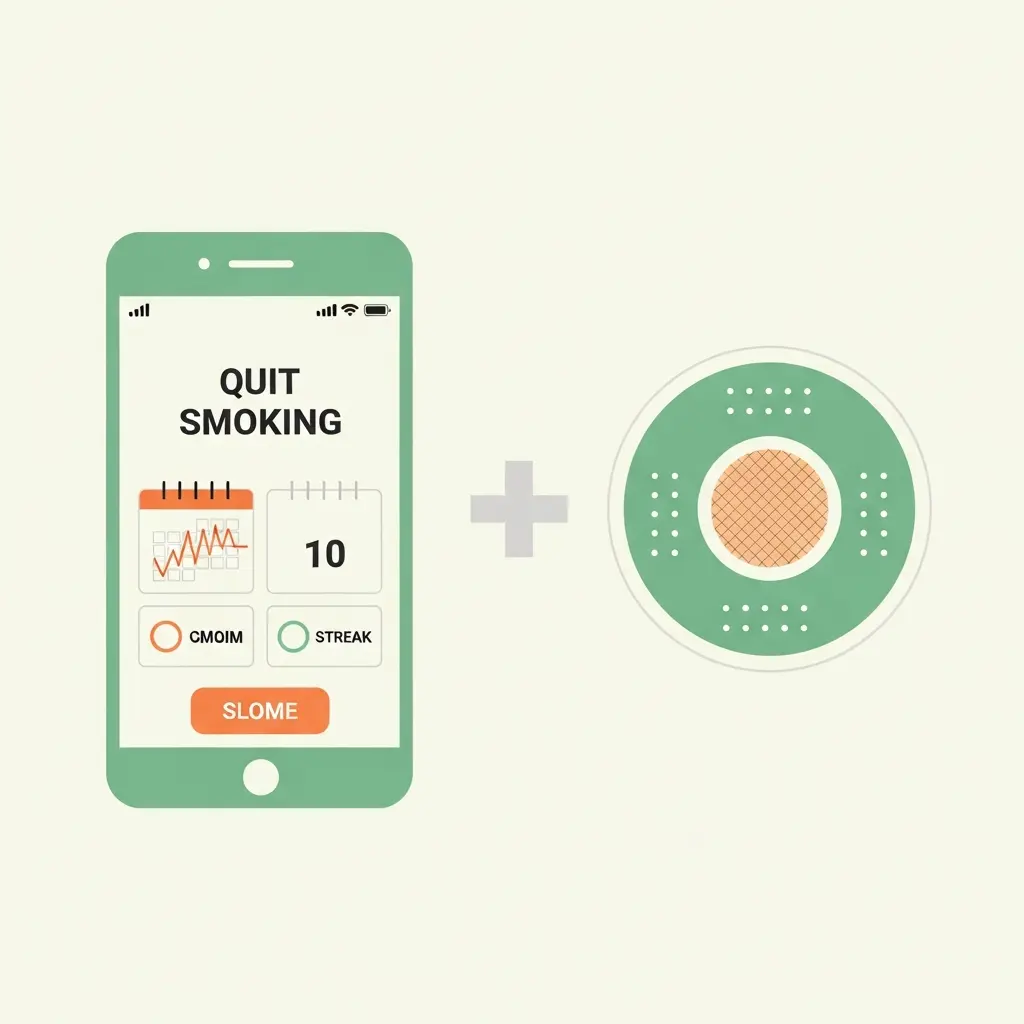
Can a Quit-Smoking App Replace Nicotine Patches? What iQuit Does and Doesn’t Do (2026)
If you have been researching quit smoking options in 2026, you have probably landed on two different kinds of advice. One camp says apps are transforming cessation and that AI coaching changes everything. The other says that nicotine replacement therapy (NRT) is clinically proven and that apps are just motivational extras. The honest answer is that both are partly right — and that the question itself contains a false premise: a quit smoking app does not replace NRT, because they solve different problems.
This guide explains, without marketing spin, exactly what iQuit does well, what nicotine patches and other NRT do that apps cannot, and why the combination of both is consistently the strongest approach recommended by clinical evidence. If you are deciding whether to use one or both, this is the clearest breakdown available.
Two Different Problems: Physical vs Behavioural
Smoking addiction has two distinct dimensions. Understanding this distinction is the key to understanding why no single tool solves both.
Physical dependence is the body’s adaptation to regular nicotine. Nicotine changes the density and sensitivity of acetylcholine receptors in your brain. When you stop supplying nicotine, these receptors generate withdrawal symptoms: irritability, anxiety, difficulty concentrating, sleep disruption, increased appetite, and intense cravings. This is a biochemical process. It cannot be coached, tracked, or motivated away. It requires either time (typically two to four weeks for the acute phase) or a pharmacological tool to manage.
Behavioural and psychological dependence is a different problem. Smoking is deeply embedded in daily routines and emotional responses. You smoke after meals, with coffee, under stress, when socialising, when bored. These associations are formed over years and exist independently of the physical withdrawal. Even when the biochemical cravings have settled (around weeks two to four), situational triggers can spark the urge to smoke months or years later.
NRT addresses the first problem. iQuit addresses the second. Replacing one with the other leaves a significant gap.
What NRT Actually Does
Nicotine replacement therapy delivers controlled doses of nicotine through a non-combustion route — patches, gum, lozenges, nasal spray, or inhalator. This keeps blood nicotine levels stable enough to prevent severe withdrawal symptoms while you work on the behavioural habits that keep the addiction alive.
The Cochrane review on NRT for smoking cessation — one of the most comprehensive analyses of cessation pharmacotherapy — confirms that all forms of NRT increase the likelihood of successfully quitting compared with no pharmacological support. Combination NRT (a steady-release patch combined with a fast-acting form like gum or lozenge) performs better than single-form NRT, with a meaningfully higher quit rate.
Patches, as the steady-release form, provide a baseline level of nicotine throughout the day that prevents the trough-and-spike pattern that intensifies cravings. Fast-acting forms like gum and lozenges address breakthrough cravings when situational triggers are strong. NRT does not make quitting effortless — but it significantly reduces the physiological barrier to doing so.
NRT is available from pharmacies in the UK and most other countries without a prescription. In the UK, some forms are available free on the NHS through Stop Smoking Services or prescriptions from your GP.
What iQuit Actually Does
iQuit tackles the behavioural dimension of quitting. Its core contribution is in three areas:
- Trigger identification and pattern disruption: The craving tracker builds a data-driven map of when, where, and why your cravings occur. Most smokers significantly underestimate how situational their urges are. Seeing the pattern makes it possible to plan interventions before triggers strike.
- Real-time craving support: The AI coach provides structured coping techniques during active cravings — breathing exercises, urge-surfing prompts, cognitive reframes — available around the clock, not just during business hours.
- Progress visibility and motivation maintenance: Health milestones and the money-saved counter make the benefits of quitting visible and concrete rather than abstract. This addresses the motivational attrition that causes many quit attempts to collapse around weeks two to four.
These are genuinely valuable contributions to a quit attempt. They are also entirely distinct from what a nicotine patch does.
What iQuit Cannot Do
Being direct here is important, because trust matters on a health topic like this.
iQuit cannot:
- Reduce physical nicotine withdrawal symptoms
- Lower blood pressure, heart rate, or carbon monoxide levels directly
- Prescribe or recommend specific NRT doses
- Perform carbon monoxide breath tests (a clinical tool used by NHS Stop Smoking advisers)
- Substitute for a GP consultation if you are considering prescription medications like varenicline (Champix)
- Guarantee cessation outcomes — no app or NRT can do that
The app is honest about this. iQuit positions itself as a behavioural support tool and consistently recommends that heavily dependent smokers speak to a healthcare professional about NRT or prescription medication alongside the app.
The Evidence for Combining App + NRT
The research on combined pharmacotherapy and behavioural support is consistent and clear. A 2024 Cochrane-methodology review of cessation interventions confirmed that combining pharmacotherapy (NRT or prescription medication) with behavioural support produces better quit rates than either approach alone. The NHS echoes this directly: you are up to three times more likely to stop smoking for good when you combine treatment with support from a Stop Smoking Service.
The logic is straightforward: NRT reduces the physiological barrier (withdrawal), while behavioural support — whether from an app, a counsellor, or a helpline — reduces the psychological and habitual barriers. Addressing only one dimension leaves the other in place.
For a full evidence-based comparison of app-only versus NRT-only versus combined approaches, see the dedicated AI coaching apps vs NRT comparison.
Who Particularly Needs NRT
Some smokers can quit without NRT using behavioural tools alone — typically lighter smokers (fewer than 10 cigarettes per day), people with shorter smoking histories, or people whose smoking is primarily habitual rather than physically driven. For these individuals, iQuit’s craving coaching and pattern tracking may be sufficient as a primary tool.
For others, NRT is not optional but essential. You are more likely to need NRT if:
- You smoke 15 or more cigarettes per day
- You smoke your first cigarette within 30 minutes of waking (a standard clinical indicator of high physical dependence)
- You have tried to quit before and found withdrawal symptoms overwhelming
- You experience significant anxiety, irritability, or difficulty concentrating in the first days of a quit attempt
A high score on the Fagerström Test for Nicotine Dependence (FTND) — which your GP or pharmacist can administer — reliably predicts who benefits most from pharmacotherapy alongside behavioural support.
The comparison between quitting cold turkey and using pharmacological support is covered in depth in the cold turkey vs nicotine patches comparison.
How to Use iQuit and NRT Together in Practice
Using iQuit and NRT together is not complicated. Here is a practical way to combine them:
- Set your quit date — ideally two weeks away, so you can begin reducing cigarettes and choose your NRT form before you stop completely
- Start iQuit now, not on quit day — use the craving tracker before you quit to build baseline data on your trigger patterns. This makes the AI coach’s personalisation more accurate from day one
- Begin NRT on quit day — apply your patch first thing in the morning; keep fast-acting gum or lozenges available for breakthrough cravings
- Use iQuit for the behavioural layer — when a situational trigger hits (after a meal, during a stressful moment, in a social setting where others smoke), open the coach rather than reaching for a cigarette
- Check in with your pharmacist or GP at weeks two and four — they can adjust your NRT dose and assess how you are managing the physical side
- Continue iQuit beyond the NRT period — NRT is typically used for 8 to 12 weeks, but situational triggers can persist much longer. iQuit’s ongoing support is valuable well after you have finished NRT
For a complete evidence-based quit plan that integrates these elements, the quit smoking success rates by method guide has the data behind different combined approaches.
Frequently Asked Questions
Can I use iQuit while wearing a nicotine patch?
Yes, absolutely. iQuit is designed to be used alongside any pharmacological cessation support, including patches, gum, lozenges, or prescription medication. The app addresses the behavioural dimension of quitting while NRT addresses the physical withdrawal dimension. They work together, not in competition.
Do I need to tell iQuit that I’m using NRT?
You can note NRT use in your iQuit profile, which helps the AI coach contextualise your craving patterns. If you are using NRT and still experiencing frequent cravings, logging this helps the coach identify whether the triggers are primarily habitual rather than physical.
Is there any research showing that apps specifically help when used with NRT?
The research supports combined behavioural support and pharmacotherapy, though studies on app-plus-NRT specifically are still developing. The Cochrane evidence confirms the benefit of combining pharmacotherapy with behavioural support broadly. The WHO’s 2024 tobacco treatment guidelines listed AI-based cessation tools as a priority area for ongoing research.
What if I don’t want to use NRT — can iQuit still help?
Yes. iQuit provides meaningful support for people quitting without NRT, particularly those with lower nicotine dependence or those who prefer a non-pharmacological approach. The app’s craving coaching and pattern tracking are valuable regardless of whether you use NRT. For lighter smokers, app-based behavioural support alone can be sufficient.
How long should I use iQuit after I finish my NRT course?
There is no fixed endpoint. Many users continue using iQuit for six months to a year after quitting, particularly for the craving tracking and motivational features. Situational relapse risk — being triggered by a social occasion or stressful event — persists well beyond the NRT period. Keeping the app active means you always have support available when you need it.