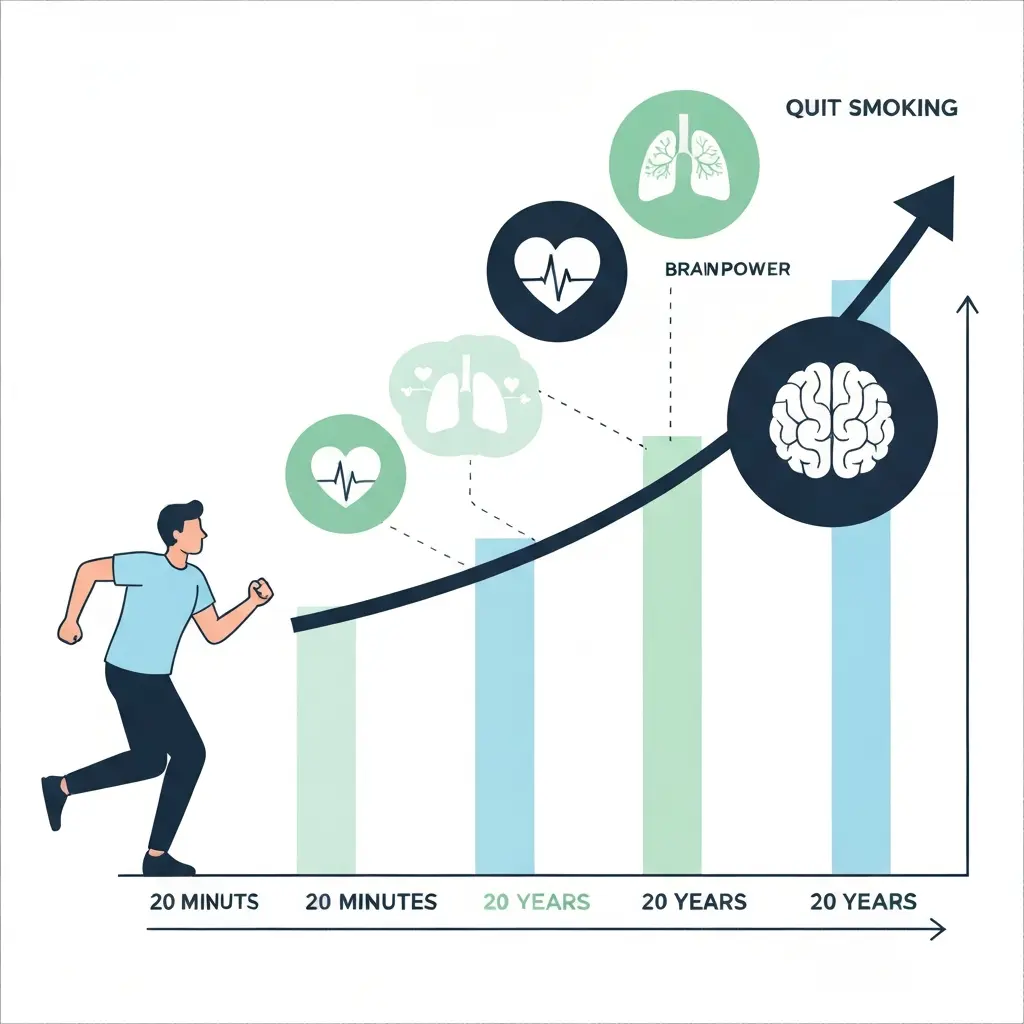
Quit Smoking Benefits Timeline: What Your Body Gains From 20 Minutes to 20 Years (2026)
The quit smoking benefits timeline is one of the most powerful arguments for quitting — and it begins the moment you stub out your last cigarette. Within 20 minutes, your heart rate drops. Within 12 hours, carbon monoxide clears your blood. Within a year, your heart attack risk is cut in half. Within 10 years, your lung cancer risk falls by 50%. These are not motivational claims — they are documented, measurable, biological events verified by the WHO, American Cancer Society, and CDC.
Most people focus on what they lose when they quit smoking: the ritual, the stress relief, the social connection. This guide flips that perspective. Every point on the quit smoking benefits timeline is something your body gains back — function, capacity, and life expectancy that smoking was steadily eroding. Whether you quit today or years ago, understanding this timeline puts your recovery into scale.
This article covers every major milestone on the quit smoking benefits timeline, from the first 20 minutes to two decades of being smoke-free, with data from the world’s leading health authorities.
You start feeling physical benefits within hours of quitting smoking. Blood pressure drops within 20 minutes, carbon monoxide clears within 12 hours, and breathing improves within weeks. The withdrawal discomfort of the first 1–3 weeks is temporary. The health benefits compound continuously for years and decades after your last cigarette.
20 Minutes to 12 Hours: Immediate Benefits of Quitting Smoking
The quit smoking benefits timeline begins faster than most people expect. These early milestones happen before you have even experienced the first full day of withdrawal:
20 Minutes After Quitting
Your heart rate and blood pressure begin to drop toward normal levels. Smoking elevates heart rate by 10–20 beats per minute and raises systolic blood pressure. Within 20 minutes of your last cigarette, both begin to normalise. This is not a small thing — the chronic cardiovascular strain of smoking contributes directly to heart disease risk, and relief from that strain begins almost immediately.
2 Hours After Quitting
Nicotine blood levels drop by approximately 50% (nicotine’s half-life is around 2 hours). Peripheral circulation begins improving — your hands and feet may feel warmer as blood vessels that nicotine had constricted begin to dilate.
8 Hours After Quitting
Nicotine and carbon monoxide levels in your blood drop to half. Carbon monoxide — a toxic gas produced by burning tobacco that binds to haemoglobin 200x more readily than oxygen — is being steadily replaced. Your blood’s oxygen-carrying capacity begins improving.
12 Hours After Quitting
Carbon monoxide levels normalise completely. Your blood oxygen saturation reaches a healthy baseline. If you have ever felt slightly breathless or sluggish, this is the beginning of that lifting. The WHO notes this as one of the earliest measurable improvements.
24 Hours After Quitting
Heart attack risk begins to fall. Smoking dramatically increases platelet aggregation (blood clotting tendency) and arterial stiffness. Within 24 hours, these cardiovascular risk factors begin improving. This effect is meaningful enough that the American Heart Association includes it in first-day quit benefits.
Days 1–90: Short-Term Recovery on the Benefits Timeline
48 Hours: Enhanced Senses Begin Returning
Taste and smell nerve endings begin regenerating. After 48 hours without nicotine, many ex-smokers notice food tasting more complex or vivid than it has in years. This improvement continues over the following weeks.
72 Hours: Breathing Becomes Noticeably Easier
Bronchial tubes begin to relax and open. The mucus-producing cells in the airways start reducing their output. Many people notice their breathing feels measurably less effortful by day 3 — a particularly powerful contrast with the respiratory constriction that smoking causes.
2 Weeks to 1 Month: Circulation Dramatically Improves
Blood circulation improves significantly over the first month. Walking, climbing stairs, and exercise become noticeably easier as peripheral blood vessels recover. Lung function continues to improve as cilia — the microscopic hair-like structures that clear debris from the airways — begin recovering after years of nicotine-induced paralysis.
1–3 Months: Lung Function Measurably Improves
Within 1–3 months of quitting, lung function improves by up to 10% according to NHS data. This is a clinically measurable improvement on spirometry testing. Coughing and wheezing decrease as airway inflammation resolves. People who had a chronic “smoker’s cough” typically see it resolve entirely during this window.
9 Months: Lungs Largely Clear
By 9 months, lung cilia have substantially recovered. The lungs are now far more capable of fighting infection. Sinus congestion, coughing, and shortness of breath have resolved for most ex-smokers. The risk of respiratory infections (colds, chest infections) is significantly reduced compared to active smoking. Read more about the complete lung recovery process in our guide to lung healing after quitting.
1 Year: The Heart Attack Milestone
One year smoke-free is one of the most clinically significant milestones on the quit smoking benefits timeline. At this point, your risk of coronary heart disease and heart attack falls to half that of a current smoker. This is not a gradual improvement — it is a step-change in risk, documented by the American Cancer Society and replicated in multiple large-scale population studies.
Additional 1-year benefits include:
- Blood pressure returned to normal range (if elevated by smoking)
- Improved immune function — the body is better equipped to fight infection and repair damage
- Significantly reduced risk of a second heart attack for those with prior cardiovascular history
- Skin improvement — circulation improvements result in better skin tone and texture
- Financial savings equivalent to thousands of dollars, pounds, or euros depending on your country and smoking rate
5 Years: Stroke Risk Returns to Non-Smoker Levels
After 5 years of not smoking, your stroke risk normalises to the same level as someone who has never smoked. This is a profound outcome — smoking roughly doubles or triples stroke risk, and within 5 years of quitting, that excess risk is eliminated.
At 5 years, your body has also experienced:
- Continued reduction in cancer risk (mouth, throat, oesophageal cancers drop significantly)
- Significantly reduced risk of cervical cancer in women who smoked
- Normalised blood vessel elasticity in most regions
- Reduced risk of peripheral artery disease
10 Years: Lung Cancer Risk Halved
The 10-year milestone on the quit smoking benefits timeline is dominated by a single, landmark statistic: your risk of dying from lung cancer falls to approximately half that of a current smoker. Lung cancer is the most common cause of cancer death globally — and this 50% risk reduction is one of the most powerful long-term outcomes of cessation.
At 10 years, additional benefits include:
- Significantly reduced risk of cancers of the pancreas, kidney, bladder, and larynx
- Pre-cancerous cells in the airways largely replaced by healthy cells
- Substantially reduced risk of COPD progression for those who quit before severe impairment
Source: TED-Ed — “How do cigarettes affect the body?” (Krishna Sudhir)
15 Years: Heart Disease Risk Returns to Non-Smoker Baseline
After 15 years smoke-free, your risk of heart disease returns to approximately the same level as someone who has never smoked. Given that smoking increases heart disease risk by 200–400%, this represents the elimination of the largest single smoking-attributable mortality risk.
At 15 years, overall health is substantially indistinguishable from a matched non-smoker cohort in most cardiovascular risk studies. The body’s extraordinary capacity for self-repair, given the chance, has largely achieved what was thought impossible when you smoked.
20 Years: Near-Normal Risk of Death from Smoking-Related Causes
At 20 years smoke-free, your risk of death from smoking-related causes — including lung disease and cancer — drops to nearly the level of someone who never smoked, according to WHO data. This is the ultimate endpoint of the quit smoking benefits timeline: the erasure of excess mortality risk accumulated over years of smoking.
WHO data also shows that people who quit smoking by age 30 add approximately 10 years to their life expectancy. Quitting by age 40 recovers 9 years. Even quitting at age 50 recovers 6 additional years of life.
Quit Smoking Benefits Timeline by Body System
| Body System | Key Benefit | Timeline |
|---|---|---|
| Cardiovascular | Heart rate and BP normalise | 20 minutes |
| Blood | CO clears, oxygen improves | 12 hours |
| Nervous System | Taste and smell return | 48 hours |
| Respiratory | Bronchial tubes relax | 72 hours |
| Circulation | Dramatically improved | 2–12 weeks |
| Lungs | Function improves 10% | 3–9 months |
| Heart | Heart attack risk halved | 1 year |
| Brain/Cerebrovascular | Stroke risk normalises | 5 years |
| Lungs (oncology) | Lung cancer risk halved | 10 years |
| Heart (long-term) | CHD risk = non-smoker | 15 years |
Does Age at Quitting Change the Timeline?
The earlier you quit, the more of the benefits timeline you can fully experience — but quitting at any age delivers measurable, significant improvements. WHO data on life expectancy gains by age at quitting:
- Age 30: Approximately 10 additional years of life expectancy
- Age 40: Approximately 9 additional years
- Age 50: Approximately 6 additional years
- Age 60: Approximately 3 additional years — plus significant reduction in COPD, cancer, and cardiovascular disease risk
Even for people who have been smoking for decades and who already have smoking-related conditions, quitting slows disease progression and improves quality of life. There is no age at which the quit smoking benefits timeline fails to apply.
For people who want to understand what their specific body is recovering from, see our detailed breakdown in what happens when you quit smoking. For the mental health improvements specifically, see our article on smoking, mental health, and quitting.
To track your personal position on the quit smoking benefits timeline, the iQuit tracker app shows exactly which health milestones you have crossed, how much money you have saved, and how many cigarettes you have avoided — updated in real time from your quit date.
See Your Personal Benefits Timeline
Enter your quit date in iQuit and watch your health milestones update in real time. Every 20 minutes, every day, every year — tracked automatically.
FAQ: Quit Smoking Benefits Timeline
How quickly do you feel better after quitting smoking?
Physical benefits begin within 20 minutes of your last cigarette. Heart rate and blood pressure begin to normalise. Carbon monoxide clears within 12 hours, improving blood oxygen levels. Breathing becomes noticeably easier within 2–3 days as bronchial tubes begin to relax. Most people report feeling markedly better — with improved energy, breathing, and mood — within 2–4 weeks once the withdrawal discomfort passes.
When does lung function improve after quitting smoking?
Lung function begins improving measurably within 1–3 months of quitting smoking. NHS data shows a 10% improvement in lung function by 3–9 months. Cilia in the airways begin recovering within weeks, and by 9 months, the lungs are substantially clearer of accumulated debris. The risk of respiratory infections falls significantly in this window. For people with early-stage COPD, quitting is the single most effective intervention to slow disease progression.
Does quitting smoking reverse all damage?
Quitting smoking reverses much of the damage from smoking, but not all of it. Cardiovascular damage largely heals — within 15 years, heart disease risk returns to non-smoker levels. Cancer risk falls dramatically, though it does not always return exactly to never-smoker levels. Established COPD (emphysema) involves permanent structural changes that cannot be fully reversed, though quitting slows progression significantly. The longer you smoked, the more residual risk remains — but at every level of damage, quitting substantially reduces further risk.
What happens to your skin when you quit smoking?
Skin improves measurably after quitting smoking. Within weeks, improved circulation delivers more oxygen and nutrients to skin cells. Skin tone brightens and becomes more even. Collagen production — suppressed by smoking — begins recovering. Within months, many ex-smokers report that their skin looks healthier, with reduced premature wrinkles, improved elasticity, and a reduction in the greyish pallor associated with chronic smoking. The improvements continue for years as circulation normalises completely.
How much longer do you live if you quit smoking?
Life expectancy gains from quitting smoking depend on age at cessation. WHO data shows that quitting at age 30 adds approximately 10 years of life expectancy; quitting at 40 adds around 9 years; quitting at 50 adds around 6 years. Even quitting at 60 provides measurable life expectancy gains. Quitting before age 40 reduces the risk of dying from smoking-related disease by approximately 90%, according to the American Cancer Society.
Sources: WHO — Health Benefits of Smoking Cessation | American Cancer Society — Benefits Over Time | American Lung Association — Benefits of Quitting