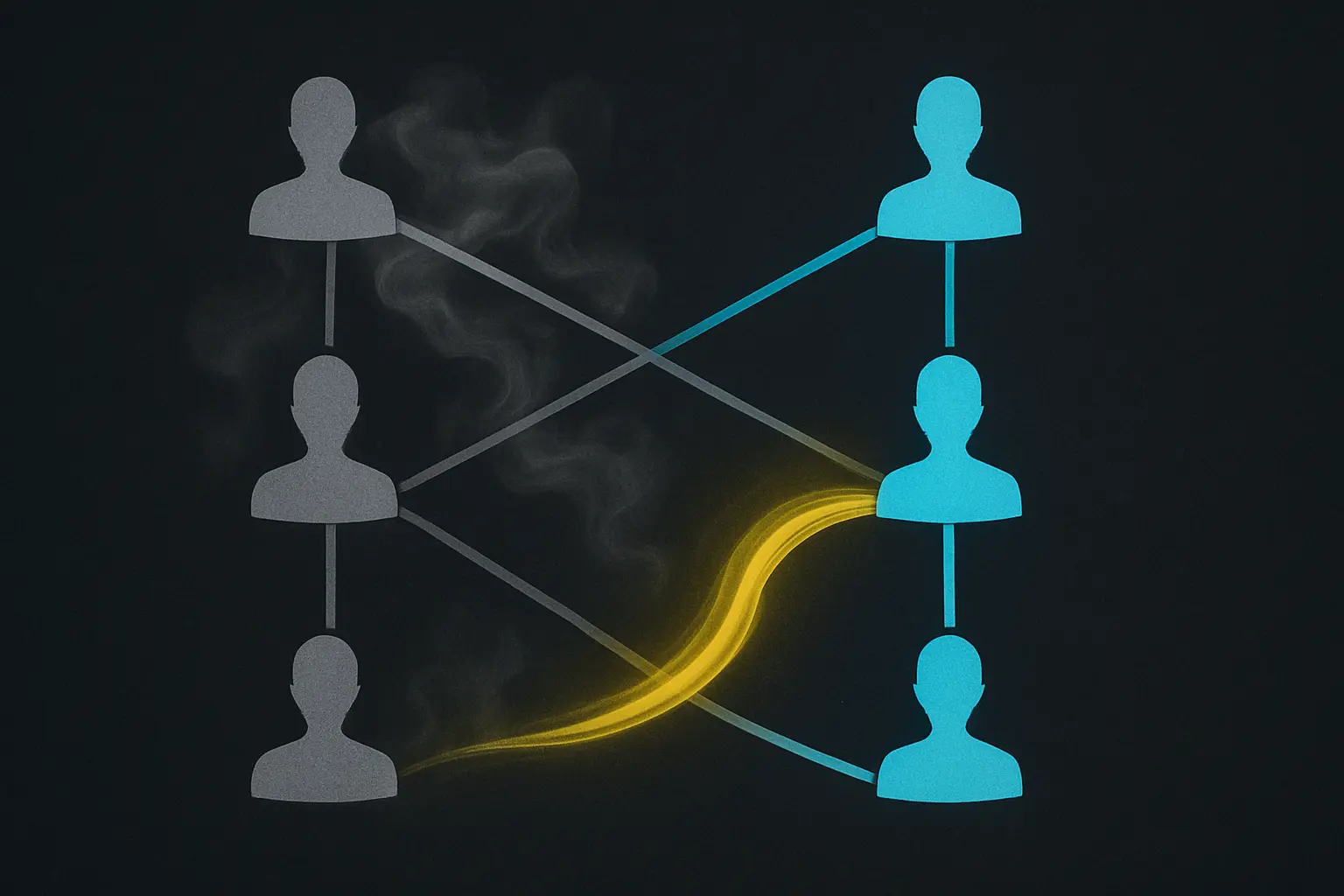
Smoking is contagious — literally, measurably, through social networks. The landmark Christakis–Fowler analysis of 12,000 people over 32 years found smoking behavior spreading person-to-person like an infection: whole clusters of friends started together and — more hopefully — quit together, with a friend’s quit cutting your own odds of smoking by roughly a third. If your cravings spike specifically around smoking friends, you’re not weak-willed; you’re experiencing the most human trigger there is. Here’s the wiring, and how to quit inside a smoking social circle without losing it.
Why watching someone smoke lights up your brain
Three mechanisms stack when a friend lights up:
- Cue reactivity, mirror-style. Brain imaging shows smokers watching others smoke activate their own smoking-action circuitry — the observed drag partially rehearses your drag. You’re not just seeing a cigarette; your motor system is miming it.
- The full sensory broadcast. The click of the lighter, the first smell of smoke — each a conditioned cue with years of training, arriving together, at close range. (The smell hits harder as your recovering nose sharpens — early quitters often report smelling smoke from remarkable distances.)
- Permission in the air. Company redefines normal. Alone, smoking is a decision; among smokers, it’s the default — and declining becomes the act that needs energy. That inversion is what makes the smoke-break exodus and the offered pack so dangerous, especially with alcohol dissolving resolve on a night out.
The playbook: keep the friends, lose the trigger
- Tell them once, straight: “I’ve quit — don’t offer me one, and don’t let me bum one even if I ask.” Good friends respect a clear rule far better than a vague hope. (Most will quietly admire it; many are planning their own attempt.)
- Move the venue, not the friendship. First weeks: coffee instead of the smoking terrace, lunch instead of the bar, activities where smoking doesn’t slot in — cinema, gym, drives.
- Handle the exodus deliberately. When the group steps out: stay in with a task, or go with a plan — upwind, drink in smoking hand, five minutes. Both work; drifting doesn’t.
- Expect the strange grief. Smoking friendships had a built-in ritual of pause-and-talk. Replace the ritual, keep the talk: suggest the walk, make the coffee. What mattered was never the cigarette.
- Watch the contagion flip. Within months of a visible quit, don’t be surprised when a friend asks how you did it. Your quit is statistically live in their heads — that’s the network effect running your direction now.
If your whole circle smokes
Then your environment is genuinely harder — and worth compensating for deliberately: add non-smoking social contexts (a class, a team, the app’s quitter community where everyone’s fighting the same fight), and lean on tools that don’t care who you’re standing next to. The free iQuit app travels into every smoking circle with you: SOS breathing for the exodus moments, the craving log that will show you exactly which friends and venues spike your urges, and an AI coach to debrief the hard evenings with.
FAQ
Why do I only crave around other smokers?
Mirror-style cue reactivity, the sensory broadcast of smoke and lighter, and the permission of company — the strongest human trigger stack there is.
Do smoker friends really affect my odds?
Network research says yes, in both directions — and a friend quitting cuts your smoking odds by about a third.
Must I avoid smoking friends?
Tactically at first (venues, exodus plans), not permanently. Clear rules beat avoidance.
Will my quit affect my friends?
Measurably — visible quits propagate through networks. You may be the reason someone else stops.
Bring backup into every smoking circle: download iQuit free on Google Play.