
People searching for celebrities who quit smoking usually want two things: proof that quitting is survivable, and a method they can borrow. This guide gives you both, with one rule. Every profile below rests on something the person said in an interview, a broadcast or a podcast, and we link to the interview or the report so you can check it. Where we could not find a direct, checkable quote, we left the name out.
Why famous quit stories help (and where they stop helping)
Quitting can feel private and shameful, so hearing a well-known person admit they struggled can lower the stakes. Ellen DeGeneres put it plainly on her show, saying smoking was “something I’ve been struggling with since I was a teenager.” If a household name had that trouble, an ordinary quitter has nothing to be embarrassed about.
The limit is evidence. A celebrity profile is a single case, picked because it makes a good story. Nobody writes a headline about the many people for whom a method did not work. So read these stories for encouragement and for ideas, and then check your choice against guidance from health bodies. The last sections of this guide do that.
For wider context on how common quitting is, see our data on how many ex-smokers there are and our summary of quit-smoking success rates and statistics. For everyday, non-famous journeys, our quit smoking success stories collection is a good companion.
Mel Gibson: a book and a doctor’s warning
On episode 2254 of The Joe Rogan Experience (the full episode on the show’s official YouTube channel, about 1 hour 32 minutes in), Mel Gibson said: “I smoked for 45 years and I couldn’t stop.” He said he read “this silly book by Allen Carr” and that “it’s the only thing that made me stop.”
He described the book as The Easy Way to Stop Smoking, said his son had given it to him, and said he used to walk past it on the bookshelf and dismiss it as a “dumb book” with a “dumb title.” What changed, in his telling, was a doctor telling him he had a first-stage lung condition. “So I read the book and I stopped,” he said, adding that he thought it was like self-hypnosis, “but it worked.”
Method: a self-help book, read after a medical warning. What to take from it: the book sat on his shelf for a long time before it worked. Readiness mattered as much as the method. We are only reporting what he said on the podcast; we do not know how his health has changed since, and we are not adding any detail he did not give.
Ellen DeGeneres: a hypnosis session and a book
On a segment of her talk show (posted on the show’s official YouTube channel), DeGeneres showed a session she did with the hypnotist Paul McKenna. In the clip, McKenna asks her to think of times she wanted to quit and to overlap those memories, and he tells her she is a non-smoker. When he asks whether she feels like a cigarette, she answers “No, I do not,” and says it has been three days and that she feels healthier.
In another on-air announcement (a clip of the broadcast reposted by a third-party channel, so we cannot say when it aired relative to the session), she said she had quit smoking and that it had been “about two months now.” She said: “I’m announcing it because I’m proud of it because it is so hard to do.” She recommended a book, The Easy Way to Stop Smoking by Allen Carr, and said that after reading it she stopped.
Method: a hypnosis session and a book, both described by her on air. What to take from it: she presents both as parts of her own quit, and there is nothing odd about combining approaches. We cannot tell you which one did the work, and her accounts are not trial evidence. The wider NHS guidance on getting ready to quit stresses planning and support, which is a useful counterweight to any single-session story.
If you prefer hearing a quit story told in a patient’s own words rather than a headline, this 90-second film from Guy’s and St Thomas’ NHS Foundation Trust is worth your time.
Dick Van Dyke: a decade on nicotine gum
In a January 2013 interview with The Telegraph, the actor talked about his smoking history. According to the interview, he mimed drawing deeply on a cigarette, then popped a Nicorette into his mouth and said: “I’ve been on this gum for 10 years and it’s just as addictive but at least it’s not hurting my lungs.”
Method: nicotine replacement in gum form, used for a long time. What to take from it: his remark is honest about the trade-off. Nicotine replacement is not a way of avoiding all dependence; it moves you from smoke to a cleaner delivery of nicotine. The NHS describes nicotine replacement therapies as giving your body “lower doses of nicotine in a safer way, helping you to manage cravings.” For many people the plan is to step down over time, and a pharmacist or Stop Smoking Service can help you build one. One person’s decade of gum is not a template.
Chrissy Teigen: gum on the red carpet
At the 2025 Oscars Vanity Fair red carpet, Teigen spoke to an Access Hollywood correspondent, in an interview reported by NBC 6 South Florida. She said: “I’m just furiously chewing Nicotine gum tonight.” She then spoke to the camera: “Don’t smoke, smoking is bad, stop now if you can.”
Method: nicotine gum. What to take from it: if you know a stressful event is coming, plan your craving support before you walk in. The report does not tell us anything beyond those two quotes, so we are not going to guess at her history, timeline or results.
Real quitters from the NHS who are not famous
The NHS Better Health page on quitting smoking carries short first-person stories that are just as instructive, and they come from a source with no interest in selling you anything. Three of them:
- Stevie: “I smoked for over 25 years, and it wasn’t easy breaking the habit. But what worked was choosing a quit date and getting help from my local Stop Smoking Service.”
- Maria: “I used lozenges to help with cravings. However, when I’m around smokers I use a vape. This helped me quit for good.” She also credits the NHS Quit Smoking app for showing her savings.
- Heather: “The NHS Quit Smoking app really helped me. I liked seeing my progress.”
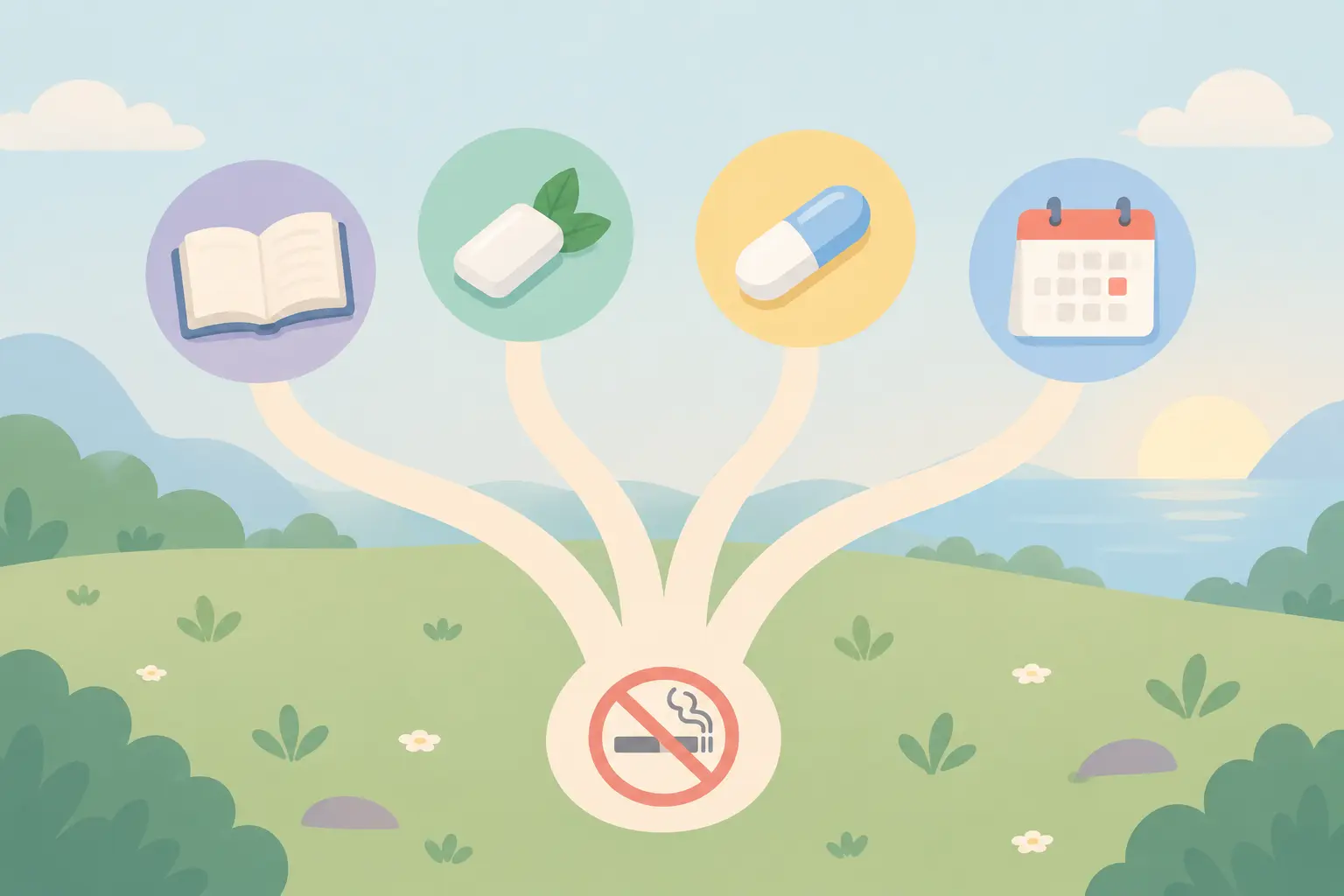
Notice what is common: a quit date, practical help, and a way of seeing progress. None of them describes willpower alone. Our guide to setting a quit date that sticks walks through the first of those steps.
Why we left some famous names out
Many lists of famous ex-smokers circulate online, and plenty of them repeat claims with no quote behind them. We kept only people whose own words we could open and check ourselves, and we did not include any celebrity’s diagnosis, weight, finances or health outcome unless they said it on the record. A shorter list you can trust beats a longer list you cannot.
That also means we are not telling you who “relapsed.” Some of the people above describe long histories with smoking, but we have no sourced detail about specific slips and will not invent any. If you slip yourself, that is normal and fixable; our guide on staying motivated when quitting covers what to do next.
What these stories have in common
- A trigger. Gibson described a doctor’s warning; DeGeneres said she had struggled since her teens; Van Dyke and Teigen both mentioned nicotine gum.
- A defined method. Book, hypnosis session, gum. Each person can name what they did.
- Long histories. Gibson said he smoked for 45 years; Van Dyke said he had been on gum for 10 years.
- Honesty about difficulty. DeGeneres called quitting “so hard to do,” and Gibson said he “couldn’t stop” until he read the book.
What they do not share is a single winning method, which fits the public-health message. Smokefree.gov says “There isn’t one right way to quit,” while noting that medication can double your chances of quitting for good.
Pick your method: a quick map
| Method | Who described it | What the source says |
|---|---|---|
| Self-help book | Mel Gibson; Ellen DeGeneres | Both credit the Allen Carr book. No success rate cited here. |
| Hypnosis | Ellen DeGeneres | Her on-air account of a session with Paul McKenna. No trial evidence cited here. |
| Nicotine gum | Dick Van Dyke; Chrissy Teigen | NHS: NRT gives lower doses of nicotine in a safer way. |
| Medication or NRT with support | NHS stories (Maria) | Smokefree.gov: medication can double your chances. |
| Local Stop Smoking Service | NHS story (Stevie) | NHS: free expert help can boost chances by 3 times. |
The NHS notes that many people try to quit with willpower alone, but that “going cold turkey can be tough,” and that planning and stop-smoking products or expert help can boost your chances (see the NHS page on getting ready to quit smoking). If you want help comparing tools, our best quit smoking apps comparison lays out the app options side by side.
A simple way to choose
- Check what suits your health and budget with a pharmacist, doctor or Stop Smoking Service.
- Choose one main method and one backup, such as gum plus a book or app.
- Pick a quit date and tell one person.
- Aim for the first 28 days; the NHS says reaching 28 days smoke free makes you 5 times more likely to quit for good.
Where iQuit fits
iQuit is a free app, available on Google Play and the App Store, that supports whichever route you choose. You can quit cold turkey or gradually, and the dashboard shows days smoke-free, cigarettes avoided and money saved. You can log cravings with their triggers, use the SOS tools (breathing exercises, grounding, craving surfing) when an urge hits, and get replies from an AI coach. Streak shields and slip recovery help you restart after a slip.
iQuit does not diagnose or treat anything and is not a replacement for medication or professional advice. It simply gives you what the NHS stories above kept mentioning: a visible record of progress.
Frequently Asked Questions
Which celebrities have talked publicly about how they quit smoking?
This guide covers four people who described their method in their own words: Mel Gibson (a book), Ellen DeGeneres (a hypnosis session and the same book), Dick Van Dyke (nicotine gum) and Chrissy Teigen (nicotine gum). Each profile links to the interview, broadcast or report we checked. We left out names we could not trace to a direct quote (NHS Better Health carries real stories from non-famous quitters too).
Does the Allen Carr book really work?
Mel Gibson and Ellen DeGeneres both say it worked for them, and that is all their stories prove. Personal accounts are not trial evidence, and we are not citing a success rate for the book. If you want the options public-health bodies back, see Smokefree.gov, which says medication can double your chances of quitting for good.
Does hypnosis help people quit smoking?
Ellen DeGeneres described a hypnosis session with Paul McKenna on her show and said afterward that she did not feel like a cigarette. A single story does not show hypnosis works for most people, and we did not fetch trial evidence for this guide. Your local Stop Smoking Service can talk through all options (NHS).
Is nicotine gum a legitimate way to quit, or just swapping one habit for another?
The NHS describes nicotine replacement therapies as giving your body “lower doses of nicotine in a safer way, helping you to manage cravings” (NHS). Dick Van Dyke told the Telegraph he had used gum for 10 years and called it “just as addictive but at least it’s not hurting my lungs.” Ask a pharmacist how long to use it.
Are celebrity quit stories good evidence for choosing a method?
No. They are memorable, but they are single cases chosen because they were interesting, and failed attempts rarely make headlines. Use them for motivation, then choose your method using guidance from health bodies and, ideally, a conversation with a health professional or Stop Smoking Service.
How long until quitting is likely to stick?
The NHS says that if you reach 28 days smoke free you are 5 times more likely to quit for good (NHS Better Health). That does not mean day 29 is risk-free, only that the first month is the hardest stretch to get through. Plan your cravings and support for it.
Can a free app help me quit the way these people did?
An app will not do the quitting for you, and it is not medication. It can make your progress visible: days smoke-free, money saved and craving moments you log. The NHS’s own real-life stories mention an app showing progress and savings. iQuit is free on Google Play and the App Store and works alongside whichever method you choose.
Start your own story with iQuit
Choose your method, pick your quit date and watch your progress add up. iQuit is free on Google Play and the App Store.