Lung Function Recovery After Quitting Smoking: The FEV1 Data Every Smoker Should See (2026)
Every year of smoking accelerates the loss of lung function. The clinical measure at the centre of that story is FEV1 — Forced Expiratory Volume in one second — and the data on what quitting smoking does to FEV1 is among the most compelling evidence in respiratory medicine. The landmark Lung Health Study tracked over 5,000 smokers for five years and produced a finding that changes the conversation: quitting smoking roughly halves the annual rate of FEV1 decline and produces an immediate gain in the first year. Understanding the lung function FEV1 recovery after quitting statistics gives every smoker a clear, measurable reason to stop.
There is one critical caveat that this article will not gloss over: quitting smoking does not reverse established airway damage or restore lost lung function to normal levels. Anyone claiming otherwise is overstating the evidence. What quitting does — powerfully and consistently — is slow the progression of decline, preserve the lung function you have, and prevent COPD from worsening at the rate it would if you continued smoking. That distinction matters enormously for realistic expectations and long-term motivation.
What Is FEV1 and Why Does It Matter?
FEV1 stands for Forced Expiratory Volume in one second — the volume of air a person can forcibly exhale in the first second of a maximal breath out. It is measured by a spirometer during a breathing test called spirometry.
FEV1 is the primary diagnostic and staging marker for chronic obstructive pulmonary disease (COPD). Under GOLD (Global Initiative for Chronic Obstructive Lung Disease) criteria, COPD is staged by the percentage of predicted FEV1:
- GOLD 1 (Mild): FEV1 ≥80% of predicted
- GOLD 2 (Moderate): FEV1 50–79% of predicted
- GOLD 3 (Severe): FEV1 30–49% of predicted
- GOLD 4 (Very Severe): FEV1 <30% of predicted
In healthy non-smokers, FEV1 rises until approximately age 20–25, plateaus, then declines gradually with age — typically at a rate of 20–30 ml per year. Smoking dramatically accelerates this decline, often to rates of 50–80 ml per year in susceptible individuals. Over decades, this accelerated loss is what transforms a smoker into a COPD patient.
How Smoking Accelerates FEV1 Decline
The mechanisms by which tobacco smoke damages lung function are well established. Cigarette smoke triggers chronic airway inflammation, damages the cilia that clear mucus from the airways, destroys the elastic walls of the alveoli (causing emphysema), and narrows the small airways through fibrosis and mucus hypersecretion. Each of these processes directly reduces FEV1.
Not all smokers lose lung function at the same rate — genetic susceptibility, smoking intensity, duration, and concurrent exposures all play a role. Studies suggest that roughly 15–20% of smokers develop clinically significant COPD. However, population-level data from large cohort studies consistently show that smokers as a group experience faster-than-normal FEV1 decline even in the absence of diagnosed COPD.
The question the Lung Health Study was designed to answer was direct: does quitting smoking actually slow that decline — and if so, by how much?
The Lung Health Study: Core Data
The Lung Health Study, published in the American Journal of Respiratory and Critical Care Medicine, enrolled 5,887 current smokers aged 35–60 with mild-to-moderate airflow limitation across 10 North American clinical centres. Participants were randomly assigned to smoking cessation intervention (intensive group behaviour modification plus nicotine gum), usual care, or a bronchodilator arm. FEV1 was measured annually for five years.
The study produced two landmark numbers that are now cited across respiratory medicine:
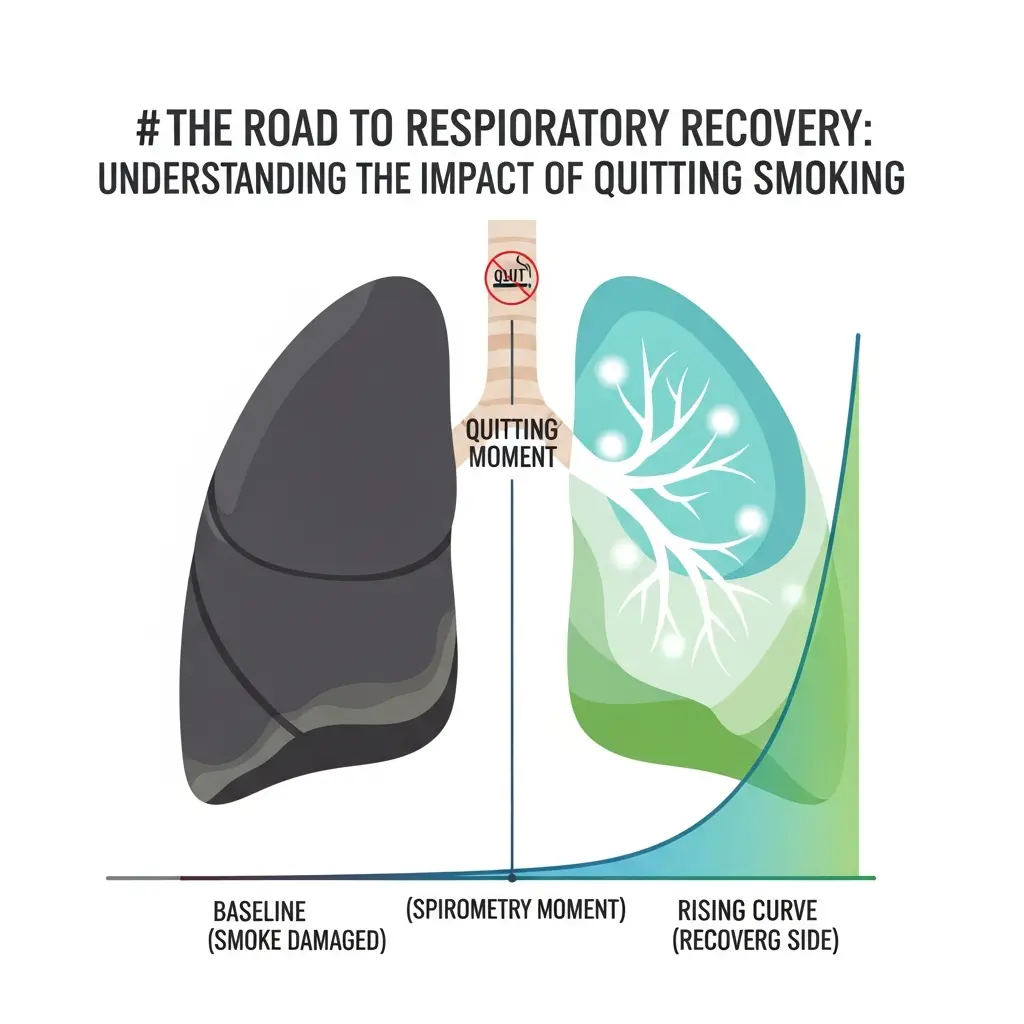
- First-year gain: Sustained quitters experienced an average improvement in FEV1 of approximately 47 ml (about 2% of predicted value) in the year after quitting. This initial gain reflects reduced airway inflammation, improved mucus clearance, and resolution of some bronchospasm — reversible components of obstruction that return to normal when smoke exposure stops.
- Annual decline thereafter: After the first-year gain, sustained quitters then declined at approximately 31 ml per year — roughly half the rate of continuing smokers, who declined at approximately 62 ml per year. The quitters’ rate of decline was comparable to that of never-smokers in the study.
These two numbers — a near-immediate gain of ~47 ml, followed by a halving of the long-term decline rate — capture the full benefit of cessation on lung function.
FEV1 Decline Data Table: Smokers vs Quitters
| Group | Year 1 FEV1 Change | Annual Decline (Years 2–5) | 5-Year Total Change |
|---|---|---|---|
| Sustained quitters | +47 ml (approx. +2%) | ~31 ml/year | Loss <50 ml |
| Continuing smokers | Decline | ~62 ml/year | ~300 ml lost |
| Never-smokers (reference) | Normal age-related decline | ~20–30 ml/year | ~100–150 ml |
Source: Anthonisen et al., AJRCCM, 2000 (Lung Health Study). Data refer to participants with mild-to-moderate airflow limitation.
The 250 ml difference in five-year FEV1 change between continuing smokers and sustained quitters is clinically meaningful: 250 ml represents roughly the difference between normal lung function and borderline COPD in many adults, or between moderate and severe COPD in someone already diagnosed.
American Lung Association — COPD & Smoking Facts
- Cigarette smoking is the leading cause of COPD, accounting for ~85–90% of cases
- Quitting smoking is the only proven way to slow FEV1 decline in smokers with COPD
- After quitting, the rate of lung function decline returns to near that of a never-smoker
- COPD affects over 16 million Americans; millions more are undiagnosed
- Spirometry testing is the key diagnostic tool — ask your doctor if you have symptoms
Source: American Lung Association — COPD
Long-Term Outcomes: 5-Year and 11-Year Data
The Lung Health Study’s 11-year follow-up data — published in subsequent analyses — extended the picture further. The divergence between continuing smokers and sustained quitters widened over time as the halved annual decline rate compounded:
- At 11 years, 18% of continuous smokers had FEV1 values below 50% of predicted (GOLD Stage 3 — severe COPD), compared with only 3.3% of sustained quitters.
- Among sustained quitters, FEV1 declined from 79% to 76% of predicted over 11 years — a clinically insignificant change.
- Among continuing smokers, FEV1 declined from 79% to 64% of predicted — a decline that moved many participants from borderline normal into clinically significant COPD.
These 11-year numbers are striking. They show that quitting does not just slow progression marginally — it prevents the transition into severe, disabling lung disease for a large proportion of smokers at risk.
An additional analysis of smoking reduction and FEV1 decline (European Respiratory Journal) found that even partial reduction in cigarette consumption produced intermediate benefits, though the full benefit accrued to sustained quitters.
Does Age and Smoking History Change the Picture?
The Lung Health Study enrolled smokers aged 35–60. The benefit of quitting on FEV1 decline rate is present across this age range, though the absolute FEV1 values at the time of quitting — and thus the room for an initial inflammatory recovery gain — vary with age and smoking history.
Younger smokers
Smokers who quit before significant airflow limitation has developed preserve more total lung function. The halving of the annual decline rate still applies, but because their baseline FEV1 is higher, they are further from the COPD threshold when the benefit kicks in.
Older smokers with established COPD
For smokers who already have established COPD, quitting remains the most effective single intervention. The COPD and smoking cessation lung recovery guide details what this looks like in practice. The rate of decline slows to near-normal even in people with severe disease, and hospitalisation rates from COPD exacerbations decrease significantly after quitting.
Pack-year history
Heavy smokers (high pack-year exposure) tend to have lower FEV1 at baseline and may see a smaller initial inflammatory recovery gain than lighter smokers, because more of their obstruction is from permanent structural damage (emphysema) rather than reversible inflammation. However, the subsequent halving of the annual decline rate remains broadly consistent across smoking histories.
| Age at Quitting | Typical FEV1 Status | Primary Benefit |
|---|---|---|
| 30s–40s | Near-normal; early decline possible | Preserves most lung function; prevents COPD onset |
| 50s | Moderate decline likely; GOLD 1–2 possible | Slows decline significantly; prevents stage progression |
| 60s+ | COPD often established | Slows progression; reduces exacerbations and hospitalisations |
What This Means for People with COPD
Quitting smoking will not reverse COPD. Destroyed alveoli do not regenerate, and fibrotic airway remodelling does not reverse. This is an important point to communicate clearly: if you have been told you have COPD, quitting will not give you back your lost lung function.
What it will do:
- Slow the rate of further FEV1 decline to near-normal
- Reduce the frequency and severity of COPD exacerbations
- Improve exercise tolerance and dyspnoea (breathlessness) — our dedicated breathlessness-after-quitting timeline maps out week by week how this specific symptom typically improves
- Reduce the risk of lung cancer, cardiovascular complications, and respiratory infections
- Improve response to bronchodilator medications
The initial 47 ml first-year gain is partly reversible in people with COPD — some of that gain comes from reduced airway inflammation and is not permanent structural recovery. But the real prize for COPD patients is the long-term trajectory: instead of losing 60+ ml per year, they lose 30 ml per year or less. Over a decade, that is the difference between remaining functional and requiring supplemental oxygen.
For the broader picture of everything that changes when you quit, see the complete health recovery guide. For cardiovascular recovery data alongside the lung function picture, see the cardiovascular recovery timeline. And for the full scope of health benefits across all body systems, the health benefits of quitting smoking guide covers the complete evidence.
The iQuit app tracks your health recovery milestones in real time — including lung-related milestones at 72 hours, one month, and one year — giving you measurable evidence of progress as your lungs begin to work better after quitting.
Frequently Asked Questions
How much does FEV1 improve after quitting smoking?
The Lung Health Study found that sustained quitters gained an average of approximately 47 ml (about 2% of predicted) in the first year after quitting. After that initial gain, FEV1 continues to decline with age, but at roughly half the rate of continuing smokers — approximately 31 ml/year versus 62 ml/year.
Will quitting smoking reverse COPD?
Quitting smoking will not reverse established COPD or fully restore lost lung function. However, it is the single most effective intervention to slow further decline. After quitting, the rate of FEV1 loss returns to near that of a non-smoker — meaning disease progression slows dramatically, even if existing damage remains.
How long does it take to see lung function improvement after quitting?
An initial FEV1 gain of approximately 47 ml (2%) occurs in the first year, largely due to reduced airway inflammation and improved mucus clearance. The more important long-term benefit is the halving of the decline rate from year one onward — which compounds significantly over decades.
What is FEV1 and why does it matter?
FEV1 stands for Forced Expiratory Volume in one second — the amount of air you can forcibly exhale in the first second of a breath. It is the primary measure used to diagnose and stage COPD, and it tracks the gradual destruction of airways caused by smoking. A normal FEV1 for an adult is roughly 80% or more of the age-predicted value.
Does everyone who smokes experience FEV1 decline?
Not all smokers lose lung function at the same rate. Studies suggest roughly 15–20% of smokers develop clinically significant COPD. However, even smokers without overt COPD experience faster-than-normal lung function decline compared with never-smokers, making cessation beneficial for all smokers regardless of current lung health.