
CBT vs Hypnotherapy vs Allen Carr: Which Psychological Quit Method Works Best? (2026)
Three psychological approaches dominate the quit-smoking space beyond pharmacotherapy: cognitive-behavioural therapy, clinical hypnotherapy, and the Allen Carr method. All three have enthusiastic advocates and compelling quit stories behind them. All three also have a clinical evidence base that is either more limited or more nuanced than their marketing suggests. For anyone trying to choose between them — or decide whether to add one to a medical quit plan — an honest summary of what the research actually shows is more useful than testimonials.
This article presents the Cochrane evidence on each method, what the most recent trials show, and how each approach compares in terms of who it is best suited for. It does not recommend one approach as definitively superior to another — because the evidence genuinely does not support that claim for all three in isolation.
Comparison Table: CBT vs Hypnotherapy vs Allen Carr (2026)
| Factor | CBT | Hypnotherapy | Allen Carr Method |
|---|---|---|---|
| Cochrane evidence | Strong (standard behavioural support) | Inconclusive — cannot confirm superiority | Very limited published evidence |
| Typical delivery | 1:1 therapy, group sessions, or app-based | 1:1 clinical sessions (3–5 typically) | Book, seminar, or app |
| Approximate cost (UK) | Free via NHS Stop Smoking Services | £75–150 per session (private) | Book ~£8; seminars ~£200–400 |
| Number of sessions typically needed | 6–12 weeks structured programme | 3–5 sessions | 1 seminar (5–6 hours) or book (self-paced) |
| Core mechanism | Identifies and restructures smoking-related thought patterns | Trance-state suggestion and subconscious reprogramming | Removing fear-based and psychological “brainwashing” about smoking |
| Best RCT quit rate (12 months) | ~15.6% (2024 RCT) | ~15.0% (same 2024 RCT) | No published RCT quit rates |
CBT: The Evidence Standard
Cognitive-behavioural therapy is the psychological intervention with the most consistent evidence for smoking cessation. CBT helps smokers identify the specific thought patterns, situations, and emotions that trigger their urge to smoke, then builds practical strategies to interrupt those patterns and substitute different responses. It addresses both the behavioural habits around smoking (routines, social contexts, rituals) and the cognitive beliefs that maintain them (“I smoke to manage stress”, “I can’t socialise without cigarettes”).
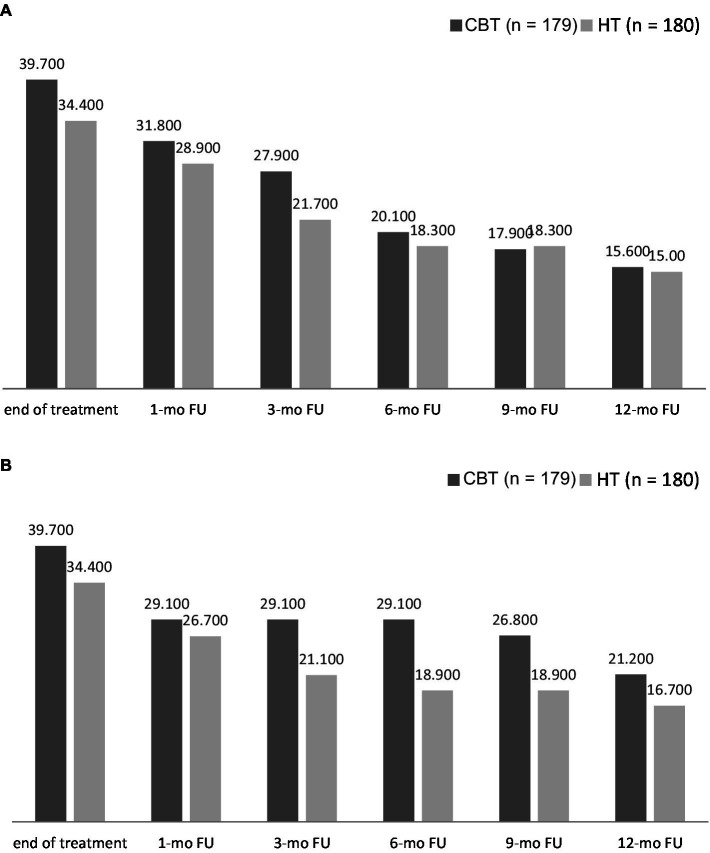
In the context of UK smoking cessation, CBT is the framework underpinning NHS Stop Smoking Services. The structured 6–12 week programme provided through these services is evidence-based and free. A 2024 randomised controlled trial published in Frontiers in Psychology compared hypnotherapy directly against CBT across 360 participants over 12 months, finding a continuous abstinence rate of 15.6% for CBT — virtually identical to hypnotherapy’s 15.0% in the same trial. Neither result was statistically significantly different from the other.
CBT is also the framework that underpins the most evidence-based quit-smoking apps, including the mission-based structure in Smoke Free and the coaching approach in iQuit. This means the principles of CBT are increasingly accessible without the cost of private therapy or the waiting time for NHS services.
Hypnotherapy: Promising but Unproven
Hypnotherapy for smoking cessation involves inducing a deeply relaxed, receptive trance state in which a therapist makes targeted suggestions designed to alter the smoker’s relationship with cigarettes — typically reinforcing disgust, reducing the perceived benefits, or strengthening the identity of being a non-smoker. Proponents report high satisfaction and dramatic immediate results. Some people do quit immediately after a single session and maintain that abstinence long-term.
The honest clinical picture, however, is more uncertain. The Cochrane Tobacco Addiction Group’s systematic review on hypnotherapy concluded that the studies conducted “have failed to demonstrate that hypnotherapy produces greater six-month quit rates than other interventions or no intervention.” This is not the same as saying hypnotherapy doesn’t work — it means the existing evidence base is insufficient to confirm or rule out an effect beyond comparison groups.
The most recent high-quality data comes from a 2024 RCT (Batra et al.) published in Frontiers in Psychology that directly compared hypnotherapy against CBT in 360 participants with a 12-month follow-up. The researchers found comparable continuous abstinence rates — 15.0% for hypnotherapy versus 15.6% for CBT — with no statistically significant difference. The conclusion was that the efficacy of hypnotherapy appears comparable to established programmes such as CBT, making it a viable alternative for smokers who are resistant to or unable to access CBT. This is an encouraging finding, but the trial is a single study, and the Cochrane review pre-dates it.
The private cost of hypnotherapy (typically £75–150 per session, with 3–5 sessions recommended) is a meaningful practical barrier compared to free NHS CBT support.
Allen Carr: Popular, Limited Evidence
Allen Carr’s Easyway method has sold tens of millions of books and is probably the most widely self-reported quit-smoking approach in the English-speaking world. Its premise is distinctive: rather than treating quitting as giving something up, Carr’s method reframes smoking itself as something smokers are being liberated from. It explicitly rejects willpower as the mechanism and instead aims to eliminate the psychological desire to smoke by dismantling the beliefs that maintain it.
Allen Carr himself stopped smoking in 1983 after a visit to a hypnotherapist — though he attributed his own quit to the insight he had during the session, not to the hypnotic suggestion itself. The method he subsequently developed does not use hypnosis, despite frequent confusion on this point.
The clinical evidence is the key limitation. As a quasi-experimental study published in PMC noted, very limited evidence is available regarding Allen Carr’s effectiveness. The one published study testing it in a workplace setting reported quit rates among participants, but the study design (non-randomised, self-selected participants motivated enough to attend a company-sponsored seminar) limits what conclusions can be drawn about population-level effectiveness. There is no completed RCT with independently verified abstinence rates.
This is not necessarily an indictment — it reflects that the method has grown commercially far faster than rigorous research has followed it. Many people who quit via Allen Carr report that no other method had worked for them. The experience of the method is qualitatively distinctive and may suit smokers who identify strongly with the “psychological trap” framing of addiction.
Head-to-Head: What the Cochrane Reviews Say
The landmark 2023 Cochrane analysis of over 150,000 smokers establishes clearly that pharmacological interventions — varenicline, cytisine, and nicotine e-cigarettes — have the strongest evidence for cessation. Behavioural support (which includes CBT-based programmes) significantly enhances pharmacological outcomes but produces more modest results in isolation.
Specifically for psychological methods in isolation:
- CBT/behavioural support: Well-established benefit; forms the basis of NHS stop smoking services and is the standard against which other interventions are compared.
- Hypnotherapy: Cochrane concludes cannot be said definitively to outperform other approaches; the 2024 RCT showing equivalence to CBT is promising but does not overturn the overall inconclusive picture.
- Allen Carr method: No systematic Cochrane review; extremely limited trial evidence; popular but unverified at population level.
Which Method Suits Which Person
| If you… | Consider… |
|---|---|
| Want the strongest evidence and lowest cost | CBT via NHS Stop Smoking Services (free) |
| Have tried CBT-based approaches and want an alternative | Clinical hypnotherapy (comparable outcomes in 2024 RCT) |
| Identify strongly with the “I’m trapped” feeling about smoking | Allen Carr book (low cost; no evidence guarantee) |
| Need daily structured support between sessions | Any of the above plus iQuit for between-session AI support |
Combining Psychological Methods with Medication and Apps
All three psychological methods work best as part of a broader quit strategy rather than in isolation. The evidence base consistently shows that combining behavioural support with pharmacological intervention (NRT, varenicline, or cytisine) outperforms either approach alone. Psychological methods address the habitual, emotional, and cognitive dimensions of smoking; medication addresses the physiological nicotine dependence. Both need tackling for the highest chance of lasting quit success.
A quit-smoking app fills the critical gap between therapy sessions — providing the always-on, 24/7 support layer that weekly CBT, hypnotherapy, or a completed Allen Carr seminar cannot. iQuit’s AI coach can reinforce CBT principles in the moment a craving strikes, making it a natural complement to any of the three psychological approaches described here. See how an AI quit-smoking coach works and how it fits into a complete quit plan.
For a full comparison of all available methods and their success rates, see quit smoking success rates by method: 60+ statistics. For practical step-by-step guidance on combining these approaches, see how to quit smoking: the step-by-step plan that actually works.
FAQ
Does hypnotherapy work for quitting smoking?
The evidence is inconclusive. The Cochrane Tobacco Addiction Group found that clinical studies have not demonstrated that hypnotherapy produces greater six-month quit rates than other interventions or no intervention. However, a 2024 RCT comparing hypnotherapy directly against CBT found virtually identical 12-month abstinence rates (15.0% vs 15.6%), leading the researchers to conclude hypnotherapy is a viable alternative for smokers who prefer it or cannot access CBT. For most smokers, combining any psychological approach with pharmacological support (NRT, varenicline) and a quit app gives the best overall results.
Does the Allen Carr method really work?
Many people report quitting successfully using Allen Carr’s Easyway method, and it has been commercially enormously successful. However, published clinical evidence is very limited — there is no completed RCT with independently verified abstinence rates. A single quasi-experimental workplace study reported quit rates but used a self-selected, motivated participant group. The method may genuinely suit smokers who identify with its “psychological trap” framing, but it cannot be clinically recommended over evidence-based options like CBT or NRT on current published data.
Is CBT available free on the NHS for quitting smoking?
Yes. NHS Stop Smoking Services provide a structured behavioural support programme based on CBT principles, free of charge, alongside pharmacological support (NRT, varenicline, cytisine). Self-refer via the NHS Better Health: Quit Smoking website or speak to your GP or pharmacist. The combination of CBT-based counselling and medication produces significantly better quit rates than either alone.
Which is better for quitting smoking — CBT or hypnotherapy?
The most recent high-quality evidence (a 2024 RCT with 360 participants) found no statistically significant difference between CBT and hypnotherapy in 12-month abstinence rates (15.6% vs 15.0%). CBT has a much stronger overall evidence base and is available free via the NHS; hypnotherapy is private and costly. For most people, CBT is the better starting point. Hypnotherapy is a reasonable alternative for those who have tried CBT or strongly prefer it.
Should I combine psychological methods with a quit-smoking app?
Yes. CBT sessions, hypnotherapy, or an Allen Carr seminar provide weekly or one-off input; a quit-smoking app provides daily, 24/7 support in the specific moments cravings arise. iQuit’s AI coach reinforces the principles from any psychological quit method in real time, helping you apply what you have learned when you need it most — not just in a therapy room.
Reinforce your quit method every day
Whether you choose CBT, hypnotherapy, Allen Carr, or all three, iQuit gives you the always-on AI support layer to apply what you have learned the moment a craving hits. Free to download.