
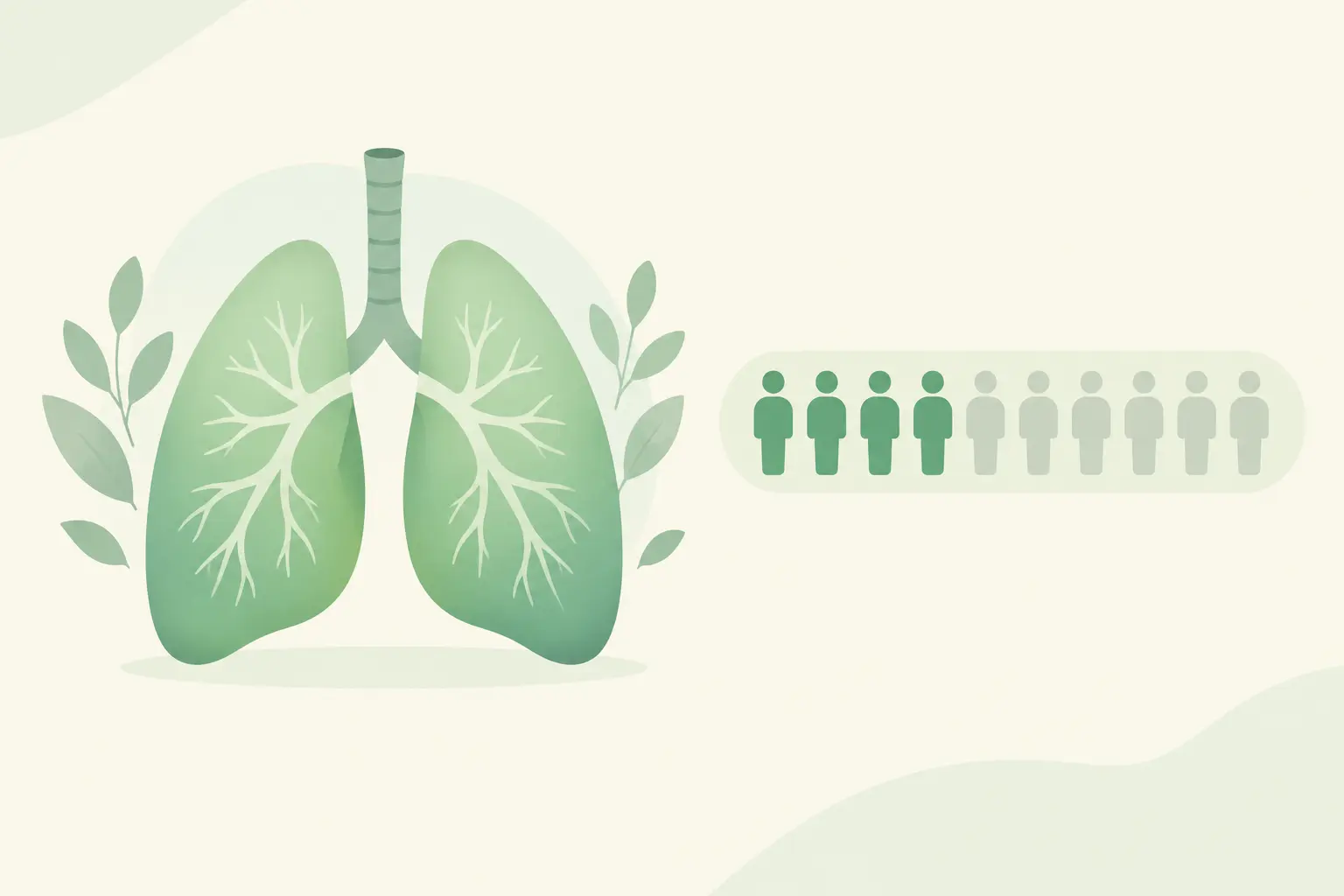
If you are asking what percentage of smokers get lung cancer, the honest answer is that most do not, but the risk is many times higher than for people who never smoked. One often-cited Canadian life-table study put the lifetime figure at about 17% for male current smokers and about 12% for female current smokers, against about 1% for people who never smoked. This guide sets those figures beside UK and US data, explains why different studies give different numbers and shows how much of the risk falls away if you quit.
What percentage of smokers get lung cancer? Most do not, but the risk is many times higher
Lifetime risk is the chance that a person develops a disease at some point between now and the end of a normal life. For lung cancer in current smokers, the best-known published estimates sit in the range of roughly one in six for men and one in nine for women. The study behind those numbers used life-table methods on Canadian rates observed from 1987 to 1989, and it is old, so other cohorts and later decades give different figures.
Two things are true at once. Most smokers will not be diagnosed with lung cancer. And a risk of about 12% to 17% is large, many times the 1% or so seen in people who never smoked. The same smoker also carries risks of COPD, heart disease and stroke that this page does not add up. For the population-level counts, see our companion piece on lung cancer statistics; this page answers the narrower question of what the odds are for a smoker.
Lifetime lung cancer risk by smoking status
The study by Villeneuve and Mao (Canadian Journal of Public Health, 1994) estimated lifetime risk for six hypothetical groups. Its abstract reports these figures per 1,000 people (see the PubMed abstract):
| Group | Per 1,000 people | Share | Compared with never-smokers (our arithmetic) |
|---|---|---|---|
| Male current smokers | 172 | 17.2% | about 13 times |
| Female current smokers | 116 | 11.6% | about 8 times |
| Male never-smokers | 13 | 1.3% | baseline |
| Female never-smokers | 14 | 1.4% | baseline |
| All men, smoking status not adjusted | 96 | 9.6% | n/a |
| All women, smoking status not adjusted | 43 | 4.3% | n/a |
Read the table with three cautions. It describes Canada in the late 1980s, a different smoking era from today. It projects a lifetime from observed rates in hypothetical cohorts rather than following real people to the end of their lives. And it is one study: other countries and decades report other figures, which is why the numbers here are a range, not a forecast.
For a US benchmark that includes people who do not smoke, the American Cancer Society’s key statistics page says the chance a person will develop lung cancer in their lifetime is about 1 in 19, and that this figure includes both people who smoke and those who do not. For people who smoke, it adds, the risk is much higher.
The other direction: what share of lung cancers are caused by smoking
Do not confuse the two questions. “What share of smokers get lung cancer?” is about risk per smoker. “What share of lung cancers happen in smokers?” is about where the cases come from. They have different answers because they divide by different groups: the first by all smokers, the second by all people with lung cancer.
- United States: the American Cancer Society says about 80% of lung cancer deaths are thought to result from smoking, and probably more for small cell lung cancer (see the ACS lung cancer risk factors page).
- United Kingdom: Cancer Research UK reports that 72% of lung cancer cases are caused by smoking (71% by active smoking and 1% by secondhand smoke) and that an estimated 86% of lung cancer deaths are caused by tobacco smoking (page last reviewed 15 June 2018, see Cancer Research UK lung cancer risk factors).
The remainder are not nothing. The ACS notes that radon is the second-leading cause of lung cancer in the United States and the leading cause among people who do not smoke, citing the EPA. Having no smoking history lowers the odds a great deal but does not remove them.

Relative risk: how many times higher than a never-smoker
Relative risk compares death rates between smokers and never-smokers. A 2013 paper in the New England Journal of Medicine (Thun and colleagues, “50-year trends in smoking-related mortality in the United States”) compared three eras. The relative risk of death from lung cancer for current smokers versus never-smokers was:
| Cohort period | Men | Women |
|---|---|---|
| 1959 to 1965 | 12.22 | 2.73 |
| 1982 to 1988 | 23.81 | 12.65 |
| 2000 to 2010 | 24.97 | 25.66 |
The abstract notes that disease risks from smoking rose over most of the 20th century, first among male smokers and later among female smokers, which is why the female figure starts so low and ends level with the male figure. In the contemporary cohorts, the same study found relative risks of 25.61 (men) and 22.35 (women) for death from COPD, and about 2.5 to 2.9 for ischemic heart disease. The abstract also states that smoking cessation at any age dramatically reduced death rates (N Engl J Med, 2013).
Cancer Research UK summarizes UK evidence on how the dose changes the odds, compared with people who have never smoked: around 5 times higher for 1 to 4 cigarettes a day, around 12 times for 8 to 12 a day, at least 24 times for 25 or more a day and 39 times for 42 or more. Those come from different cohorts, some including only women or middle-aged people, so use them for the pattern rather than as exact thresholds.
Pack-years: why how long you smoked matters most
A pack-year is the number of packs you smoked per day multiplied by the number of years. It is the unit doctors use for screening decisions, and our pack-year calculator guide shows how to work yours out.
Cancer Research UK reports that risk rises with both duration and amount, but that duration has the most effect: smoking one pack of cigarettes a day for 40 years is more hazardous than smoking two packs a day for 20 years, even though both add up to 40 pack-years. Starting young also raises the risk. In one cohort study of women the lung cancer death risk was 37% higher for every five years younger at smoking initiation. The practical meaning is that every year you stop adding is a year of the strongest risk factor removed.
How much quitting lowers the risk
Cancer Research UK, summarizing cohort studies, states that giving up smoking in middle age avoids most of the subsequent risk of lung cancer. It gives the cumulative risk of dying from lung cancer by age 75 for people who quit at different ages (page last reviewed 18 April 2019):
| Smoking history | Men | Women |
|---|---|---|
| Smoked all their lives | 15.9% | 9.5% |
| Stopped by age 60 | 9.9% | 5.3% |
| Stopped by age 50 | 6% | 2.2% |
| Stopped by age 40 | 3% | not reported |
| Stopped by age 30 | 1.7% | not reported |
A separate meta-analysis cited on the same page found that the risk in people who quit around 7 years earlier is 43% lower than in current smokers, and around 12 years after quitting it is 72% lower. Cutting down is a weaker route: lung cancer risk was similar in heavy smokers (around 16 to 18 cigarettes a day) who halved their intake and those who continued to smoke heavily. For the full timeline, see how lung cancer risk drops after quitting.
Screening if you smoke or used to smoke
The US Preventive Services Task Force recommends annual lung cancer screening with low-dose CT in adults aged 50 to 80 years who have a 20 pack-year smoking history and currently smoke or have quit within the past 15 years. Screening should stop once a person has not smoked for 15 years or develops a health problem that substantially limits life expectancy or the ability or willingness to have curative lung surgery (see the USPSTF recommendation). Rules differ in other countries, so ask your doctor what applies to you. Our guide to lung cancer screening eligibility walks through the US criteria for former smokers.
This short video from a US health system explains who should consider screening and what to expect.
Beyond lung cancer: other cancers and COPD
Lung cancer is only one of the outcomes. The Thun study above found that current smokers had about 25 times the COPD death risk of never-smokers and roughly 2.5 to 2.9 times the heart disease death risk. Smoking also causes cancers at other sites. The Thun abstract’s conclusion for these outcomes points the same way: smoking cessation at any age dramatically reduced death rates. If the numbers push you toward quitting, our guide to quit success rates by method shows what the evidence says works.

Putting the numbers to use with iQuit
Risk figures are only useful if they change what you do next. iQuit is free on Google Play and the App Store and includes a health-recovery timeline and disease-risk insights for 11 conditions, alongside craving tools, an AI coach and a mood journal. These are educational features, not a diagnosis, and they do not calculate your personal lung cancer odds. For that, talk to your doctor.
Frequently Asked Questions
What percentage of smokers get lung cancer?
One Canadian life-table study estimated that 172 in 1,000 male current smokers (17.2%) and 116 in 1,000 female current smokers (11.6%) would develop lung cancer in their lifetime, versus about 1.3 to 1.4% of never-smokers (Villeneuve and Mao, 1994).
Do most smokers get lung cancer?
No. Even in the highest published estimates, most smokers are not diagnosed with lung cancer. But the risk is roughly 8 to 13 times that of never-smokers in that study, and smokers also face COPD and heart disease (Villeneuve and Mao, 1994; Thun et al., 2013).
What percentage of lung cancers are caused by smoking?
The American Cancer Society says about 80% of US lung cancer deaths are thought to result from smoking. Cancer Research UK reports 72% of UK cases and an estimated 86% of UK lung cancer deaths are caused by smoking (ACS; Cancer Research UK).
How many cigarettes a day raise lung cancer risk?
Risk rises with amount, but duration matters most. Cancer Research UK cites around 5 times higher risk at 1 to 4 cigarettes a day and at least 24 times at 25 or more, versus never-smokers (cohort studies summarized by Cancer Research UK).
Does quitting lower the risk of lung cancer?
Yes. Cancer Research UK reports that quitting in middle age avoids most of the later risk: 15.9% of men who smoked all their lives die of lung cancer by 75, versus 9.9% who stopped by 60 and 1.7% who stopped by 30 (Cancer Research UK).
Who should be screened for lung cancer in the US?
The USPSTF recommends annual low-dose CT screening for adults aged 50 to 80 with a 20 pack-year history who currently smoke or quit within the past 15 years (USPSTF lung cancer screening recommendation).
Can non-smokers get lung cancer?
Yes. The American Cancer Society says radon is the leading cause of lung cancer among people who do not smoke, and secondhand smoke also raises risk. Never-smokers had a lifetime risk of about 1.3 to 1.4% in the Canadian study (ACS; Villeneuve and Mao, 1994).
Use the numbers to start your quit plan
Turn the numbers into a quit plan
iQuit is free on Google Play and the App Store. It pairs a health-recovery timeline and disease-risk insights for 11 conditions with craving tools, a mood journal and an AI coach. It is a support tool, not medical advice or a diagnosis.
Download iQuit Free on Google Play
Download on the App Store


