
Lung cancer kills more Americans than any other cancer, and cigarette smoking is behind the great majority of those deaths. If you searched for lung cancer statistics 2026, here is the direct, sourced answer: how many people are diagnosed, how many die, how survival breaks down by stage, and exactly how much of it traces back to smoking.
Key figures at a glance
| Measure | Figure | Data year / region |
|---|---|---|
| New cases | 229,410 | 2026 estimate, US (SEER/ACS) |
| Deaths | 124,990 | 2026 estimate, US (SEER/ACS) |
| 5-year relative survival, all stages | 29.5% | SEER 2015-2021 diagnoses |
| Attributable to smoking | ~9 in 10 deaths (US) | CDC |
| Global new cases | 2.6 million | 2024, WHO/GLOBOCAN |
| Global deaths | 1.86 million | 2024, WHO/GLOBOCAN |
| UK new cases | 50,218 | 2019 registrations (Cancer Research UK) |
| UK deaths | 32,800 | 2022-2024, UK |
New cases and deaths per year
In the United States, the American Cancer Society’s 2026 estimate — built from Surveillance, Epidemiology, and End Results (SEER) registry data and modeled forward by the National Cancer Institute — puts new lung cancer cases at 229,410 (110,910 in men, 118,500 in women) and deaths at 124,990 (63,040 in men, 61,950 in women). Lung cancer is the leading cause of cancer death in the US, responsible for about 1 in 5 of all cancer deaths, and it kills more people each year than colon, breast, and prostate cancers combined — part of the wider picture covered in our guide to how many people die from smoking each year. Most people diagnosed are 65 or older; the average age at diagnosis is about 70.
Globally, the picture is similarly stark. The World Health Organization’s most recent worldwide cancer data, for 2024, records lung cancer as the most commonly diagnosed cancer causing death: an estimated 2.6 million new cases and 1.86 million deaths, more than colorectal, liver, breast, or stomach cancer.
In the United Kingdom, Cancer Research UK’s statistics hub reports around 50,218 new lung cancer cases a year (based on 2019 UK-wide registrations, the latest full dataset it has compiled) and roughly 32,800 deaths a year, using data from 2022 to 2024. Lung cancer remains the UK’s leading cause of cancer death, even though it is not the most commonly diagnosed cancer there.
How much is attributable to smoking
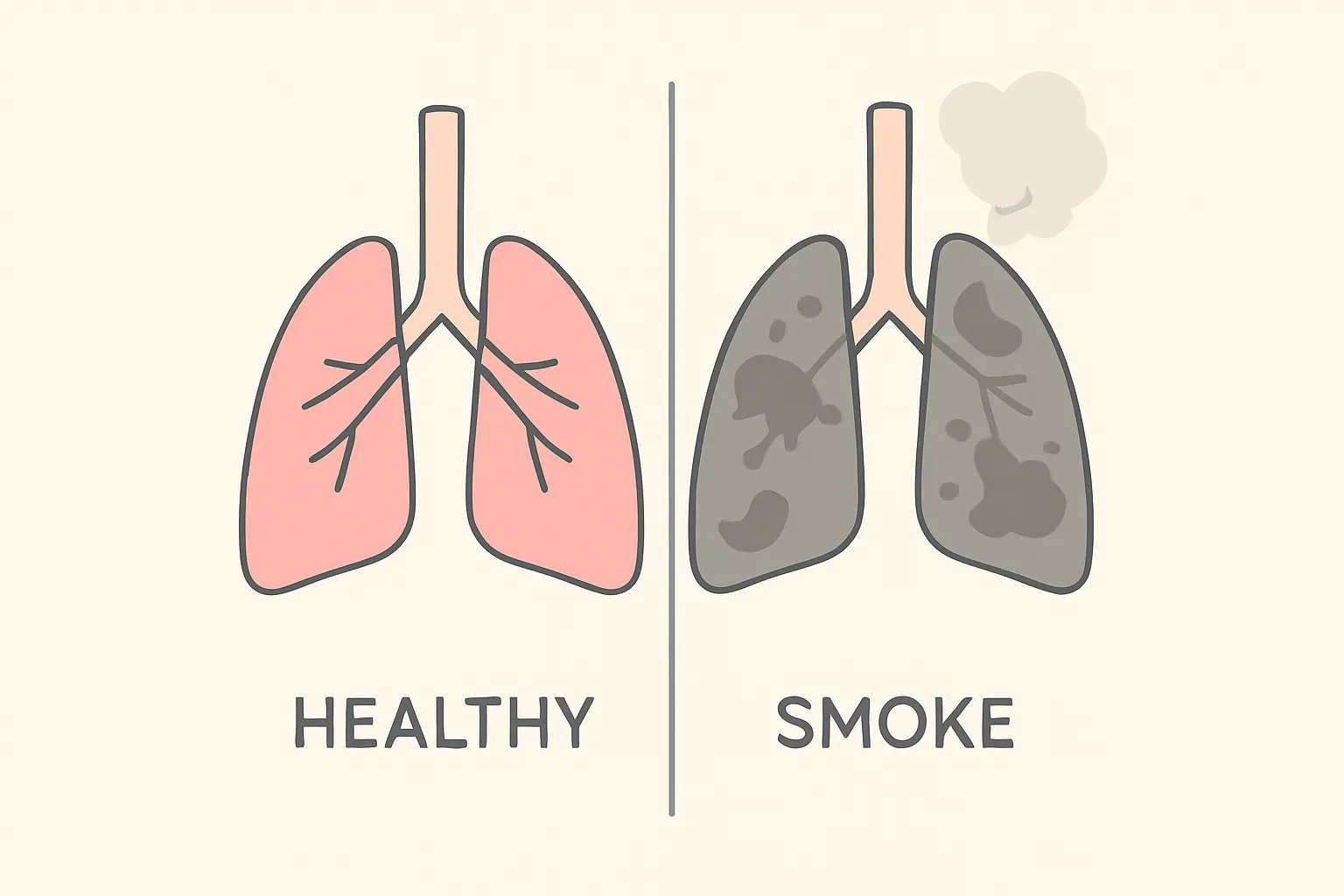
Cigarette smoking is by far the dominant cause. The Centers for Disease Control and Prevention states that cigarette smoking or secondhand smoke exposure causes nearly 9 out of 10 lung cancer deaths in the US, and that people who smoke are about 25 times more likely to develop lung cancer than people who never smoke — lung cancer is just one entry in a longer list covered in our guide to what cancers does smoking cause. Smoking is also linked to roughly 1 in 3 of all US cancer deaths, not just lung cancer. Older CDC mortality data, drawn from the landmark Surgeon General reports, found that men who smoke are more than 23 times as likely, and women who smoke more than 12 times as likely, to die from cancer of the trachea, lung, and bronchus compared with people who never smoked. Secondhand smoke exposure alone is estimated to cause around 7,333 US lung cancer deaths a year among nonsmokers.
In the UK, Cancer Research UK estimates that 79% of lung cancer cases are preventable, based on a 2015 analysis of known risk factors — the large majority of that preventable share is smoking. That figure has not been recalculated more recently at a UK-wide level, so treat it as an estimate for that data year rather than a current one.
Put another way: of the roughly 229,000 US cases and 125,000 US deaths projected for 2026, the large majority trace back to a single modifiable behavior. That is different from cancers with no clear dominant cause, where prevention advice is necessarily vaguer. It is also why lung cancer statistics, more than most cancer statistics, double as smoking statistics.
Survival by stage
Survival depends heavily on how early lung cancer is caught, and most cases are found late. SEER data show 5-year relative survival of 65.5% for cancer still confined to the lung (localized, 24% of cases), dropping to 38.2% once it has spread to nearby lymph nodes (regional, 21% of cases), and to just 10.5% once it has spread to distant organs (metastatic, 51% of cases — the single largest group). Combined across all stages, 5-year relative survival in the US is 29.5%.
The UK tells a similar story with a longer follow-up window: only 11.1% of people diagnosed with lung cancer in 2018 survived 10 or more years. Cancer Research UK also reports that in 2022, only 34% of English lung cancer cases with a known stage were caught early (stage I or II), and that of cases diagnosed in England in 2019, around 1 in 3 (33%) were diagnosed only after an emergency presentation and a further 1 in 4 (26%) via an urgent suspected-cancer referral — together, a majority of cases reach diagnosis only once symptoms are already advanced.
| Stage | Share of cases | 5-year survival |
|---|---|---|
| Localized | 24% | 65.5% |
| Regional | 21% | 38.2% |
| Distant | 51% | 10.5% |
| Unstaged | 4% | 17.5% |
Trends over the last decade
The trend line is genuinely encouraging, and it runs in step with falling smoking rates. SEER data show US lung cancer incidence falling by an average of 1.9% a year between 2014 and 2023, while the age-adjusted death rate fell faster still, by an average of 4.1% a year between 2015 and 2024 — a gap that reflects real gains in earlier detection and treatment, not just fewer new cases. The American Cancer Society attributes the decline in both new cases and deaths partly to fewer people smoking (or never starting) and partly to advances in screening and treatment. This mirrors the broader picture in our smoking cessation statistics 2026 roundup, which tracks quitting rates alongside these disease outcomes.
This short CDC video explains why cancer risk starts falling as soon as you stop smoking.
Lung cancer in people who never smoked
Smoking is the dominant cause, but it is not the only one. A meaningful minority of lung cancer cases occur in people who have never smoked, linked instead to radon exposure, secondhand smoke, air pollution, occupational carcinogens (such as asbestos), and genetic factors. Because the SEER lifetime-risk figure of about 1 in 19 for developing lung cancer covers the whole population — people who smoke and people who never have — individual risk varies enormously depending on smoking history: it is much higher for people who smoke and lower for people who have never smoked.
This is also why “lung cancer” is not one disease with one cause. The same organ, and often the same broad category of tumor, can arise from decades of cigarette exposure in one patient and from radon or genetic susceptibility in another with no smoking history at all. Researchers still track these as separate populations precisely because their risk profiles, average age at diagnosis, and even typical tumor genetics can differ.
How risk falls after quitting
Population-level trends make the direction of travel clear: as US smoking rates have fallen, so have lung cancer incidence and death rates, and the American Cancer Society explicitly credits quitting (alongside not starting) as one of the drivers. Our smoking disease risk overview covers how risk for lung cancer and 10 other conditions shifts once you quit. For the detailed year-by-year timeline of how an individual’s own lung cancer risk changes after their last cigarette, see our full guide to lung cancer risk after quitting smoking, which covers when risk starts to drop and by how much over time.
Screening eligibility
Low-dose CT screening exists specifically to catch lung cancer earlier in people with a long smoking history, which is part of why the “diagnosed early” share in the UK data above is still a minority. Eligibility criteria (age range and pack-year smoking history) are specific enough that they deserve their own explainer rather than a summary here.

Methodology and sources
US figures come from the National Cancer Institute’s SEER program statistics for lung and bronchus cancer and the American Cancer Society’s 2026 Cancer Facts & Figures estimate, both of which model forward from the most recent complete registry years rather than reporting a literal same-year count. Global figures come from the World Health Organization’s cancer fact sheet using 2024 data (drawing on the IARC GLOBOCAN estimates). UK figures come from Cancer Research UK’s cancer statistics hub, which compiles data from UK cancer registries with data years ranging from 2018 to 2024 depending on the measure. Every figure above is labeled with its actual data year because no registry publishes a true real-time 2026 count — even the “2026” US estimate is a projection published in advance of the year, not a completed count.
Frequently Asked Questions
How many people get lung cancer each year?
In the US, the American Cancer Society estimates 229,410 new lung cancer cases for 2026. Worldwide, the World Health Organization recorded about 2.6 million new cases in 2024, the most recent year with complete global data (cancer.org, who.int).
How many people die of lung cancer each year?
The American Cancer Society estimates 124,990 US lung cancer deaths for 2026. Globally, the WHO recorded about 1.86 million lung cancer deaths in 2024, more than any other cancer type (cancer.org, who.int).
What percentage of lung cancer is caused by smoking?
The CDC states that cigarette smoking or secondhand smoke exposure causes nearly 9 in 10 US lung cancer deaths, and that smokers are about 25 times more likely to develop lung cancer than people who never smoke. In the UK, Cancer Research UK estimates 79% of cases are preventable, mostly through not smoking (cdc.gov via CDC video content, cancerresearchuk.org).
What is the survival rate for lung cancer?
US 5-year relative survival across all stages is 29.5%, but it ranges from 65.5% for cancer caught while still localized to 10.5% once it has spread to distant organs. In the UK, 11.1% of people diagnosed in 2018 survived 10 or more years (seer.cancer.gov, cancerresearchuk.org).
Is lung cancer becoming more or less common?
Less common. US incidence has fallen an average of 1.9% a year from 2014 to 2023, and the death rate has fallen faster, an average of 4.1% a year from 2015 to 2024, a trend SEER and the American Cancer Society link partly to declining smoking rates (seer.cancer.gov, cancer.org).
Can nonsmokers get lung cancer?
Yes. A minority of lung cancer cases occur in people who have never smoked, linked to radon, secondhand smoke, air pollution, occupational exposures, and genetic factors, though smoking remains the dominant driver of overall rates (cdc.gov, cancer.org).
Does quitting smoking lower lung cancer risk?
Population data support this: as smoking rates have declined, so have lung cancer incidence and mortality. For the detailed timeline of how individual risk changes year by year after quitting, see our dedicated guide on lung cancer risk after quitting (cancer.org; see linked guide for the full timeline).
Why is a “2026” lung cancer statistic based on older data?
Cancer registries take years to collect and verify complete case and death data. The American Cancer Society’s 2026 figures are a projection modeled from the latest complete SEER registry years, published in advance of the year rather than a same-year count (seer.cancer.gov, cancer.org).
Every cigarette you don’t smoke is a step away from these numbers
iQuit tracks your smoke-free days, cigarettes avoided, and money saved, and shows you disease-risk insights across 11 conditions — as information, not diagnosis — to help you see your own progress. Free on Google Play and the App Store.
Download iQuit Free on Google Play
Download on the App Store