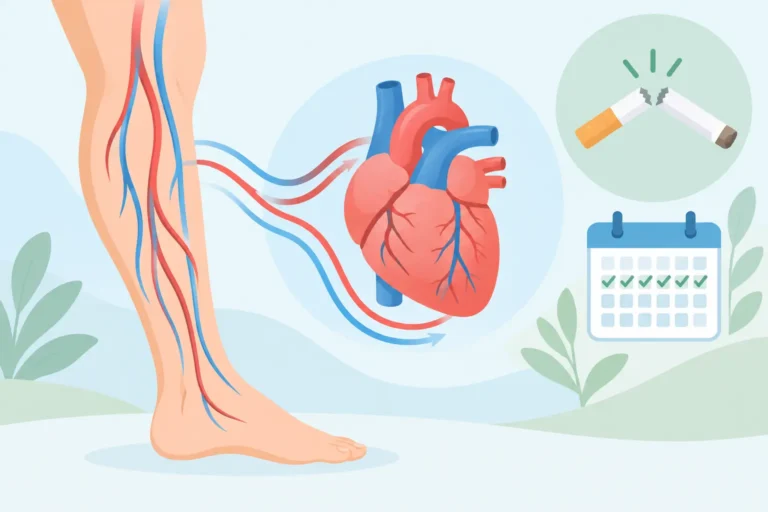

If you smoke, the honest question is not “is this bad for me” — you already know that. The real question is how much your specific risk drops if you quit today, and for which conditions. A smoking disease risk calculator answers that by combining how much you smoke, how long you have smoked, and how you smoke it into a personal estimate across the conditions smoking is proven to cause, then showing how each one falls once you stop.
What a Smoking Disease Risk Calculator Actually Does
A disease risk calculator does not diagnose anything. It takes population-level data — the kind published by the CDC, the U.S. Surgeon General, and peer-reviewed cohort studies — and applies it to your personal smoking history to produce a directional estimate. Feed it your daily cigarette count, the years you have smoked, your age, and (increasingly) your time-to-first-cigarette, and it returns something closer to “your added risk is elevated for these specific conditions, and here is roughly how much of that is reversible” than a single scary number.
The most useful versions do two things most quit-smoking content skips: they name the specific diseases, not just “cancer” and “heart disease” in the abstract, and they show the same numbers running backward from a quit date — because for a smoker deciding whether to act, “your risk falls this much if you quit today” is a far more useful frame than a static warning.
The 11 Conditions Smoking Raises Your Risk For
The U.S. Surgeon General’s reports have causally linked cigarette smoking to more than a dozen cancers plus a long list of cardiovascular, respiratory, metabolic, and reproductive conditions, summarized in the CDC’s overview of smoking and health. The 11 below are the ones with the strongest, most quotable dose-response and cessation data — the set most personal risk tools, including iQuit’s disease-risk insights, are built around.
| Condition | Smoking’s role | Primary source |
|---|---|---|
| Lung cancer | Linked to about 80% of lung cancer deaths in the U.S. | CDC |
| COPD (chronic bronchitis & emphysema) | The leading cause; the Surgeon General attributes roughly 85–90% of cases to current or former smoking | Surgeon General, 2014 |
| Coronary heart disease | Smoking causes one of every four deaths from cardiovascular disease | CDC |
| Stroke | A major cause; added risk starts falling 5–10 years after quitting | CDC |
| Peripheral artery disease | One of the strongest modifiable risk factors for PAD | CDC |
| Oral, throat & laryngeal cancer | Causally linked; added risk halves 5–10 years after quitting | CDC Benefits of Quitting |
| Bladder cancer | Causally linked; risk declines within about 10 years of quitting | CDC Benefits of Quitting |
| Esophageal cancer | Causally linked, dose-dependent on pack-years | Surgeon General |
| Pancreatic cancer | Causally linked; risk nears non-smoker levels about 20 years after quitting | CDC Benefits of Quitting |
| Type 2 diabetes | People who smoke are 30–40% more likely to develop type 2 diabetes | CDC |
| Erectile dysfunction | Impairs penile blood flow; rates of ED are higher among smokers | Surgeon General / clinical reviews |
Several of these already have their own deep-dive on iQuit Now — for the population-level cancer data behind the table above, see our smoking and cancer statistics breakdown, and for how stroke and dementia risk specifically move with smoking, see smoking’s effect on stroke risk and smoking’s link to dementia risk.
How Risk Models Work: Pack-Years, Age, and Dependence
Underneath every credible risk estimate sits a handful of inputs that do most of the work:
- Pack-years — the standard clinical unit of cumulative exposure. The formula is (cigarettes per day ÷ 20) × years smoked. One pack-year equals a pack a day for a year. It is the single number doctors use most, and it is directly tied to real thresholds: the U.S. Preventive Services Task Force sets lung cancer screening eligibility at 20 pack-years or more for adults 50–80 who currently smoke or quit within the past 15 years.
- Age — the same pack-year total carries more absolute risk the older you are, because cumulative cellular damage compounds with time.
- Time-to-first-cigarette — how soon after waking you smoke your first cigarette is a single-question dependence marker that predicts both how much nicotine you actually absorb and your odds of certain diseases, independent of how many cigarettes you smoke per day. Read more on why time-to-first-cigarette matters for a full breakdown of the data.
- Years quit — the input that turns a static risk score into a moving one. Every condition on the list above has its own “half-life” for added risk once you stop, which is the part a good calculator shows you rather than burying.
A Worked Example: 45 Years Old, 20 a Day
Take a reader who started at 18 and has smoked a pack a day (20 cigarettes) ever since. At 45, that is 27 years of smoking.
| Input | Value |
|---|---|
| Cigarettes per day | 20 (1 pack) |
| Years smoked | 27 |
| Pack-years (20 ÷ 20 × 27) | 27 pack-years |
| USPSTF lung screening threshold | 20 pack-years |
| Result | Already eligible for annual low-dose CT lung cancer screening |
That 27 pack-year total places this reader well above the screening threshold — a concrete, actionable number, not an abstract warning. It also means they are a strong candidate to talk to a doctor about screening regardless of whether or when they quit. But the number that matters for motivation is the second one: what happens to that risk starting today.
Why “Your Risk if You Quit Today” Beats “Your Risk if You Keep Smoking”
Most public health messaging is framed as a threat: keep smoking, and here is what happens to you. That framing is accurate, but it is also passive — it describes a future the reader is not actively choosing, and passive fear rarely sustains behavior change for more than a few days. A “risk if you quit today” projection reframes the same data as an outcome the reader controls starting with their next decision, which is a meaningfully different psychological trigger — it turns a diagnosis into a plan.
This is also simply more honest about what the data shows: for nearly every condition on the list above, risk does not stay flat once you quit — it starts falling, often within months, and the calculator’s job is to show that curve rather than a single frozen number.
How Fast Each Condition’s Added Risk Falls After You Quit
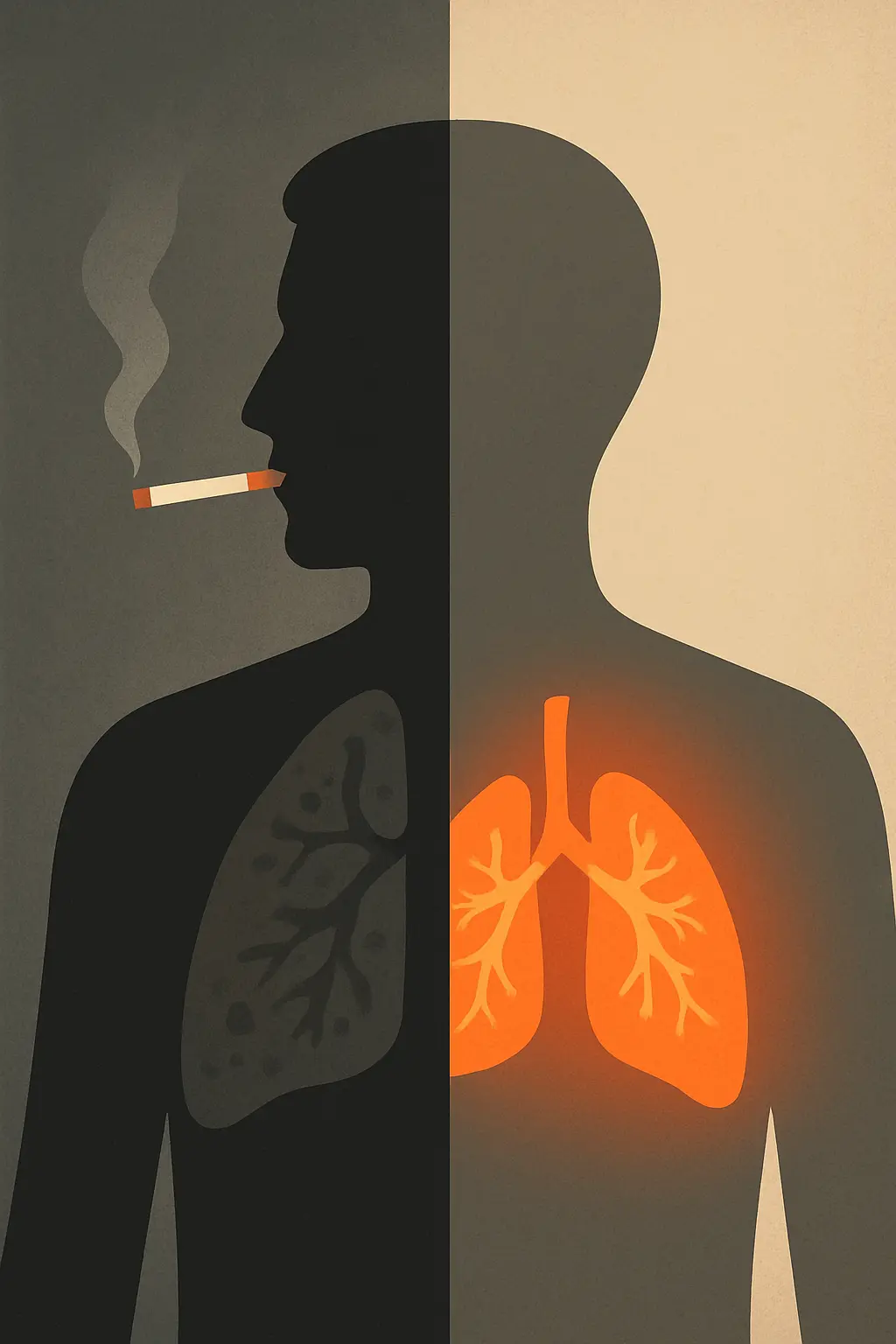
Here is the CDC’s documented timeline for how added risk declines by condition once you stop smoking, translated into a table.
| Time smoke-free | What changes |
|---|---|
| Minutes | Heart rate drops toward normal |
| 24 hours | Blood nicotine level drops to zero |
| 1–12 months | Coughing and shortness of breath decrease as lung function begins recovering |
| 1–2 years | Heart attack risk drops sharply |
| 3–6 years | Added coronary heart disease risk drops by half |
| 5–10 years | Added oral, throat, and voice box cancer risk drops by half; stroke risk decreases |
| 10–15 years | Added lung cancer risk drops by half; bladder, esophageal, and kidney cancer risk decrease |
| 15 years | Coronary heart disease risk drops to close to that of someone who does not smoke |
| 20 years | Risk of mouth, throat, voice box, and pancreatic cancer drops close to non-smoker levels |
Type 2 diabetes risk follows an unusual curve worth flagging honestly: some cohort studies find a short-term uptick in diabetes risk in the first years after quitting, largely explained by post-quit weight gain, before risk falls back toward never-smoker levels over the following decade. It is a real finding and a good reason to pair quitting with basic activity and eating support rather than a reason not to quit — the cardiovascular and cancer benefits of quitting far outweigh a temporary metabolic wobble.
This NHS animation walks through the same timeline visually if you want to see it end to end.
Seeing your own numbers move is a different kind of motivation than reading someone else’s statistics. iQuit’s disease-risk insights run this same math against your profile and update it automatically as your smoke-free days add up — free on Android, no subscription needed.
The Honest Limits of Any Risk Estimate
A risk calculator is a probability estimate built from population averages, not a personal medical prediction. It cannot account for your family history, other health conditions, environmental exposures, or genetics — factors that can move your individual risk meaningfully in either direction. It also cannot promise you will avoid every condition on the list by quitting, or that you were guaranteed to develop one by continuing. What it can do, credibly, is show you the direction and rough magnitude of the shift, which for most people is a far more useful decision input than either no information or a single undifferentiated warning.
None of this replaces a conversation with a doctor, especially if you are already above the 20 pack-year lung screening threshold or have symptoms. Use a risk calculator to understand the shape of the problem and the shape of the improvement — not as a diagnostic tool.
How iQuit Turns This Into a Daily Insight
iQuit’s free dashboard already tracks the inputs a risk model needs — days smoke-free, cigarettes avoided, and your quit history — and its disease-risk insights feature applies that same “your risk if you quit today” logic across the 11 conditions above, updating as your smoke-free streak grows. It sits alongside the app’s 15 health milestones and money-saved tracker, so the abstract disease-risk number and the concrete “you’ve avoided X cigarettes and saved $Y” number reinforce each other on the same screen.
It is one part of a broader shift in how people quit — see our guide to how digital tools are changing cessation for the wider picture. For context on the life-expectancy side of the same math, this breakdown of years of life regained by quit age is worth reading alongside your disease-risk numbers, and if you want the organ-level version of the recovery timeline rather than the disease-risk version, see what happens in your body organ by organ after you quit.
The feature is free in the core app — no subscription required to see your own numbers. It is available today on Android via Google Play (iOS support is planned but not yet available), rated 4.3 stars.
Frequently Asked Questions
What is a pack-year and how do I calculate mine?
A pack-year equals smoking one pack (20 cigarettes) a day for one year. Calculate it as (cigarettes smoked per day ÷ 20) × years smoked. Someone smoking 10 a day for 20 years has 10 pack-years; someone smoking a pack a day for 20 years has 20 pack-years (source: standard clinical pack-year formula used in oncology and screening guidelines).
How many pack-years qualify you for lung cancer screening?
The U.S. Preventive Services Task Force recommends annual low-dose CT screening for adults aged 50–80 with a 20 pack-year smoking history who currently smoke or quit within the past 15 years — lowered from a previous 30 pack-year threshold to catch more cancers earlier (source: USPSTF, 2021 recommendation).
Does my disease risk really start dropping the same day I quit?
Some changes are near-immediate — heart rate drops within minutes and blood nicotine clears within 24 hours. Disease-specific risk reductions, like heart attack risk dropping sharply, take 1–2 years, and cancer risks take 5–20 years to approach non-smoker levels, but the process starts on day one (source: CDC, Benefits of Quitting).
Which 11 conditions does a smoking risk calculator usually cover?
Typically lung cancer, COPD, coronary heart disease, stroke, peripheral artery disease, oral/throat/laryngeal cancer, bladder cancer, esophageal cancer, pancreatic cancer, type 2 diabetes, and erectile dysfunction — all causally linked to smoking by the U.S. Surgeon General’s reports.
Does quitting smoking increase diabetes risk?
Some studies show a temporary uptick in type 2 diabetes risk in the first years after quitting, mostly linked to weight gain, before risk falls back toward never-smoker levels over the following decade. The underlying comparison still favors quitting: the CDC reports that people who smoke are 30–40% more likely to develop type 2 diabetes than people who do not (source: CDC).
Can erectile dysfunction improve after quitting smoking?
Often, yes. Smoking damages the blood vessels that make an erection possible, and clinical reviews report circulation improvements in the months after quitting, with many men noticing a difference within the first year. Individual results vary, particularly for long-term heavy smokers or where other health conditions also contribute (source: Surgeon General reports on smoking and vascular health).
Is a risk calculator accurate for someone who vapes instead of smokes?
Not directly — the pack-year data behind these models is built on combustible cigarette exposure. Vaping carries its own, still-emerging risk profile that isn’t captured by cigarette pack-years, so a calculator built for smokers shouldn’t be applied to vaping history without adjustment.
Does quitting later in life still lower my disease risk?
Yes, at any age. The CDC is explicit that benefits occur no matter how long or how much you have smoked — quitting at 60 still meaningfully reduces heart disease and cancer risk compared with continuing to smoke, even if it doesn’t fully return risk to never-smoker levels (source: CDC, Benefits of Quitting).
See Your Own Disease-Risk Numbers Today
iQuit’s free disease-risk insights show your personal odds across 11 conditions — and how fast they fall once you quit. Track it alongside your health milestones, money saved, and craving tools in one app.