Smoking and stroke risk statistics 2026 confirm that cigarette use remains one of the strongest modifiable risk factors for stroke: the international INTERSTROKE study, covering 32 countries, found current smokers face a 64% higher risk of any stroke, and a 2025 analysis of 2022 US survey data put smokers at 1.71 times the stroke risk of non-smokers overall — climbing far higher in younger adults and women. The reassuring half of the data: unlike smoking-related cancers, stroke risk falls comparatively fast after quitting.
1. Overall Stroke Risk From Smoking
The INTERSTROKE study is one of the largest international case-control studies of stroke risk factors, built on 13,462 stroke cases and 13,488 matched controls recruited across 32 countries. Its 2024 tobacco-specific analysis found current smokers had a 64% increased risk of all stroke types compared with never-smokers (odds ratio 1.64, 95% CI 1.46-1.84), with a global population attributable risk of 12.4% for current smoking (eClinicalMedicine, 2024). US survey data tells a consistent story at the population level: a 2025 analysis of the 2022 Behavioral Risk Factor Surveillance System found smokers were 1.71 times more likely to report a stroke than non-smokers (95% CI 1.65-1.78), with the gap far wider in some subgroups.
- Current smoker vs. never-smoker, all stroke types: OR 1.64, 95% CI 1.46-1.84 (INTERSTROKE, 32 countries)
- Global population attributable risk of stroke from current smoking: 12.4% (INTERSTROKE)
- US smokers vs. non-smokers, self-reported stroke: 1.71x higher (2022 BRFSS analysis, Cureus 2025)
- Female smokers vs. female non-smokers: 2.8x higher (same analysis)
- Smokers aged 18-24 vs. non-smoking peers: 5.2x higher (same analysis)
- Product type matters: non-filtered cigarettes carried a higher risk (OR 2.59) than filtered (OR 1.73) in INTERSTROKE
This demographic pattern echoes what the site has documented for the related risk in our heart attack risk statistics and cardiovascular recovery data — stroke and heart attack share overlapping vascular mechanisms but are distinct conditions with their own risk curves.
2. Relative Risk by Smoking Status
| Group / Comparison | Relative Risk | Source |
|---|---|---|
| Current smoker, all stroke types | OR 1.64 (1.46-1.84) | INTERSTROKE, 32 countries (2024) |
| Current smoker, ischemic stroke | OR 1.85 (1.61-2.11) | INTERSTROKE (2024) |
| Current smoker, intracerebral hemorrhage | OR 1.19 (1.00-1.41) | INTERSTROKE (2024) |
| Current smoker, large-vessel ischemic stroke | OR 2.16 (1.63-2.87) | INTERSTROKE (2024) |
| Secondhand smoke, more than 10 hours a week | OR 1.95 (1.69-2.27) for all stroke | INTERSTROKE (2024) |
| US smokers vs. non-smokers (self-reported stroke) | 1.71x (1.65-1.78) | 2022 BRFSS analysis (Cureus, 2025) |
Two things stand out. Smoking’s association is clearly stronger with ischemic stroke than with bleeding strokes, and secondhand smoke exposure at high weekly levels carries a risk increase in the same range as smoking itself. For the everyday physiological changes behind these numbers, our guide to what happens to blood pressure after quitting covers one of the main mechanisms driving stroke-risk reduction.
3. Ischemic vs. Hemorrhagic Stroke
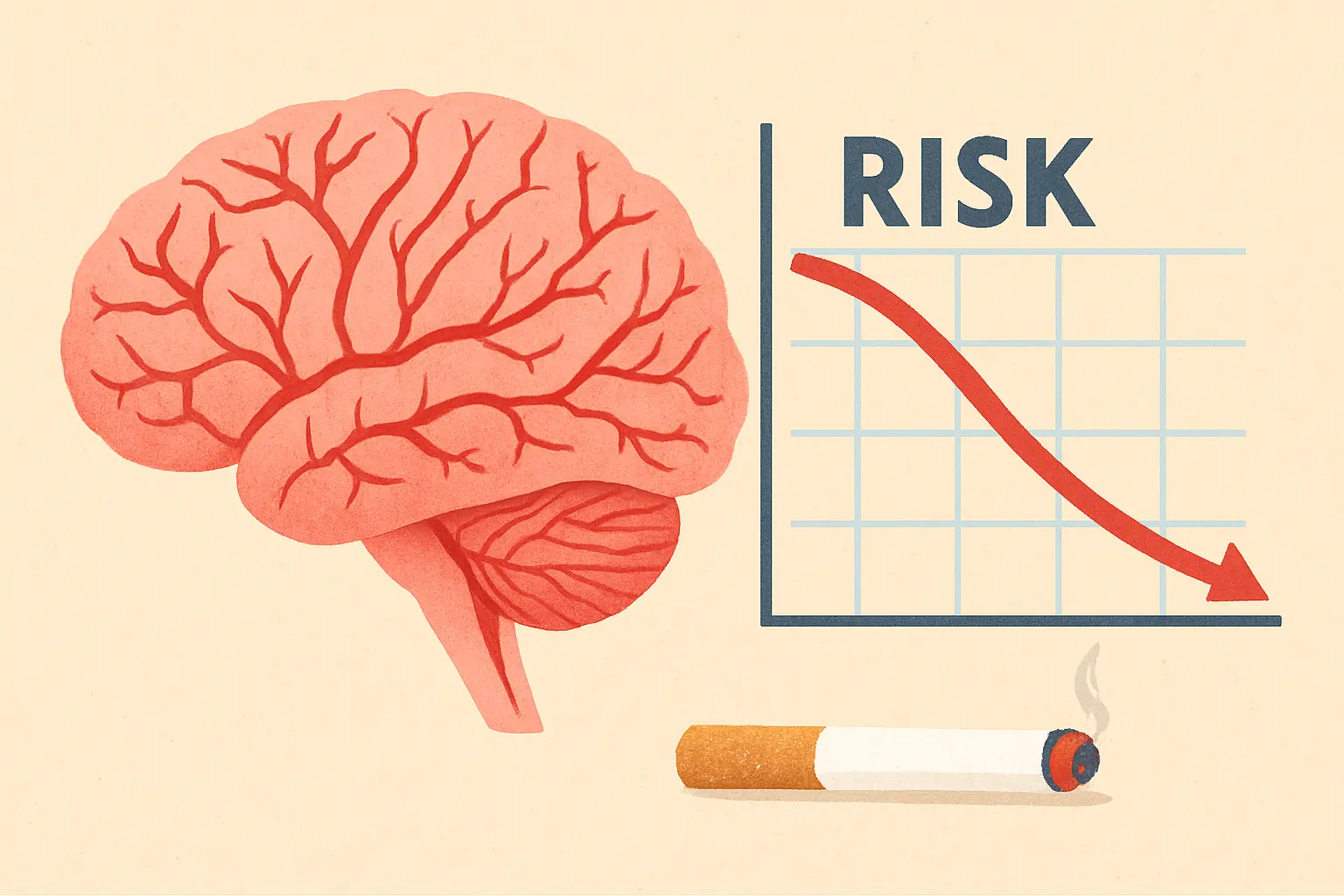
Stroke is not one disease: ischemic stroke (a blocked blood vessel, roughly 85% of strokes) and hemorrhagic stroke (a ruptured blood vessel, roughly 15%) have different underlying mechanisms, and smoking’s risk contribution differs between them. The INTERSTROKE data shows a notably stronger association with ischemic stroke (OR 1.85) than with intracerebral hemorrhage (OR 1.19), consistent with smoking’s well-documented role in accelerating atherosclerosis and blood-clotting tendency, the processes that cause blood-vessel blockages.
- Ischemic stroke (blocked vessel): about 85% of strokes; strongest smoking association (OR 1.85), rising to 2.16 for large-vessel stroke
- Intracerebral hemorrhage (ruptured vessel): about 15% of strokes; weaker association (OR 1.19, confidence interval touching 1.00)
- Shared mechanism: smoking damages vessel walls, raises blood pressure, and increases clotting tendency — contributing to both stroke types through different pathways
4. Why Stroke Risk Falls Faster Than Lung Cancer Risk
One of the more encouraging patterns in cessation data: stroke risk falls back toward non-smoker levels considerably faster than lung cancer risk does. CDC’s benefits-of-quitting guidance states that the risk of stroke decreases within 5 to 10 years of quitting, while the added risk of lung cancer only drops by about half after 10 to 15 years — still meaningfully elevated at the point where stroke risk has largely resolved (CDC, Benefits of Quitting).
- Stroke risk: decreases within 5 to 10 years of quitting (CDC)
- Lung cancer risk: added risk drops by half after 10 to 15 years, and does not fully normalize (CDC)
- Why the difference: smoking’s cardiovascular effects — elevated blood pressure, increased clotting tendency, vessel-wall inflammation — are largely functional and reverse once exposure stops. Lung cancer risk instead reflects accumulated DNA mutations from decades of carcinogen exposure, which persist in tissue even after the exposure ends
This distinction is worth understanding alongside our broader organ-by-organ recovery timeline after quitting, which covers both the fast-reversing and slow-reversing categories of damage, and our cardiovascular recovery timeline after quitting, which runs on a similar clock to the stroke-risk data above.
5. Women and Hormonal Contraception
Smoking and estrogen-containing hormonal contraception interact to raise stroke risk well beyond either factor alone, which is why clinical guidelines single out this combination. Women under 35 generally carry a low baseline cardiovascular risk, and clinical guidance treats combined hormonal contraception with only mild caution at that age. For women over 35 who smoke, however, major guidelines advise against estrogen-containing combined contraception specifically because of the compounded stroke risk, recommending progestin-only or non-hormonal methods instead. The 2022 BRFSS analysis above, which found female smokers 2.8 times more likely to report a stroke than female non-smokers, is consistent with women carrying a disproportionate share of smoking-attributable stroke risk.
- Women under 35: low baseline cardiovascular risk; combined hormonal contraception generally used with mild caution
- Women 35+ who smoke: guidelines advise against estrogen-containing combined contraception
- Recommended alternative for smokers with stroke risk factors: progestin-only or non-hormonal contraception
6. Risk Normalization Timeline
Sources converge on a similar recovery arc, even where exact figures vary by methodology. The CDC places the meaningful reduction in stroke risk within 5 to 10 years of quitting. Longer-term cohort and stroke-prevention literature generally finds that former smokers who have been abstinent for a decade or more carry a stroke risk broadly comparable with never-smokers, though the exact crossover point differs between studies and depends heavily on how much and how long someone smoked.
| Time Since Quitting | Change in Stroke Risk |
|---|---|
| 2-12 weeks | Circulation improves and blood pressure falls toward baseline |
| 1-5 years | Cardiovascular risk factors continue improving; risk trending downward |
| 5-10 years | Risk of stroke decreases (CDC) |
| 10+ years | Risk broadly comparable with never-smokers in most long-term cohort data |
This timeline pairs naturally with milestone-based motivation — see our data on quit smoking success rates by method for how different cessation approaches affect the odds of staying smoke-free long enough to reach these milestones, and our smoking disease-risk breakdown across 11 conditions for how stroke compares with the other risks that shift after a quit date.
7. Stroke Warning Signs: FAST
Because stroke risk, while reduced by quitting, never reaches zero for smokers or ex-smokers with a significant smoking history, recognizing symptoms matters regardless of where someone is in their quit journey. The American Stroke Association’s FAST acronym remains the standard public-education tool.
- F — Face drooping: one side of the face droops or feels numb; ask the person to smile
- A — Arm weakness: one arm drifts downward when both are raised
- S — Speech difficulty: slurred or strange speech; ask them to repeat a simple sentence
- T — Time to call emergency services: if any sign is present, call for emergency help immediately, even if symptoms fade
Some health systems now teach an expanded “BE FAST,” adding sudden loss of Balance and Eye or vision changes as additional early warning signs.
This brain-focused risk data sits alongside our 2026 statistics on smoking and dementia risk and our broader look at smoking and cardiovascular disease risk and recovery, both covering related risk categories that share overlapping vascular mechanisms with stroke.
8. Methodology and Sources
Primary relative-risk figures are drawn from Tobacco use and risk of acute stroke in 32 countries in the INTERSTROKE study (eClinicalMedicine, 2024), a case-control study of 13,462 stroke cases and 13,488 controls, which reports odds ratios with 95% confidence intervals for overall stroke, ischemic stroke, intracerebral hemorrhage, etiological subtypes, and secondhand smoke exposure. US population-level figures come from Association Between Smoking and Stroke: A Retrospective Study Using the 2022 Behavioral Risk Factor Surveillance System Data (Cureus, 2025). Risk-normalization timelines are drawn from CDC benefits-of-quitting guidance; where the CDC gives a range (5 to 10 years for stroke, 10 to 15 years for lung cancer), that range is reproduced here rather than narrowed to a single figure. Warning-sign guidance reflects American Stroke Association public education materials. Subgroup estimates from single studies are labeled as such, because pooled and single-cohort estimates for hemorrhagic stroke in particular vary widely between analyses.
Frequently Asked Questions
How much does smoking increase stroke risk?
The international INTERSTROKE study found current smokers have a 64% higher risk of any stroke than never-smokers (OR 1.64, 95% CI 1.46-1.84), rising to 85% higher for ischemic stroke specifically (OR 1.85). A 2025 analysis of 2022 US BRFSS data found smokers overall were 1.71 times more likely to report a stroke than non-smokers.
How long after quitting smoking does stroke risk go down?
CDC guidance states the risk of stroke decreases within 5 to 10 years of quitting. Longer-term cohort data generally finds former smokers who have been abstinent for a decade or more carry a stroke risk broadly comparable with never-smokers, though the exact crossover depends on how much and how long someone smoked.
Does smoking cause more ischemic or hemorrhagic strokes?
Ischemic. In INTERSTROKE, current smoking carried an odds ratio of 1.85 for ischemic stroke (about 85% of all strokes) and 2.16 for large-vessel ischemic stroke, compared with 1.19 for intracerebral hemorrhage, where the confidence interval touched 1.00.
Why does stroke risk fall faster than lung cancer risk after quitting?
Stroke risk is driven largely by functional cardiovascular changes — elevated blood pressure, clotting tendency, vessel inflammation — that reverse once smoking stops, so CDC places the reduction within 5 to 10 years. Lung cancer risk instead reflects accumulated DNA mutations that persist in tissue, so the added risk only drops by about half after 10 to 15 years and never fully normalizes.
Is stroke risk higher for women smokers who take birth control?
Yes. Smoking combined with estrogen-containing hormonal contraception raises stroke risk substantially beyond either factor alone. Major guidelines recommend women over 35 who smoke avoid combined estrogen contraception and use progestin-only or non-hormonal methods instead; women under 35 carry lower baseline risk.
Are young smokers at higher stroke risk?
Relative risk appears disproportionately high in younger smokers, since their baseline stroke risk is otherwise very low. A 2025 analysis of 2022 US BRFSS data found smokers aged 18-24 were 5.2 times more likely to report a stroke than non-smoking peers in the same age group, though absolute stroke numbers in this age group remain small.
Does secondhand smoke raise stroke risk too?
Yes, in a dose-dependent way. INTERSTROKE found exposure to secondhand smoke for more than 10 hours a week was associated with an odds ratio of 1.95 for all stroke, 1.89 for ischemic stroke, and 2.00 for intracerebral hemorrhage — risk increases in the same range as active smoking.
What are the warning signs of a stroke?
The American Stroke Association’s FAST acronym covers the core signs: Face drooping, Arm weakness, Speech difficulty, and Time to call emergency services immediately. Some health systems use an expanded “BE FAST,” adding sudden Balance loss and Eye or vision changes as additional early signs.
Track Your Own Risk-Reduction Timeline
iQuit’s disease-risk insights show how your risk for stroke and 10 other conditions changes the longer you stay smoke-free, alongside 15 health milestones from 20 minutes to 15 years.