

New smoking and dementia risk statistics 2026 from a May 2026 study in Neurology put a hard number on something clinicians have long suspected: people who quit smoking have a 16% lower risk of dementia than people who keep smoking, and that risk gap keeps closing the longer someone stays smoke-free. Tracking 32,802 middle-aged and older US adults from the Health and Retirement Study, the analysis is the freshest large-cohort evidence connecting a quit date to long-term brain health.
1. The 2026 Neurology Study
Published online 20 May 2026 in Neurology, the peer-reviewed journal of the American Academy of Neurology, the study followed 32,802 dementia-free US adults drawn from the Health and Retirement Study (1995-2020), with a mean baseline age of 60.5 years and 57.1% women. Smoking status and body weight were recorded every two years, and dementia was identified using the Langa-Weir algorithm. Over 25 years of follow-up (median 9.9 years), 5,868 dementia cases were documented (Neurology, May 2026).
Compared with people who kept smoking, dementia risk was 16% lower for those who quit during follow-up (hazard ratio 0.84, 95% CI 0.73-0.95), 21% lower for those who had already quit before baseline (HR 0.79, 0.72-0.87), and 25% lower for people who had never smoked (HR 0.75, 0.69-0.83).
- Study size: 32,802 adults, dementia-free at baseline (mean age 60.5)
- Follow-up: up to 25 years, median 9.9 years; 5,868 dementia cases
- New quitters: 16% lower dementia risk vs. continuing smokers (HR 0.84)
- Established quitters (quit pre-baseline): 21% lower (HR 0.79)
- Never-smokers: 25% lower risk than continuing smokers (HR 0.75)
- Published: Neurology, 20 May 2026 (American Academy of Neurology)
What makes this cohort unusual is that it tracks cessation timing, cessation duration, and post-quit weight change together, which is why it has become a fast-moving citation across health journalism and patient-facing dementia resources since publication. It joins the wider evidence base in our 2026 smoking cessation statistics hub.
2. Dementia Risk by Smoking Status and Years Quit
Long-running UK and international data sets add context to the fresh 2026 numbers. Alzheimer’s Research UK, summarizing pooled analyses of dozens of underlying studies, reports that current smokers are roughly 30% more likely to develop dementia overall and around 40% more likely to develop Alzheimer’s disease specifically, compared with never-smokers. Former smokers, by contrast, do not show a clearly elevated risk once enough time has passed.
| Group | Relative Dementia Risk | Source |
|---|---|---|
| Current smoker | Around 30% higher than never-smoker (about 40% higher for Alzheimer’s specifically) | Pooled analyses summarized by Alzheimer’s Research UK |
| Quit after baseline (new quitter) | HR 0.84 (0.73-0.95) — 16% lower than continuing smoker | Neurology, May 2026 |
| Quit before baseline (established quitter) | HR 0.79 (0.72-0.87) — 21% lower | Neurology, May 2026 |
| Never smoked | HR 0.75 (0.69-0.83) — 25% lower | Neurology, May 2026 |
| Quit and stayed smoke-free ~7 years | Risk approaches never-smoker level and plateaus | Neurology, May 2026 (spline analysis) |
For the wider disease-risk picture beyond the brain, our smoking and cancer statistics for 2026 covers the comparable risk-reduction curve for cancer, which follows a similar quit-duration pattern, and our smoking disease-risk breakdown across 11 conditions sets dementia alongside the other risks that change after a quit date.
3. Vascular vs. Alzheimer’s: How Smoking Damages the Brain
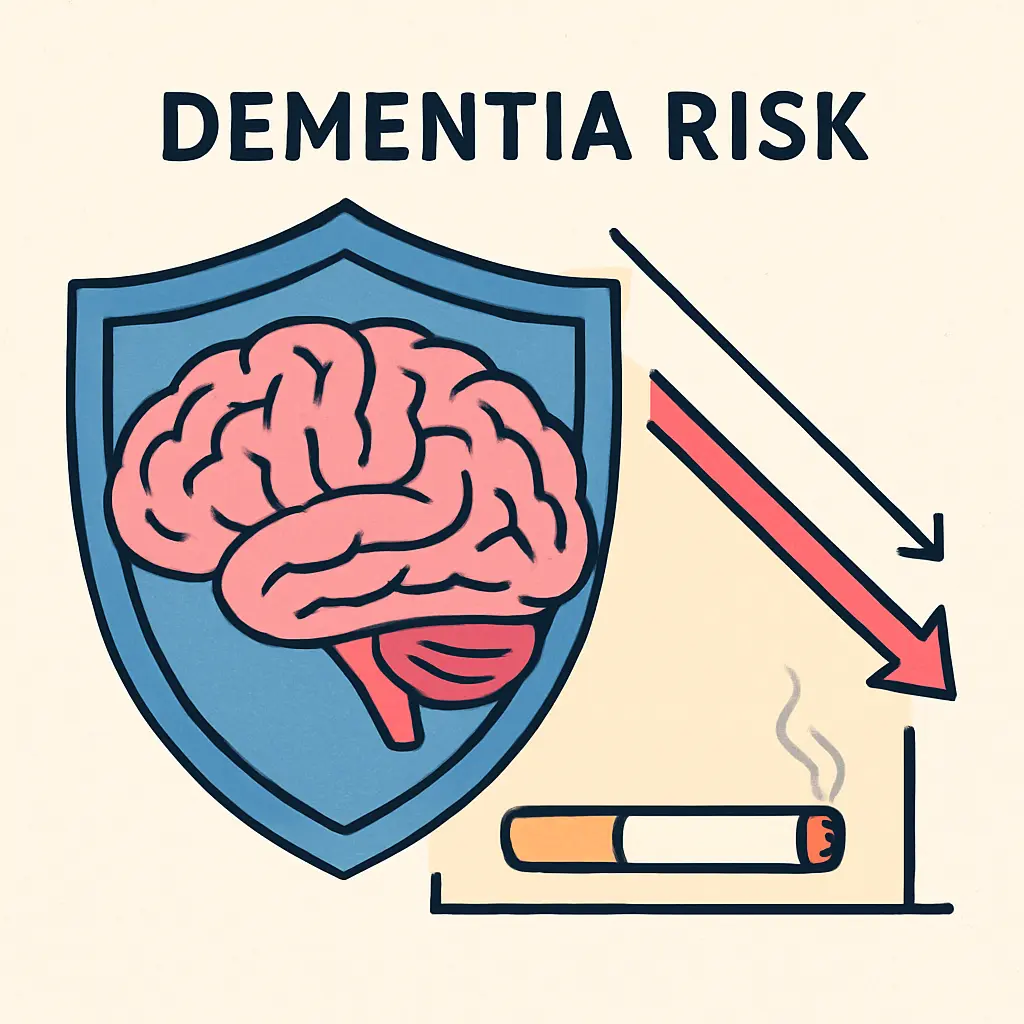
Smoking appears to raise dementia risk through two overlapping pathways rather than one single mechanism. Cigarette smoke impairs nitric-oxide-mediated regulation of cerebral blood vessels, stiffens small brain blood vessels, and reduces cerebral blood flow — a vascular pathway that contributes directly to vascular dementia, in which damaged connections between brain regions slow signal transmission. Separately, oxidative stress from smoke exposure is linked to amyloid-beta accumulation and tau changes associated with Alzheimer’s disease, plus accelerated overall brain shrinkage.
- Vascular pathway: impaired cerebral blood flow, stiffened small vessels, reduced oxygen delivery to brain tissue
- Alzheimer’s-related pathway: oxidative stress linked to amyloid-beta and tau changes
- Shared endpoint: accelerated brain shrinkage compared with non-smokers
The short-term side of the same story — what nicotine itself does to brain chemistry within minutes — is covered in our explainer on the nicotine dopamine and craving loop.
A Mayo Clinic neurologist explains how damaged blood vessels — smoking among the modifiable risk factors involved — can lead to vascular dementia.
4. The Weight-Gain Caveat
The 2026 Neurology study includes an important nuance that headlines sometimes miss: the dementia-risk benefit of quitting was concentrated in people who gained little or no weight afterward. Participants with no or modest two-year post-cessation weight gain — roughly 5 kg (about 11 lb) or less — kept the lower dementia risk associated with cessation. In the group who gained more than about 10 kg (22 lb), the association with quitting was no longer statistically significant (HR 1.33, 95% CI 0.87-1.82), meaning the data could not distinguish that group’s risk from continuing smokers in either direction.
- Weight gain ≤5 kg after quitting: dementia-risk benefit largely preserved
- Weight gain >10 kg after quitting: association not statistically significant (HR 1.33, 95% CI 0.87-1.82) — the confidence interval spans no effect, so this is a signal to watch, not a proven reversal
- Cognitive trajectory: quitting was associated with slower long-term cognitive decline, again strongest among those with minor weight gain
- Clinical takeaway: the study’s authors frame this as an argument for building weight management into cessation programs, not a reason to avoid quitting
For readers concerned about this trade-off, our guide to organ-by-organ recovery after quitting puts the weight-gain question in the context of everything else that improves after a quit date.
5. Global Attributable Burden
Smoking sits among the modifiable risk factors identified in the 2024 Lancet Commission on dementia prevention, intervention and care, which estimated that up to 45% of dementia cases worldwide could theoretically be prevented or delayed by addressing 14 modifiable risk factors across the life course, including hypertension, hearing loss, and smoking. In the Commission’s population-level modeling, midlife smoking carries a meaningful attributable share of dementia risk, and its authors note that midlife smoking may matter more than late-life smoking, partly because improved treatment of smoking-related heart disease and cancer means more smokers now live long enough to develop dementia.
- Theoretical dementia reduction from addressing all 14 modifiable risk factors: up to 45% (2024 Lancet Commission)
- Smoking’s role: one of the 12 risk factors named in the 2020 Commission and carried into the expanded list of 14 in 2024, with midlife smoking flagged as particularly influential
- Longstanding WHO estimate: roughly 14% of dementia cases worldwide have been estimated as potentially attributable to smoking
6. How Risk Normalizes Over Years Quit
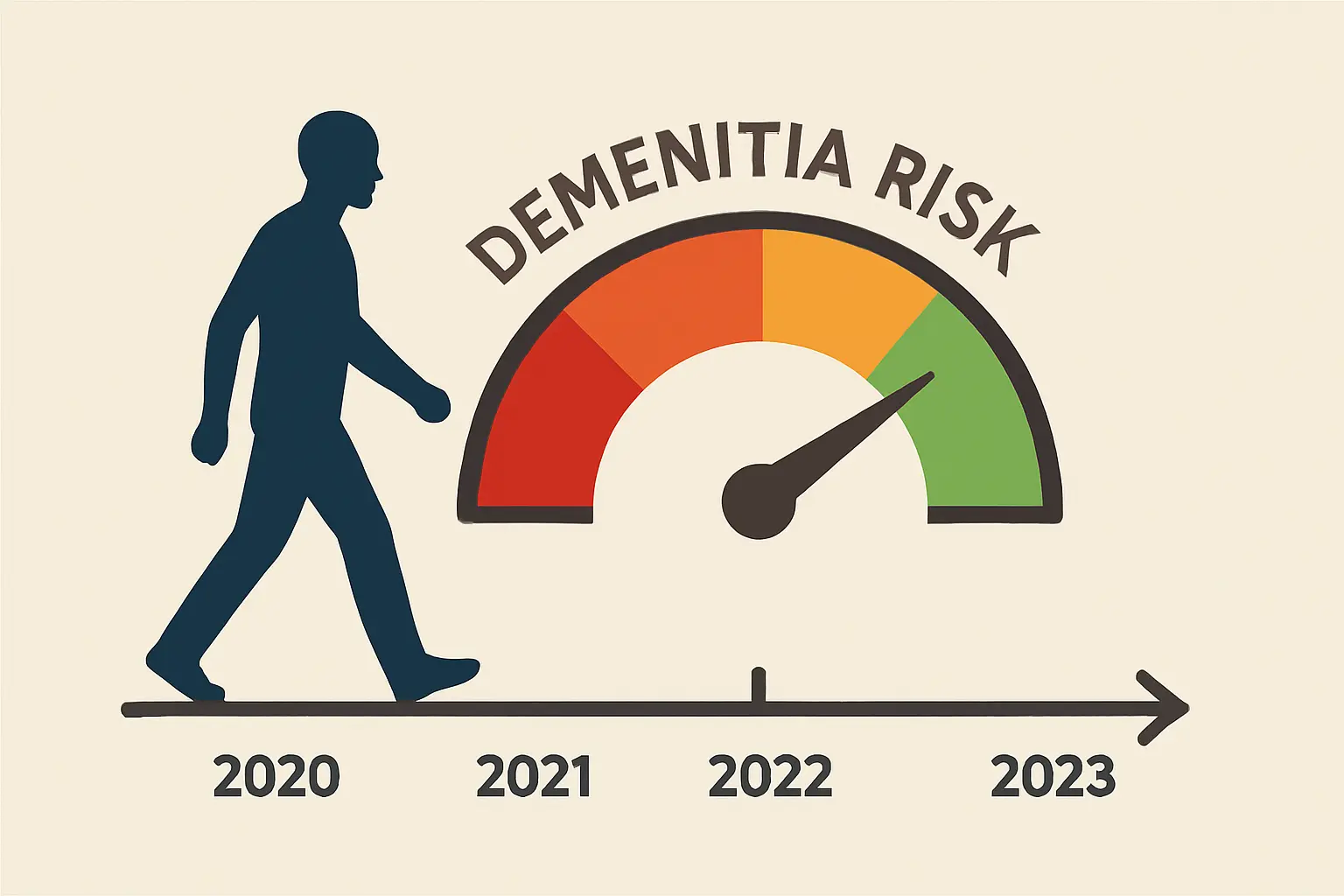
Both the 2026 US cohort and earlier UK-based reviews converge on a similar timeline: dementia risk falls steadily the longer someone stays smoke-free, reaching a level close to never-smokers somewhere between 5 and 10 years after quitting. The 2026 Neurology spline analysis specifically found risk approaching never-smoker levels and plateauing at around 7 years, while Alzheimer’s Society materials cite roughly 10 years for risk to fully normalize. The exact figure varies by study population and how strictly “normalize” is defined, but the direction and general timescale are consistent across the evidence base.
This mirrors the risk-normalization pattern documented for other conditions — see our data on life expectancy gained by quit age and whether it’s too late to quit at 40, 50, or 60 for the equivalent curves in other health domains. Readers researching other 2026 disease-risk datasets may also want our smoking and stroke risk statistics for 2026, which follows a comparably fast recovery curve.
7. What the Data Cannot Say
Every figure in this article comes from observational cohort and meta-analysis data, not randomized controlled trials — it is neither ethical nor practical to randomly assign people to keep smoking. That means these studies show association, not proof of direct causation, even though the consistency of findings across multiple independent cohorts, plausible biological mechanisms, and a clear dose-response relationship with years quit gives researchers reasonable confidence in the link. The authors of the 2026 Neurology study are explicit on this point, cautioning that residual confounding and measurement error remain possible: the results support quitting as a dementia-risk-reduction strategy but do not prove that smoking cessation alone causes lower dementia rates independent of every other factor that differs between quitters and continuing smokers.
8. Methodology and Sources
Primary figures are drawn from Smoking Cessation, Weight Change, and Risk of Dementia: A Prospective Cohort Study, published in Neurology on 20 May 2026 (American Academy of Neurology), a prospective cohort analysis of 32,802 US adults in the Health and Retirement Study, 1995-2020. Supplementary risk-ratio and normalization-timeline figures come from Alzheimer’s Research UK and Alzheimer’s Society public risk-factor guidance, both summarizing pooled analyses of many underlying cohort and case-control studies; because those pooled figures are reported as approximations, they are given here as approximations. Global attributable-risk context is drawn from the 2024 Lancet Commission on dementia prevention, intervention, and care, and from long-standing World Health Organization estimates. Mechanistic detail on vascular and Alzheimer’s pathways draws on peer-reviewed physiology research into cerebral blood flow and oxidative stress. All figures are the most recent published data available at the time of writing.
Frequently Asked Questions
Does quitting smoking really lower dementia risk?
A May 2026 study in Neurology, following 32,802 US adults for a median of 9.9 years, found people who quit smoking had a 16% lower dementia risk than those who kept smoking (hazard ratio 0.84), with risk approaching never-smoker levels and plateauing at roughly 7 years smoke-free. The study shows a strong association, though it cannot prove direct causation on its own.
How much more likely are smokers to develop dementia?
Pooled analyses summarized by Alzheimer’s Research UK put current smokers at roughly 30% more likely to develop dementia overall, and around 40% more likely to develop Alzheimer’s disease specifically, compared with people who have never smoked. Former smokers do not show a clearly elevated risk once enough time has passed.
How many years after quitting does dementia risk return to normal?
Estimates vary by study, but converge on roughly 5-10 years. The 2026 Neurology cohort found risk approaching never-smoker levels and plateauing at about 7 years smoke-free, while Alzheimer’s Society guidance cites approximately 10 years for full normalization.
Does weight gain after quitting cancel out the dementia benefit?
Possibly it weakens it. The 2026 Neurology study found the dementia-risk benefit was concentrated in people who gained 5 kg (about 11 lb) or less. In those who gained more than 10 kg (22 lb) the association was no longer statistically significant (HR 1.33, 95% CI 0.87-1.82). Researchers frame this as a case for weight-conscious quit support, not a reason to keep smoking.
Does smoking cause vascular dementia or Alzheimer’s disease?
Smoking is linked to both. It impairs blood flow to the brain and stiffens small blood vessels, a pathway tied to vascular dementia, while oxidative stress from smoke exposure is separately linked to amyloid-beta and tau changes associated with Alzheimer’s disease and to faster overall brain shrinkage.
What percentage of dementia cases worldwide are linked to smoking?
The World Health Organization has estimated that roughly 14% of dementia cases worldwide may be attributable to smoking. Smoking is also among the 14 modifiable risk factors identified by the 2024 Lancet Commission, which estimates up to 45% of dementia cases could theoretically be prevented by addressing all 14 factors combined.
Is it too late to quit smoking for brain health if I’m over 60?
No. Research indicates cognitive benefits from quitting occur even in mid- and later life, though earlier quitting generally produces a larger risk reduction. The 2026 Neurology study had a mean baseline age of 60.5 years and still found a measurable dementia-risk benefit associated with quitting, plus slower long-term cognitive decline.
See Your Own Risk-Reduction Timeline
iQuit’s disease-risk insights show how your risk for 11 conditions changes the longer you stay smoke-free, alongside 15 health milestones from 20 minutes to 15 years — so the data above becomes something you can track for yourself.