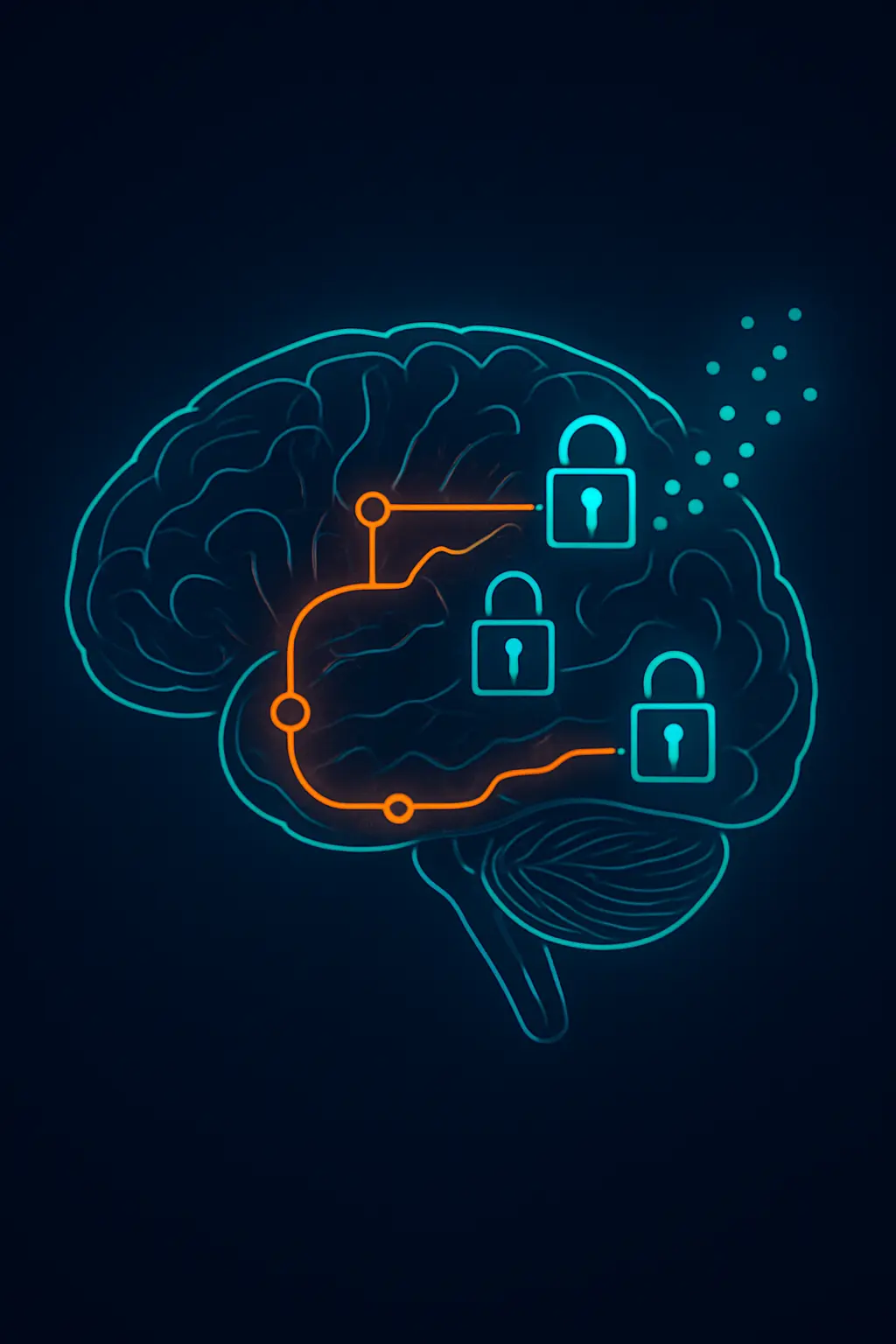
Nicotine reaches your brain about 10 seconds after a puff — faster than an intravenous injection reaches it from your arm. There it binds to nicotinic acetylcholine receptors and triggers a dopamine release in the reward pathway, the circuit that evolved to reward eating and bonding. Repeat that hit 200 times a day and the brain adapts: it grows more receptors, expects the drug on schedule, and converts every dip between cigarettes into a craving. That loop — hit, deplete, crave, hit — is the entire architecture of smoking addiction. Understanding it is surprisingly practical: it tells you exactly why quitting feels the way it does, and why it gets easier on a predictable schedule.
The 10-second hit
Smoke delivers nicotine through the lungs’ enormous surface area straight into arterial blood — brain arrival in 10–20 seconds. Speed matters enormously in addiction science: the faster a drug rewards a behavior, the harder the behavior wires in. This is why cigarettes out-addict nicotine patches by such a margin — same molecule, but the patch takes hours and the cigarette takes seconds. Your brain didn’t fall for nicotine; it fell for nicotine at that speed.
Dopamine: the “do that again” signal
Nicotine’s binding causes dopamine release in the nucleus accumbens. Dopamine isn’t pleasure exactly — it’s the salience signal, the neural highlighter that marks an experience “important, repeat this.” Each cigarette highlights the whole scene: the coffee, the balcony, the stress that preceded it. This is how, over years, hundreds of ordinary moments become smoking cues — the brain marked them all.
The cruelest adaptation: more receptors
A smoker’s brain up-regulates: imaging studies show smokers carrying dramatically more nicotinic receptors than non-smokers. More receptors means more machinery demanding to be filled. Nicotine’s half-life is roughly two hours, so 45–90 minutes after a cigarette the receptors begin emptying — and their emptiness is felt as restlessness, irritability, poor focus. The next cigarette “fixes” a problem the previous one created. What smokers experience as “cigarettes help me relax and concentrate” is, mechanically, the drug relieving its own withdrawal — the withdrawal cycle running in miniature between every smoke.
The reset: what happens when you quit
- 72 hours: nicotine fully cleared. Receptors are empty and loud — this is peak withdrawal, and it’s the mechanism behind the intensity of days 2–3.
- 2–4 weeks: receptor down-regulation is well underway; craving frequency falls steeply, exactly as the craving duration data shows.
- 4–12 weeks: receptor density approaches never-smoker levels in imaging studies. Dopamine rebalances. Concentration returns to (or above) your smoking-era baseline.
- What remains: the conditioned cues — coffee, stress, the drive home. Chemistry resets in weeks; the marked memories fade more slowly, which is why craving tools matter longest for cues, not chemistry.
Using the science against the loop
The loop’s weakness is that it’s mechanical, and mechanical things are predictable. Cravings fire on schedule (map yours), peak for minutes (outlast them), and weaken with every unrewarded repetition (extinction). The free iQuit app is essentially an anti-loop machine: it logs your cravings to expose the schedule, warns you before your usual windows, and arms you with breathing, grounding and a virtual cigarette for the peaks — while its milestone tracker shows the receptor-level recovery you can’t feel happening. The loop took years to build; watching it dismantle in weeks is one of quitting’s genuine satisfactions.
FAQ
What does nicotine do to the brain?
Reaches it in ~10 seconds, binds nicotinic receptors, spikes dopamine, and — with repetition — grows extra receptors whose emptying you feel as craving every 45–90 minutes.
Does the brain recover after quitting?
Substantially and fast: receptor density approaches never-smoker levels within 4–12 weeks, and dopamine signaling rebalances.
Why does smoking seem to help focus?
It mostly relieves the withdrawal-induced fog it caused. Ex-smokers’ baseline focus matches or beats their smoking days once withdrawal ends.
Is nicotine or the ritual harder to beat?
Chemistry resets in weeks; conditioned cues linger longer. That’s why the strongest quit systems treat both.
Start dismantling the loop today: download iQuit free on Google Play.