Three answers, because “how long do cravings last” is really three questions. A single craving: the peak lasts 3–5 minutes, then fades whether you smoke or not. The intense phase — multiple strong cravings daily: about 2–4 weeks, worst in the first 72 hours. Occasional cue-triggered urges: these can flicker for months, but they arrive weaker and pass faster every time. Knowing which of the three you’re facing changes everything about how it feels.
Level 1: the single craving (minutes)
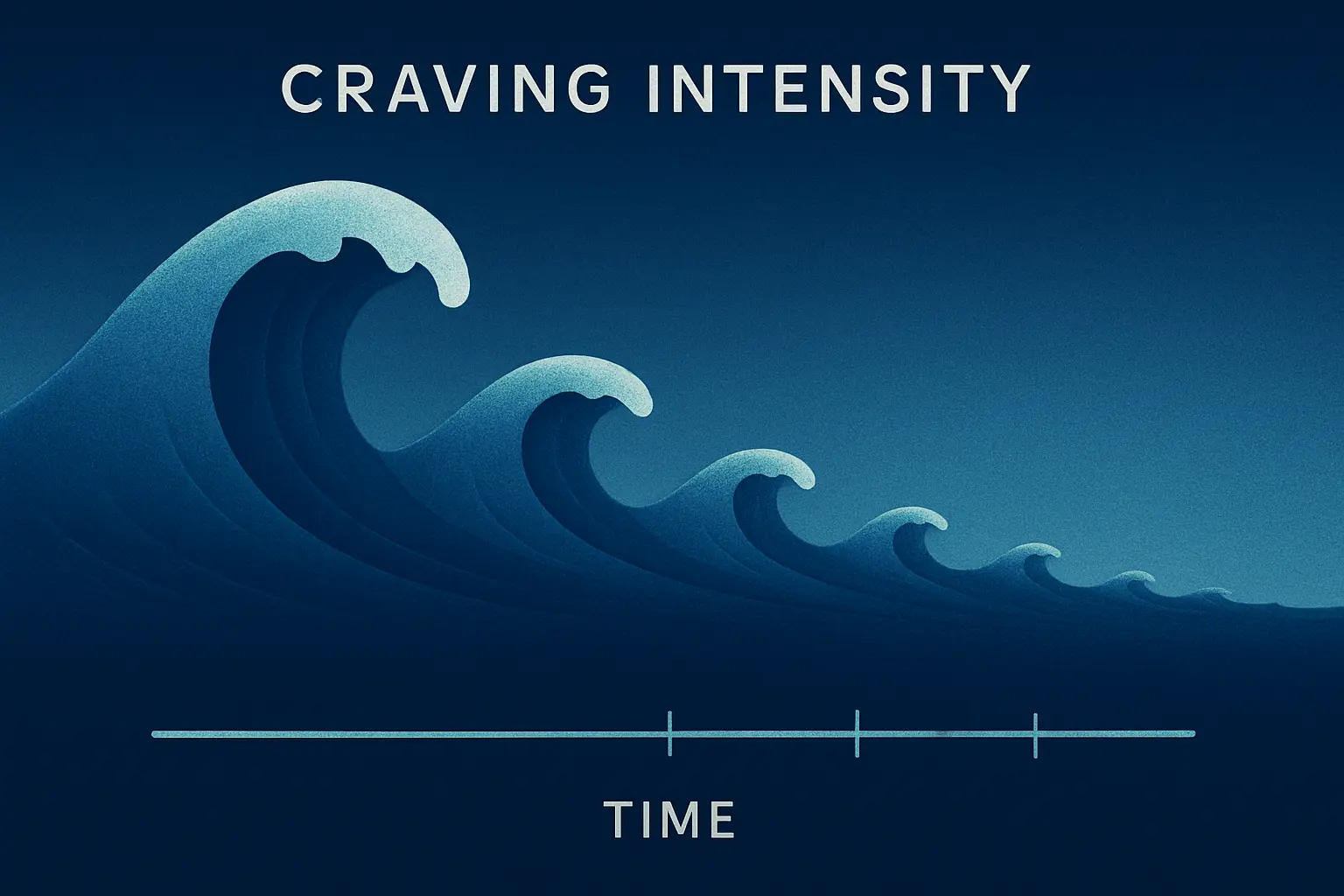
An urge builds, crests and breaks like a wave — the acute peak reliably passes within 3–5 minutes. This is the most practically useful fact in quitting: you never need infinite willpower, only a plan for the next five minutes. That’s the entire basis of the 3-minute rule and urge surfing. The feeling of “this will never stop” is a symptom, not a forecast.
Level 2: the intense phase (weeks)
- Hours 0–72: the chemical storm. Nicotine fully clears your body within about three days. Cravings here are withdrawal-driven — frequent, unprompted, strongest around days 2–3. (This window often overlaps with smoker’s flu symptoms — the two together are why day 3 has a reputation.)
- Days 4–14: the habit echo. Chemistry has settled; conditioned cues take over. Cravings now cluster around your rituals — coffee, driving, breaks, evenings — several per day, each still short.
- Weeks 3–4: the fade. Frequency drops to one or two strong urges daily. Whole mornings pass without thinking of smoking, which itself feels strange.
Level 3: the long tail (months, occasionally)
By months two to three, regular cravings largely end. What remains are conditioned flickers: a specific bar, a rough phone call, a smell, that one friend. These aren’t chemical — nicotine is long gone — they’re memories firing. Expect them at parties and crises for up to a year, shrinking every time. A flicker at month six isn’t failure or “still addicted”; it’s the last embers of a hundred thousand repetitions, going out.
The duration table
| Timeframe | What cravings look like |
|---|---|
| Single craving | 3–5 minute peak, then fades — smoke or not |
| Days 1–3 | Frequent, unprompted; withdrawal peak |
| Days 4–14 | Several daily, tied to rituals and cues |
| Weeks 3–4 | 1–2 daily, predictable trigger windows |
| Month 2–3 | A few per week, then occasional |
| Month 3–12 | Rare cue-triggered flickers, weaker each time |
What actually shortens the timeline
Exercise blunts urge intensity acutely; steady sleep steadies the whole curve; mapped triggers with planned counters mute the level-2 phase; and NRT or prescription support, where appropriate, softens the first 72 hours. The single biggest lengthener is “just one” — a lapse re-sensitizes receptors and audibly rewinds the clock. Tracking helps more than people expect: the free iQuit app logs each craving in one tap, shows your personal frequency curve falling week over week, and learns your trigger hours so warnings arrive before the urge does. Watching your own graph drop is the most convincing proof that the timeline is real.
FAQ
How long does one craving last?
The peak: 3–5 minutes. Outlast that and it breaks on its own.
How long until cravings stop being daily?
Usually 3–4 weeks; by months two to three, regular cravings have largely ended.
Why do I crave months later?
Conditioned memory, not chemistry — old contexts firing. Each one you outlast weakens the link further.
Do cravings ever fully disappear?
For most long-term quitters, effectively yes — rare nostalgic flickers may visit, but they carry no real force.
Watch your own craving curve fall: download iQuit free on Google Play and log your first one today.