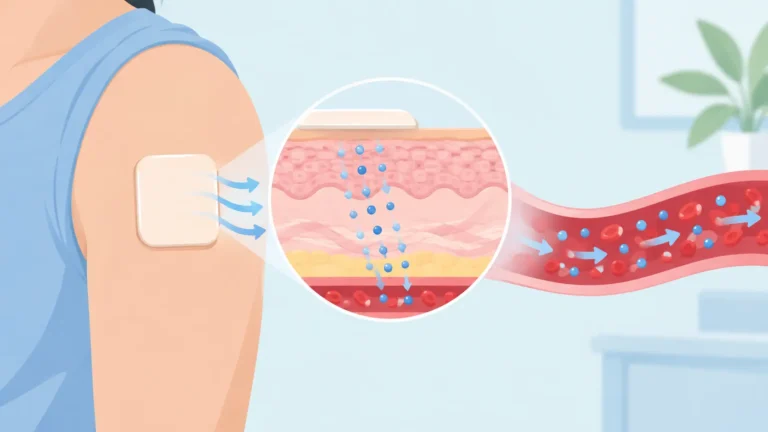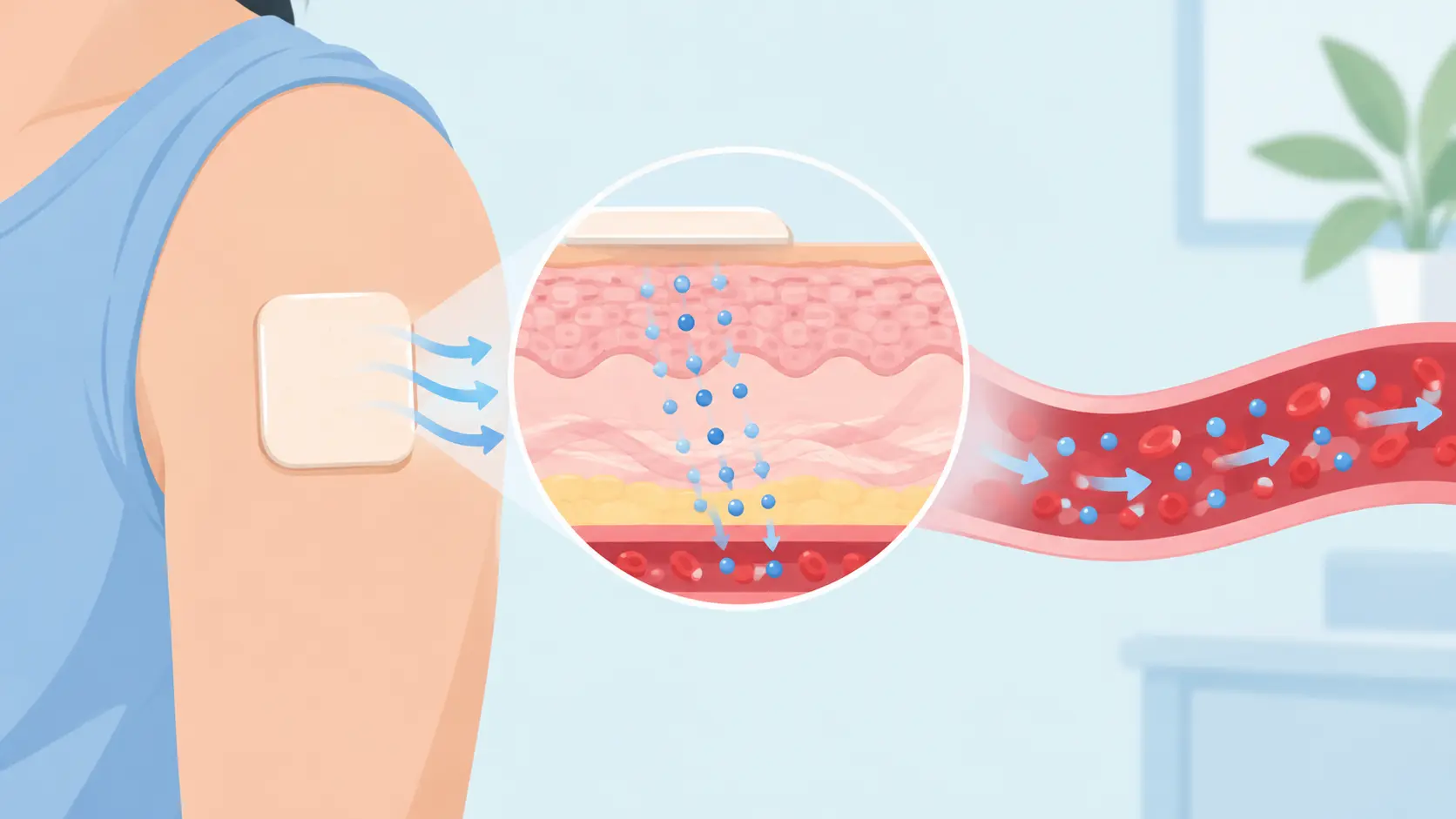
How do nicotine patches work? A patch is a sticky pad that holds a measured amount of nicotine and passes it slowly through your skin into your bloodstream over about a day. That steady supply takes the edge off cravings and withdrawal without the smoke, and without the sharp spikes you get from a cigarette. This guide explains the mechanism, how the 21, 14 and 7 mg strengths fit together, what Cochrane reviews say about results, and where patches fall short.
How Do Nicotine Patches Work? How the Patch Delivers Nicotine
A nicotine patch is a transdermal system: the medicine goes through the skin rather than through the lungs or the mouth. The label on a standard over-the-counter patch describes each step by the dose it delivers, for example “Nicotine, 21 mg delivered over 24 hours,” with lower steps at 14 mg and 7 mg (DailyMed label, Nicotine Transdermal System Steps 1 to 3). The directions say to “apply one new patch every 24 hours on skin that is dry, clean and hairless.”
The goal is replacement, not reward. A Cochrane review describes the idea this way: nicotine replacement therapy “aims to temporarily replace much of the nicotine from cigarettes to reduce motivation to smoke and nicotine withdrawal symptoms, thus easing the transition from cigarette smoking to complete abstinence” (Cochrane, Hartmann-Boyce et al., 2018). You are keeping the chemical dependence quiet while you work on the habit side of quitting.
The NHS makes the safety logic plain: “nicotine on its own doesn’t cause cancer, lung disease, heart disease or stroke. It’s the other chemicals in cigarettes that cause most of the damage” (NHS, Find the best stop-smoking products for you). If you want the longer version of what nicotine itself does, see what nicotine does to your body.
Patch vs Cigarette: Why the Nicotine Curve Is Different
The biggest difference between a patch and a cigarette is the shape of the nicotine curve. When you smoke, nicotine hits the brain in seconds. The National Institute on Drug Abuse reports that levels “peak within 10 seconds of inhalation,” and the effects fade quickly, which drives repeat dosing (NIDA). A patch does the opposite: slow in, slow out.
A crossover study of 14 healthy male smokers who smoked at least 30 cigarettes a day compared a 21 mg/24-hour patch with half-hourly smoking. The authors noted that “cigarette smoking yields nicotine concentrations in plasma that rise and fall with each cigarette,” while the patch provides continuous delivery, and that “Cmax and Cavg values were approximately half those of smoking” (Journal of Clinical Pharmacology, 1995). Cmax is the peak level and Cavg is the average level. In plain language, the patch gives a lower and smoother supply than heavy smoking.
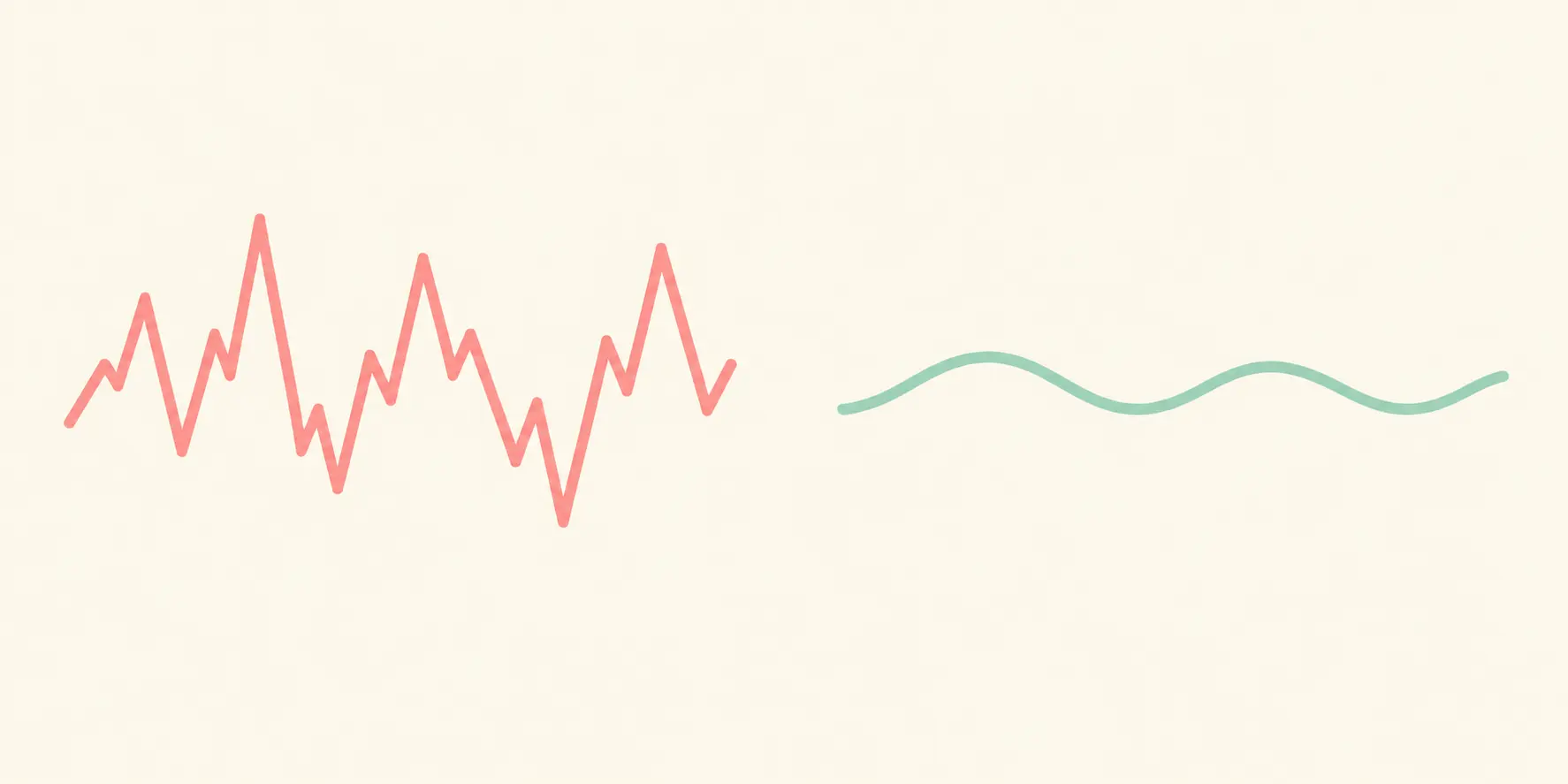
That smoothness is a feature and a limitation. It calms background craving, but it will not give you the instant relief of a cigarette when a sudden trigger hits. That is why guidelines often suggest adding a fast-acting form, which we cover below. For how to wear the patch day to day, see our step-by-step guide on how to use nicotine patches correctly.
A health service video walks through what a nicotine patch is and how people use it:
Patch Strengths: What 21, 14 and 7 mg Mean
Patches come in steps so you can start at a dose that matches your smoking and then step down. The label for the over-the-counter step system says: “if you smoke 10 or less cigarettes per day, start with Step 2 for 6 weeks, then Step 3 for 2 weeks.” The schedule for heavier smokers starts at Step 1. Always follow the product’s own directions, since brands differ.
| Step | Nicotine delivered | Who starts here |
|---|---|---|
| Step 1 | 21 mg over 24 hours | People who smoke more than 10 cigarettes a day |
| Step 2 | 14 mg over 24 hours | People who smoke 10 or fewer cigarettes a day start here (6 weeks, then Step 3 for 2 weeks) |
| Step 3 | 7 mg over 24 hours | Lowest step |
Does the higher dose matter? A 2023 Cochrane review of different doses found moderate-certainty evidence that “21 mg patches are more effective than 14 mg (24-hour) patches (RR 1.48, 95% CI 1.06 to 2.08; 1 study, 537 participants).” It also reported that 42/44 mg patches were as effective as 21/22 mg patches, and that a 25 mg 16-hour patch had a benefit over 15 mg, though “the lower limit of the CI encompassed no difference” (Cochrane, 2023). The reviewers conclude there is “some indication that the lower-dose nicotine patches and gum may be less effective than higher-dose products.”
Our comparison of nicotine patch strength 21mg vs 14mg vs 7mg helps you work out where to start, and your pharmacist can confirm.
16-Hour vs 24-Hour Patches
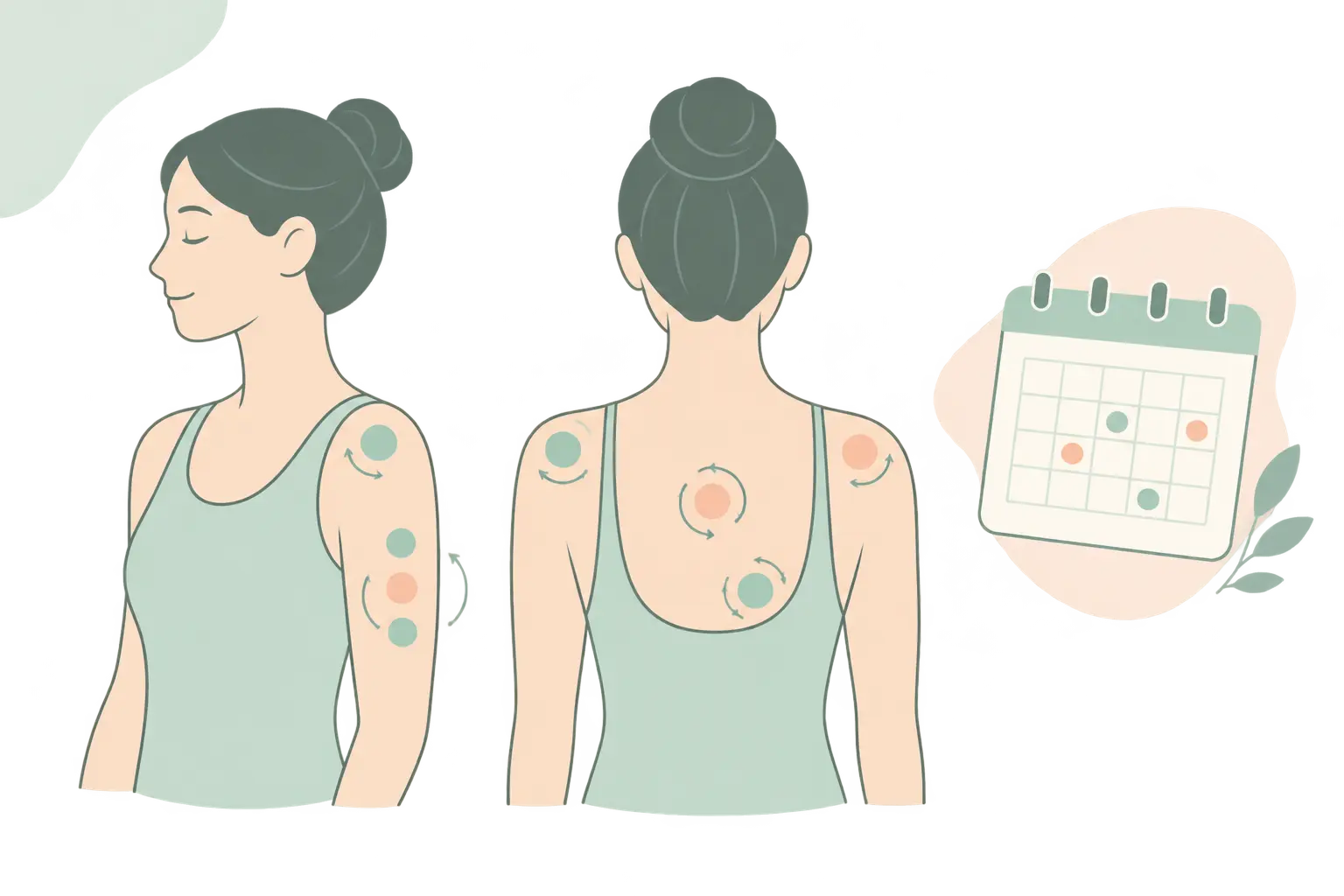
Most patches in the table above are worn for 24 hours. Some products are designed for 16 hours, and the Cochrane dose review compares both types. The practical question is sleep. The label warns: “When using this product if you have vivid dreams or other sleep disturbances remove this patch at bedtime.” It also says the patch should not be worn longer than intended, because “it may irritate your skin and loses strength after 24 hours.”
If you get vivid dreams or wake at night, taking the patch off at bedtime and applying a fresh one in the morning is what the directions suggest. If that leaves you craving first thing in the morning, speak to a pharmacist about a product designed for your pattern rather than cutting patches yourself, since the label says “do not cut patch in half or into smaller pieces.”
How Well Do Nicotine Patches Work? What Cochrane Found
The strongest evidence comes from Cochrane, the group that pools randomized trials. Its 2018 review of NRT versus control identified “136 studies; 133 with 64,640 participants contributed to the primary comparison.” For the patch specifically, it reported a pooled risk ratio of “1.64 (95% CI 1.53 to 1.75, 51 trials, 25,754 participants).” A risk ratio of 1.64 means people using a patch were about 64% more likely to be abstinent at six months or more than people on placebo or no NRT. For all NRT forms combined the figure was 1.55, and the authors concluded “NRTs increase the rate of quitting by 50% to 60%” (Cochrane, 2018).
| NRT form | Risk ratio (95% CI) | Trials |
|---|---|---|
| Nicotine patch | 1.64 (1.53 to 1.75) | 51 |
| Nicotine gum | 1.49 (1.40 to 1.60) | 56 |
| Lozenges and oral tablets | 1.52 (1.32 to 1.74) | 8 |
| Any form of NRT | 1.55 (1.49 to 1.61) | 133 studies |
Two caveats are worth knowing. First, the authors say the effect “appears to be largely independent of the intensity of additional support,” but more support still helps people quit more often. Second, a patch is not a guarantee, which is why the next section matters. For the bigger picture on what quitting methods deliver, see our how to quit smoking in 2026 complete evidence based guide.
Patch Plus a Fast-Acting Form
The 2023 Cochrane dose review found “high-certainty evidence that combination NRT (fast-acting form plus patch) results in higher long-term quit rates than single form” (risk ratio 1.27, 95% confidence interval 1.17 to 1.37; 16 studies, 12,169 participants). The same review found that a fast-acting form on its own and a patch on its own gave “similar long-term quit rates” (RR 0.90, 95% CI 0.77 to 1.05).
The NHS describes the logic: “The best approach is to combine a fast-acting source of nicotine, like a mouth spray with a slow-acting source of nicotine like a patch that eases you out of dependence without tipping you into withdrawal.” In other words, the patch covers the baseline and the gum, lozenge or spray covers the sudden spikes.
The same Cochrane review reported moderate-certainty evidence that starting NRT before quit day, known as preloading, may improve quit rates (RR 1.25, 95% CI 1.08 to 1.44; 9 studies). The reviewers add that further research is needed, so ask your clinician before trying it. For the full menu, read best NRT options compared.
Side Effects, Sleep and Who Should Ask a Doctor First
The Cochrane review notes that “NRT often causes minor irritation of the site through which it is administered,” and that adverse events include “skin irritation from patches.” Chest pain and palpitations were reported more often with NRT than control (odds ratio 1.88), but the authors stress they “were rare in both groups and serious adverse events were extremely rare.”
The patch label lists situations in which you should check with a doctor before use, including “Heart disease, recent heart attack, or irregular heartbeat,” uncontrolled high blood pressure, skin problems, stomach ulcer or diabetes. It says to stop use and ask a doctor if redness “does not go away after four days,” or if you get an irregular heartbeat, palpitations, or symptoms of nicotine overdose such as nausea, vomiting, dizziness, weakness and rapid heartbeat.
On pregnancy, the label states: “If you are pregnant or breast-feeding, only use this medicine on the advice of your health care provider.” Used patches can also harm children and pets, so fold them and dispose of them safely. If you are tempted to smoke while wearing one, read can you smoke while using nicotine patches.
How Long Should You Use a Patch?
The NHS says: “The general advice is to use NRTs and other products for at least 12 weeks, or even longer if needed.” The 2023 Cochrane review, interestingly, found “no clear evidence of an effect of duration of nicotine patch use,” and rated that evidence as low certainty. So no single length is proven best, and the product’s own schedule is the sensible default. The label adds: “It is important to complete treatment. If you feel you need to use the patch for a longer period to keep from smoking, talk to your health care provider.”
Our guide to how long you should use nicotine patches walks through tapering in more detail.
A patch does nothing for the cues that trigger cravings: the morning coffee, the work break, the drive home. Those habits are what a plan has to cover. In iQuit you can log each craving with its trigger and intensity, lean on SOS tools when one hits, and check the dashboard for days smoke-free and money saved while the patch handles the chemical side. The app does not replace medical advice about your patch.
Frequently Asked Questions
How do nicotine patches work?
A patch holds a measured dose of nicotine and releases it through the skin over about 24 hours, for example 21, 14 or 7 mg. This gives a steady supply that eases craving and withdrawal without smoke. One study found patch levels were roughly half of those from half-hourly smoking (DailyMed label; J Clin Pharmacol 1995).
How fast does a nicotine patch start working?
Unlike a cigarette, which delivers nicotine to the brain within about 10 seconds, a patch is slow in and slow out. The studies cited here show it gives a steady, lower level rather than a quick peak, so it will not relieve a sudden craving instantly (NIDA; J Clin Pharmacol 1995).
How effective are nicotine patches?
A 2018 Cochrane review pooled 51 patch trials with 25,754 participants and found a risk ratio of 1.64 for quitting versus placebo or no NRT, with a 95% confidence interval of 1.53 to 1.75. For all NRT forms the authors say NRT increases the rate of quitting by 50% to 60% (Cochrane 2018).
Is 21 mg better than 14 mg?
A 2023 Cochrane review found moderate-certainty evidence that 21 mg 24-hour patches work better than 14 mg (RR 1.48, 95% CI 1.06 to 2.08), based on one study of 537 participants. The label starts people who smoke 10 or fewer cigarettes a day at the 14 mg step (Cochrane 2023; DailyMed label).
Can I use a patch with gum or a lozenge?
Yes. The same Cochrane review found high-certainty evidence that combining a patch with a fast-acting form gives higher quit rates than a single form (RR 1.27, 95% CI 1.17 to 1.37). The NHS recommends combining a fast-acting form with a slow-acting patch. Ask a pharmacist about doses (Cochrane 2023; NHS).
Do nicotine patches cause bad dreams?
They can. The patch label says that if you have vivid dreams or other sleep disturbances you should remove the patch at bedtime. Apply a new one in the morning and rotate the skin site. If sleep problems continue, ask a pharmacist or doctor (DailyMed label).
How long should I wear a nicotine patch?
Each patch is worn for up to 24 hours. For total treatment length, the NHS advises at least 12 weeks or longer if needed, while Cochrane found no clear evidence that duration of patch use changes quit rates. Follow your product directions and ask your clinician if you want to continue (NHS; Cochrane 2023).
Pair the Patch With a Plan for Triggers
The Patch Handles the Chemistry. Habits and Triggers Are Up to You.
iQuit adds craving logging with triggers and intensity, SOS tools for the hard moments, an AI coach and a real-time dashboard of days smoke-free, cigarettes avoided and money saved. Free on Google Play and the App Store.
Download iQuit Free on Google Play
Download on the App Store