

You bought the patches, you picked a quit day, and now a practical question is nagging at you: how long should you use nicotine patches? The short answer depends on whose instructions you follow. The product labels describe a course of roughly 8 to 10 weeks. UK health advice says to use nicotine replacement for about 12 weeks, or longer if you need it. And the best trial evidence cannot yet say that a longer course works better. This guide lays out each source so you can see where they agree and where they differ.
The short answer: 8 to 12 weeks, depending on the source
There is no single number that every authority agrees on, and it is better to know that than to hear one confident figure. In the United States, the over-the-counter label for NicoDerm CQ patches describes a 10-week schedule for people who smoke more than 10 cigarettes a day. In the UK and Europe, the product information for NiQuitin Clear describes a 10-week course, or 8 weeks for lighter smokers. The NHS, meanwhile, says nicotine replacement is “recommended” for “about 12 weeks or for as long as they’re needed to stop you from smoking again.”
Those can all be true at once. A label describes a standard course for one product. Health advice is about making sure you stay quit. If you are partway through a course and wondering whether to stop, extend or step down, the sections below walk through what each source actually says. This is general information, not personal medical advice, so use it to prepare for a conversation with your pharmacist, doctor or stop-smoking service.
For the how-to side, including where to put the patch and how to rotate sites, see how to use nicotine patches correctly.
What the US label and the UK product text say
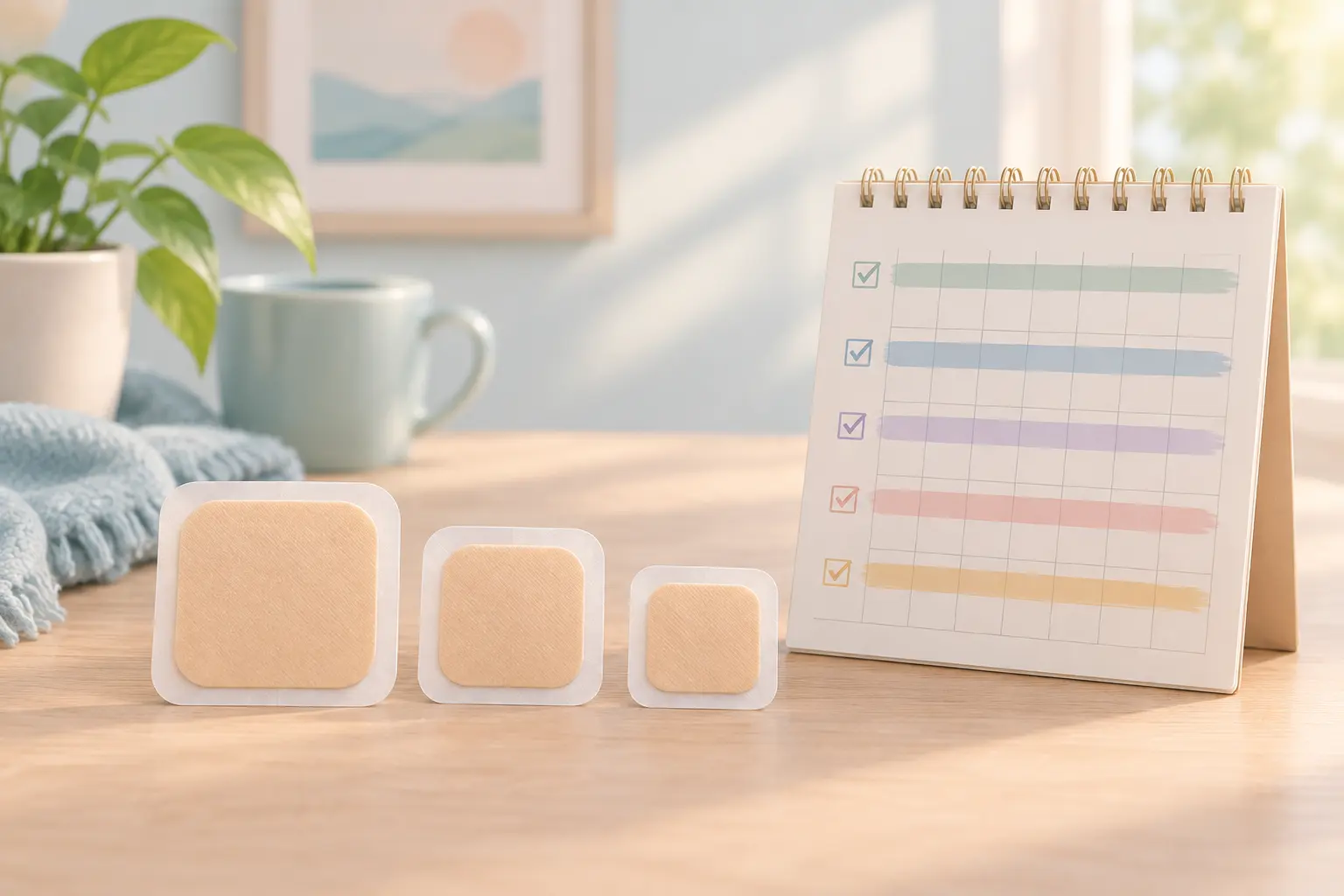
The US label for NicoDerm CQ on DailyMed lays out a three-step program. “If you smoke more than 10 cigarettes per day, use according to the following 10-week schedule”: one 21 mg patch a day in weeks 1 to 6, one 14 mg patch in weeks 7 to 8, and one 7 mg patch in weeks 9 to 10. For lighter smokers, it says: “If you smoke 10 or less cigarettes per day, do not use STEP 1 (21 mg). Start with STEP 2 (14 mg) for 6 weeks, then STEP 3 (7 mg) for 2 weeks and then stop.”
The European text for NiQuitin Clear, a 24-hour patch, is very similar. Its summary of product characteristics (revised April 2021, as posted by the Swedish Medical Products Agency) sets 21 mg for the first 6 weeks, 14 mg for the next 2 and 7 mg for the last 2. It adds: “For optimum results, the 10 week treatment course (8 weeks for patients who have reduced strength as above), should be completed in full.”
| Source | Heavier smokers | Lighter smokers (10 or fewer a day) | Extending beyond the course |
|---|---|---|---|
| US label (NicoDerm CQ, DailyMed) | 10 weeks: 21 mg, 14 mg, 7 mg | 8 weeks: 14 mg then 7 mg | Talk to your health care provider |
| European text (NiQuitin Clear SmPC) | 10 weeks: 21 mg, 14 mg, 7 mg | 8 weeks: 14 mg then 7 mg | “Should not extend beyond 10 consecutive weeks”; later courses allowed if smoking resumes |
| NHS Better Health | About 12 weeks, or as long as needed | About 12 weeks, or as long as needed | At least 12 weeks, or even longer if needed |
Patch strengths and when to move down are covered in more detail in nicotine patch strength: 21 mg vs 14 mg vs 7 mg. And if you are weighing the all-day patch against the waking-hours patch, see 16-hour vs 24-hour nicotine patches compared.
Stopping early and the relapse risk
The most common mistake is not using the patch for too long, but stopping too soon. The NHS says: “Many people don’t use stop-smoking products for long enough, which can cause cravings to return.” Its general advice is “to use NRTs and other products for at least 12 weeks, or even longer if needed.”
The US label makes a similar point in its own words: “Completing the full program will increase your chances of quitting successfully.” It also says it is “important to complete treatment.”
The NHS adds a line that is worth remembering on a bad day: “If you’re feeling unsure about your ability to stay quit, don’t stop using your support products.” In practice that means the decision to step down or stop should be driven by how stable you feel, not by a date on the calendar or by feeling you should be “past it” by now.
Patches also work best with a partner. The NHS says nicotine patches “are most effective when you use them with a faster-acting nicotine product (like gum or spray) to help with cravings.” Our overview of the best NRT options compared covers those fast-acting forms.
Using a patch longer than the label course
This is where the sources genuinely differ, so it is worth being precise.
The US label says: “If you feel you need to use the patch for a longer period to keep from smoking, talk to your health care provider.” It does not forbid longer use. It asks you to involve a professional.
The European NiQuitin Clear text is stricter about the product itself: “It should not extend beyond 10 consecutive weeks. However, further courses may be used at a later time, for NiQuitin Clear users who continue or resume smoking.” The same document describes a combination regimen with gum or lozenges and says: “The treatment duration depends on the needs of each smoker. In general, the use of oral NiQuitin preparations is 2 – 3 months, then use may be reduced gradually.”
The NHS, as a general health service, takes a more flexible stance: “at least 12 weeks, or even longer if needed,” and “Some people may need more time, and that’s okay.”
How do you reconcile these? Treat the label as the standard course for that specific product, and treat longer use as a decision to make with a pharmacist, GP or stop-smoking service rather than on your own. They can tell you which product, strength and schedule fit your situation, and can arrange a second course or a switch to a different form if you need more time.
Here is a short clip from the CDC showing step-by-step instructions for using a patch by itself.
What the research says about duration
If longer patch use is better, the best evidence should show it. It does not, at least not clearly. A 2023 Cochrane review of different doses, durations and modes of delivery of NRT (Theodoulou and colleagues) included 68 studies with 43,327 participants. On duration, the authors wrote: “We found no clear evidence of an effect of duration of nicotine patch use (low-certainty evidence).”
In the same review, “high-certainty evidence that combination NRT (fast-acting form plus patch) results in higher long-term quit rates than single form (risk ratio (RR) 1.27, 95% confidence interval (CI) 1.17 to 1.37).” So the strongest finding is not about how long you wear the patch, but about pairing it with a fast-acting product.
That does not mean duration is irrelevant. “No clear evidence of an effect” with low certainty means the studies could not tell. It is also not a reason to quit early: the same body of Cochrane work found that nicotine patches helped people quit compared with control, with a pooled risk ratio of 1.64 (95% CI 1.53 to 1.75) in an earlier 2018 review of 51 trials. The practical reading is simple. Use the patch as directed, complete the course, and ask for help if you feel you need more time.
For an honest picture of how often quit attempts succeed overall, see quit smoking success rates statistics.
Signs you are ready to step down
None of the sources we reviewed gives a medical test for “ready to step down,” and we are not going to invent one. What they do give is a framing. The NHS says: “When you feel ready, you can reduce your dose gradually and eventually stop.” The label’s step schedule exists for the same reason: it “allow[s] you to gradually reduce your level of nicotine.”
A practical way to judge readiness is to look at your own record rather than a feeling. For example, ask yourself:
- Have my cravings been steady or falling for a couple of weeks, rather than spiking?
- Do I manage trigger moments without reaching for a cigarette, with the help of a fast-acting form if needed?
- Am I confident I can stay quit at a lower strength?
If the honest answer to the last question is “not really,” the NHS advice above applies: do not stop your support products yet. A craving log makes this much easier to judge, because it shows a trend rather than a mood. That is one place a tracker can help, which we return to below.
If cravings return at a lower strength
Cravings that return when you step down are common and are not a failure. They are a signal about the plan. The label’s advice is to involve a professional if you need to keep using the patch, and the NHS’s advice is to use “as many NRTs as you need to help you manage your cravings.”
Options to discuss with your pharmacist or stop-smoking adviser include staying on the current strength a little longer, adding or increasing a fast-acting form such as gum, lozenge or spray for the hard moments, or starting a second course later if needed. The European patch text, for example, allows further courses at a later time for people who continue or resume smoking.
If you notice skin irritation, vivid dreams or sleep problems as you go, our guide to nicotine patch side effects and what is normal explains what to expect and when to ask for advice. The US label also tells people who have vivid dreams to remove the patch at bedtime.
Patch plus a fast-acting form at the end
The end of a patch course is when many people feel most exposed, because the steady background dose is going away. This is exactly where a fast-acting product can help. The European patch text describes a combination regimen in which, once the patches stop, the instruction is: “Continue to use lozenges/ gums, when necessary.” The number of pieces is then reduced gradually, and the text notes that oral products are in general used for 2 to 3 months before use is reduced.
That is a way of tapering the habit in layers: the patch goes first, then the as-needed forms. The NHS describes the same pairing in plain terms: a patch for “steady support throughout the day,” and a fast-acting product for “sudden cravings.”
If you are also curious about what recovery looks like once the nicotine is out of your system, read what happens to your body when you stop smoking.
Tracking your course
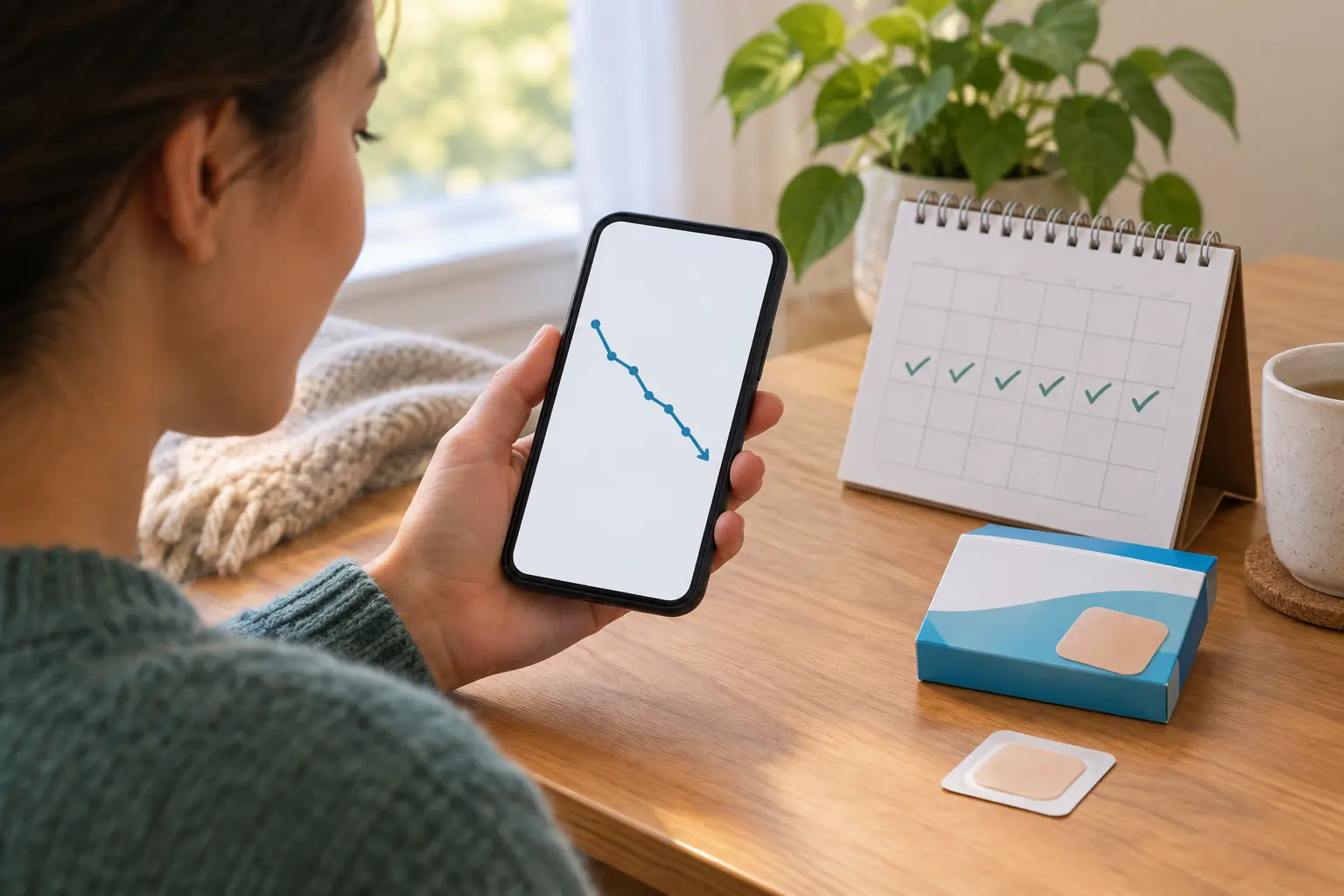
A patch course is a few months of small decisions, and the hardest one is when to step down. iQuit does not choose a patch strength or replace professional advice, but it can give you the data for that conversation. Its dashboard counts your smoke-free days, and the craving log lets you record each urge with its trigger and intensity, so you can see whether cravings are stable before you move to a lower step. The milestones view marks how far you have come while you wait.
Log your cravings before you step down
iQuit’s craving log, milestones and smoke-free day counter help you see whether you are ready for the next step. Free on Google Play and the App Store.
Download iQuit Free on Google Play
Download on the App Store
Frequently Asked Questions
How long should you use nicotine patches?
Labels describe a 10-week course (8 weeks if you smoke 10 or fewer cigarettes a day), while the NHS recommends nicotine replacement for about 12 weeks or as long as needed to stay smoke-free. Follow your product’s schedule and ask a professional before extending (DailyMed; NHS Better Health).
What is the standard nicotine patch step-down schedule?
For people who smoke more than 10 cigarettes a day, the US label sets 21 mg for 6 weeks, 14 mg for 2 weeks and 7 mg for 2 weeks. Lighter smokers start at 14 mg for 6 weeks, then 7 mg for 2 weeks (DailyMed NicoDerm CQ label).
Is it okay to use nicotine patches for longer than 12 weeks?
The NHS says to use NRT for at least 12 weeks or even longer if needed, and the US label says to talk to a health care provider if you need longer. One European patch text says a course should not extend beyond 10 consecutive weeks, so check with a pharmacist (NHS; DailyMed; NiQuitin Clear SmPC).
What happens if I stop using nicotine patches early?
Cravings can return. The NHS says many people do not use stop-smoking products for long enough, which can cause cravings to return, and the US label says completing the full program increases your chances of quitting successfully (NHS Better Health; DailyMed).
Does using the patch longer improve your chances of quitting?
Not clearly. A 2023 Cochrane review found no clear evidence of an effect of duration of nicotine patch use, based on low-certainty evidence. Its strongest finding was that combining a patch with a fast-acting form beat a single form (Cochrane, 2023).
What if cravings come back when I step down a strength?
Talk to a pharmacist or stop-smoking adviser. Options include staying on the current strength longer, adding a fast-acting form for sudden cravings, or a later second course. The NHS advises using as many NRTs as you need to manage cravings (NHS Better Health).
Should I use a fast-acting product with the patch?
Usually yes. The NHS says patches are most effective with a faster-acting product such as gum or spray, and Cochrane found combination NRT gave higher long-term quit rates than a single form (risk ratio 1.27) (NHS Better Health; Cochrane, 2023).


