
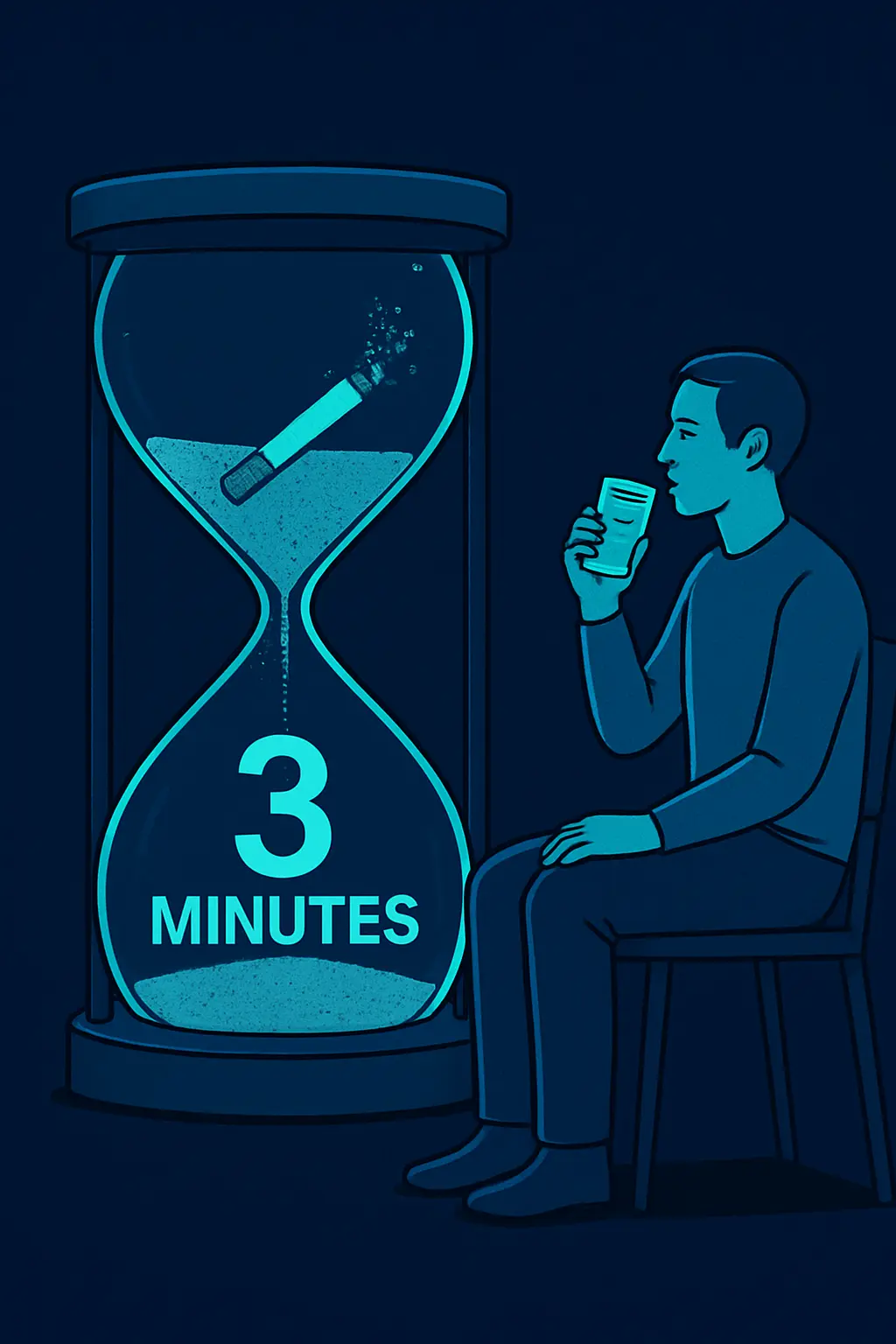
Here is the most useful fact in all of quitting: a cigarette craving peaks and begins fading within about 3 minutes — whether you smoke or not. The urge feels permanent from the inside; it is actually a short wave. The 3-minute rule turns that biology into a protocol: when a craving hits, you don’t decide “never” — you decide “not for 3 minutes,” then fill those minutes deliberately. By the time the timer ends, the peak has usually broken.
Why 3 minutes beats “forever”
Telling yourself “I can never smoke again” mid-craving pits you against eternity — a fight the craving usually wins. Postponing for 3 minutes asks almost nothing of your willpower, which is exactly why it works. You’re not white-knuckling a lifetime; you’re supervising 180 seconds. Stack enough won 3-minute battles and the war quietly ends — cravings arrive weaker and rarer each week, a pattern every quitter’s craving log confirms.
The 3-minute protocol, step by step
- Declare the delay (0:00). Say it plainly: “I can decide in 3 minutes.” This one sentence converts refusal into postponement — the brain barely objects to postponement.
- Start a real timer (0:10). Phone timer, 3:00. Externalizing the countdown matters: you stop checking the clock and start filling the time.
- Breathe in a pattern (0:10–1:00). One minute of box breathing — 4 in, 4 hold, 4 out, 4 hold — blunts the adrenaline spike that’s amplifying the urge. Exhales longer than inhales if you can’t keep count.
- Change your inputs (1:00–2:30). Cold water drunk slowly, a different room, thirty seconds of stairs, stepping outside. Cravings are wired to contexts; changing the sensory scene weakens the cue firing underneath.
- Re-decide at the bell (3:00). Rate the urge again. The 8/10 that started the timer is usually a 3 or 4 now. Deciding not to smoke at a 3 is easy — and every completed cycle trains your brain that cravings end without nicotine.
For the cravings that laugh at timers
Some urges — first morning coffee, after a fight, third drink — run hotter and longer. Escalate, don’t surrender:
- Run a second timer. Even monster cravings rarely survive two rounds.
- Surf it instead. The urge-surfing technique — observe, locate, breathe, ride — handles the waves too big to distract away.
- Occupy your hands. The ritual half of a craving responds to ritual tools; iQuit’s virtual cigarette exists for exactly these moments.
- Phone a voice. A friend, a quitline, or the app’s AI coach — saying the craving out loud reliably shrinks it.
Make the rule automatic
The protocol works best when you don’t have to remember it mid-crisis. The free iQuit app packages the whole sequence behind one SOS button — tap it (or shake your phone) and it runs you through paced breathing, grounding and distraction with a timer built in, then logs the craving you just beat. The log matters more than it seems: it shows your urges getting shorter and weaker week over week, and it powers the app’s trigger-hour predictions. If a slip does happen, the right response in the next 24 hours decides everything.
FAQ
Do cravings really only last 3 minutes?
The acute peak typically lasts 3–5 minutes. Background restlessness can linger, but the overwhelming “must smoke now” wave is short — that’s the part the rule outlasts.
What if the craving comes right back?
Run the protocol again. Multiple short waves are normal in the first weeks; each one you outlast weakens the next.
How many cravings will I get a day?
Most new quitters face a handful of strong urges daily in week one, declining steeply by weeks three to four.
Does the rule work for vaping urges?
Yes — the urge curve is the same shape. Delay, breathe, change inputs, re-decide.
Put the timer, the breathing and the log behind one button: get iQuit free on Google Play.