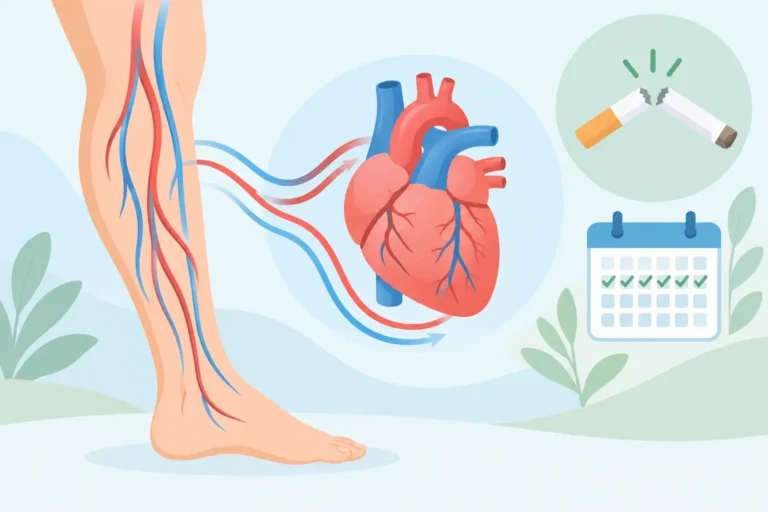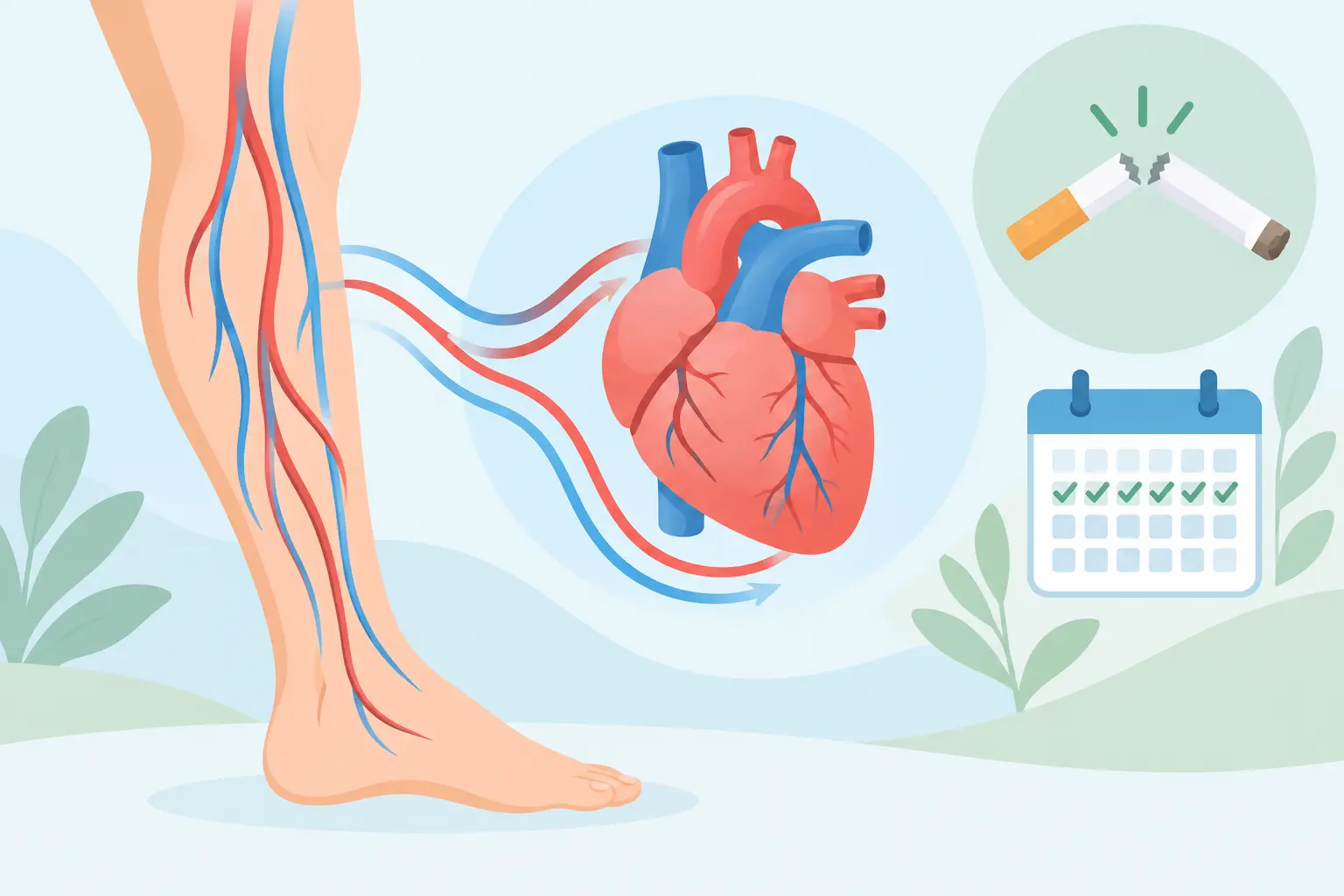
Does smoking cause blood clots? Yes, it raises the risk, but by less than many people assume. A large 2013 review of studies found that smoking is associated with a “slightly increased risk” of clots that form in the veins (venous thromboembolism), and the NHS also says smoking makes clots in the arteries of the heart and brain more likely. If you take the pill or HRT, are about to have surgery, or fly a lot, smoking adds to risks you may already be carrying. This guide sets out what the numbers show, without inflating them.
Does smoking cause blood clots? The short answer
There are two kinds of clot problem to keep apart. Venous clots form in veins, usually in the leg, and are called deep vein thrombosis (DVT). If part of one travels to the lungs it becomes a pulmonary embolism. Arterial clots form in the arteries that supply the heart and brain, and cause heart attacks and strokes.
The NHS DVT page lists “smoke” among the factors that make DVT more likely, and under prevention it says “do not smoke.” For the arterial side, the NHS says nicotine and carbon monoxide from smoke “also increase your risk of blood clots.” Smoking is a contributing risk factor, not a certainty: most smokers never get a clot, and some people with no risk factors do.
How smoking makes clots more likely
The NHS coronary heart disease causes page explains that both nicotine and carbon monoxide put a strain on the heart by making it work faster, and that they increase the risk of blood clots. It adds that other chemicals in cigarette smoke can damage the lining of the coronary arteries, leading to furring of the arteries. The NHS calls this process atherosclerosis.
This guide does not go beyond the NHS description of the mechanism, because no single authoritative source spells out every step of how smoking changes the blood itself. What matters for you is the result seen in large studies, which we cover next.
DVT and pulmonary embolism: how big is the risk?
A 2013 systematic review and meta-analysis in PLoS Medicine pooled 32 observational studies with 3,966,184 participants and 35,151 venous thromboembolism events. Compared with never smokers, the relative risks were 1.23 for current smokers, 1.10 for former smokers and 1.17 for ever smokers. The risk rose by 10.2 percent for every additional ten cigarettes per day. The authors’ conclusion: “Cigarette smoking is associated with a slightly increased risk for VTE.”
| Group compared with never smokers | Relative risk of VTE | 95% confidence interval |
|---|---|---|
| Current smokers | 1.23 | 1.14 to 1.33 |
| Former smokers | 1.10 | 1.03 to 1.17 |
| Ever smokers | 1.17 | 1.09 to 1.25 |
A relative risk of 1.23 means about a quarter more clots than in people who never smoked. It is a real effect, but the review itself calls it slight. The authors also found that body mass index appears to be a confounding factor, with the relative risk for current smokers rising to 1.30 in 13 studies that adjusted for it.
For the clot that reaches the lungs, the NHS describes a pulmonary embolism as a blood clot that blocks a blood vessel in the lungs, and says it “can be life-threatening if not treated quickly.” Its symptoms include difficulty breathing that comes on suddenly, chest pain that is worse when you breathe in, and coughing up blood. The NHS says to ask for an urgent GP appointment or contact NHS 111 for sudden breathing difficulty or coughing up blood, and to call 999 or go to A&E for severe difficulty breathing or pain in your chest or upper back.
This Mayo Clinic video explains what deep vein thrombosis is and how it is treated.
Smoking, the pill and HRT
The NHS DVT page lists several risk factors side by side: smoking, taking HRT, and taking the combined contraceptive pill or using contraception that contains estrogen, such as the patch or vaginal ring. Having more than one of them does not simply add up in a number anyone can quote, because no published source gives a combined figure, so this guide does not invent one.
On HRT specifically, the NHS says HRT tablets can increase the risk of blood clots, “but the risk is still very low,” while HRT patches, sprays and gels do not increase it. If you are at risk of clots you are usually advised to use patches, spray or gel rather than tablets. Whether a particular medicine is right for you is a decision for your doctor.
If you smoke and use the combined pill, read our dedicated guide on smoking on birth control pill risks, and ask your doctor or pharmacist about your own situation. Do not stop a prescribed medicine on your own because of an article.
Flights, surgery and pregnancy
The NHS lists situations that raise DVT risk regardless of smoking: staying in or recently leaving hospital, having or having had surgery, being confined to bed for 3 days or more, a long journey of more than 4 hours by plane, car or train, pregnancy or having had a baby in the previous 6 weeks, and being dehydrated. Smoking adds to this list.
Surgery is where the evidence on smoking is clearest. A UK study of 1,162,718 women, published in Circulation in 2013, found that in the absence of surgery, current smokers had a significantly increased incidence of VTE compared with never smokers (relative risk 1.38). Among women who had surgery, the incidence in the first 12 weeks afterward was also greater in current than never smokers (relative risk 1.16). The authors wrote that smoking is “another factor to consider in the assessment of venous thromboembolism risk in patients undergoing surgery.” If you have an operation planned, tell your surgical team that you smoke.

For the journey itself, the NHS suggests wearing loose clothing, drinking plenty of water, avoiding alcohol and walking around when possible.
Heart attack and stroke: clots in the arteries
Clots in the arteries are a different mechanism from DVT, but smoking contributes to them too. The NHS calls smoking “a major risk factor for coronary heart disease” and says it “significantly increases your risk of developing heart disease.” For stroke, the NHS says that if you have had a stroke or a mini-stroke you are more at risk of another one, and lists “quit smoking” first among the things you can do to lower that risk.
If you have already had a stroke, our guide to quitting smoking after a stroke covers what to expect. Smoking harms other blood vessels as well, including those in the legs, which is the subject of our article on smoking peripheral artery disease leg pain and the rare, smoking-linked Buerger’s disease and quitting explained.
How fast risk falls after you quit
This is the question readers most want answered and the one the evidence answers least precisely. In the PLoS Medicine meta-analysis, former smokers had a relative risk of 1.10, lower than the 1.23 for current smokers, but still slightly above never smokers. That tells us that quitting is associated with a lower excess risk than continuing. It does not tell us how many months or years it takes, and no published source cited here gives a time course for clot risk after quitting.
So the accurate message is modest. Stopping removes an avoidable contributor, and the NHS lists not smoking as one of the things you can do to prevent DVT. For a broader picture of what changes in your body and when, see our what happens when you quit smoking complete health recovery guide, and for success numbers see quit smoking success rates statistics.
Warning signs that need urgent care
- One leg that is painful, swollen, red or darkened, usually in the calf or thigh (possible DVT): the NHS says to ask for an urgent GP appointment or call 111.
- Those leg symptoms plus shortness of breath or chest pain: call 999 or go to A&E, because the clot may have reached your lungs.
- Breathing difficulty that comes on suddenly, or coughing up blood (possible pulmonary embolism): the NHS says to ask for an urgent GP appointment or call 111; for severe difficulty breathing or pain in your chest or upper back, call 999 or go to A&E.
If you are ready to stop, the free iQuit app can help with the day-to-day: you can choose cold turkey or gradual reduction, log each craving with its trigger and intensity, and use SOS tools when an urge hits. It tracks smoke-free days, cigarettes avoided and money saved. iQuit supports quitting; it does not assess clot risk, so see a doctor if you have symptoms or a high-risk situation.
Frequently Asked Questions
Does smoking cause blood clots?
It raises the risk. A meta-analysis of 32 studies found current smokers had a relative risk of 1.23 for venous thromboembolism compared with never smokers, which the authors called a slightly increased risk. The NHS lists smoking as a DVT risk factor and says it increases clot risk in heart disease (PLoS Med, 2013; NHS).
Does smoking cause DVT?
Smoking is associated with DVT but is one factor among many. The NHS lists smoking alongside age over 60, overweight, HRT, the combined pill, surgery and long journeys as things that make DVT more likely. The excess risk in smokers is modest, not a certainty (NHS; PLoS Med, 2013).
Can quitting smoking reduce blood clot risk?
Former smokers had a lower relative risk of venous thromboembolism than current smokers, 1.10 versus 1.23, in a 2013 meta-analysis. The NHS lists not smoking as a way to prevent DVT. Published sources do not say how quickly the risk falls (PLoS Med, 2013; NHS).
Is smoking and the pill a risky combination for clots?
The NHS lists both smoking and the combined contraceptive pill as factors that make DVT more likely, but no published source gives a combined risk figure. Talk to your doctor or pharmacist about your own risk and do not stop a prescribed medicine on your own (NHS).
Does smoking raise clot risk after surgery?
Yes. In a UK study of 1,162,718 women, the incidence of venous thromboembolism in the first 12 weeks after surgery was greater in current smokers than never smokers, with a relative risk of 1.16. Tell your surgical team that you smoke (Circulation, 2013).
Do long flights increase clot risk for smokers?
The NHS lists journeys of more than 4 hours by plane, car or train as raising DVT risk for anyone. Smoking is a separate factor on the same list. It advises loose clothing, plenty of water, avoiding alcohol and walking around when possible (NHS).
What are the signs of a blood clot in the leg or lungs?
For DVT, the NHS lists throbbing pain and swelling in one leg, usually the calf or thigh, with red, blue or darkened skin. A clot in the lungs causes sudden breathing difficulty, chest pain worse on breathing in or coughing up blood. Call 999 for severe symptoms (NHS).
Cut a Clot Risk You Can Control
Smoking is a modifiable contributor to clot risk. iQuit is free on Google Play and the App Store and helps you log cravings, track smoke-free days and use SOS tools when urges hit.