Buerger’s disease (also called thromboangiitis obliterans) is a rare condition in which the small and medium-sized blood vessels of the hands and feet narrow or become blocked. It is unusual among diseases because tobacco is so tightly bound to it that many researchers treat past or present tobacco use as a requirement for the diagnosis. If you smoke and your fingers or toes are cold, painful or developing sores, this guide explains what the condition is, what the evidence says about stopping, and how to get started today.
What Buerger’s disease is
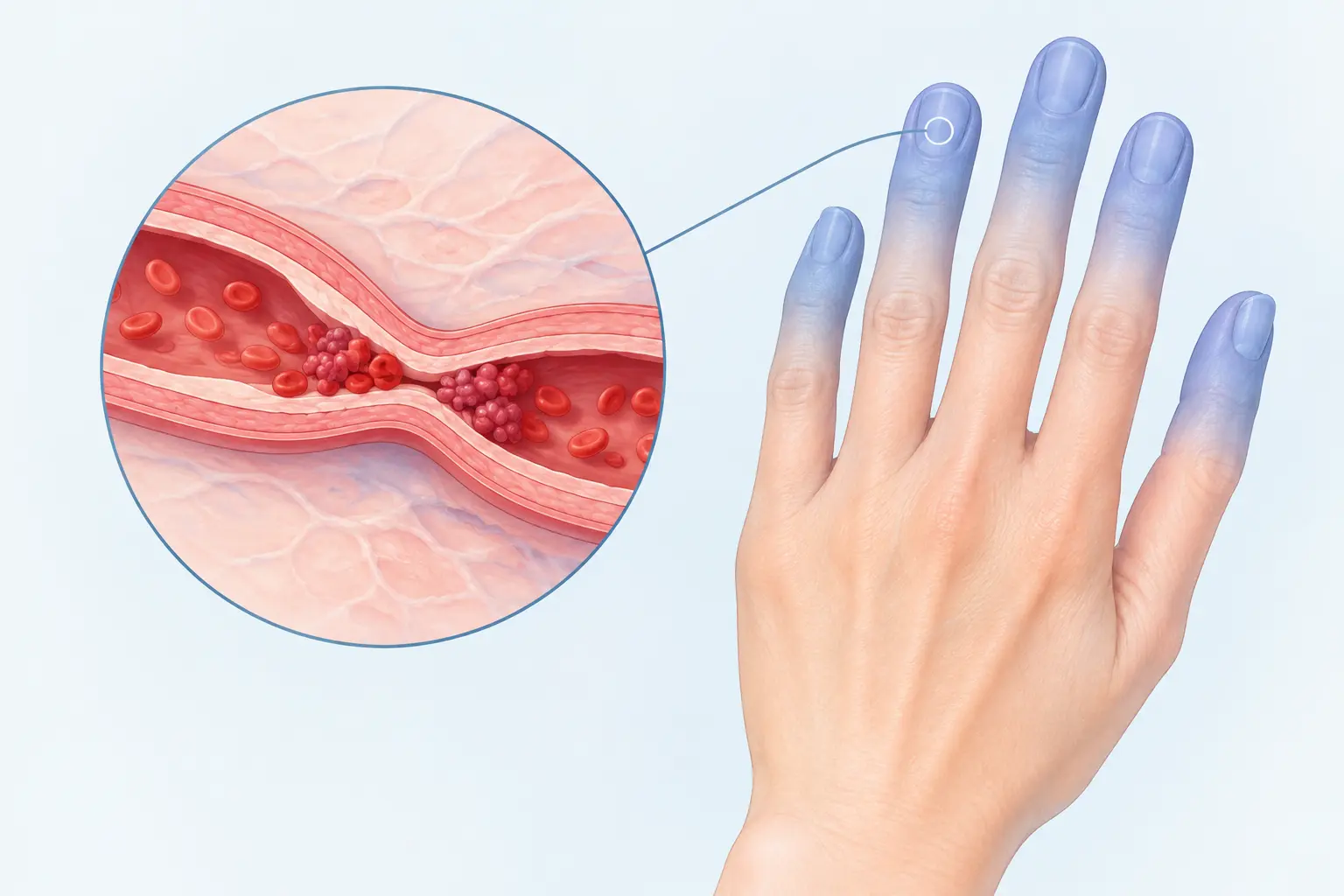
The National Organization for Rare Disorders (NORD) describes Buerger’s disease as a rare disorder that, in most cases, affects young or middle-aged male cigarette smokers. It is characterized by narrowing or blockage (occlusion) of the veins and arteries of the extremities, which reduces blood flow to those areas. The legs are affected more often than the arms.
The word “inflammatory” matters here. Buerger’s disease is not simply a build-up of fatty deposits, which is the picture most people have of clogged arteries. It involves inflammation and clotting in small vessels, and that is part of why the usual surgical fixes are often hard to apply. If you want to understand the more common leg-artery problem in smokers, our guide to smoking peripheral artery disease leg pain covers it, and it is a different disease.
NORD notes that the condition tends to occur in sudden (acute) episodes that may last from one to four weeks, and that it runs a recurrent course. In other words, a good week does not mean the underlying problem has gone away.
Who gets it
NORD describes Buerger’s disease as very rare, with onset of symptoms typically before 40-45 years of age. It reports that the incidence in the United States has been estimated at 12.6-20 per 100,000 people in the general population, and that the disease is extremely rare in the United States and Europe but more common in other parts of the world, especially in parts of Asia and the Far and Middle East. It also occurs with greater frequency in countries that have heavy tobacco use.
Historically it was seen overwhelmingly in men. NORD states that at one time the ratio of affected men to women was 100:1, and that recent medical articles have speculated the ratio may be 10:1 or closer. Some scientists have speculated this reflects more women smoking. A 2019 case report titled “Thromboangiitis Obliterans: Changing Demographics for a Preventable Disease” described a 46-year-old woman who had smoked since age fifteen, and noted that the patient population has been shifting to include more women, more non-Asian ethnicities and older people.
If you prefer to see the condition explained visually, this short educational video from Osmosis from Elsevier introduces Buerger disease.
Symptoms: claudication, Raynaud’s and ulcers
NORD lists the following features. In most cases, the first sign is extreme pain in the lower arms and legs while at rest. People may also get cramping in the legs when they walk, which in rare cases causes limping (claudication). The table summarizes what NORD describes.
| Feature | What NORD describes |
|---|---|
| Rest pain | Extreme pain in the lower arms and/or legs while at rest, often the first sign |
| Claudication | Cramping in the legs when walking that can, in rare cases, cause limping |
| Ulcers | Sores on the arms and legs; dry dark ulcerations on fingertips or toe tips may be extremely painful |
| Raynaud’s phenomenon | Lack of normal blood flow to fingers and/or toes in the cold |
| Thrombophlebitis | Inflammation and clotting of certain veins |
| Gangrene | Tissue death of affected limbs in severe cases |
Cold, pale or painful fingers and toes have many possible causes, and most are not Buerger’s disease. But a toe or fingertip sore that does not heal, pain at rest, or a digit that turns dark are reasons to be seen promptly by a doctor, not reasons to wait and see. If you are a smoker with these signs, tell the doctor that you smoke at the start of the appointment, because NORD notes that many physicians require a history of recent or current tobacco use before making the diagnosis.
Some people ask whether warming the hands or feet is enough. Warmth can be comforting, but it does not treat the underlying disease. If you want to understand how circulation changes once smoking stops, read our piece on circulation recovery after quitting cold hands.
Why tobacco is the cause
NORD states that the exact cause of Buerger’s disease is unknown, but that the use of tobacco is associated with the development of the disorder. In fact, most researchers believe that past or present use of tobacco products is a requirement for the diagnosis. The exact relationship is not completely understood. Some scientists believe the disease may be autoimmune, and NORD adds that trauma to the hands and feet may contribute in some cases and that genetic factors may play a role, because prevalence varies significantly between ethnic groups.
So the honest answer to “why does tobacco do this?” is that nobody can give you the full mechanism. What the evidence supports is the association and the practical consequence: people with this condition who stop using tobacco tend to do better than those who do not.
NORD also notes that in extremely rare cases people who did not smoke have developed Buerger’s disease, and that although most cases are associated with cigarette smoking, the disorder has also developed in people who used smokeless tobacco such as chewing tobacco. That point is worth remembering. Switching from cigarettes to another tobacco product is not a way out of the problem.
Quitting completely: the only proven treatment
NORD’s treatment summary is blunt. It says that treatment of Buerger’s disease is symptomatic and supportive, that symptoms usually improve if affected individuals stop smoking, and that in some cases, when individuals stop smoking, complete remission of the disorder may occur. It adds that if an affected individual does not stop smoking, treatment options should avoid premature or unnecessary surgery.
A 2022 review of therapeutic angiogenesis in Buerger’s disease, published in the medical literature and indexed on PubMed, makes a similar point from the treatment side. It states that patients typically present with limb claudication but symptoms may progress to rest pain and tissue loss, “especially in those unable to abstain from tobacco use,” and that traditional medical treatments are largely ineffective.
The word that keeps appearing is “abstain.” Cutting down is not what these sources describe. The treatment is stopping, and staying stopped. If you want a fuller picture of what changes in the body over time once you do, our what happens when you quit smoking complete health recovery guide walks through the timeline.
What “completely” means in practice
- No cigarettes, including “just one” after a stressful day.
- No cigars, pipes, hand-rolled tobacco or chewing tobacco.
- No plan that depends on a smaller number of cigarettes as a stepping stone unless your specialist has agreed to it and set an end date.
The aim is to take tobacco out of your day entirely, and to treat a slip as information rather than failure, then restart immediately.

Does nicotine replacement or vaping count?
This is the question people ask next, and it deserves a careful answer rather than a confident one. The sources I reviewed for this article do not settle whether nicotine replacement therapy (NRT) such as patches or gum, or vaping, is acceptable for someone with Buerger’s disease. NORD’s page describes tobacco as the associated factor and documents cases in smokeless tobacco users, but it does not address nicotine patches, gum or e-cigarettes. The research literature is also unclear on whether nicotine itself, or other substances in tobacco and smoke, drives the disease.
What this means for you:
- Do not assume that a nicotine product is safe for your condition just because it is not a cigarette.
- Do not assume it is unsafe either. This is a question for your vascular specialist or the doctor managing your care.
- Ask directly. “Is nicotine replacement acceptable for me, which type, and for how long?” is a reasonable question to bring to your appointment.
For general information about the NRT options your doctor may discuss, see best NRT options compared. Treat it as background reading, not as medical advice for this condition.
Amputation risk and quitting
Severe disease can end in amputation. NORD notes that in severe cases surgeons may be forced to remove (amputate) a finger or toe or part of an arm or leg, and that in severe cases people may have tissue death (gangrene) of the affected areas. The 2022 PubMed-indexed review mentioned above says a significant number of patients eventually require major amputation.
I am not going to quote an amputation percentage here, because the figures vary between studies, countries and stages of disease, and I did not find a single reliable number that applies to everyone. What the available sources do say consistently is that tobacco abstinence is central to avoiding that outcome.
A 2026 case report on wound care in two men with Buerger’s disease, indexed on PubMed, illustrates the point. Both men had about a 30-year smoking history, and both had toes affected; one had a toe amputated for demarcated necrosis and the other had a toe amputated and a wound that recurred. The authors concluded that in patients with this disease, best-practice wound care and smoking cessation are key practices for wound management and limb salvage. It is a small report of two people, not a trial, but it matches the broader message.
This is also where the heart and circulation picture matters. Smoking affects the whole vascular system, so quitting helps more than your hands and feet. Our guide to heart disease risk after quitting explains how that risk changes, and the smoking disease risk calculator 11 conditions page shows how to think about your broader risk picture.
Getting help to quit fast
If a doctor has told you that you may have Buerger’s disease, you are in a different position from most people who want to quit “someday.” The sources describe quitting as the treatment, so the question is not whether to stop, but how to make it stick.
Step 1: tell your care team you want to stop
Tell your vascular specialist or GP that you are quitting and ask what support they can arrange. Stop-smoking services, prescription medicines and counseling all exist. The right combination is a decision for you and your clinician, especially given the open question about nicotine products above.
Step 2: set a quit date and remove tobacco
Pick a date within days, not months. Throw out cigarettes, lighters and ashtrays the night before. Tell one person who will check in with you.
Step 3: plan for cravings
Cravings are short. Breathing exercises, a glass of water, a short walk or a call to a friend can carry you through the worst few minutes. Note what triggered the craving so you can plan around it next time.
Step 4: track what you gain
Seeing smoke-free days, cigarettes avoided and money saved can help on the harder days. Watching your own recovery milestones add up is a legitimate motivator, and a reason to keep going after the first week.
Bring a short list of questions to your next appointment:
- Is my diagnosis confirmed, and how was it confirmed?
- What is the safest way for me to stop using tobacco, including whether any nicotine product is appropriate?
- What signs should make me call you or seek urgent help?
- How should I care for my hands and feet day to day?
- How often do you want to see me while I quit?
Our free app can support the behavior side of this. iQuit lets you choose cold turkey or gradual reduction, log cravings with their triggers and intensity, use SOS tools such as breathing exercises and grounding when a craving hits, and keep a streak with shields and slip recovery, so one slip does not erase your progress. It supports your quit attempt; it does not diagnose or treat Buerger’s disease, and it does not replace your doctor.
Frequently Asked Questions
What is Buerger’s disease?
A rare disorder, also called thromboangiitis obliterans, in which the veins and arteries of the arms and legs narrow or become blocked, reducing blood flow. NORD says it mostly affects young or middle-aged male cigarette smokers, with legs affected more often than arms (NORD).
Can you get Buerger’s disease if you have never smoked?
It is extremely rare, but NORD reports that a few people who did not smoke have developed it. Most cases are linked to cigarette smoking, and some have occurred in people who used smokeless tobacco such as chewing tobacco (NORD).
Is Buerger’s disease reversible if I quit smoking?
NORD states that symptoms usually improve if affected people stop smoking and that complete remission of the disorder may occur in some cases. That is not a guarantee for everyone, so talk to your vascular specialist about your own outlook (NORD).
What are the first symptoms of Buerger’s disease?
NORD says that in most cases the first sign is extreme pain in the lower arms and legs while at rest. Other features include leg cramping on walking, ulcers on fingers or toes, and fingers or toes that react badly to cold (NORD).
Can nicotine patches or vaping be used with Buerger’s disease?
The sources reviewed for this article do not settle that question. NORD does not address nicotine patches, gum or e-cigarettes, so please ask your vascular specialist whether any nicotine product is appropriate for you (NORD).
Does Buerger’s disease lead to amputation?
It can in severe cases. NORD says surgeons may have to remove a finger, toe or part of a limb, and a 2022 review notes a significant number of patients eventually require major amputation, especially those unable to abstain from tobacco (PubMed, 2022).
How is Buerger’s disease diagnosed?
NORD says diagnosis can be based on characteristic physical features and symptoms, and many physicians require a history of recent or current tobacco use. Angiography or noninvasive tests may be used to confirm it (NORD).
Is cutting down on cigarettes enough for Buerger’s disease?
The sources reviewed describe stopping, not reducing. The 2022 review refers to patients “unable to abstain from tobacco use” doing worse, so the goal is complete cessation, ideally with support from your care team (PubMed, 2022).
Quit Completely, One Day at a Time
If tobacco is part of your circulation problem, the next step is to stop completely. iQuit helps you log cravings, use SOS tools and watch your smoke-free streak grow, on top of the care your doctor provides.