If you want to know how to quit nicotine, the honest answer starts with a question: which products are you actually using? Cigarettes, vapes, nicotine pouches and cigars all feed the same dependence, but the best exit route differs for each one. Most guides cover cigarettes only. This one is a single plan that works whether you use one product or several, and it is built around what the NHS, NICE and Smokefree.gov actually say rather than around hype.
Step 1: Measure your nicotine, product by product
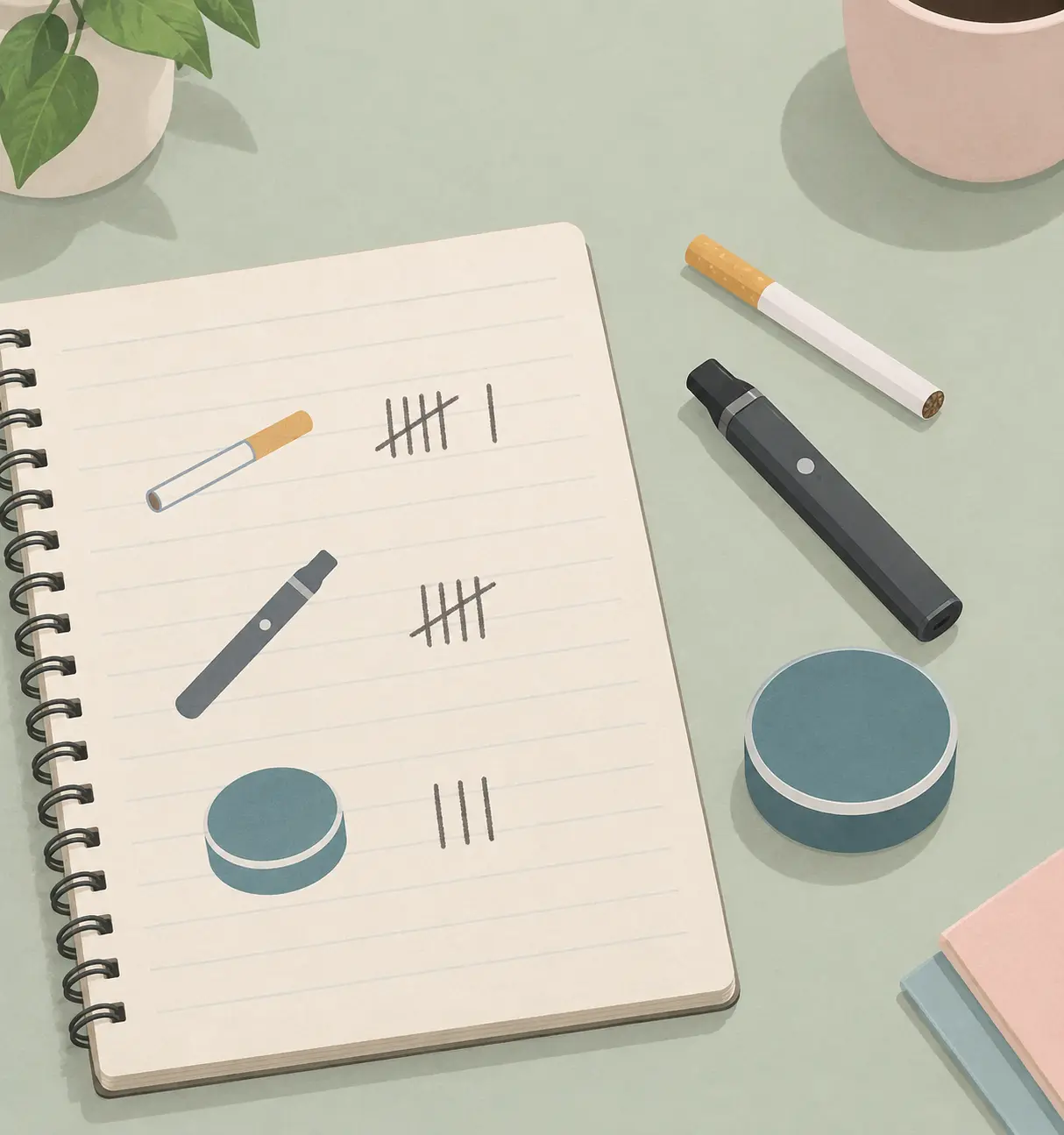
You cannot plan an exit from a habit you have not counted. For three days, write down every time you use nicotine: the product, the time, what you were doing, and how strong the urge was. Do not try to cut down yet. You are collecting evidence.
At the end of three days you want four numbers.
- Units per day for each product (cigarettes, puffs or pod refills, pouches).
- Time of your first hit after waking. An early first hit can signal stronger dependence, so plan for more support.
- Your top three triggers, such as coffee, stress, driving or alcohol.
- Your total spend per week across every product.
The NHS makes the same point about vaping: it advises starting at a nicotine level that matches how often and how much you smoke. Your log gives you that number. For a deeper look at triggers, the 8-week science-backed quit plan walks through the trigger map in detail.
Step 2: Choose cold turkey or a taper
There are two ways out, and neither is morally better. Cold turkey means you stop on your quit date. A taper means you step down over days or weeks. Pick the one you will actually follow.
When cold turkey tends to fit
- You use one product, and you can leave it behind completely.
- You have tried tapering before and kept drifting back to the old level.
- You want a clear line in the calendar.
When a taper tends to fit
- You vape all day, so a sudden stop leaves a large gap.
- You are worried that a hard stop will send you back to cigarettes.
- You want to practice handling cravings in smaller doses first.
For vaping, the NHS guide to quitting vaping describes three tapering levers: lower the nicotine strength (mg/ml) gradually, extend the time between sessions (for example from every 20 minutes to every 40), and create vape-free spaces. It adds a useful warning: if you find yourself vaping more, you may have reduced the strength too quickly. Our step-by-step vaping plan turns that into a weekly schedule.
For pouches, the same logic applies in principle, and the Zyn taper plan for nicotine pouches shows one way to step down. Treat any pouch schedule as a plan you adjust, because the official evidence on pouch tapering is limited.
Step 3: Choose your support
Willpower alone is the weakest tool in the box. Smokefree.gov says quit-smoking medications can double your chances of quitting for good, and the NHS says NRT is “safe, proven to work and can double your chances of quitting for good.” Both are about quitting smoking, and that matters for how you read the rest of this section.
The three kinds of support
- Nicotine replacement therapy. Patches, gum, lozenges, inhalers and sprays give lower doses of nicotine without the harmful chemicals in cigarette smoke. The NHS recommends using NRT for about 12 weeks, or for as long as you need it to avoid going back to smoking.
- Nicotine-free medicines. The NHS says combining NRT with a nicotine-free medicine makes you over 5 times more likely to quit for good. These are prescription medicines, so ask a doctor or a stop smoking service.
- Behavioral support. Smokefree.gov says combining NRT with counseling, such as telephone quitlines or text programs, can boost your chances. In the US you can text QUIT to 47848 for its SmokefreeTXT program.
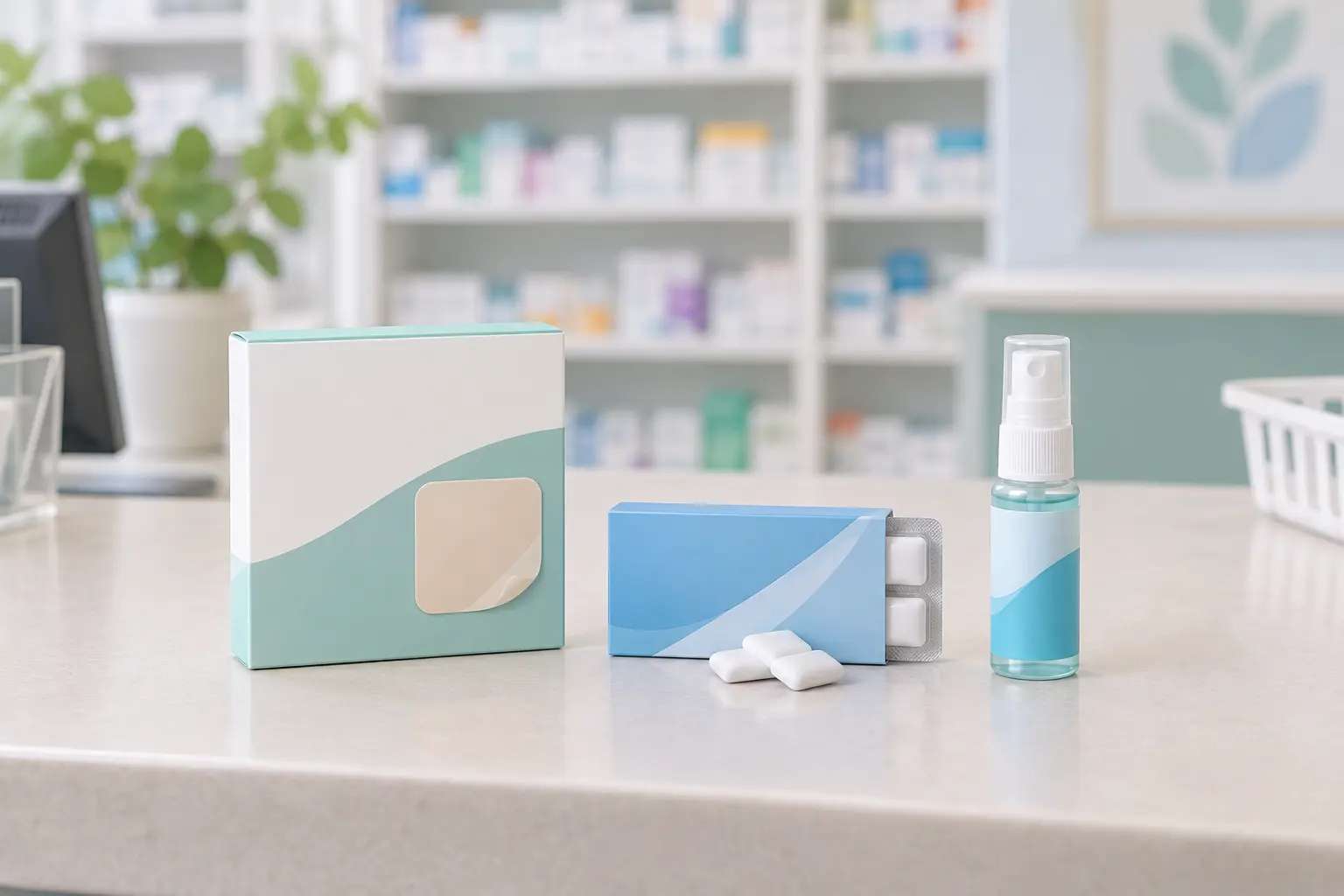
The NHS recommends combining a slow-acting product (a patch for steady background nicotine) with a fast-acting one (gum, lozenge, inhaler or spray) for sudden cravings. Our comparison of NRT options sets the products side by side.
If your product is a vape or pouch
Here the guidance gets narrower, and you deserve to know exactly where. For vaping, the NHS says that if you want to stop in one step you can ask a pharmacist or stop smoking adviser about a suitable NRT, and that right now Nicorette QuickMist is the only approved NRT for quitting vaping in the UK. It suggests combining it with a patch. For pouches, the NHS says they are not licensed stop-smoking products in the UK and that there is not yet enough evidence on how well they work for quitting smoking.
The US pages I checked describe NRT as a smoking cessation treatment and do not cover vape or pouch quitting. So in the US, using NRT to quit vaping or pouches is a conversation to have with a pharmacist or clinician, not something to improvise from a web page. That includes this one.
The guidance at a glance
| Product you use | What the guidance supports | What is still unknown |
|---|---|---|
| Cigarettes or roll-ups | Nicotine replacement therapy (NRT) can double your chances of quitting; combining a patch with a fast-acting product is recommended (NHS, Smokefree.gov). | Fewer gaps here, because most of the guidance is written for smoking. |
| Vapes | Taper by lowering e-liquid strength or lengthening the gaps, or switch in one step to NRT. In the UK, NHS guidance names Nicorette QuickMist as the only approved NRT for quitting vaping. | Official guidance for quitting vaping is thinner than for smoking, and approvals vary by country. |
| Nicotine pouches | Pouches are not licensed stop-smoking products in the UK, and the NHS says there is not yet enough evidence on how well they help people quit smoking. | Evidence on tapering pouches is limited, so treat any exact schedule as a plan, not a protocol. |
| Cigarettes plus a vape or pouches | Smoking is the harm to remove first. The NHS warns that any smoking is harmful and that you should only quit vaping if you can do it without smoking. | NICE lists dual use as an open research question, so there is no proven exit sequence. |
Notice how much of this is “we do not know yet.” That is not a reason to wait. It is a reason to pick the plan you can follow and to involve a professional for anything off the beaten path. The NHS page on NRT and Smokefree.gov guide to NRT are the two sources worth reading in full.
Step 4: Set a quit date
Choose a date within the next one to two weeks. Soon enough that motivation does not fade, far enough away to get your supplies and tell people. Avoid a day that is already a trigger, like a big party or a deadline.
Before the date arrives:
- Buy or arrange your support. If you are using NRT, have it in the house before day one.
- Clear the equipment. Clear out cigarettes, lighters, ashtrays, vapes, chargers, e-liquid and pouch tins. The NHS says vapes count as electronic waste, so take them to a recycling point instead of the bin.
- Tell two people. The NHS suggests letting friends or family know and teaming up with someone else who is quitting.
Step 5: Get through the first 72 hours
The NHS guidance on withdrawal says symptoms are usually strongest during the first week, and especially in the first 3 days. Common symptoms include strong cravings, trouble concentrating, restlessness, trouble sleeping, irritability, and feeling anxious or low. The NHS also notes that these symptoms do not last, and that they are a sign your body is starting to recover.
What to do when a craving hits
- Get moving. The NHS suggests a quick burst of activity to get your blood pumping.
- Remember it passes. A craving is temporary. Set a timer and wait it out.
- Keep your mouth busy. Carrots, celery sticks or sugar-free gum can help with the oral habit.
- Avoid triggers. The NHS advises staying away from places and situations that make you want to smoke for the first 28 days.
- Use your fast-acting product if you chose one. That is exactly what it is for.
For a full timeline of what to expect hour by hour, read the stages of nicotine withdrawal.
Where iQuit fits
iQuit is a quit-smoking app, and it is free on Google Play and the App Store. Its SOS craving tools include breathing exercises, grounding, craving surfing and a virtual cigarette for the moments a craving peaks. You can log each craving with its trigger and intensity, and craving forecasts help you prepare for your riskier times. It supports cold turkey and gradual reduction, so it matches either choice in Step 2.
Step 6: Weeks 1 to 4
The NHS says your goal is to reach 28 days smoke-free, because if you can do that, you are 5 times more likely to quit for good. On average, it says, withdrawal symptoms last 3 to 4 weeks, although some people feel them for longer, sometimes even for a few months. Plan for the long version and be pleasantly surprised if you do not need it.

Do not rush to drop your NRT. The NHS recommends about 12 weeks, and says you can reduce the dose gradually and eventually stop when you feel ready. If you want a second opinion on tools and apps while you wait, the comparison of the best quit smoking apps lays out what each one offers.
If you use more than one product
Dual use is common, and it is also the area where the evidence is weakest. The NICE tobacco guideline lists whether nicotine e-cigarettes are effective and safe for harm reduction when used alongside tobacco, the dual-use approach, as a recommendation for research. In plain terms, nobody can hand you a proven order of operations.
What the NHS pages do say points to a sensible rule of thumb.
- Remove smoking first. The NHS says any smoking is harmful and that you only get the full benefits of vaping if you stop smoking completely. It also says you should only quit vaping if you are confident you can do so without smoking cigarettes.
- Keep the lower-harm product as a bridge if you need it. The NHS says that if you have been vaping to stop smoking, going back to vaping is much better than starting to smoke again.
- Then quit the remaining product with its own plan. Use Step 2 and Step 3 again for the vape or the pouches.
This is a sequencing idea drawn from what the sources say, not a clinical protocol. If your situation is complicated, a pharmacist or a local stop smoking service can tailor it. Which brings us to something every plan should include.
A slip is data, not failure
The NHS is blunt that even one cigarette can pull you back into the cycle of cravings and withdrawal, and it advises avoiding even a single puff. It is just as clear that it is okay if it takes a few tries to quit for good. Both things are true. You protect the quit by taking slips seriously, and you protect yourself by not treating a slip as proof you cannot do this.
When a slip happens:
- Stop at one. The slip is the event, not the whole day.
- Write down what happened. Time, trigger, mood, who was there.
- Change one thing. Add a fast-acting product, move a routine, or ask for help.
- Restart the clock if you need to. Then keep going.
iQuit’s streak shields and slip recovery are built for exactly this moment, so one bad evening does not have to erase the progress on your dashboard. If you quit smoking before and relapsed, that experience is training for this attempt, and the NHS quit smoking hub has free tools too.
Frequently Asked Questions
Can I quit all nicotine at once?
Yes, many people stop every product on one date, which is cold turkey. It works best if you use one product and can remove it completely. If you use several, think about removing cigarettes first. Ask a pharmacist about support, because NHS guidance says NRT can double your chances of quitting smoking. (NHS)
How long do nicotine withdrawal symptoms last?
The NHS says symptoms are usually strongest in the first week, especially the first 3 days, and last 3 to 4 weeks on average. Some people feel them for longer, sometimes even for a few months. Cravings come in waves and each wave passes, so use a plan for the worst moments. (NHS)
Is cold turkey or tapering better for quitting nicotine?
No source I checked ranks one above the other, so choose the one you will follow. For vaping, the NHS describes tapering by lowering e-liquid strength, lengthening gaps between sessions and creating vape-free spaces, or stopping in one step with NRT. For cigarettes, NHS guidance centers on setting a quit date with support. (NHS)
Can I use nicotine patches to quit vaping or pouches?
In the UK, NHS guidance says Nicorette QuickMist is currently the only approved NRT for quitting vaping and suggests combining it with a patch. It says pouches are not licensed stop-smoking products. US pages on NRT describe it as smoking cessation treatment, so ask a pharmacist or clinician before using NRT for vaping or pouches. (NHS, Smokefree.gov)
What is the 28-day milestone?
The NHS says that if you reach 28 days smoke-free, you are 5 times more likely to quit for good. That statistic is about smoking, but the 4-week mark is a useful target for any product. Keep your support in place through day 28 and beyond, and avoid your biggest triggers while you get there. (NHS)
How long should I use nicotine replacement therapy?
The NHS recommends using NRT for about 12 weeks, or for as long as you need it to stop you from smoking again. When you feel ready you can reduce the dose gradually and eventually stop. Do not drop it early just because day 28 went well. (NHS)
What if I slip and use nicotine after quitting?
The NHS says it is okay if it takes a few tries to quit for good. If you were using a vape to stop smoking, it says going back to vaping is much better than starting to smoke again. Stop at one, note the trigger, adjust your plan and restart. (NHS)
Should I quit vaping if I also smoke cigarettes?
NHS guidance says you should only quit vaping if you are confident you can do it without smoking cigarettes. Smoking is the bigger harm, so it makes sense to remove cigarettes first. NICE lists dual use as an open research question, so ask a stop smoking service to tailor the order for you. (NHS, NICE)
Start Your Nicotine-Free Plan Today
You have a plan. iQuit is free on Google Play and the App Store, and its craving log, SOS tools, craving forecasts and streak shields can sit alongside your NRT or your vape taper. It supports cold turkey and gradual reduction, and slip recovery helps you restart after a slip. Download it, choose your quit date, and start your first 72 hours with a plan in your pocket.