
How iQuit Tracks Your Health Milestones and Money Saved (2026 Feature Guide)
Quitting smoking is one of the most significant health decisions a person can make, but the early stages feel far removed from the long-term benefits. Your lungs do not announce when they start recovering. Your wallet does not visibly grow thicker. That invisibility is part of what makes quitting hard to sustain — you are giving something up daily without a clear sense of what you are gaining.
The iQuit health milestone tracker and money-saved calculator exist to fix that problem. They turn the abstract benefits of quitting into something concrete and visible every time you open the app. This guide explains exactly how both features work, what each milestone represents biologically, and how the money counter is calculated — with UK, US, and Australian reference figures.
Setting Up Both Features
When you first open iQuit and enter your quit date, cigarettes per day, and local pack price, both features activate automatically. You do not need to configure them separately — they run from the moment your quit clock starts.
If you are quitting from today, you enter today’s date. If you have already been smoke-free for several days before downloading the app, you can backdate your quit date and the tracker will populate your milestones and savings retroactively.
The pack price input is important for accuracy. iQuit uses this figure — not a global average — to calculate your specific savings, so it is worth taking a moment to enter the real price you pay for cigarettes in your area.
The Health Milestone Timeline Explained
iQuit’s health milestones map your body’s recovery against well-established physiological checkpoints documented by health authorities including the NHS and the American Cancer Society. Here is what each major milestone represents:
| Time Since Last Cigarette | What Changes in Your Body |
|---|---|
| 20 minutes | Heart rate and blood pressure begin to drop toward normal levels |
| 8 hours | Carbon monoxide (CO) level in your blood falls to a normal range; oxygen levels improve |
| 48 hours | All nicotine has cleared from your body; nerve endings begin to regenerate, improving smell and taste |
| 72 hours | Bronchial tubes begin to relax; breathing becomes noticeably easier |
| 2 weeks to 3 months | Circulation improves; lung function begins to increase by up to 30% |
| 1 to 9 months | Coughing, sinus congestion, and fatigue decrease; lung cilia regrow and regain function |
| 1 year | Risk of coronary heart disease is roughly half that of a current smoker |
| 5 years | Risk of stroke falls to the same level as a non-smoker; mouth, throat, oesophagus, and bladder cancer risk is halved |
| 10 years | Risk of dying from lung cancer is about half that of a continuing smoker |
| 15 years | Risk of coronary heart disease is the same as a lifelong non-smoker |
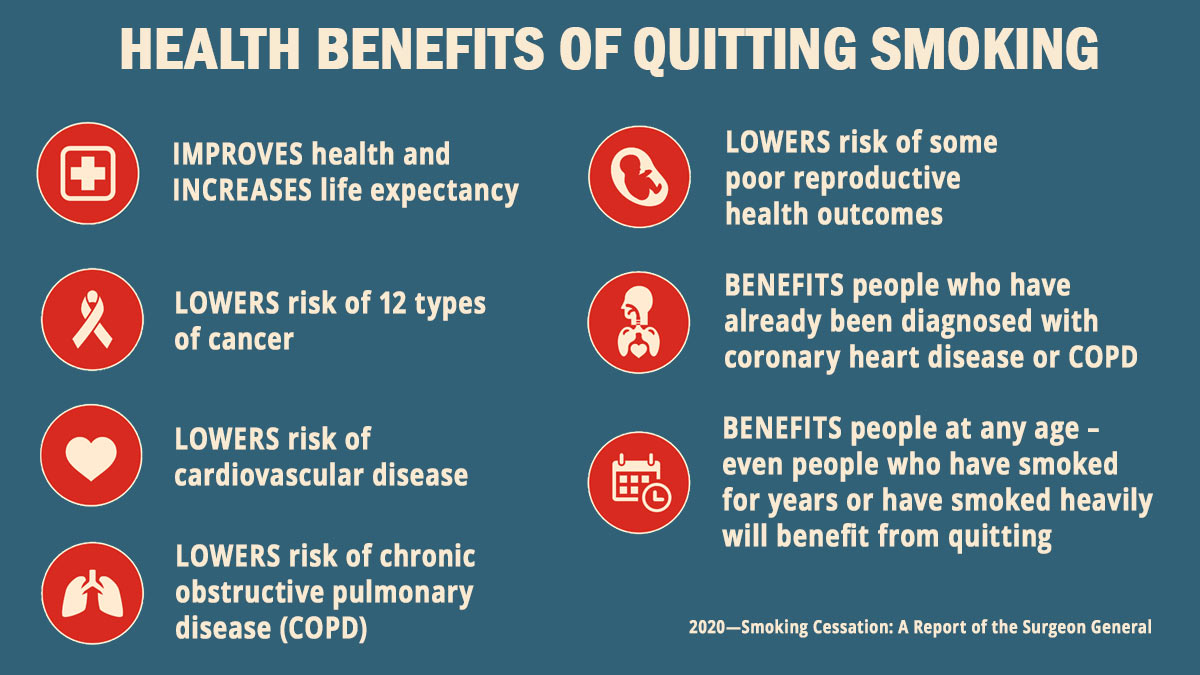
iQuit displays whichever milestone you are approaching next, so there is always a near-term target to work toward. This forward-looking framing is deliberate — it shifts focus from what you are giving up to what you are building toward. For a deeper look at the science behind each stage, the 10-year health recovery roadmap goes into considerable detail. To see how these milestones translate into your personal risk for specific conditions, try our disease-risk calculator (11 conditions).
Why Milestone Tracking Works Psychologically
Milestones are not just informational — they are motivational tools grounded in behaviour change science. The concept of “goal gradient” suggests that people increase effort and commitment as they approach a visible checkpoint. Knowing you are 14 hours away from the 48-hour milestone — when all nicotine clears your body — gives you a concrete short-term target that purely willpower-based approaches cannot provide.
iQuit’s milestone system also works as a loss-aversion mechanism. Once you have unlocked a milestone, going back to smoking means losing it. The cognitive weight of that loss — giving up a real marker of progress — can be a more effective deterrent than abstract health warnings.
The Money-Saved Counter: How It Works
iQuit’s money-saved counter calculates your financial savings in real time using a simple but accurate formula:
Cumulative saving = daily saving × smoke-free days
The counter updates continuously — not just daily — so you can see money accumulating in real time as the hours pass. This live feedback loop is psychologically distinct from seeing a weekly total: watching the number grow by the minute creates a more immediate sense of financial progress.
You set your cigarettes per day and pack price during onboarding. If either changes — for example, if cigarette prices increase or if you have been smoke-free long enough that the pack price has changed — you can update the inputs and the counter recalculates accordingly.
Real-World Savings Figures by Country
To give you a sense of what the counter will show at different time points, here are indicative figures for average smokers in key markets. These are based on typical cigarette prices and an average consumption of 15 cigarettes per day:
| Country | After 1 Month | After 1 Year | After 5 Years |
|---|---|---|---|
| UK | ~£230 | ~£2,750 | ~£13,750 |
| USA | ~$175 | ~$2,100 | ~$10,500 |
| Australia | ~AUD 470 | ~AUD 5,700 | ~AUD 28,500 |
These figures are indicative based on typical pack prices in each market and are for orientation purposes — your iQuit counter will reflect your actual inputs. For detailed country-by-country breakdowns, the quit smoking money saved calculator guide has thorough per-country data.
Using Both Features Together
Health milestones and the money-saved counter address two different motivational needs, and they are most powerful when used together. Milestones address the intrinsic motivation — your health, your longevity, your body recovering. The money counter addresses extrinsic motivation — the tangible financial reward that accumulates every day you stay smoke-free.
Some people are driven primarily by the health narrative. Others are more motivated by the financial reality. Most people find that both work, but in different moments: on a morning when you feel good and clear-headed, the health milestone reminds you why that feeling is growing. On a stressful evening when a cigarette feels tempting, seeing £400 in your counter might be the nudge that tips the balance.
The quit smoking rewards and milestones guide has practical ideas for how to mark your milestone achievements in ways that reinforce the behaviour change.
Beyond the Counter: What the Money Means
One technique that many iQuit users find effective is naming what the savings mean to them personally. A UK smoker who quits in January and sees £2,750 accumulate by December can link that figure to something real: a flight, a home improvement, a significant contribution to savings. When you can visualise the money counter as a specific tangible goal rather than an abstract number, the motivational pull becomes considerably stronger.
iQuit allows you to set a financial goal within the savings feature, so the counter shows both the cumulative amount saved and how close you are to your personal target. This goal-tracking framing has solid support in behaviour change research — concrete goals tied to visible progress outperform vague commitments to “save money.”
To understand the full financial picture of what smoking costs — beyond just pack prices, including healthcare costs and productivity — see the detailed breakdown in how much smoking really costs per year.
Frequently Asked Questions
Can I backdate my quit date in iQuit if I’ve already been smoke-free for a few days?
Yes. When you set up iQuit, you can enter any past date as your quit date. The milestone tracker and money-saved counter will populate retroactively from that date, showing you milestones you have already passed and the savings you have already accumulated.
Are iQuit’s health milestones medically verified?
The milestones iQuit uses are based on established physiological recovery data documented by the NHS, the American Cancer Society, and the CDC. They reflect real biological changes that occur after quitting, not invented milestones.
What happens to my milestone progress if I slip and smoke?
If you log a slip in iQuit, the app recalculates your timeline from your new smoke-free date. Your previous milestone history is preserved as a record of your progress, but the active counter resets. The app treats slips as data, not failure, and the AI coach supports recovery without shame.
Can I change my cigarettes-per-day figure if I was cutting down before quitting?
Yes. You can update your cigarettes-per-day figure in your iQuit profile settings. The money-saved calculator will recalculate based on your updated inputs. If you were cutting down gradually, entering your pre-quit average gives the most accurate financial baseline.
Does iQuit show health milestones for vaping cessation as well?
The health milestone timeline in iQuit is based on smoking cessation research. Many of the cardiovascular and respiratory recovery milestones also apply to nicotine cessation generally, but the specific physiological checkpoints (carbon monoxide normalisation, lung cilia regrowth) are most directly applicable to cigarette smokers.