
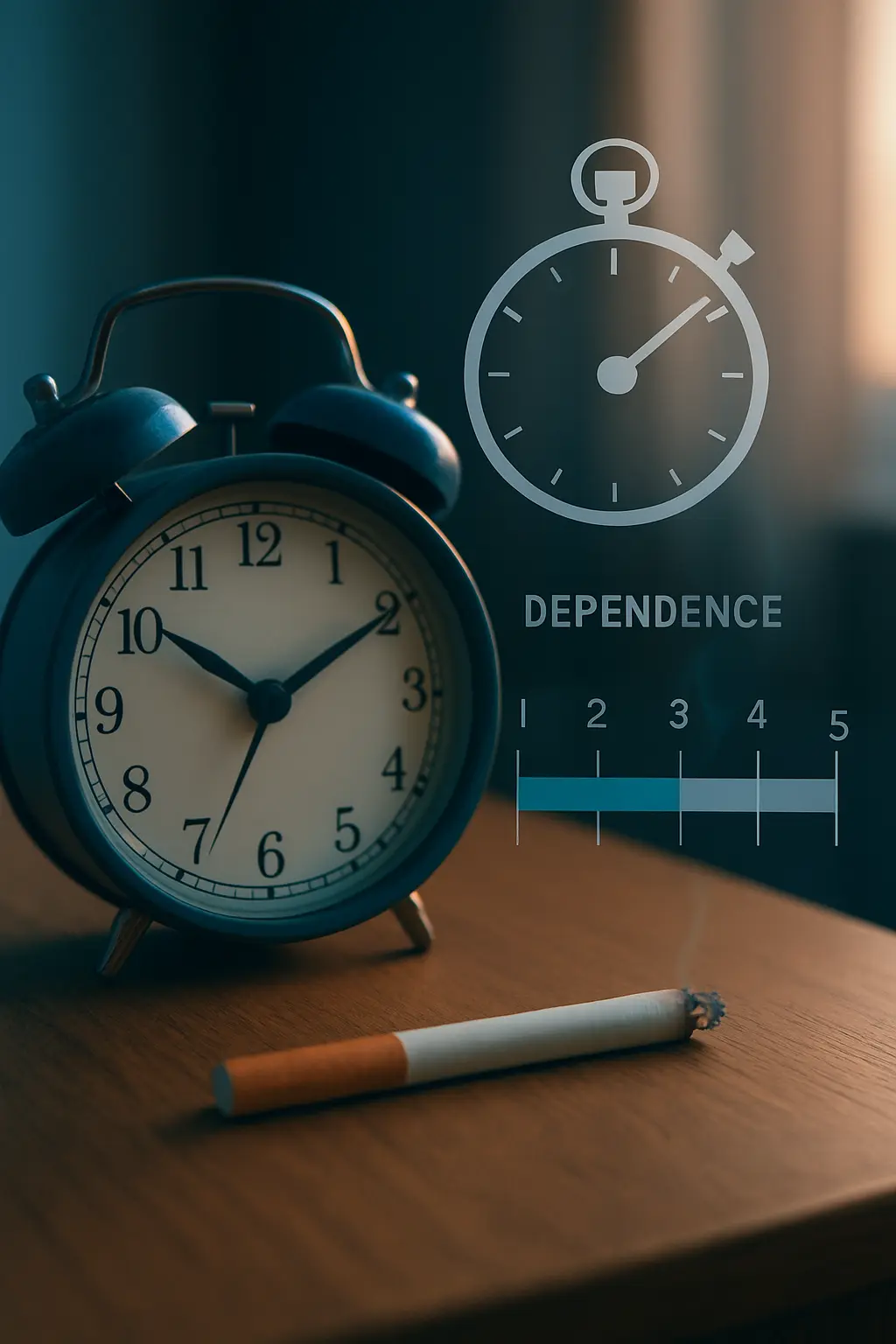
Addiction researchers can learn more from one question than from your entire smoking history: “How soon after waking do you smoke?” Time-to-first-cigarette (TTFC) — under 60 minutes, under 30, under 5 — predicts nicotine dependence, quit difficulty, biomarker toxin levels and even smoking-related cancer risk better than the obvious metric, cigarettes per day. Your morning number is a dependence test you’ve been taking daily for years without knowing. Here’s what the data says it means.
Why the morning tells the truth
Overnight is your longest nicotine gap — seven or eight hours of receptor emptying, uninterrupted. Daily cigarette count is polluted by lifestyle: meetings, bans, budgets, social pacing. But nobody schedules your 6:40am. How urgently your brain demands its refill after the overnight fast is a direct read on receptor adaptation — pure dependence, unfiltered by circumstance. That’s why TTFC anchors the Heaviness of Smoking Index and the Fagerström test, the standard clinical dependence measures.
What the research links to a short TTFC
- Harder quitting. Sub-30-minute smokers show markedly lower unaided quit success and stronger withdrawal in study after study.
- Deeper smoking. Short-TTFC smokers inhale more deeply and extract more nicotine per cigarette — their cotinine (nicotine metabolite) levels run higher at the same daily count.
- Higher toxin dose and cancer risk. Landmark analyses found smoking within 30 minutes of waking associated with significantly elevated lung and head/neck cancer risk versus later-morning smokers — independent of cigarettes per day. The morning urgency literally measures how hard you smoke each cigarette.
Read your own number
| TTFC | Dependence signal | Quit-planning implication |
|---|---|---|
| < 5 min | Very high | Treat as heavy dependence regardless of daily count; medical support strongly worth discussing |
| 5–30 min | High | Structured support + possible NRT; expect a loud first 72 hours |
| 31–60 min | Moderate | Behavioral tools usually sufficient; morning ritual still the key battle |
| > 60 min | Lower | Habit-dominant smoking; cue management is most of the fight |
TTFC is only one input into overall dependence, alongside things like craving intensity between cigarettes and withdrawal severity when you skip a day. For a fuller picture that combines these signals into a single score, our nicotine dependence test walks through the complete Fagerström-based assessment and what each score band means for your quit plan.
Using TTFC to build a smarter quit
- Calibrate honestly. A ten-a-day smoker with a 5-minute TTFC is more dependent than a twenty-a-day smoker who waits two hours. Plan for your chemistry, not your pack math — and expect the multiple-attempts statistics to apply more strongly at short TTFC.
- Fortify the morning first. Whatever your TTFC, the wake-up slot is your single strongest cue. Rebuild it deliberately — water before coffee, changed sequence, the morning mission structure — because winning the first hour reshapes the whole day.
- Shorten your TTFC’s shadow. If you’re pre-quit and reducing, pushing the first cigarette later each day is one of the few cut-down tactics with mechanistic logic: it retrains the highest-dependence moment directly.
- Match support to dependence. Short-TTFC quitters benefit most from combining behavioral support with NRT/medication — the pairing that consistently wins trials for heavy dependence.
Track the number that matters
The free iQuit app asks about your smoking pattern at setup precisely to calibrate to your dependence level — and its craving log will show you the modern echo of your TTFC: how loud your morning window still is, and how it quiets week by week. Watching your fiercest hour go silent is the dependence test running in reverse.
FAQ
What is TTFC?
Time from waking to first cigarette — the strongest single everyday indicator of nicotine dependence.
Is TTFC really better than cigarettes per day?
For predicting dependence, quit difficulty and per-cigarette toxin exposure, yes — daily count is lifestyle-distorted; the morning isn’t.
My TTFC is under 5 minutes — is quitting hopeless?
No — it means plan for high dependence: support plus NRT/medication, a fortified morning ritual, and realistic expectations for week one.
Does a long TTFC mean I’m not addicted?
Lower chemical dependence, typically — but habit-driven smoking still kills; the cues just matter more than the chemistry.
Whatever your morning number, plan the quit around it: download iQuit free on Google Play.