

A nicotine dependence test takes about ninety seconds and tells you something most smokers never measure directly: how tightly nicotine has its hooks in your body, not just your habits. The six-question Fagerström Test for Nicotine Dependence (FTND) is the tool clinicians actually use to decide whether someone needs a nicotine patch, a prescription medication, or can likely manage with willpower and a plan. Take it below, score it in under a minute, and use the result to pick a quit method that matches your actual dependence level instead of guessing.
Take the Test: The 6 Questions
The FTND is a revision of the older Fagerström Tolerance Questionnaire, published by Heatherton, Kozlowski, Frecker and Fagerström in the British Journal of Addiction in 1991, and it remains the standard instrument researchers and stop-smoking services use to grade physical nicotine dependence (NCBI Bookshelf, Table 4.2). Answer each question honestly based on your smoking in the last few weeks, and write down the point value as you go.

For a closer look at how nicotine dependence takes hold and what breaking it actually involves, this Mayo Clinic Health Matters podcast episode walks through the process with an addiction specialist.
| # | Question | Answer | Points |
|---|---|---|---|
| 1 | How soon after you wake up do you smoke your first cigarette? | Within 5 minutes | 3 |
| 6–30 minutes | 2 | ||
| 31–60 minutes | 1 | ||
| After 60 minutes | 0 | ||
| 2 | Do you find it difficult to refrain from smoking in places where it is forbidden? | Yes / No | 1 / 0 |
| 3 | Which cigarette would you hate most to give up? | The first one in the morning / All others | 1 / 0 |
| 4 | How many cigarettes/day do you smoke? | 10 or fewer | 0 |
| 11–20 | 1 | ||
| 21–30 | 2 | ||
| 31 or more | 3 | ||
| 5 | Do you smoke more frequently during the first hours after waking than during the rest of the day? | Yes / No | 1 / 0 |
| 6 | Do you smoke if you are so ill that you are in bed most of the day? | Yes / No | 1 / 0 |
Questions 1 and 4 use a 0–3 scale because how fast you reach for a cigarette after waking and how many you smoke in a day carry the most diagnostic weight. Questions 2, 3, 5 and 6 are simple yes/no items scored 0 or 1. Add all six together for your total.
How to Score Yourself
Total scores range from 0 to 10. Different services draw the lines in slightly different places, but the bands used most widely — and the ones the rest of this guide follows — are:
| Score | Dependence level | Typical implication |
|---|---|---|
| 0–3 | Low | Behavioral support and tracking may be sufficient |
| 4–6 | Moderate | Standard-dose NRT is usually recommended |
| 7–10 | High | Combination NRT or prescription medication is usually recommended |
These bands are a starting point for a conversation with a clinician or a pharmacist, not a diagnosis. A score of 4 and a score of 6 both land in “moderate,” but the person scoring 6 is closer to the high-dependence group and may want to plan accordingly.
A Worked Example: Two Smokers, Two Very Different Scores
Numbers are easier to trust once you see them applied. Take two people who both describe themselves as “a pack-a-day smoker”:
| Question | Smoker A | Smoker B |
|---|---|---|
| First cigarette | Within 5 minutes (3) | After 60 minutes (0) |
| Difficult to refrain where forbidden | Yes (1) | No (0) |
| Hardest cigarette to give up | First one in the morning (1) | All others equally (0) |
| Cigarettes per day | 20 (1) | 20 (1) |
| Smoke more in first hours | Yes (1) | No (0) |
| Smoke while ill in bed | Yes (1) | No (0) |
| Total | 8 — high | 1 — low |
Same cigarette count, wildly different dependence profile. Smoker A wakes up needing nicotine within minutes and struggles anywhere it’s restricted — a strong candidate for combination NRT or a prescription medication from day one. Smoker B smokes the same 20 cigarettes spread comfortably across the day with no urgency around the first one, which points toward a plan built more around routine-breaking and trigger management than pharmacology. This is exactly why “how many do you smoke” alone is a poor way to plan a quit attempt, and why the full six-question test earns its place over a single question.
What a Low Score (0–3) Means for Your Plan
A low FTND score usually means your smoking is driven more by routine, stress, or social cues than by a strong physical need for nicotine every hour. That doesn’t make quitting effortless, but it does change the toolkit: tracking your triggers, replacing the hand-to-mouth ritual, and building a support routine often matter more than pharmacology here. Many people in this band do well starting with a nicotine replacement option only as a backup for specific high-risk hours rather than a full daily schedule.
If you’re in this band, the biggest risk isn’t withdrawal — it’s underestimating how automatic some cigarettes have become. Logging every cigarette for a week before your quit date is one of the few things that reliably surfaces the “automatic” ones you didn’t know you had. Our guide to tracking your smoking for a week before you quit walks through exactly how to do this.
Moderate (4–6): Why You’ll Likely Need NRT
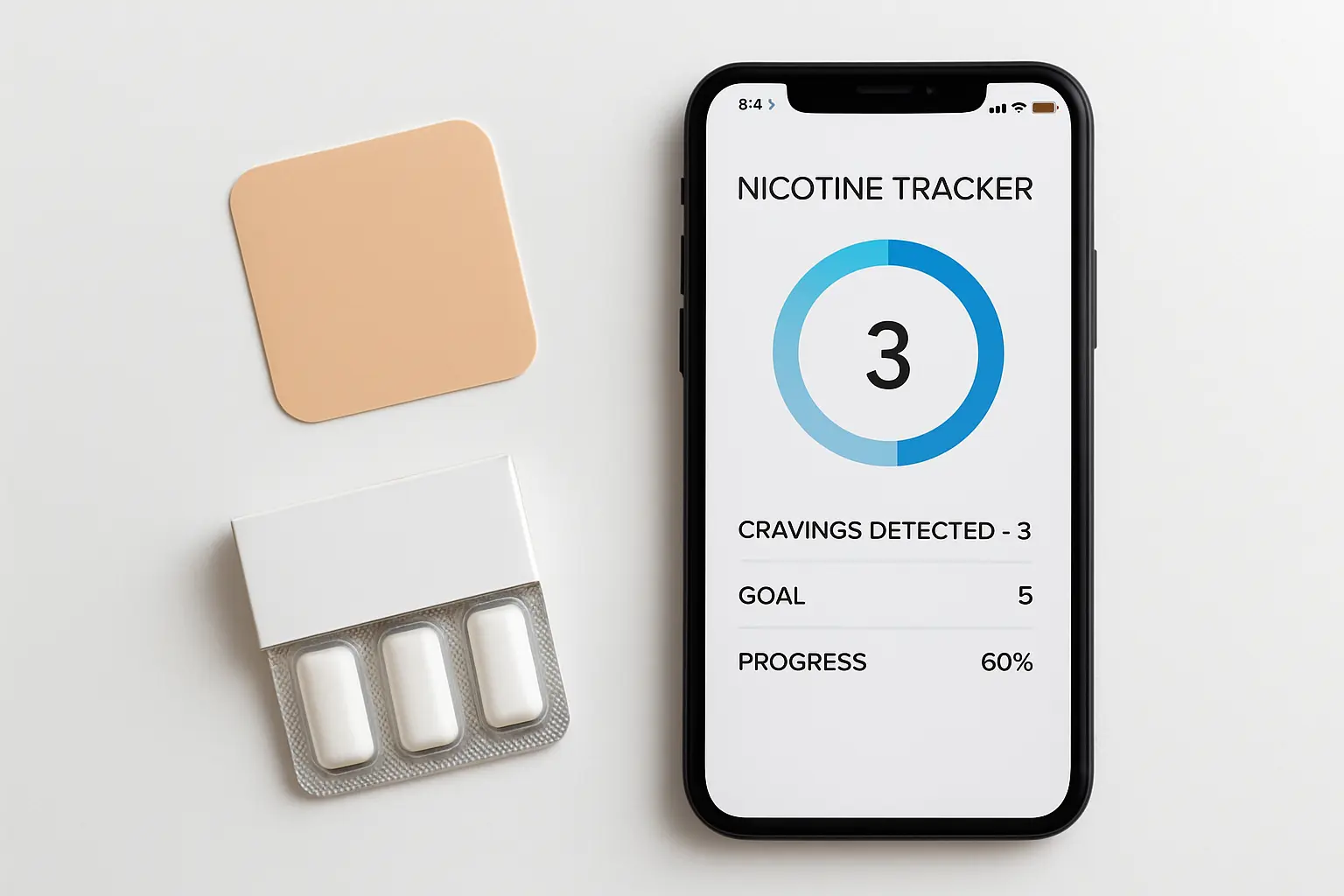
This is the largest band, and it’s where nicotine replacement therapy earns its reputation as the single most evidence-backed over-the-counter aid. At this level, quitting cold with no substitute puts you up against real withdrawal — irritability, poor concentration, and cravings strong enough to derail a quit attempt within days. A standard-dose patch plus a fast-acting form (gum, lozenge, or spray) for breakthrough cravings covers most people in this range; you can see how the options stack up in our nicotine replacement therapy comparison.
This is also the band where choosing the wrong method costs the most relapses. If you’re already using a patch and want extra support day to day, pairing it with a quit smoking app alongside patches and gum is a structured way to close that gap.
High (7–10): The Case for Combination NRT or Medication
A score of 7 or above means you’re likely smoking within minutes of waking, smoking heavily through the day, and finding it hard to go without in places where it’s banned. At this level, single-form NRT frequently under-delivers — the patch alone doesn’t spike nicotine fast enough for how often and how strongly cravings hit. Combination NRT (patch plus a fast-acting form) or a prescription medication such as varenicline or bupropion, taken under medical guidance, is generally the better starting point for this group than a single form of nicotine replacement on its own.
If you score in this range, it’s worth a short conversation with a doctor or pharmacist before your quit date rather than after a failed attempt. High dependence isn’t a character flaw — it’s a data point that tells you which tools to reach for first.
Whatever band you land in: a score is a snapshot, and the plan only works if you can see your pattern day to day. The free tier of iQuit logs every craving with its trigger and intensity, and its SOS tools — shake-to-SOS, box breathing, 5-4-3-2-1 grounding — are built for the moments a quiz can’t predict. It’s available on Google Play and the App Store.
Why Time-to-First-Cigarette Predicts More Than Pack Count
Of the six questions, “how soon after waking do you smoke” is the single strongest item on the test. When researchers took the FTND apart to see which parts were doing the work, they found that much of its predictive validity came from this first item, and that time-to-first-cigarette had greater validity than any other single measure — it appears to capture a pattern of heavy, uninterrupted and automatic smoking (Baker et al., Nicotine & Tobacco Research, 2007).
In practice that means someone who smokes 10 a day but reaches for the first one within five minutes of waking is often more physically dependent than someone who smokes 20 a day but waits an hour. It is also why two smokers with the “same” habit on paper can have very different quit experiences. Even people who use smokeless tobacco face a similar mismatch between habit and physical dependence — our piece on whether a quit smoking app can help you quit dip looks at how that plays out for chewing tobacco specifically.
What the Score Doesn’t Measure
The FTND is a well-validated tool for physical dependence, but it was built around cigarette smoking specifically, and it deliberately doesn’t measure everything that makes quitting hard. It doesn’t capture:
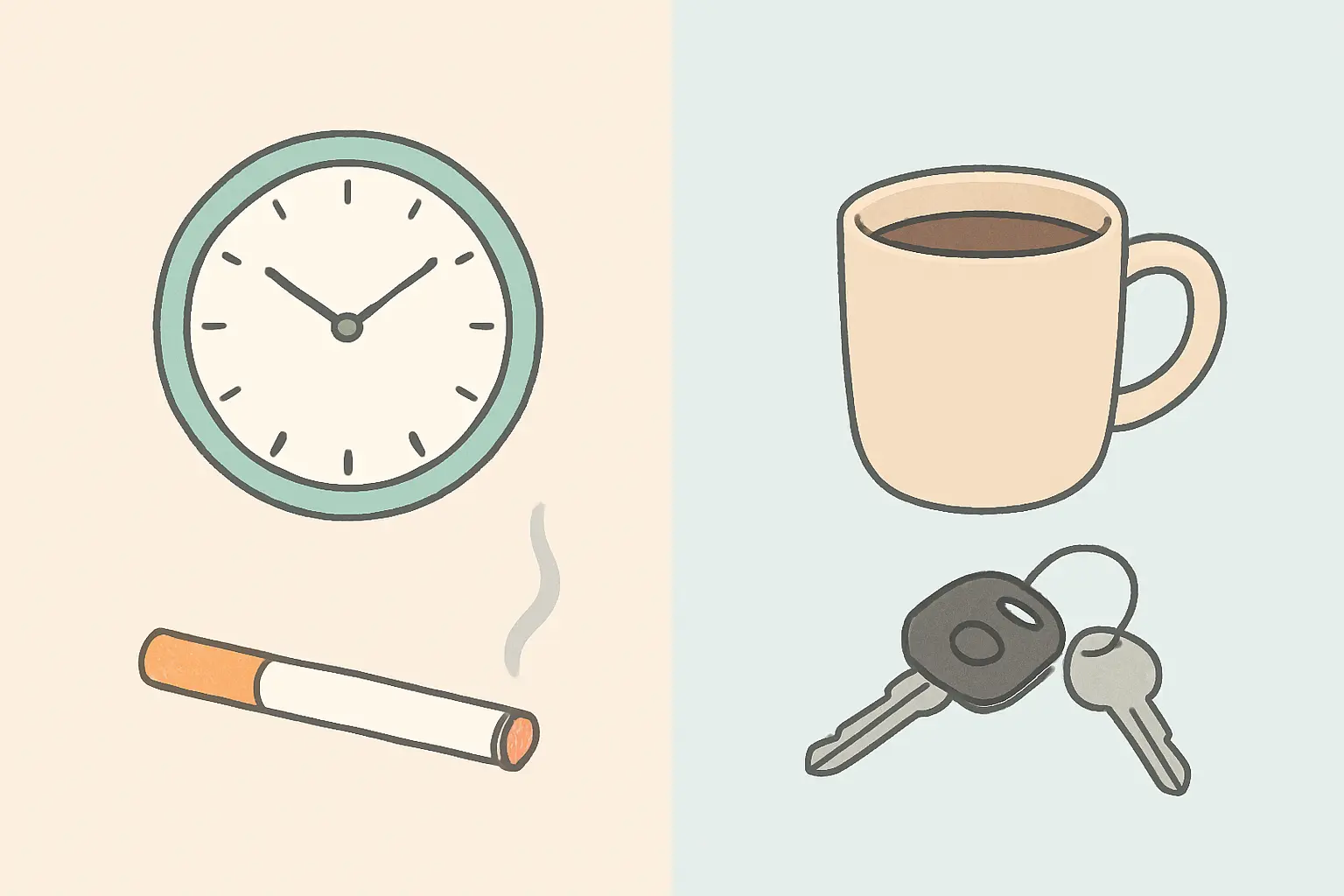
- Habit strength — the automatic, low-craving cigarettes tied to coffee, driving, or a work break
- Identity — how much smoking is tied to how you see yourself or your social group
- Specific triggers — stress, alcohol, boredom, or particular people and places
- Psychological cravings that persist long after the nicotine has left your system
This is exactly the gap that pairing a dependence score with day-to-day tracking closes. Logging when and why you actually smoke — not just how many — reveals the habit-driven cigarettes a one-time quiz can’t see. iQuit’s craving forecasts feature learns your risky hours over time so the app nudges you a few minutes before a habitual craving hits rather than after. The app has a free core tier and a Premium plan at $6.99/month, $39.99/year, or $79.99 lifetime after a 7-day trial; it is available on Google Play (4.3★) and the App Store.
Whatever your FTND score, pairing it with a week of honest tracking gives you a much fuller picture than either number alone. And if the score comes back higher than you expected, that is worth reading as information rather than a verdict — the CDC’s own explanation of why quitting smoking is hard is a physiological one, not a motivational one (CDC, Tips From Former Smokers).
Dependence Test FAQ
Is the Fagerström Test for Nicotine Dependence accurate?
It’s the most widely used and studied measure of physical nicotine dependence, and a reasonable indicator of how much support a smoker is likely to need. It doesn’t capture habit strength or psychological cravings, so treat it as one input alongside your own tracking, not a complete diagnosis (Heatherton et al., British Journal of Addiction, 1991).
What’s a “normal” nicotine dependence score?
There’s no single normal score — it depends entirely on how much and how you smoke. Most daily pack-a-day smokers land in the moderate (4–6) or high (7–10) band, while occasional or social smokers often score low (0–3). The score is meant to guide your quit method, not to be compared against other people.
Can vapers use this test too?
The original FTND was written for cigarettes, so questions about “cigarettes per day” don’t map cleanly onto vaping. Researchers have adapted versions for e-cigarettes that ask about puffs or pod use instead, but the core idea — time to first nicotine use after waking matters most — still applies.
Does a low score mean I’m not really addicted?
Not necessarily. A low score means your physical dependence, as measured by this specific test, is lower than someone scoring in the moderate or high band. You can still have a strong psychological or habitual attachment to smoking that makes quitting hard even with a low FTND score.
Should I retake the test after I’ve cut down?
Yes. The FTND reflects your current smoking pattern, so a score taken after weeks of gradual reduction can be meaningfully lower than your baseline. Retaking it partway through a taper is a useful, if informal, way to see whether your plan is actually reducing physical dependence.
What should I do with a high score before quitting?
Talk to a pharmacist or doctor before your quit date. A score of 7 or above is a reasonable trigger to discuss combination NRT or a prescription medication in advance, rather than discovering mid-quit that a single patch isn’t covering your cravings.
Can I just answer question one instead of the whole test?
Time-to-first-cigarette on its own is a strong single-item indicator, and researchers have used it that way (Baker et al., Nicotine & Tobacco Research, 2007). But the other five questions still add useful detail — particularly whether you smoke when ill and whether restricted places bother you, which say a lot about how hard your first smoke-free week is likely to be.
Does a high score mean I’m less likely to quit successfully?
It means you’re likely to face stronger withdrawal without support, not that you can’t quit. Plenty of heavily dependent smokers stop for good — usually with combination NRT or a prescription medication plus a plan for their trigger hours, rather than willpower alone.
Turn Your Score Into a Plan, Not Just a Number
iQuit logs your cravings, triggers and intensity from day one, learns your risky hours with craving forecasts, and gives you an SOS button for the moments a quiz can’t predict. Free to start on Google Play (4.3★) and the App Store.