

The single easiest first step toward quitting isn’t quitting — it’s spending a week learning exactly how to track your smoking before you quit. No commitment to stop, no NRT decision, no quit date pressure: just an honest log of every cigarette for seven days. That log turns out to be one of the most useful preparation tools there is, because it replaces guesswork about your own habit with actual data before you need to act on it.
Why a Baseline Week Doubles as Preparation
Most people who’ve thought about quitting have a rough mental estimate of their habit — “about a pack a day,” “mostly at work,” “worse when I’m stressed.” A baseline week replaces that estimate with an actual record, and the act of logging itself starts doing some of the work before you’ve changed anything: people who track tend to notice cigarettes they’d normally smoke on autopilot, simply because writing it down forces a half-second of awareness. Knowing your own triggers before quit day is one of the standard preparation steps recommended by Smokefree.gov, and our 24-hours-before quit day checklist assumes you already know your patterns — this is the step that gets you there.
Mayo Clinic clinicians run through the tools worth having lined up once your baseline week is done.
What to Log for Each Cigarette
Four fields are enough to make the week genuinely useful:
| Field | Why it matters |
|---|---|
| Time | Reveals your riskiest hours once you have several days of data |
| Place | Surfaces environmental cues (car, back porch, specific room at work) |
| Mood | Separates stress-driven cigarettes from routine ones |
| Need score (1–10) | The single most useful field — distinguishes a genuine craving from an automatic habit |
Logging takes about ten seconds per cigarette if you do it in the moment rather than trying to reconstruct the day from memory at bedtime — memory is unreliable here in a specific way, because the automatic cigarettes are exactly the ones people forget happened at all.

A Worked Example: One Real-Shaped 7-Day Log
Here is what a completed baseline week actually looks like. This is a composite example — an 18-a-day office worker who smokes at home in the mornings and evenings and outside at work in between — but the shape of it is typical enough to be worth reading closely before you start your own.
| Day | Total | First cigarette | Heaviest window | Most-logged mood | Average need score |
|---|---|---|---|---|---|
| Mon | 19 | 7:05am | 3–5pm (5) | Stressed | 5.4 |
| Tue | 18 | 7:10am | 3–5pm (4) | Stressed | 5.1 |
| Wed | 21 | 6:55am | 3–5pm (5) | Stressed / bored | 5.8 |
| Thu | 17 | 7:15am | 12–1pm (3) | Neutral | 4.6 |
| Fri | 22 | 7:00am | 9pm–midnight (6) | Relaxed / social | 4.2 |
| Sat | 16 | 9:40am | 9pm–midnight (5) | Relaxed / social | 3.9 |
| Sun | 13 | 9:55am | 7–9pm (3) | Bored | 4.0 |
Seven rows, about ninety seconds of reading, and already more information about this person’s habit than years of smoking it gave them. The weekly total is 126 — call it “a pack a day,” which is what they would have told you before the week started, and which turns out to be roughly right in volume and completely wrong about structure.
Reading Your Log: A Trigger-Analysis Walkthrough
Analysis sounds like a big word for what is really four questions. Ask them in this order at the end of your week.
1. Where does the volume actually sit? Add up your heaviest window across the whole week. Here, 3–5pm on weekdays accounts for around 17 cigarettes, and 9pm–midnight on Friday and Saturday another 11. Two windows, roughly 22% of a 126-cigarette week, both entirely predictable in advance. Those are the two hours that need an actual plan; the rest of the day mostly needs a routine change.
2. What separates the high-need cigarettes from the low-need ones? Sort your entries by need score rather than by time. In this log the 8s and 9s cluster in the weekday afternoon and are almost all tagged “stressed” — those are the genuinely craved cigarettes. The 2s and 3s cluster at the weekend evenings and are tagged “relaxed / social” — high in volume, low in need. That combination (many cigarettes, low need) is the classic signature of a habit cue rather than dependence, and it responds to changing the situation rather than to nicotine replacement.
3. Which cigarette is the anchor? Look at the first-cigarette column. Weekdays: 6:55–7:15am, every single day, inside twenty minutes of waking. Weekends: 9:40 and 9:55am — nearly three hours later, on the same body, with the same dependence. That gap is the single most useful line in the whole log, because it says the morning cigarette is welded to the alarm clock and the commute, not to a physiological need that arrives at dawn. A weekday-morning routine change is therefore likely to pay off out of proportion to the number of cigarettes involved.
4. What is the day-to-day range? 13 to 22 is a nine-cigarette spread — not noise. Wednesday and Friday are the outliers, and both have obvious causes in the mood column. Knowing your range matters when you pick a quit date: starting on a Wednesday, in this person’s week, would mean starting on their hardest day.
Write your four answers down in two or three sentences. That short paragraph — not the raw log — is what you actually carry into your quit plan.
Doing this on paper is fine. Doing it in an app means the analysis happens for you: iQuit’s free tier logs each craving with its trigger and intensity and turns a week of entries into risky-hour forecasts, so the 3–5pm block above would surface as a nudge before the craving rather than a discovery afterwards. Available on Google Play and the App Store.
What the Log Usually Reveals After 3 Days
By day three, most people can already see a shape in their data that wasn’t visible from memory alone: two or three time windows account for a disproportionate share of the day’s cigarettes, one or two specific moods (boredom, stress, or a specific social context) show up repeatedly, and a meaningful chunk of entries score low on the need scale — meaning they were closer to a reflex than a craving. Our data piece on how many cravings new quitters typically face is a useful benchmark to compare your own numbers against once you have them.
Three days is enough to see the shape, but not enough to trust it. Weekday and weekend patterns often differ so much — as they do in the log above — that stopping at day three would have hidden an entire second trigger window. Finish the week.
Finding Your Automatic vs Wanted Cigarettes
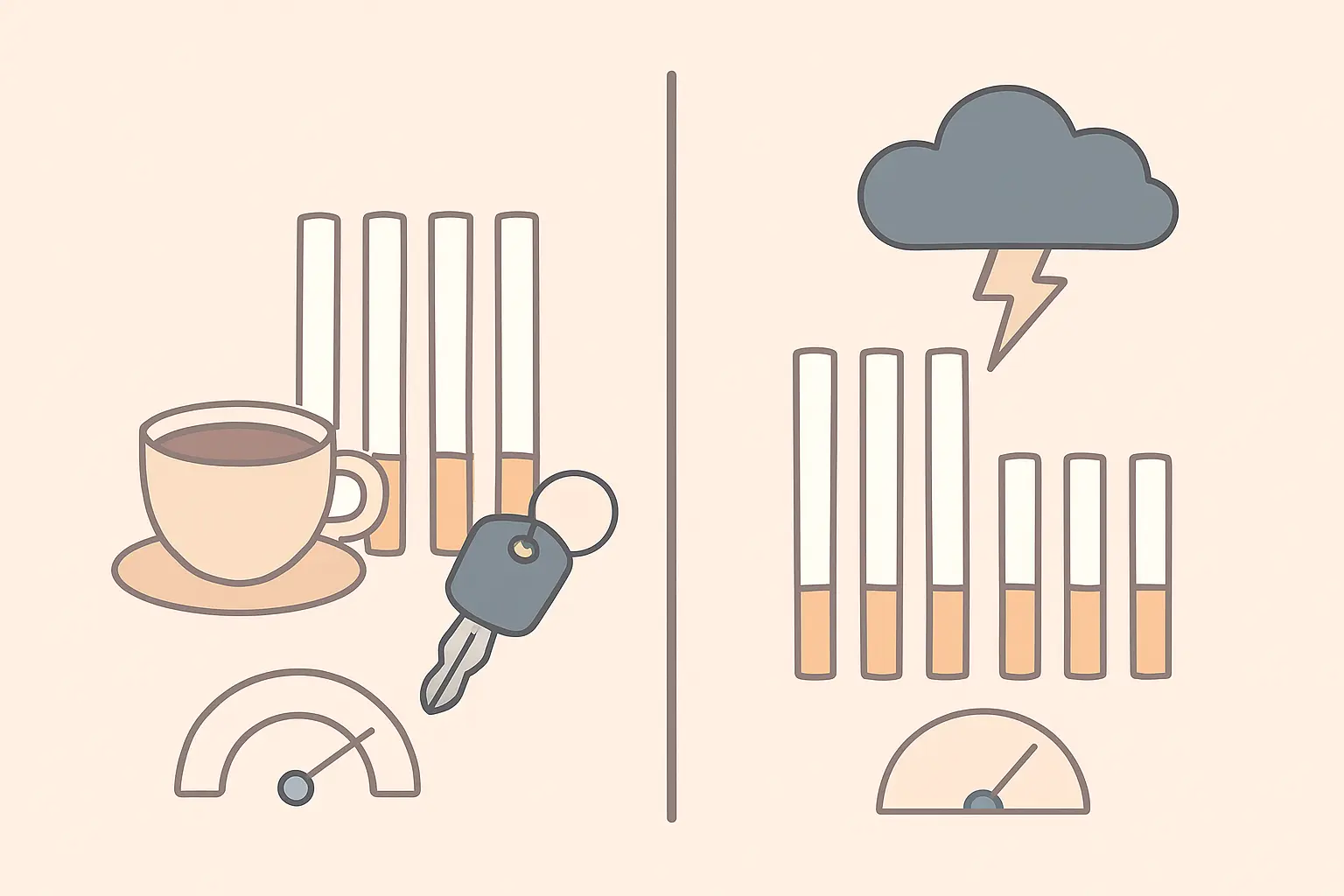
This is the single most actionable output of a baseline week. Cigarettes that score low on your need scale and cluster around a specific routine (coffee, driving, a work break) are automatic — driven by habit and cue, not by physical craving. Cigarettes that score high, especially the ones tied to stress or a specific difficult moment, are the ones your body is actually asking for. This distinction matters because the two categories respond to completely different interventions: automatic cigarettes respond well to routine changes and substitution, while high-need cigarettes are where NRT or another stop-smoking treatment or a craving-management technique earns its keep.
If almost everything in your log scores high, that is a dependence signal rather than a habit one, and it is worth checking against a scored measure — our nicotine dependence test takes about ninety seconds and points toward whether NRT or a prescription medication should be in your plan from day one.
Using the Log to Pick Your Quit Date
A week of real data lets you choose a quit date based on your own patterns rather than an arbitrary Monday. If your log shows your hardest stretch is a specific stressful workday, picking a quit date the day after that stretch (not during it) gives you a calmer first 24 hours. Our guide on setting a quit date that actually sticks covers the full decision process; a baseline week is what makes that decision informed rather than arbitrary.
Turning Trigger Hours Into an If-Then Plan
Once you know your top two or three trigger windows, build a specific plan for each one rather than a vague intention to “resist cravings.” For example: “If it’s 3pm and I’m at my desk, then I take a five-minute walk instead.” A concrete if-then plan tied to your actual logged trigger hours outperforms general willpower, because it removes the decision-making step at exactly the moment decision-making is hardest. Our piece on mapping your trigger hours goes deeper on building this out.
Two or three if-then rules is the right number. A plan with a rule for every logged cigarette is a plan nobody follows past Tuesday; a plan covering your two heaviest windows and your first cigarette of the day covers most of what actually goes wrong in week one.
Moving From Tracking to Quitting in the Same App
The advantage of tracking in the same app you’ll eventually use to quit is that your baseline week becomes your quit plan’s starting data rather than a separate exercise you have to translate manually. The iQuit app‘s free tier is built for exactly this: log your baseline week for free, and when you’re ready, the same trigger and mood data feeds into craving forecasts and the journal rather than starting from zero. It’s on Google Play (4.3★) and the App Store, with Premium at $6.99/month, $39.99/year, or $79.99 lifetime after a 7-day trial if you want deeper craving analytics once you’ve moved past the baseline stage. The journal feature is where the mood field from your baseline week keeps paying off well past week one.
Baseline Tracking FAQ
How long should a baseline tracking week actually be?
Seven days is enough to capture both weekday and weekend patterns, which often differ meaningfully. Three or four days can reveal early patterns, but a full week is more reliable for spotting your true trigger hours.
Won’t tracking make me smoke more because I’m thinking about it?
Most people report the opposite — the small pause to log each cigarette tends to reduce a handful of automatic ones simply by making them conscious rather than reflexive. It’s not designed to reduce your count during the week, but it often does anyway.
Do I need to already be planning to quit to do this?
No. Tracking is a genuinely low-commitment first step, useful even if you’re only considering quitting. It costs nothing to try and gives you real information either way.
What if my log shows almost every cigarette scores high on need?
That’s useful information too — it suggests higher physical dependence, which points toward NRT or a prescription medication playing a bigger role in your quit plan than routine changes alone. A scored dependence test is a good next step before setting a date.
Should I log cravings I resist, not just cigarettes I smoke?
If you can, yes — resisted cravings show you which triggers you already handle well, which is useful context once you move from tracking into an actual quit attempt.
What if I forget to log for half a day?
Note the gap rather than reconstructing it from memory, and carry on. One patchy afternoon in seven days barely affects the pattern; guessed entries do, because the cigarettes you forget are systematically the automatic ones you most need to see.
Paper notebook or an app — does it matter?
For the logging itself, no; whichever you’ll actually use in the moment wins. An app helps at the analysis stage, because sorting a week of entries by hour and by need score by hand is the step most people skip, and it’s the step that produces the plan.
Should I try to cut down during the baseline week?
No. The point is a true picture of your normal habit, and cutting down mid-measurement gives you a baseline you can’t plan against. If the count drops a little on its own because you’re paying attention, that’s fine — just don’t aim for it.
Start Tracking Before You Commit to Quitting
iQuit’s free tier is built for exactly this first step — log a baseline week, see your real patterns, and decide your quit date with actual data. Available on Google Play (4.3★) and the App Store.