
Most quit smoking apps are built and marketed around cigarettes — packs, cigarettes-per-day, ash. If you dip or chew, that mismatch can make it feel like there’s no tool built for you. There is, with one honest caveat: the tracking, craving-management and streak logic transfers cleanly to smokeless tobacco, but the counters and milestones were written for cigarettes, so you do a little translating. Here’s exactly how to set that up, what to track when there’s no pack count to log, and where a cigarette-shaped app genuinely won’t help.
Do Quit-Smoking Apps Work for Dip and Chew?
The core mechanics that make a quit app useful — logging urges, spotting trigger patterns, tracking a streak, giving you something to do for the few minutes a craving takes to peak and pass — don’t depend on how the nicotine gets into your body. What changes for smokeless users is the unit of measurement and the trigger profile: dip cravings are often tied to specific activities (driving, working outdoors, watching sports) more than to a smoke break, and the habit is oral rather than respiratory. Our guide on how to quit chewing tobacco covers the quit plan itself in depth; this piece is about the app layer on top of it.
One practical wrinkle worth naming up front: most apps ship with default assumptions built for cigarettes — a morning craving spike, a post-meal cue, an evening wind-down cigarette. Dip and chew don’t follow that same clock as reliably. A construction worker might dip almost entirely during work hours and not at all on weekends off; a long-haul driver’s pattern might cluster around driving shifts regardless of time of day. Overriding the default assumptions with your own logged data in the first week matters more here than it does for a fairly predictable cigarette schedule.
Mayo Clinic clinicians walk through how the risks of chewing tobacco compare with smoking and vaping in this short explainer.
What to Track When There’s No Pack Count
Cigarette apps default to “cigarettes today.” For dip, the workable equivalent is pinches or sessions per day, because dose varies far more by brand and cut than a cigarette does. A CDC laboratory analysis of six US commercial moist snuff products found mean total nicotine content ranging from 7.11 mg/g to 11.04 mg/g, with one outlier — Hawken Wintergreen — at 3.37 mg/g. Mean free (unprotonated) nicotine, the fraction most readily absorbed, varied far more dramatically: from 0.01 mg/g in that same Hawken product up to 6.23 mg/g in Copenhagen Snuff, tracking the products’ pH, which ranged from 5.24 to 8.35 (CDC MMWR, 1999).
That spread is the whole argument for tracking your own actual use rather than an assumed “average.” Two people using the same number of pinches a day, from different tins, can be taking in very different amounts of absorbable nicotine — which is exactly why a generic conversion to “cigarette equivalents” is guesswork and your own logged pattern isn’t.
Log three things from day one: tin size and brand (so your baseline stays consistent), pinches per day, and time-of-day patterns. That third one usually reveals the real structure of a dip habit faster than it does for cigarettes, because dip use tends to cluster tightly around a handful of specific activities rather than spreading evenly through the day.
What Transfers, What Doesn’t: An Honest Breakdown
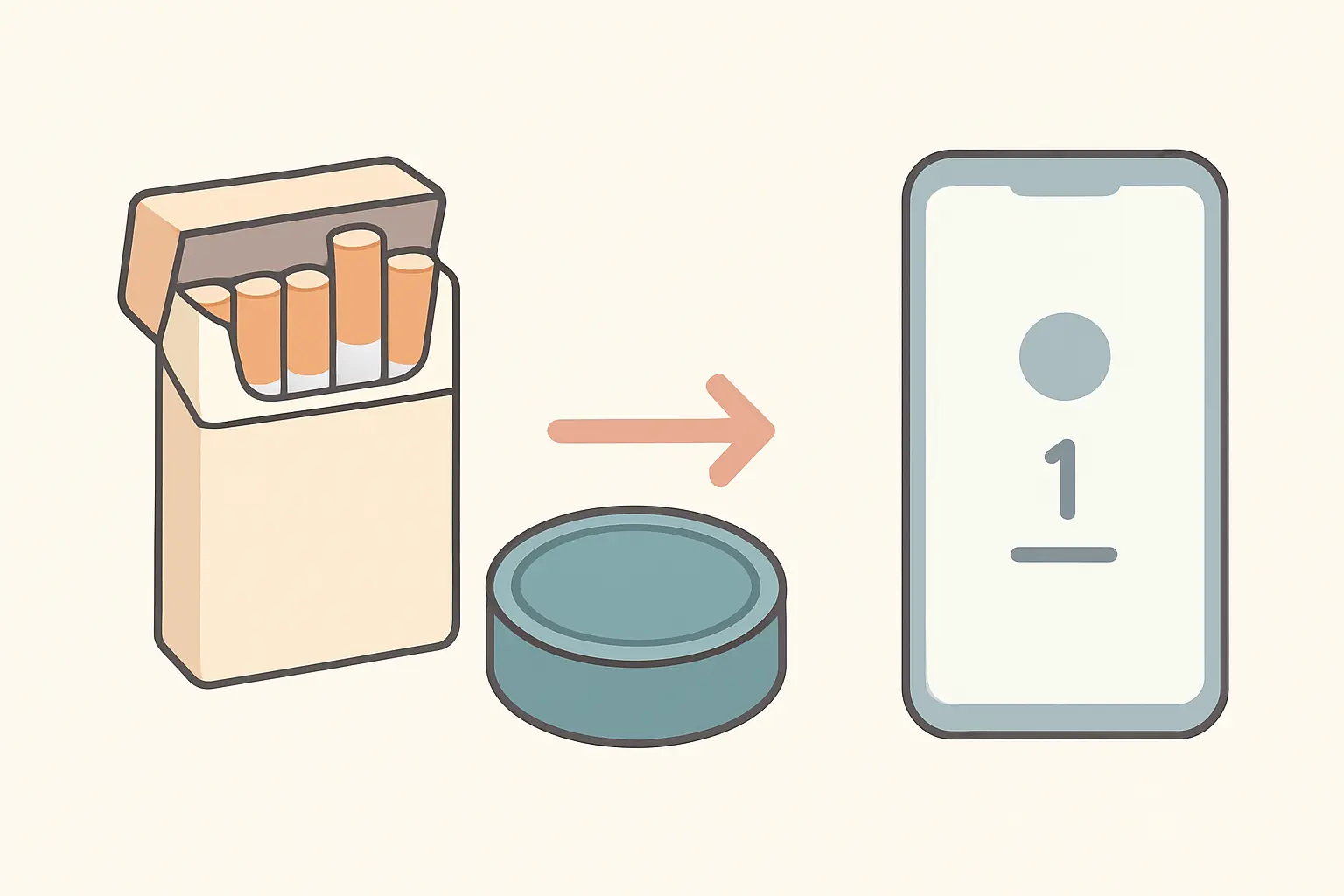
It’s worth being precise about this rather than selling you a tool that half-fits. iQuit, like almost every quit app on the market, was designed for cigarettes. Here is what that actually means in practice for a dip or chew user.
| Feature | Works for dip? | Notes |
|---|---|---|
| Craving log (trigger + intensity) | Fully | The single most useful part, and completely format-neutral |
| Predictive craving forecasts | Fully | Learns your risky hours from your own entries, whatever you logged |
| SOS tools (breathing, grounding, craving surfing) | Fully | Aimed at the urge, not the delivery method |
| Streak counter and slip recovery | Fully | Days nicotine-free is days nicotine-free |
| Mood journal | Fully | Where you record gum and mouth changes as informal milestones |
| Money saved | With translation | Priced per pack; enter your can price and read the number as a proxy |
| Cigarettes avoided / life regained (11 min per cigarette) | Partly | A cigarette-specific figure. Treat it as a motivational proxy, not a measurement of your own risk |
| Virtual cigarette | Partly | Occupies the hands; it does not address an oral cue directly |
| Lung and carbon-monoxide milestones | No | Genuinely cigarette-only — ignore these rather than measuring yourself against them |
Read that table as the honest version of “yes, it works.” Roughly two-thirds of what a modern quit app does is format-neutral, which is more than enough to be worth using — but nobody should tell you the cigarette counters mean something precise about a can of dip.
Money Saved: Tins vs Packs Math
Money tracking is the clearest example of “translate, don’t expect magic.” Set your baseline in the unit you actually buy — cans per week at your local price — and read the app’s saved-money figure as what it is: price × quantity, arithmetic that doesn’t care whether the product burns.
The arithmetic is worth doing by hand once, because it tends to be the first genuinely motivating number a dip user sees. A can a day at $6 is $42 a week and roughly $2,190 a year. Five cans a week at the same price is about $1,560 a year. Even two cans a week lands near $625. Dip’s cost rarely gets discussed the way cigarette prices do, so most daily users have never put a yearly figure on it — and a yearly figure is much harder to shrug off than a daily one.
The part that transfers perfectly is the craving log. iQuit’s free tier records each craving with its trigger and intensity and turns those entries into risky-hour forecasts — which, for a dip habit clustered around a shift or a drive, is usually more useful than any counter on the dashboard. Available on Google Play and the App Store.
Oral-Cue Tools That Work on a Phone
A cigarette habit is partly respiratory (the inhale, the exhale, the hand-to-mouth motion with a lit object); a dip habit is purely oral and often paired with a specific physical activity. That means the craving tools that transfer best from a cigarette-focused app are the ones addressing the urge itself rather than the inhale — breathing exercises, grounding, and craving surfing — combined with a physical oral substitute you supply yourself: sunflower seeds, gum, toothpicks, or a non-nicotine pouch. Our piece on beating the hand-to-mouth habit covers substitute options that map directly onto a dip craving. iQuit’s craving forecasts feature learns your specific trigger windows over time and nudges you a few minutes before a typical risky activity starts, regardless of whether the underlying habit is smoking or dipping (see the craving forecasts feature guide).

Health Milestones That Matter for Smokeless Users
Some of the standard quit-app milestones (lung capacity, carbon monoxide clearance) are cigarette-specific and won’t apply to a smokeless quit. The milestones that do apply and matter for dip users are oral and cardiovascular: gum tissue starting to heal, reduced mouth irritation and lesions, and the general cardiovascular recovery that follows any reduction in nicotine exposure — the FDA’s overview of smokeless tobacco products sets out which harms are specific to this category. Tracking these — even informally, in a journal entry rather than an automated milestone — gives smokeless users the same “visible progress” motivation that lung-recovery milestones give cigarette smokers.
A practical way to do it: once a week, write two lines in the journal. What your gums and the inside of your lip look and feel like, and whether anything has changed since last week. Any white patch, sore or lump that does not clear within a couple of weeks is a reason to see a dentist or doctor rather than to keep journaling about it.
Setting a Taper In-App
If you’re tapering rather than quitting outright on a fixed date, set your daily target as pinches-per-day or cans-per-week and step it down on a schedule, the same way a cigarette taper reduces a daily count — the structure is close to the one in our nicotine pouch taper plan. A four-week taper is a reasonable starting structure: track your true baseline for a few days first, then cut your daily target by roughly a quarter each week. iQuit supports gradual and scheduled-reduction quit methods alongside cold turkey, so the taper is a supported path rather than something you have to fake with a cigarette counter. The app’s job here is mostly to make the current number visible daily, since dip habits are easy to underestimate without a log — a few extra pinches during a stressful day rarely feel significant in the moment but add up over a taper week.
iQuit Setup for a Dip User, Step by Step
| Step | What to do |
|---|---|
| 1 | Log a baseline for 3–5 days before changing anything: brand, tin size, and average pinches per day, written in your journal so the numbers survive |
| 2 | Choose your quit method — cold turkey, gradual or scheduled reduction — rather than defaulting to the cigarette-shaped one |
| 3 | Enter your spend using the price you actually pay per can, and read the money-saved figure as a proxy |
| 4 | Log every craving with its trigger and intensity, naming the activity (shift, drive, game) rather than a time of day, so the forecasts learn your real pattern |
| 5 | Use the SOS toolkit during high-risk activities and keep a physical oral substitute within reach — the app handles the urge, you handle the mouth |
| 6 | Write a weekly journal line on gum and mouth changes, and ignore the lung milestones entirely |
All six steps sit inside the free tier. iQuit is on Google Play (4.3★) and the App Store, with Premium available at $6.99/month, $39.99/year, or $79.99 lifetime after a 7-day trial for anyone who wants deeper craving analytics on top. If you’re unsure how physically dependent your habit actually is, the nicotine dependence test is written around cigarettes but the underlying logic — how soon after waking you need nicotine, how hard it is to go without — transfers reasonably well to smokeless use too.
Dip App FAQ
Can a cigarette-focused quit app really help with dip?
Yes, for the parts that aren’t about cigarettes specifically. Craving logging, trigger pattern recognition, streak building, SOS tools and journaling all work regardless of whether the nicotine source is smoked or smokeless. The cigarette counters and lung milestones are the parts that don’t transfer.
How much nicotine is actually in a can of dip?
It varies significantly by brand. A CDC analysis of six US moist snuff products found mean total nicotine of 7.11 to 11.04 mg per gram, with one product at 3.37 mg/g; free nicotine — the readily absorbed fraction — ranged from 0.01 to 6.23 mg/g depending on the product’s pH (CDC MMWR, 1999).
What should I log instead of “cigarettes per day”?
Pinches or sessions per day, tin size and brand, and the activity you were doing when the craving hit. That last one matters more for dip than for cigarettes, since smokeless cravings tend to cluster tightly around specific activities rather than the clock.
Do the lung-recovery milestones apply to smokeless users?
No, those are cigarette-specific. The milestones that matter for smokeless users are oral (gum and mouth tissue healing) and cardiovascular, since nicotine exposure still affects the cardiovascular system regardless of delivery method.
Is tapering or quitting outright better for a dip habit?
Both work, and the right choice depends on your dependence level and daily use pattern, the same as for cigarettes. A tracked taper over about four weeks is a reasonable default if you’re unsure which to choose.
Does it matter if I chew loose tobacco instead of using pouched dip?
Not for app tracking purposes — log by pinch or session regardless of the format. Loose chewing tobacco tends to involve longer sessions and more spitting than pouched dip, so noting session length alongside frequency can be a useful extra data point for this format specifically.
Should I convert my dip use into “cigarette equivalents”?
It’s not worth taking seriously as a measurement. Nicotine content and, more importantly, the freely absorbed fraction vary several-fold between brands, so any single conversion factor is guesswork. Track pinches or sessions and watch your own trend instead — that number is real.
Will NRT help with dip, or is that only for smokers?
Nicotine replacement addresses nicotine withdrawal, which is the same withdrawal whichever product delivered it — but products are labeled for smoking cessation, so dose and suitability for smokeless use are a conversation for a pharmacist or doctor rather than something to work out from a packet.
Track Sessions, Triggers and Streaks — Whatever the Format
iQuit’s craving log, risky-hour forecasts, SOS toolkit and streak recovery all work the same for dip and chew as for cigarettes; only the counters were written for packs. Free to start on Google Play (4.3★) and the App Store.