
Dip, chew, and snuff don’t get the same quit-smoking advice that cigarettes do, which is a problem, because how to quit chewing tobacco is genuinely a different question. There’s no smoke, no lungs involved, and no daily pack count to track — but the nicotine keeps absorbing for as long as the dip sits in your mouth, and the craving is tied to your jaw and cheek in a way that gum and patches alone don’t always address.
If you’ve tried to quit dip before and found that standard nicotine replacement therapy (NRT) advice — built around cigarette smokers — didn’t quite fit, that’s not in your head. This guide covers what a can of dip actually delivers, why the oral habit needs its own substitutes, which NRT options suit smokeless users best, what withdrawal looks like week by week, and a four-week plan built around your actual pattern.
How nicotine from dip actually reaches you
Smokeless tobacco delivers nicotine differently from a cigarette, and the difference matters for quitting. The CDC confirms that smokeless tobacco contains nicotine and is addictive, and that the nicotine is absorbed through the lining of the mouth rather than the lungs. A cigarette delivers a fast spike that fades within minutes; a dip releases nicotine steadily for as long as it sits against your cheek, and absorption continues for a while even after you spit it out.
That slower, sustained pattern is why dip can feel less “hard-hitting” in the moment than a cigarette while still leaving you every bit as dependent. It’s also why some dip users underestimate their own dependence level — the lack of an obvious “count” (like a pack of 20) makes daily intake harder to track. Logging tins-per-week rather than trying to estimate nicotine directly is a more reliable way to see your real pattern, and it’s the same logic our nicotine dependence test scoring uses — the test works for any nicotine product, not just cigarettes.
| Factor | Cigarettes | Chewing tobacco / dip |
|---|---|---|
| How nicotine arrives | Fast peak through the lungs, then falls away | Slower, sustained absorption through the mouth lining |
| Easy way to count daily use | Pack count | Harder — track tins/week or dips/day instead |
| Primary craving trigger | Hand-to-mouth + smell + nicotine | Jaw/cheek placement + nicotine, minus any smell or smoke cue |
| Organ system most affected | Lungs, airway | Gums, oral tissue, jaw |
Here’s a short Mayo Clinic Minute on the health risks smokeless tobacco carries and why quitting matters:
Why dip cravings are oral, not just chemical
A cigarette craving is partly about nicotine and partly about a whole ritual — lighting up, inhaling, exhaling, the visible smoke. Dip strips almost all of that away except one thing: the physical sensation of having something placed against your gum or cheek for an extended period. That’s a powerful, specific cue, and it’s one reason plain nicotine gum (which you chew briefly, then park) doesn’t always satisfy a dip craving the way it satisfies a cigarette craving — the placement and duration are different from what your mouth has learned to expect.
This overlaps with, but isn’t identical to, the general hand-to-mouth habit smokers describe. Our guide on beating the oral fixation of smoking covers the broader mechanism, but dip users specifically need a substitute that sits in the same place in the mouth for a similar amount of time — not just something to hold or chew quickly.
Taper vs. quit date for dip users
Both approaches work, and the right one depends on your daily pattern. If you use dip constantly through the day (a “one long dip” pattern), a hard quit date with NRT support from day one tends to work better, because gradually reducing frequency is hard to define when there’s no clear “next cigarette” moment to skip. If you have distinct, countable dips per day, a taper — cutting one dip per day over one to two weeks before your quit date — can reduce the size of the withdrawal dip you’ll face on day one.
Whichever you choose, setting an actual date and preparing for it in advance measurably improves outcomes; our guide to setting a quit date that actually sticks applies just as well to dip as to cigarettes, since the planning principles (removing supply, telling someone, picking a lower-stress week) are product-agnostic.
Substitutes that work
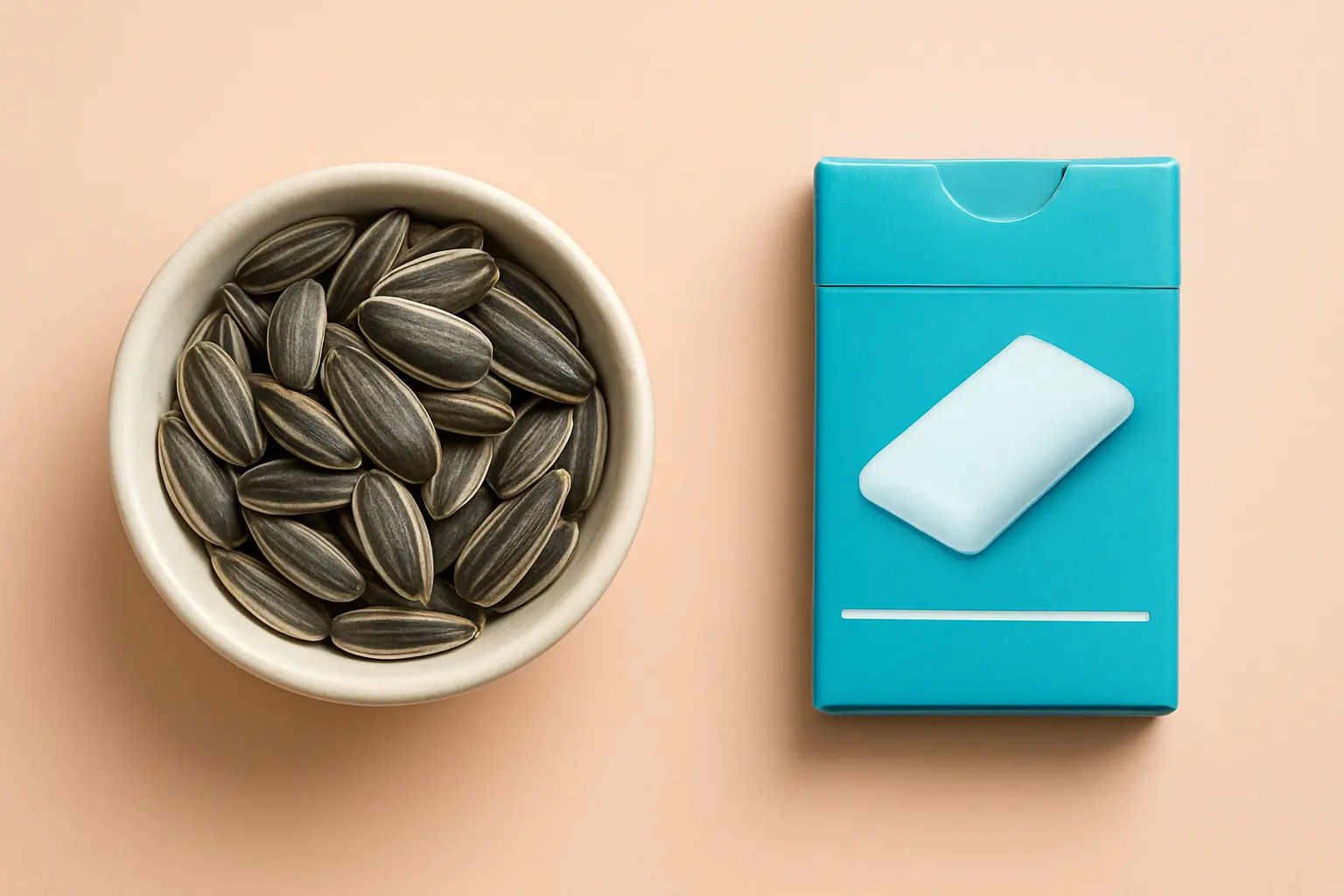
The goal is to give your mouth something to do in roughly the same place and for roughly the same duration as a dip, without nicotine or tobacco.
- Non-nicotine pouches: herbal or flavored pouches that sit in the same cheek position as dip, without nicotine or tobacco, are the closest sensory match available.
- Sunflower seeds: a genuinely popular substitute among people quitting dip specifically, because they occupy the mouth for an extended, repetitive session similar to a dip.
- Beef jerky or tough gum: gives a longer chewing session than regular gum, which better matches the duration cue than a quick stick of gum.
- Toothpicks or cinnamon sticks: lower-effort options for moments you just need something in your mouth without a real chewing session.
None of these replace NRT if you’re nicotine-dependent — they solve the placement and ritual craving, not the chemical one. Using a non-nicotine substitute alongside proper NRT dosing, rather than instead of it, is what actually holds up over four weeks.
Which NRT suits an oral habit
The evidence base for NRT in smokeless tobacco users is much smaller than the very large one for cigarette smokers, and it comes with real caveats. A 2025 systematic review in Tobacco Prevention & Cessation, The effectiveness of nicotine replacement therapy on oral smokeless tobacco cessation and reduction rate, concluded that NRT can aid smokeless tobacco cessation, and that combining NRT with other interventions — such as coach calls and web-based interactive support — can enhance abstinence rates. The same review cautions that the evidence, while promising, is limited by study variability and inconsistent outcome reporting.
Two practical things follow from that. First, don’t expect NRT alone to carry the quit: pairing it with tracking, coaching, or a structured program is the part the review actually singles out. Second, since the trials don’t cleanly rank one format above another for smokeless users, choose the form that fits how your habit behaves.
- Nicotine lozenges are a natural fit for most dip users: they dissolve slowly in the mouth, which loosely mirrors the duration cue of a dip, while delivering a steady, on-demand nicotine dose.
- Nicotine patches cover the steady background craving through the day without any oral action at all, which suits constant, all-day dippers who would otherwise be reaching for something hourly.
- Nicotine gum adds jaw movement and a fast on-demand option, and many people use it as a secondary product alongside a lozenge or patch base rather than on its own.
See our full NRT options compared guide for strength tiers and how to combine forms, and the fastest-acting NRT comparison if you need something for sudden, sharp cravings on top of your base dose.
What dip withdrawal feels like, week by week
Nicotine withdrawal is the same chemistry whether the nicotine came from smoke or from a pouch under your lip, so the general shape of the timeline holds: symptoms usually begin within the first day, peak in the first few days, and ease substantially over the following weeks. What differs for dip users is which symptoms stand out.
- Days 1–3: Irritability, restlessness and difficulty concentrating are usually sharpest here, and the physical “empty mouth” feeling can be more distracting than the nicotine craving itself. Start your NRT on day one rather than waiting to see how bad it gets — catching up on dosing later is harder than starting at the right level.
- Days 4–10: The acute edge comes off, but jaw restlessness and the urge to put something in your cheek persist. This is where the non-nicotine substitute earns its place; keep seeds, herbal pouches or tough gum within arm’s reach at the trigger moments you identified.
- Weeks 2–4: Cravings become shorter and further apart, and mouth soreness often starts improving. Sleep and mood usually settle in this stretch. Resist stepping your NRT down purely because the calendar says so — step down when cravings have genuinely thinned out.
- Beyond week 4: What’s left is mostly cue-driven: the truck, the job site, the fishing trip, the third inning. Those respond to planning and substitution rather than to dose changes.
If a symptom feels severe or persists well beyond this window — especially low mood that doesn’t lift — that’s worth raising with a doctor rather than pushing through alone.
Your mouth after quitting: gums, lesions, healing
Smokeless tobacco causes direct, localized damage to the gum and cheek tissue where it sits — receding gums, white or gray patches called leukoplakia, and increased risk of gum disease are all documented effects, and the CDC confirms smokeless tobacco causes cancer of the mouth, esophagus, and pancreas in addition to gum disease and tooth loss. The good news: once you stop, mouth sores typically begin healing, taste and smell recover, and further gum recession slows or stops. Full healing of any leukoplakia patches should be checked by a dentist, since some patches persist and need monitoring even after quitting.
Our data on smoking and gum disease covers periodontal recovery timelines in more depth, and while that piece focuses on cigarette smoking, the healing mechanism — reduced local irritation and improved blood flow to gum tissue — applies to quitting dip as well.
Week-by-week 4-week plan
- Week 1: Set your quit date, start your NRT (lozenge or patch based on your pattern), and stock your chosen non-nicotine substitute (seeds, herbal pouches, or tough gum) before day one, not after.
- Week 2: Track cravings by time and place rather than trying to remember them later — this is where a habit-loop becomes visible (car, break room, after meals are common dip triggers).
- Week 3: Reassess your NRT dose. If cravings are still frequent and sharp, step up strength or frequency rather than assuming the method has failed.
- Week 4: Begin planning a taper off NRT only if cravings have clearly dropped in frequency and intensity; otherwise, hold your current dose for another week or two before stepping down.
Seeing your smoke-free days, your money saved, and your craving log fill in gives dip users the same visible progress a cigarette quitter gets from a pack-a-day counter — logging each craving with its trigger and intensity in the iQuit app is what turns “I just want a dip” into a pattern you can plan around, and it’s exactly the kind of behavioral support the review above found adds to NRT.
Dip quit FAQ
Is quitting chewing tobacco harder than quitting cigarettes?
Not necessarily harder, but different. Nicotine from dip is absorbed through the lining of the mouth and keeps arriving for as long as the dip is in place, rather than spiking and fading like a cigarette, and the craving is tied to a specific oral placement and duration that cigarette-focused advice doesn’t address well.
What’s the best NRT for quitting dip?
A 2025 systematic review in Tobacco Prevention and Cessation found NRT can aid smokeless tobacco cessation but did not cleanly rank the formats, noting the evidence is limited by study variability. Choose by habit: a lozenge mirrors a dip’s duration, a patch covers all-day use, and gum works as a fast on-demand add-on.
What can I use instead of dip to keep my mouth occupied?
Non-nicotine herbal pouches, sunflower seeds, tough gum, and beef jerky are common substitutes because they occupy the mouth for a similar duration to a dip. Use them alongside proper NRT dosing, not as a replacement for it, if you’re nicotine-dependent.
How long does it take for gum damage from dip to heal?
Mouth sores typically begin healing and taste recovers within weeks of quitting, and further gum recession generally slows or stops. Any leukoplakia (white or gray patches) should be checked and monitored by a dentist even after quitting, since some patches persist.
Should I taper my dip use or quit on a set date?
If you have distinct, countable dips per day, a short taper before your quit date can soften day-one withdrawal. If your use is closer to constant all-day dipping, a hard quit date with NRT from day one is usually easier to plan around than trying to reduce frequency.
Do nicotine pouches (like Zyn) help you quit dip?
Nicotine pouches still deliver nicotine, so they’re a substitution rather than a quit method on their own — some people use them as a lower-risk bridge, then taper off the pouches using the same NRT-based approach described here.
How long does dip withdrawal last?
Nicotine withdrawal typically starts within the first day, peaks in the first few days, and eases substantially over the following weeks. The oral restlessness that’s specific to dip often outlasts the chemical symptoms, which is why a non-nicotine substitute stays useful past week four.
Will my dentist be able to tell I used to dip?
Often yes, from gum recession and any remaining tissue changes at the spot where you held the dip. That’s a reason to book a dental check after quitting rather than avoid one: leukoplakia patches need monitoring, and recession is easier to manage once the irritation has stopped.
See the pattern behind every craving
iQuit tracks days smoke-free, money saved and every craving with its trigger and intensity, then forecasts the hours you’re most at risk — plus SOS breathing and a virtual cigarette for the moments that hit hardest. Free to start on Android and iPhone.