

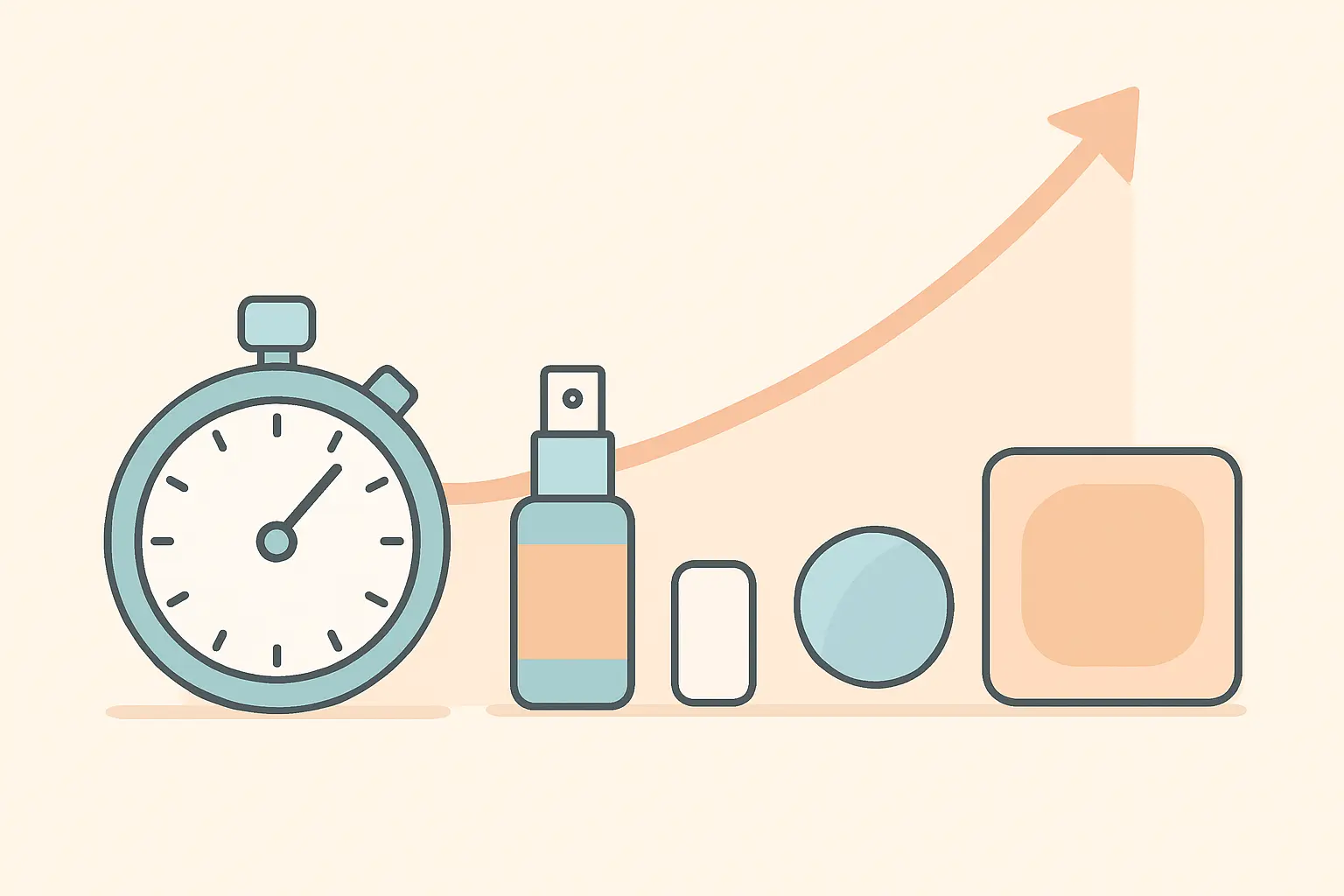
The fastest acting nicotine replacement is nicotine mouth spray: in a randomized crossover study of 45 smokers, the median time to peak plasma nicotine was 10–12.5 minutes for the spray, compared with 30 minutes for gum and 45 minutes for a lozenge. Speed matters because most cigarette cravings peak and fade within a few minutes; a slow-acting product often “arrives” after the worst of the urge has already passed. This guide ranks every over-the-counter NRT form by measured absorption speed, not marketing claims, and matches each one to the craving pattern it actually solves.
Fastest acting nicotine replacement: the speed ranking
Speed here means time to peak plasma nicotine (Tmax) after a single dose — the pharmacokinetic measure researchers actually use, not a subjective “feels fast” impression. The gap between the fastest and slowest forms is large: minutes versus hours.
| Form | Median time to peak nicotine (Tmax) | Best for |
|---|---|---|
| Mouth spray | 10–12.5 minutes | Sudden, sharp cravings |
| Gum (4mg) | 30 minutes | Predictable cravings you can see coming |
| Lozenge (4mg) | 45 minutes | Hands-free, discreet, longer-lasting cravings |
| Inhalator | Not measured in this study — absorbed through the mouth and throat lining, broadly like gum | Strong hand-to-mouth habit |
| Patch | Several hours, then a steady plateau rather than a spike | Background dosing, not acute cravings |
Spray, gum and lozenge figures are median Tmax values from a randomized crossover single-dose study in 45 healthy adult smokers (Nicotine & Tobacco Research, 2011). Individual absorption varies with technique, saliva pH, and whether you have eaten or had acidic drinks recently.
Mouth spray: fastest relief, and its downsides
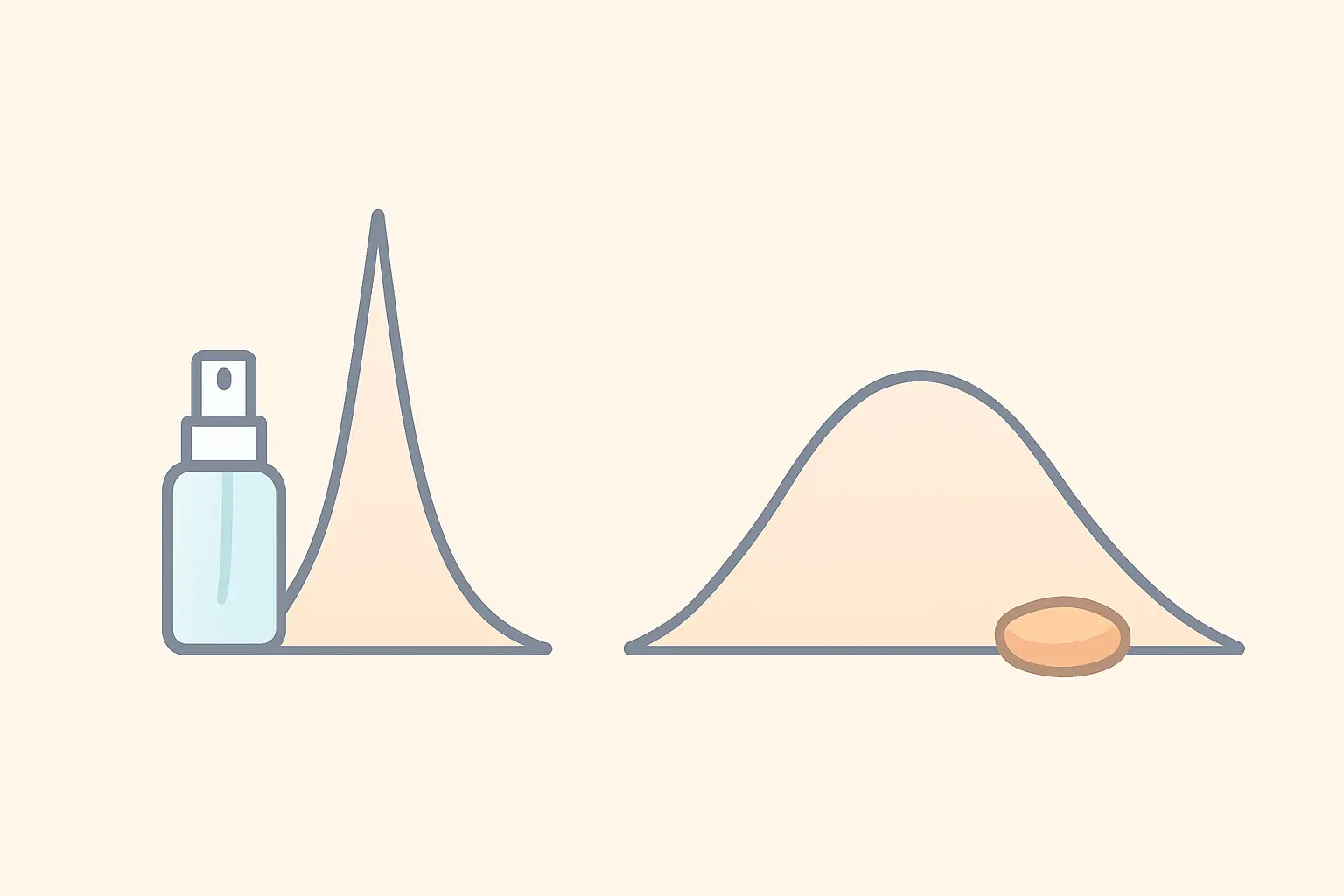
Nicotine mouth spray is absorbed directly through the lining of the mouth, and the single-dose comparison is unusually clean. In that randomized crossover trial, the average amount of nicotine in the blood over the first 10 minutes was three times as high with a 4mg spray dose as with a 4mg lozenge or 4mg gum, and peak concentration with the 4mg spray exceeded the lozenge by 34% and the gum by 20% (single-dose pharmacokinetic study, Nicotine & Tobacco Research 2011). The authors’ conclusion is blunt: nicotine from the mouth spray is absorbed considerably faster than from gum or lozenge.
The trade-off is a sharper, more medicine-like taste and a stinging sensation some users dislike, plus a real risk of overuse precisely because each dose arrives quickly. Sticking to the labeled maximum doses per hour and per day matters more with spray than with slower forms, and hiccups, throat irritation or nausea are usually a sign of taking doses too close together rather than a sign the product is wrong for you.
Lozenge vs. gum: absorption and technique
Gum reached peak plasma nicotine at a median of 30 minutes after a single 4mg dose in that same trial, while a 4mg lozenge took 45 minutes — both slower than spray, but still far faster than the patch’s multi-hour rise. Technique changes both numbers. Gum needs the “chew and park” method (a few chews against the cheek, then rest, repeated) to avoid swallowing nicotine-laden saliva, which reduces absorption and can cause hiccups or stomach upset; lozenges dissolve passively but are easy to swallow too quickly if you suck rather than let them melt. Neither form should be used within about 15 minutes of coffee, soda, or juice, since acidic drinks lower the mouth’s pH and cut absorption. For a full walkthrough of dosing and technique across every NRT form, see our complete NRT comparison.
The CDC walks through how the patch, gum and lozenge are meant to be combined so a slow form and a fast form cover different jobs.
Mistakes that make a fast form feel slow
Most complaints that “NRT just doesn’t work for me” trace back to how the product was used rather than to the product itself. Four errors account for the majority of them.
- Chewing the gum like ordinary chewing gum. Continuous chewing releases nicotine faster than the mouth lining can take it up, so most of it is swallowed instead of absorbed. Chew a few times, park the gum against your cheek, and chew again only when the tingle fades.
- Sucking or crunching a lozenge. A lozenge is designed to dissolve slowly; shortening that window sends nicotine to the stomach, where it is absorbed slowly and can cause nausea rather than relief.
- Using an oral form straight after coffee. Coffee, soda and fruit juice lower the pH in your mouth, and nicotine crosses the mouth lining poorly in an acidic environment. Waiting about 15 minutes costs you nothing and recovers most of the absorption.
- Deliberately under-dosing. Rationing gum or spray to make a box last longer is the most common reason a fast form stops feeling fast. You end up comparing a half dose of NRT with a full cigarette, then conclude the NRT failed.
If you are pairing a tracker with your NRT schedule, our guide to using a quit-smoking app alongside patches and gum covers how to log doses so these mistakes show up in your own data rather than as a vague sense that nothing is helping.
The inhalator’s hand-to-mouth advantage
The nicotine inhalator — a plastic mouthpiece with a nicotine cartridge, puffed like a cigarette — delivers nicotine through the mouth and throat lining rather than into the lungs, which puts its speed broadly in gum territory rather than spray territory. Its real advantage isn’t raw speed; it’s replicating the hand-to-mouth motion and puffing action that a spray, gum, or patch can’t, which matters most for smokers whose craving is as much behavioral as chemical. If your urge to smoke is tied to what your hands are doing rather than pure nicotine hunger, an inhalator can feel faster in practice even when the absorption curve is similar to gum.
Why the patch is never the fast option (and why you still want one)
The transdermal patch takes several hours to reach peak plasma nicotine and, once at steady state, holds a plateau rather than producing a spike. That slow, steady rise is a feature, not a flaw, for its job: keeping baseline withdrawal at bay across a whole day so you aren’t fighting constant low-grade cravings (the NHS guide to choosing stop-smoking products describes the same division of labor). But it cannot rescue you from a sudden, sharp urge the way spray or gum can, which is exactly why combination NRT — patch plus a fast-acting form — consistently performs as well as or better than either alone in trials. See our combination NRT comparison and our step-by-step guide to using nicotine patches correctly and choosing between 21mg, 14mg and 7mg strengths.
A worked plan: patch plus a fast form
Here is what combination NRT looks like in practice for a typical pack-a-day smoker in the first two weeks. Confirm strengths with a pharmacist or your stop-smoking service, since the right patch step depends on how much you smoke and when you have your first cigarette of the day.
| When | Background dose | Fast form | What you are watching for |
|---|---|---|---|
| Days 1–3 | Patch on first thing, same time each morning | Spray or gum at every urge, up to the labeled daily maximum | Whether the baseline hum of withdrawal settles. If it doesn’t, the patch step may be too low. |
| Days 4–7 | Same patch, same time | Fast form still on demand — do not ration it in week one | Which hours you reach for the fast form most. Those are your risk windows. |
| Week 2 | Same patch | Pre-empt the two or three hours you identified, instead of waiting for the urge | Whether the number of rescue doses per day is trending down on its own. |
The point of writing it down is that the fast form’s job changes across the fortnight: in week one it is a rescue tool, and by week two it works better as a scheduled pre-empt for the hours your own log flags. That shift is much easier to see in a craving log than from memory.
Matching form to your craving pattern
The clearest recommendation here is: match the tool to the shape of the urge, not to whichever product happens to be on the shelf. If your cravings spike hard and fast with little warning, mouth spray is the best rescue tool. If they build more gradually and you can feel them coming, gum or a lozenge works and avoids spray’s sharper taste. If cravings are tied to habit and hand movement as much as chemistry, the inhalator earns its place even though it isn’t the fastest option numerically. And if you’re fighting all-day baseline withdrawal rather than isolated spikes, the patch is the right backbone — paired with a fast form for the moments it can’t cover. Understanding how long a craving actually lasts helps you judge which category you’re in, and our guide to stopping cravings instantly covers non-NRT techniques to use alongside whichever form you pick.
Cost per craving handled
Spray and gum cost roughly similar amounts per dose at retail, but because spray delivers relief faster, some users need fewer doses per craving to feel the urge pass, which can offset its slightly higher per-unit price in practice. Patches are the cheapest per day of any NRT form since one application covers 16–24 hours, but that number is misleading if you still reach for cigarettes during breakthrough cravings the patch can’t touch — at that point the “cheap” patch-only approach is costing you in relapsed cigarettes, not in NRT spend. A pack-a-day habit continuing alongside patch-only use, priced against our breakdown of every quit method’s real cost, usually makes combination NRT the better financial bet, not just the better clinical one.
Frequently Asked Questions
What is the single fastest-acting NRT product?
Nicotine mouth spray. In a randomized crossover study of 45 healthy adult smokers, the median time to peak plasma nicotine was 10–12.5 minutes for the spray, versus 30 minutes for 4mg gum and 45 minutes for a 4mg lozenge (Nicotine & Tobacco Research, 2011). Over the first 10 minutes, blood nicotine was about three times higher with the 4mg spray.
Why is the nicotine patch so slow if it’s the most common NRT?
The patch is designed for slow, steady delivery rather than acute relief — it takes several hours to reach peak plasma nicotine and then holds a plateau. That steady background dose prevents constant low-grade withdrawal across the day, which is a different job from stopping a sudden craving in the moment.
Can I use a fast-acting form together with a patch?
Yes — this is combination NRT, and trial evidence shows it performs as well as or better than any single NRT form alone. The patch covers steady baseline withdrawal while spray, gum, lozenge or inhalator handles breakthrough cravings the patch can’t reach quickly enough.
Does chewing gum faster make it work faster?
No — chewing too fast or continuously releases nicotine faster than the mouth can absorb it, so more gets swallowed instead, which can cause hiccups or stomach upset without speeding up relief. The recommended “chew and park” technique (a few chews, then resting the gum against the cheek) gives the most consistent, comfortable absorption.
Is the inhalator as fast as mouth spray?
No. The inhalator delivers nicotine through the mouth and throat lining rather than as a concentrated spray dose, which puts its absorption broadly in gum territory rather than spray territory. Its main advantage is replicating the hand-to-mouth motion of smoking, which matters for habit-driven cravings.
Should I avoid coffee before using NRT?
For oral forms like gum, lozenge and spray, yes — acidic drinks including coffee, soda and juice lower mouth pH and reduce nicotine absorption. Manufacturers generally recommend waiting about 15 minutes after these drinks before using oral NRT products; the patch is unaffected since it doesn’t rely on absorption through the mouth.
How many doses of mouth spray a day is too many?
Follow the maximum printed on your pack, since limits differ by product and country — both an hourly cap and a daily cap are stated on the label. Because spray relief arrives quickly, it is the form people most often over-use. Hiccups, throat irritation or nausea usually mean doses are landing too close together rather than that the product is wrong for you.
Is there an app that helps me time the fast form better?
Craving logs are the practical tool here: recording the time and intensity of each urge shows which hours need a pre-emptive dose rather than a rescue one. iQuit does this on both Android and iPhone, and its free tier includes craving logging and SOS techniques for the moment an urge arrives.
Track which cravings need the fast option
iQuit’s craving log shows whether your urges are sudden spikes or slow builds, so you know when to reach for a fast-acting form and when a steady patch is doing its job. Free to start, with SOS tools for the moment a craving hits. Available on Google Play and the App Store.