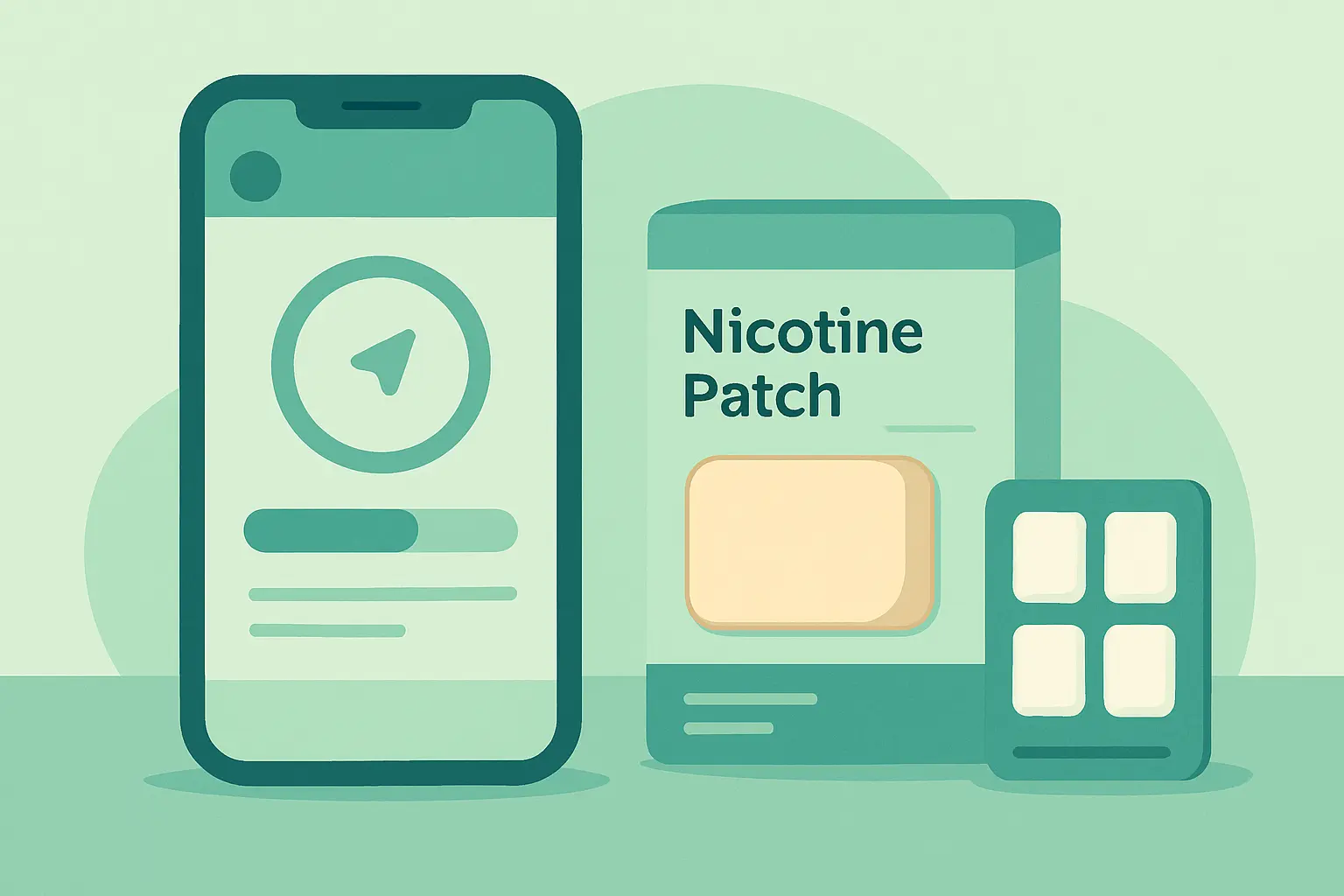
Pairing a quit smoking app with nicotine patches and gum isn’t a compromise between “doing it properly” and “using an app” — it’s the combination the evidence actually favors. Nicotine replacement therapy handles the physical withdrawal; a tracking app catches the moment-to-moment cravings, dosing patterns, and slip risks that NRT alone can’t see. This guide walks through a full 12-week schedule for running both together, what to log each day, and how to read your own data when something isn’t working.
Why Behavioral Support and NRT Work Better Together
The Cochrane review of nicotine replacement therapy versus control pooled 133 studies with 64,640 participants and found a risk ratio for abstinence of 1.55 (95% CI 1.49 to 1.61) — and, importantly here, that “the effects were largely independent of… the intensity of additional support provided” (Hartmann-Boyce et al., Cochrane Database of Systematic Reviews, 2018). Read carefully, that is good news for combining the two: NRT delivers roughly the same proportional boost whatever else you are doing, so anything that lifts your underlying odds — structure, tracking, a plan for your worst hours — stacks on top of it rather than competing with it.
In plain terms: the patch handles your blood nicotine level, but it doesn’t remind you why you’re doing this at 3pm on a Tuesday, or notice that every slip this month happened after an argument. That’s the gap a tracking app is built to close.
This is also why the question isn’t really “app or NRT” — our piece on whether an app can replace NRT patches concludes it shouldn’t try to for anyone with moderate-to-high dependence. The two tools solve different problems.
The CDC explains how a patch and a fast-acting form are meant to work together in this short guide.
Setting Up a 12-Week Patch Schedule in the App
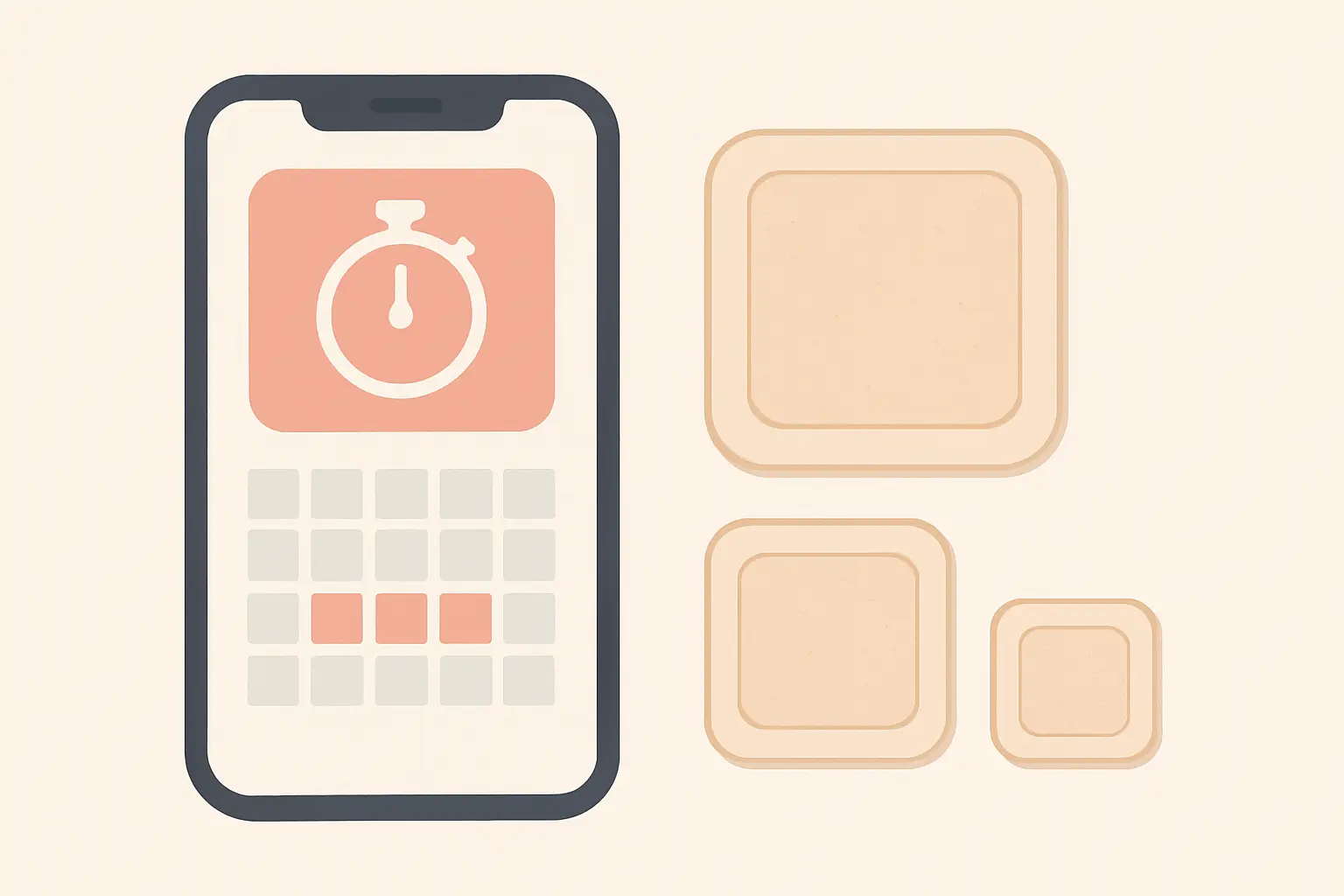
Most standard NRT patch courses run 8 to 12 weeks and step down through patch strengths as your body adjusts — the exact milligram schedule (typically moving from a higher starting strength down through two lower steps) is laid out in our step-by-step guide to using nicotine patches correctly. Follow the strengths and timings printed on your product’s packaging or the advice of your pharmacist; nothing here replaces that. What an app adds on top of that calendar is a daily home for three things:
| Item | Why it matters |
|---|---|
| Patch strength and start date | Creates a visual countdown to your next step-down, so you don’t drift on the same strength too long |
| Rescue NRT type (gum, lozenge, spray) | Lets you log breakthrough doses separately from the patch, which is where most of the useful data lives |
| Baseline craving intensity | Gives you a “before” number to compare against as weeks pass |
In the iQuit app, this takes about two minutes during onboarding, and the free tier covers all three. It’s on Google Play (4.3★) and the App Store, with Premium at $6.99/month, $39.99/year or $79.99 lifetime after a 7-day trial for anyone who wants deeper analytics on top.
Logging Rescue Doses and What the Pattern Tells You
The patch is meant to hold you at a steady baseline; gum, lozenge, or spray covers the spikes on top of that baseline. Every time you reach for a rescue dose, log it with the time and what triggered it. After a week or two, patterns emerge that a patch calendar alone will never show you: maybe every rescue dose clusters around 3–4pm, or maybe you’re using gum every single morning before the patch has had time to build up. iQuit’s craving forecasts feature learns exactly this kind of pattern over time and starts nudging you a few minutes before your typical risky hour, rather than after the craving has already built.
A Worked Example: One Week of Rescue-Dose Data
Abstract advice about “reading your log” is much easier to act on once you have seen a real week laid out. Here is week three of a fictional but realistic quitter on a stable patch strength, logging every rescue dose with its time and trigger:
| Day | Rescue doses | Times | Most common trigger logged |
|---|---|---|---|
| Monday | 4 | 7:40am, 10:15am, 3:20pm, 3:55pm | Work stress |
| Tuesday | 3 | 7:35am, 3:10pm, 6:40pm | Work stress |
| Wednesday | 5 | 7:30am, 9:50am, 3:05pm, 3:40pm, 9:10pm | Work stress / after dinner |
| Thursday | 3 | 7:45am, 3:15pm, 6:30pm | Work stress |
| Friday | 4 | 7:40am, 3:00pm, 5:50pm, 10:30pm | Drinks with friends |
| Saturday | 1 | 11:20am | Boredom |
| Sunday | 1 | 10:50am | Boredom |
Three things fall out of that table within about thirty seconds of looking at it, and none of them were visible from memory alone. First, the weekday morning dose is nearly automatic — 7:30 to 7:45am, five days out of seven, and absent at the weekend. That is a routine cue tied to getting ready for work, not a dose problem, and it responds to changing the routine (different first drink, different route, patch applied earlier so it has built up before the trigger arrives).
Second, the 3pm cluster is a genuine trigger window, present every weekday, sometimes needing two doses within an hour. That is the hour to build an if-then plan around and to let a craving forecast warn you about in advance.
Third, the weekend collapse to one dose a day is the real signal about patch strength. If the patch were badly under-dosed you would expect breakthrough cravings across the whole day, weekends included. Here they are concentrated in weekday work hours, which points at stress and routine rather than milligrams — and that changes what you do next: a conversation about triggers rather than a conversation about a higher-strength patch.
Spotting Under-Dosing From Your Craving Log
Under-dosing is one of the most common, quietly sabotaging problems with patch-based NRT — people stay on a strength that isn’t matching their actual dependence, keep having breakthrough cravings, conclude “the patch doesn’t work for me,” and go back to smoking. Your log is the tool that catches this before it becomes a relapse story. A useful rule of thumb: if you’re needing rescue gum or lozenge more than 3–4 times a day for more than three or four consecutive days at a stable patch strength — and, unlike the worked week above, the doses are spread right across the day rather than clustered in one or two trigger windows — that’s a signal worth raising with a pharmacist rather than pushing through silently.
Comparing patch-only against a properly matched combination approach is exactly what our combination NRT vs single NRT comparison covers in more depth, including how to know which dosing combination fits your dependence level. If you haven’t already scored yourself, the nicotine dependence test is a fast way to check whether your starting patch strength was ever realistic for your habit.
Five Mistakes That Undo an App-Plus-NRT Plan
Most of the ways this combination goes wrong are procedural rather than pharmacological — small habits that quietly strip the data of its usefulness.
| Mistake | Why it hurts | Do this instead |
|---|---|---|
| Logging at bedtime from memory | The automatic doses are exactly the ones you forget, so the log flatters you | Log in the moment; it takes about ten seconds |
| Only logging doses you take, never cravings you resist | You lose the evidence that a trigger is already under control, which is what tells you it is safe to taper | Log resisted cravings too, with intensity |
| Stopping the log the week you feel fine | Week four confidence is where most tapers get pulled forward too early | Keep light logging for a month past your last patch |
| Treating a slip as a reset | Restarting the taper from day one throws away real physical progress and usually ends the attempt | Log it, keep your scheduled strength, carry on |
| Changing patch strength on a bad day | One rough day is noise; dose decisions need a trend | Wait for a 7–10 day pattern, then ask a pharmacist |
When the Data Says Taper, and When It Says Wait
Not every rough week means you’re on the wrong dose — some weeks are just hard. Here’s a simple way to read your own data before deciding to change anything:
- Taper signal: rescue-dose frequency has been low and stable for 10+ days, and you’re approaching your scheduled step-down date anyway
- Wait signal: a spike in cravings coincides with a specific stressor (a bad week at work, a social event, illness) rather than a steady upward trend
- Talk-to-someone signal: rescue-dose frequency keeps climbing over multiple weeks with no obvious external cause
An app makes this distinction visible instead of a gut call, because you can actually see the last two or three weeks laid out rather than relying on memory, which tends to overweight yesterday.
Want the log to do this reading for you? iQuit’s free tier records each craving with its trigger and intensity and turns those entries into risky-hour forecasts, so the 3pm cluster in the table above would surface as a nudge before the craving rather than a note after it. Available on Google Play and the App Store.
Handling a Slip While on NRT
Smoking a cigarette while you’re still using patches or gum doesn’t undo the plan, and it’s not a sign the combination has failed. Log it the same way you’d log a rescue dose — time, trigger, what happened right before — and keep going with your scheduled patch strength rather than restarting the whole taper from day one. iQuit’s streak-shield approach is built around exactly this idea: a slip is data, not defeat, and the app is designed to keep your progress record intact rather than resetting everything to zero over one cigarette.
Week 12: Stepping Off Both
By the final scheduled week, most people are on the lowest patch strength with rescue doses used only occasionally, if at all. Coming off both at once — patch and rescue NRT — in the same week you stop tracking daily is usually the wrong move for anyone whose log still shows more than one or two rescue doses a week. A more reliable sequence is: finish the patch taper on schedule, keep rescue NRT and app logging active for another one to two weeks, then drop rescue NRT once your log shows several consecutive low-craving days, and keep light tracking going for a month after that as your new baseline.
A Two-Minute Weekly Check-In Worth Keeping
The single habit that makes this whole combination work is a short weekly review rather than only reacting in the moment. Once a week, look back at your log and ask three questions: did rescue-dose frequency go up, down, or stay flat; did any new trigger show up more than once; and are you still on schedule for your next patch step-down. This takes under two minutes and catches problems — an under-matched dose, a new stress trigger, a taper that’s moving faster than your cravings can handle — while they’re still small and easy to adjust, instead of after a slip has already happened.
Couples who quit together, shift workers with irregular trigger hours, and anyone restarting after a previous attempt tend to get the most value from this weekly habit, simply because their craving patterns are less predictable week to week than a straightforward 9-to-5 schedule.
App + NRT FAQ
Can I use a quit-smoking app instead of nicotine patches?
For low-dependence smokers, an app alone may be enough. For moderate or high dependence, patches (or another NRT form) address the physical withdrawal that an app can’t — the two work better as a pair than as alternatives to each other (Cochrane, 2018).
Should I log every cigarette craving or just the ones I act on?
Log both. Cravings you resist are just as informative as rescue doses you take — they show you which triggers you’re already handling well, which matters when you’re deciding whether to taper.
How do I know if my patch strength is too low?
Frequent rescue doses (more than 3–4 a day) sustained over several days at a stable patch strength, spread across the whole day rather than clustered in one trigger hour, is the clearest sign. Bring that pattern to a pharmacist rather than just pushing through it.
Does a slip while using NRT mean I’ve failed?
No. A single cigarette doesn’t erase weeks of reduced dependence or reset your NRT schedule. Log it, note the trigger, and continue your planned taper rather than starting over.
Can I use gum and patches together from day one?
Yes — combining a patch for steady dosing with a fast-acting form like gum or lozenge for breakthrough cravings is standard combination NRT and is generally considered safe when used as directed, though it’s worth confirming with a pharmacist for your situation.
How long should I keep logging after the patch course ends?
Give it about a month of light tracking past your last patch. Cravings after the taper tend to be less frequent but occasionally sharp, and a thin log is enough to tell you whether a bad evening was an isolated event or the start of a trend worth acting on.
Does the app need to be a paid one for this to work?
No. Everything in this plan — patch start date, rescue-dose logging with triggers and intensity, and a weekly look back at the pattern — is available in free tiers, iQuit’s included. Paid tiers mostly add deeper analytics on top of the same underlying log.
What if my rescue doses cluster in the first hour after waking?
Early-morning breakthrough usually reflects the patch not having built up yet rather than the wrong strength. Applying the patch as soon as you wake — or discussing overnight wear with a pharmacist, which is a labeled option for some products — is the usual first thing to try.
Run Your NRT Schedule and Your Cravings in One Place
iQuit tracks your patch schedule, rescue doses, and craving patterns side by side, with forecasts that learn your risky hours and an SOS button for the moments in between. Free to start on Google Play (4.3★) and the App Store.