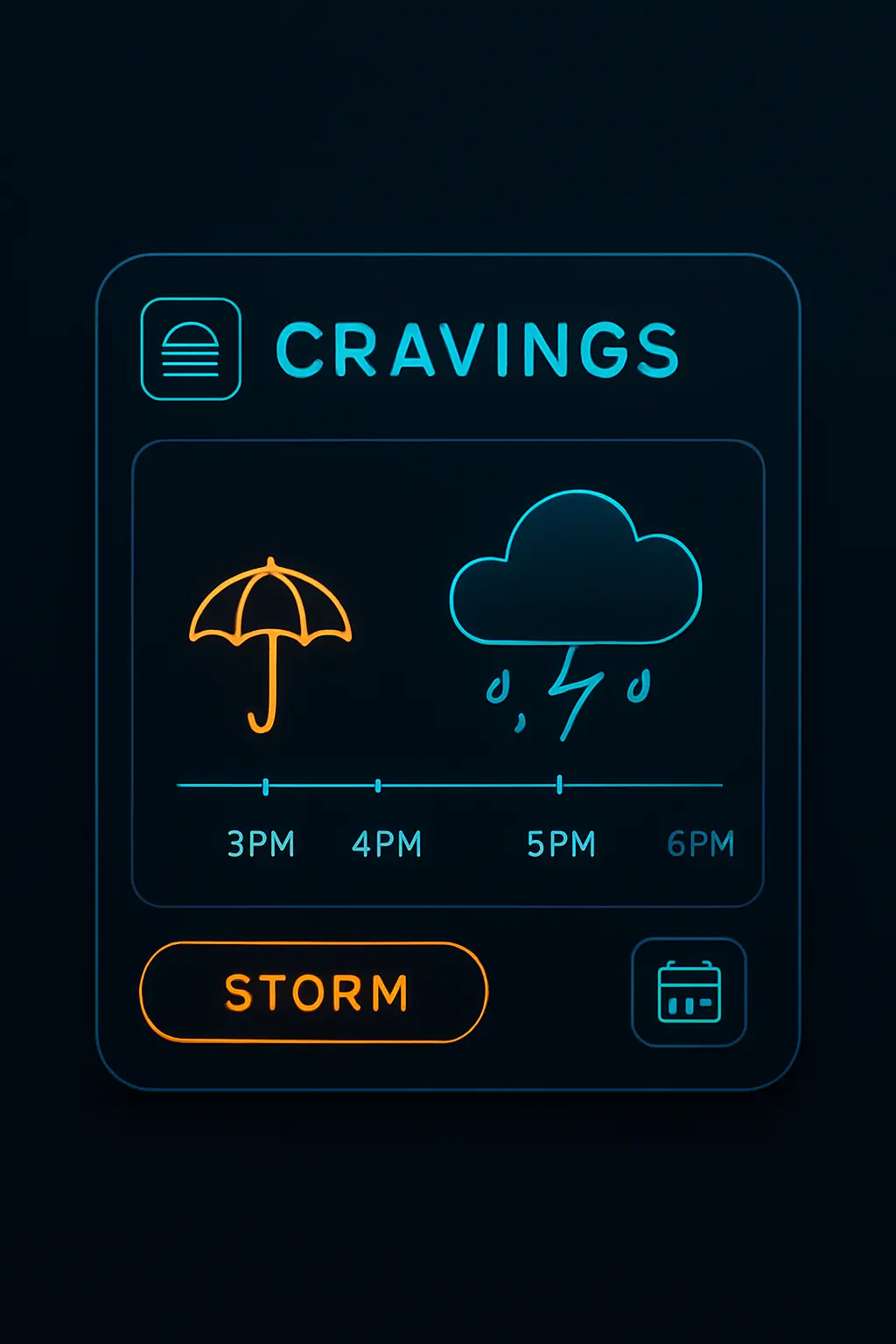
Every quit app helps you during a craving. iQuit’s craving forecasts try something more ambitious: reaching you before one starts. The app studies your own craving log for repeating patterns, and once your risky hours emerge, it sends a quiet heads-up about 15 minutes before the window opens: “Your 6pm craving usually follows stress — a 3-minute breath now?” By the time the urge would have arrived, you’re already mid-countermeasure.
The insight: your cravings run on a schedule
Real-time logging studies of quitters keep finding the same thing — most cravings aren’t random. They cluster into 3–4 daily windows welded to routine: the morning coffee, the post-lunch dip, the commute, the evening wind-down. (The full technique for mapping your trigger hours manually is worth reading even if the app does it for you.) A schedule is a vulnerability — anything predictable can be pre-empted. Forecasting simply industrializes what good quit coaches have always told patients to do with a notebook.
How the forecast engine works
- You log cravings normally. One tap when an urge hits — intensity, trigger, whether you overcame it. (You’d want this log anyway; it’s what shows your craving frequency curve falling week over week.)
- The app hunts for clusters. When three or more cravings land in the same hour-of-day bucket across two-plus weeks, that hour is flagged as a risky window. Your personal map, built from your actual behavior — not a generic schedule.
- The warning fires 15 minutes early. Before the window opens, a gentle notification names the pattern (“your 6pm craving usually follows stress”) and proposes a concrete pre-emptive move — breathing, a walk, water, opening the coach.
- Guardrails keep it a whisper, not a nag. Quiet hours (22:00–08:00) are always respected, forecasts cap at one per weekday, and every notification category in iQuit — motivational, milestones, craving reminders, community, challenges, check-ins — can be toggled individually.
Why 15 minutes changes the fight
A craving at full strength narrows your thinking to smoke/don’t-smoke. Fifteen minutes ahead of it, you have options a craving never offers: change rooms, start the kettle, run six rounds of box breathing, message the AI coach. Pre-craving action is cheap; mid-craving resistance is expensive. It’s the difference between sandbagging before the flood and bailing during it. And every pre-empted window weakens the underlying cue — prevention compounds.
Part of a layered defense
Forecasts are the outer wall of iQuit’s craving system. If an urge gets through anyway, the free SOS toolkit takes over — one tap (or a phone shake) to breathing, grounding, the virtual cigarette, and quitline access. And if a slip ever happens, streak shields and the recovery flow catch the landing. Craving-prevention alerts are part of iQuit Premium (7-day free trial; the logging that trains them is free), alongside unlimited AI coaching and advanced craving analytics.
Training your forecast faster
- Log honestly, including the ones you lose. The model needs the real pattern, not the highlight reel.
- Log promptly. A craving noted at 18:05 lands in the right bucket; the same craving remembered at bedtime doesn’t.
- Give it two weeks. Prediction needs repetition; the first fortnight of logs is the tuition.
FAQ
How does iQuit predict cravings?
It clusters your logged cravings by hour; three-plus in the same window over two weeks flags it risky, and alerts fire ~15 minutes before that window.
Will it ping me at 3am?
No — quiet hours 22:00–08:00 are respected, and forecasts cap at one per weekday.
Is forecasting free?
Craving logging and SOS tools are free; the predictive alerts are Premium, with a 7-day free trial.
What if my schedule changes?
Keep logging — the model follows your data, so new patterns replace old windows within a couple of weeks.
Stop fighting cravings at full strength — meet them 15 minutes early: download iQuit free on Google Play and start logging today.