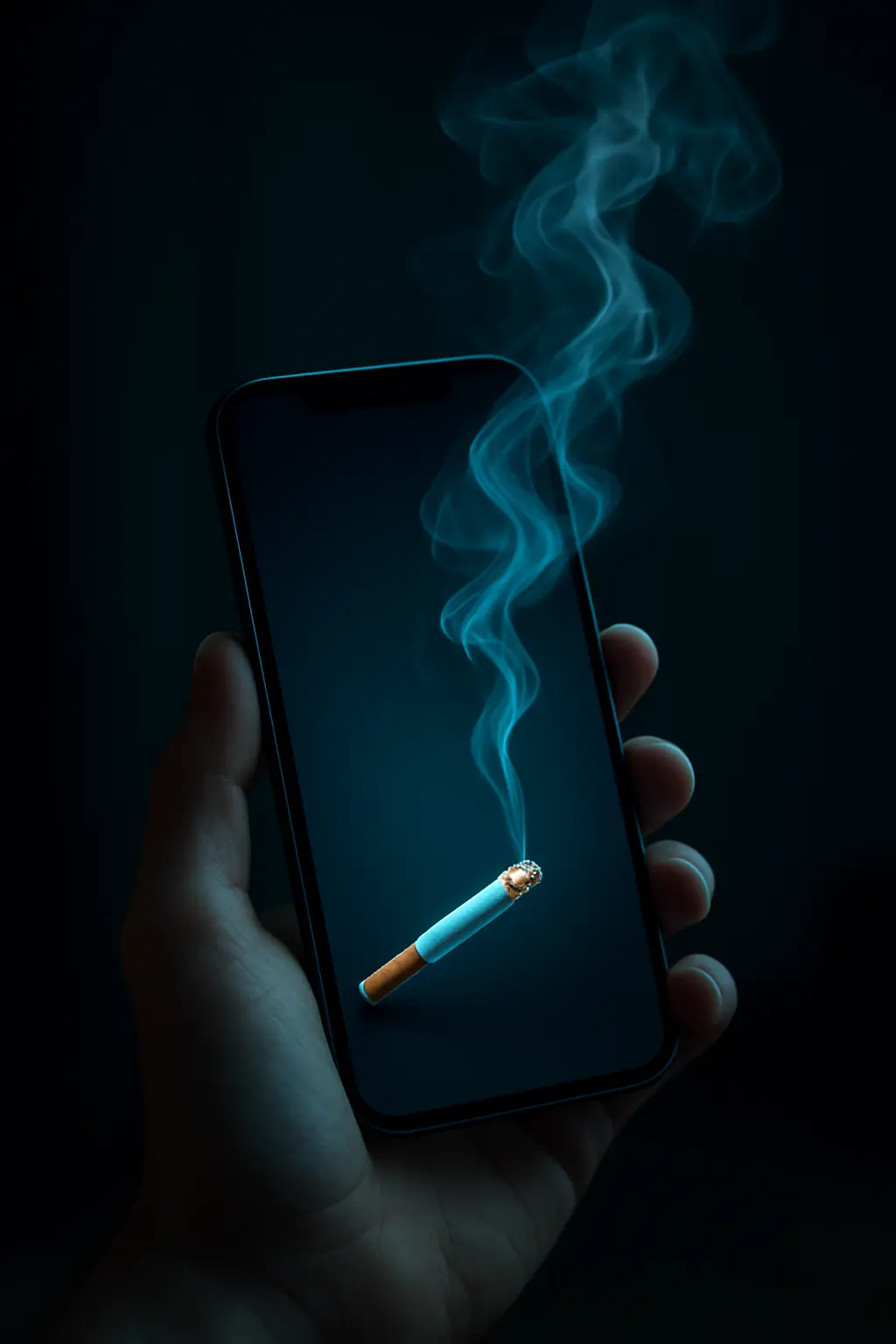
The strangest feature in the iQuit app is also the one users talk about most: a cigarette you can smoke that contains nothing at all. Press and hold the screen and a photorealistic cigarette glows as you “draw” — a soft haptic pulse repeating under your finger like a real drag. Hold it about four seconds, release, and smoke drifts across the screen as you exhale. After eight puffs, the app delivers its quiet punchline: “You smoked nothing. The craving passed anyway.”
Why simulate the thing you’re quitting?
Because smoking was never one addiction — it was two. The nicotine leaves your body within about 72 hours of quitting. The ritual — hand to mouth, the slow drag, the pause, the long exhale, repeated 200+ times a day for years — keeps firing for weeks. Patches and gum treat the chemistry and ignore the ritual entirely, which is one reason cravings blindside people long after withdrawal “should” be over. The virtual cigarette is aimed at exactly that gap: it lets the ritual complete, with the drug permanently removed. The full comparison of virtual vs real cigarettes breaks down what each actually delivers.
What using it feels like
- Open it from the SOS screen when a craving hits — no menus to dig through in a weak moment.
- Press and hold to draw. The tip glows; the haptic pulse paces you through a ~4-second inhale, the same length as a real drag.
- Release to exhale. Smoke curls across the screen. Your breathing has just done a slow in-hold-out cycle — paced breathing disguised as smoking.
- Repeat up to eight puffs. Eight drags ≈ one cigarette ≈ about three minutes — conveniently, the length of a typical craving peak.
- Read the closing line. “You smoked nothing. The craving passed anyway.” Each session is a small experiential proof that relief doesn’t require nicotine.
The psychology working under the hood
- Paced breathing: the draw-hold-exhale cycle slows your breath like a guided exercise, activating the parasympathetic calm response — the same mechanism behind the 4-4-4-4 box breathing method, wrapped in a ritual your brain already loves.
- Extinction training: each time the ritual completes without a nicotine reward, the conditioned link weakens. You’re not avoiding the cue; you’re defusing it.
- Proof over promises: quit advice says “cravings pass.” The virtual cigarette lets you watch one pass, mid-craving, with your own hands busy. Evidence beats reassurance.
When it shines (and when to use something else)
Reach for it in ritual-shaped moments: after meals, the coffee pairing, the work break, the drive home — times when your hands ask for the motion more than your brain asks for the drug. For pure stress spikes, box breathing or grounding may serve better; for late-night ruminating urges, the app’s AI coach is the right tool. Most users lean on the virtual cigarette hard in weeks one and two, then naturally forget it exists — which is the feature working as intended.
Part of a full free toolkit
The virtual cigarette ships free in iQuit on Google Play, alongside the SOS button (shake your phone to trigger it), three breathing exercises, craving logging with success-rate tracking, 15 health milestones, streak shields and daily missions. The complete iQuit review walks through how the pieces fit together.
FAQ
How does the virtual cigarette work?
Press-and-hold to draw with a haptic pulse (~4 seconds), release to exhale with on-screen smoke, up to eight puffs per session — about the length of a craving peak.
Is it free?
Yes — it’s part of iQuit’s free toolkit, not a premium feature.
Isn’t simulating smoking counterproductive?
No nicotine ever arrives, so dependence can’t be maintained. The ritual completes while the craving passes, which weakens the ritual over time — extinction, not reinforcement.
Does it work for vaping cravings too?
The hand-to-mouth and paced-exhale ritual overlaps heavily with vaping, so many users find it equally effective for vape urges.
Try smoking nothing tonight: download iQuit free and open the virtual cigarette on your next craving.