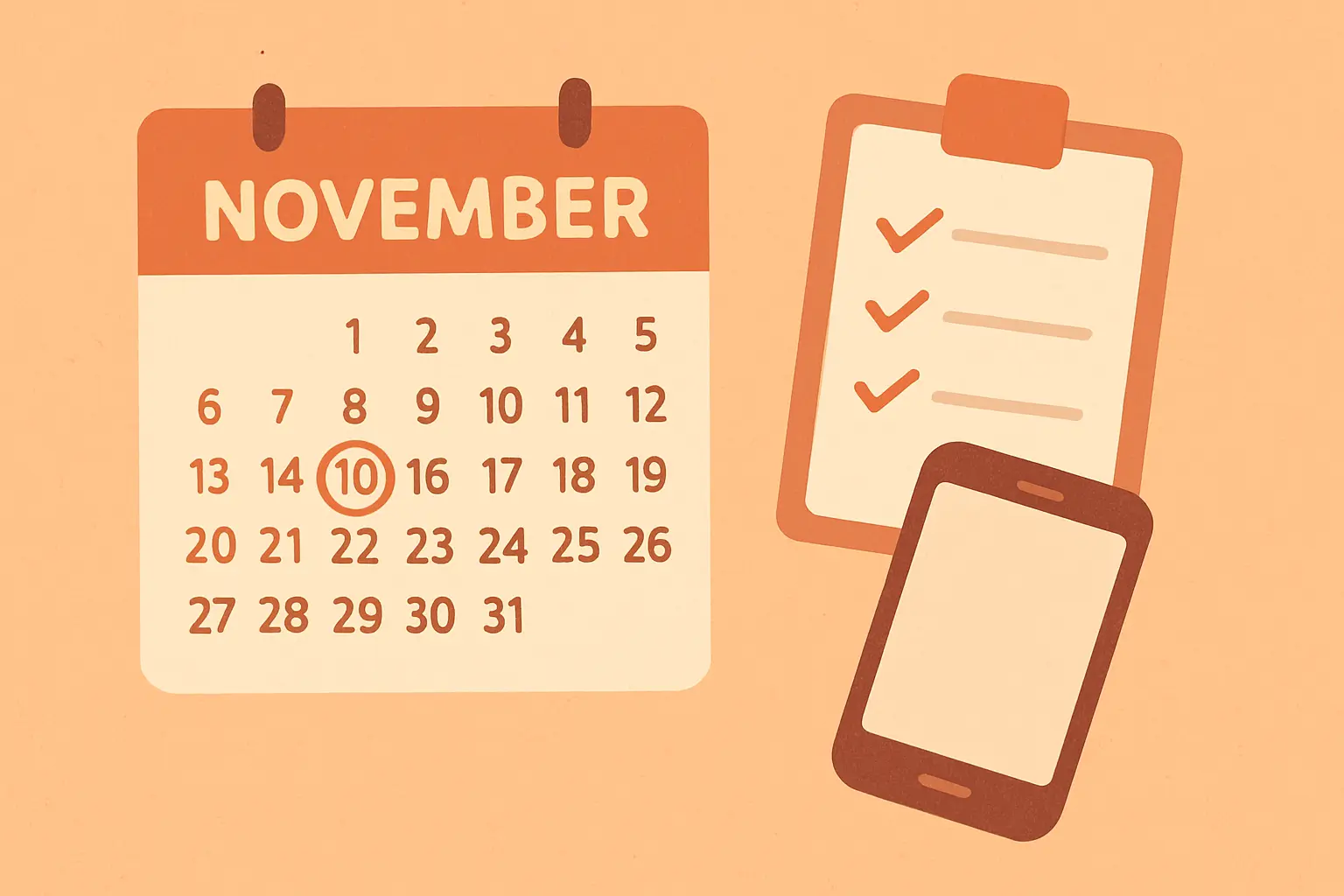
The Great American Smokeout 2026 falls on Thursday, November 19 — the third Thursday of November, as it is every year (American Cancer Society). It’s a single, low-stakes commitment: not “quit forever starting today,” just “don’t smoke for these next 24 hours.” That framing is exactly why it works for people who’ve stalled on bigger, vaguer quit plans. Here’s how to actually use the day, hour by hour, and what to do with the momentum afterward.
What the Smokeout Is and When It Falls in 2026
The Great American Smokeout is the American Cancer Society’s national quit-smoking event, held every year on the third Thursday of November — this year, that’s November 19, 2026. Unlike Stoptober’s month-long UK structure (which our Stoptober 2026 guide covers in detail), the Smokeout is deliberately a single day. It exists to give smokers a low-friction entry point: not a resolution, not a program, just one specific day to try not smoking and see what happens.
The event has a genuinely long history. In 1970, Arthur P. Mullaney of Randolph, Massachusetts, asked people to give up cigarettes for a day and donate the money they would have spent to a high school scholarship fund. In 1974, Lynn R. Smith, editor of the Monticello Times in Minnesota, spearheaded that state’s first “D-Day,” or Don’t Smoke Day. Then, on November 18, 1976, the California Division of the American Cancer Society got nearly a million people who smoke to quit for the day — the first official Smokeout — and the Society took the event nationwide in 1977 (American Cancer Society, History of the Great American Smokeout).
The American Cancer Society tells that story itself in this short retrospective.
Why a One-Day Commitment Beats an Open-Ended One
“Quit smoking” as a goal is enormous and vague, which is exactly why so many attempts stall before they start. “Don’t smoke today” is small enough to actually commit to without the psychological weight of forever attached to it. This is the same logic behind picking a firm quit date rather than a vague “someday” — our guide on why timing your quit date matters covers the broader version of this idea. The Smokeout just gives you a date that’s already chosen for you, with a lot of other people doing it on the same day.
Most people who’ve tried to quit before know the discouraging math: the average smoker makes several attempts before one finally sticks (how many quit attempts it usually takes). A single 24-hour attempt isn’t a failure risk in the same way a “forever” attempt is — if it doesn’t stick, you’ve lost nothing and learned something about your triggers.
The Week Before: Your 7-Day Prep List
Walking into the Smokeout unprepared is the single biggest reason people give up by lunchtime. Spend the week before doing this:
| Day | Task |
|---|---|
| 7 days out | Decide your method (cold turkey, NRT, or app-supported) and get any NRT you’ll need |
| 5 days out | Tell at least one person your plan for the 19th |
| 3 days out | Remove cigarettes, lighters, and ashtrays from your car, desk, and home |
| 1 day out | Plan your first three hours of the 19th in detail — where you’ll be and what you’ll do instead of smoking |
Our 24-hours-before quit day checklist goes deeper on this final stretch if you want the full list.
The 24-Hour Plan, Hour by Hour
A single day is easier to get through when you break it into blocks instead of facing “24 hours” as one abstract stretch. Here is a concrete version you can adapt to your own schedule — the times assume a roughly 7am start, so shift them to match your own waking hour rather than the clock.
| Time | What’s happening | What to do instead |
|---|---|---|
| 7:00–7:30am | The first-cigarette window — the most automatic smoke of the day for most people | Change the whole sequence: different first drink, shower before coffee, get outside for five minutes. Apply a patch now if you’re using one. |
| 7:30–9:00am | Commute or school run — a strong environmental cue if you normally smoke in the car | Clean out the car the night before, take a different route, queue up a podcast rather than driving in silence. |
| 9:00am–12:00pm | Morning work block. Cravings usually mild but frequent; the “break” reflex is the risk. | Take your breaks somewhere you never smoked. Keep gum, water, or a fidget object within reach of your desk. |
| 12:00–1:00pm | The after-lunch cigarette — one of the most cue-bound of the day | Eat somewhere different, brush your teeth right after, walk for ten minutes before going back inside. |
| 1:00–3:00pm | Energy dips; concentration wobbles. This is when “just one” starts sounding reasonable. | Front-load your easiest tasks here. Use a fast-acting NRT dose if you have one rather than waiting for the craving to peak. |
| 3:00–6:00pm | The hardest stretch. Fatigue, accumulated stress, and the end-of-day trigger stack up together. | Have a specific tool decided in advance — a breathing exercise, a walk, a phone call. Do not improvise this hour. |
| 6:00–8:00pm | Transition home, dinner, and the after-dinner cigarette | Change what happens straight after the plate goes down: dishes immediately, a walk, or a shower. |
| 8:00–10:00pm | Wind-down. Alcohol, if it’s part of your evening, is the single biggest relapse risk here. | Skip alcohol for this one night if it’s normally paired with smoking. Tell whoever you’re with that today is the Smokeout. |
| 10:00pm–bed | The last-cigarette-of-the-day habit, plus early sleep disruption from withdrawal | Log the day before you sleep. Note the hardest hour — that single line is the most useful thing you’ll write all day. |
Notice that almost every row is about changing a sequence, not resisting an urge. On a first smoke-free day, breaking the cue is reliably easier than out-willing the craving once it has already arrived.
Craving Tools for the Three Hardest Hours
Most people find three windows disproportionately hard on a first smoke-free day: right after waking, the mid-afternoon slump, and right after the last meal of the day. Having a specific tool ready for each one, rather than improvising, makes a real difference. iQuit’s SOS button is built for exactly this — a single tap gives you box breathing (4-4-4-4), the 5-4-3-2-1 grounding technique, or a guided craving-surfing exercise, all inside the window a craving typically peaks and fades (our SOS button feature guide walks through how it works). The app is on Google Play (4.3★) and the App Store, free to start.
For the afternoon slump specifically, the virtual cigarette feature is worth having ready before 3pm arrives rather than discovering it mid-craving: a press-and-hold action that gives your hands and habit-brain something to do for the few minutes a craving usually takes to peak and start fading. Pairing that with a short walk or a change of room breaks both the chemical urge and the environmental cue at the same time, which matters more on day one than on any later day of a quit attempt.
Decide your 3pm tool before 3pm. iQuit’s free tier includes the SOS toolkit — shake-to-SOS, box 4-4-4-4 and 4-7-8 breathing, 5-4-3-2-1 grounding, craving surfing and the virtual cigarette — plus craving logging so you can see afterwards which hour actually cost you the most. Available on Google Play and the App Store.
How to Turn 24 Hours Into 7 Days
The Smokeout’s real value isn’t the single day — it’s the platform it gives you to keep going. The free iQuit dashboard already counts days smoke-free, cigarettes avoided and money saved from your first logged hour, which turns the Smokeout from a one-off event into day one of a visible streak rather than an isolated win that fades from memory by the weekend. If you want the structured version, the 7-Day Shield challenge is part of iQuit Premium ($6.99/month, $39.99/year or $79.99 lifetime, after a 7-day free trial) — but the streak counter and craving log that carry most people through week one are free. Either way, don’t stop logging on day two just because the “event” is over.
The reason a lot of Smokeout attempts fizzle by the following Monday isn’t that the day itself was too hard — it’s that nothing was set up to carry momentum past midnight on the 19th. Before the day starts, decide what “day two” looks like: same wake-up routine change, same NRT plan if you’re using one, and the same log open on your phone. Treating November 20th as a continuation rather than a fresh decision removes a moment where a lot of people quietly talk themselves out of continuing.
If You Smoke on the Day Anyway
Smoking on the Smokeout itself doesn’t mean the day was wasted. You still learned which hour was hardest, which trigger caught you off guard, and what you’d change next time. A single slip is data, not a verdict on whether you can quit; the point of a low-stakes commitment day is precisely that a stumble doesn’t cost you much.
What matters is the next twenty minutes, not the cigarette. Three things reliably separate “a slip” from “the end of the attempt”:
- Write down what happened before you do anything else. Time, place, who you were with, what you were feeling in the ten minutes beforehand. This is the highest-value data you will collect all day, and it evaporates within an hour if you don’t record it.
- Get rid of the rest of the pack. The most common pattern isn’t one cigarette — it’s one cigarette followed by “well, the day’s ruined” and then the other nineteen. Breaking that sequence is the whole job.
- Restart the clock immediately, not tomorrow. Waiting for a clean midnight boundary means giving yourself permission to smoke for the rest of the day. The next smoke-free hour can start at 4:15pm just as well as at 00:00.
If the slip came with a strong physical craving rather than a social or emotional cue, that’s a signal about dependence rather than willpower — it’s worth checking your score on our nicotine dependence test before your next attempt, because a moderate-to-high score usually means NRT or a prescription medication should be part of the plan rather than an optional extra. iQuit’s slip-recovery approach is built on the same idea — a slip is data, not defeat, and the app is designed to keep your record intact rather than resetting everything to zero.
Smokeout FAQ
What day is the Great American Smokeout in 2026?
Thursday, November 19, 2026 — the third Thursday of November, when the American Cancer Society holds the event every year.
Is the Great American Smokeout the same as Stoptober?
No. Stoptober is a UK-based 28-day quit challenge in October. The Smokeout is a US-based single-day event in November, organized by the American Cancer Society, with a different structure and purpose.
Do I need NRT to get through the Smokeout?
Not necessarily, but if you already know you have moderate or high nicotine dependence, having gum, lozenge, or a patch ready reduces the odds of the day ending early. It’s worth checking your dependence level in advance rather than deciding mid-craving.
What if I’ve never made it a full day before?
That’s exactly who the Smokeout is designed for. A single day is a smaller ask than an open-ended quit attempt, and each attempt — successful or not — teaches you something about your specific trigger patterns that makes the next attempt easier.
Can I do the Smokeout if I’m not planning to quit permanently yet?
Yes. Many people use the Smokeout as a low-pressure test run before committing to a full quit plan — it’s a single day, not a lifetime pledge, and treating it that way is part of why it works.
How long has the Great American Smokeout been running?
The first official Smokeout was organized by the California Division of the American Cancer Society on November 18, 1976, and the Society took it nationwide in 1977. The 2026 event falls fifty years after that first California day.
Which hour of Smokeout day is usually hardest?
For most people it’s mid-to-late afternoon, roughly 3pm to 6pm, when fatigue, accumulated stress and an end-of-day trigger arrive together. The first cigarette window right after waking is a close second, because it’s the most automatic smoke of the day rather than the most craved one.
Do I have to tell people I’m doing the Smokeout?
You don’t have to, but telling one or two people helps in a practical way rather than a motivational one: it changes what happens around you. Colleagues stop inviting you outside, and whoever you eat dinner with knows not to suggest a cigarette on the balcony afterwards.
Make November 19th Day One, Not a One-Off
iQuit’s SOS button gets you through the hardest hours, and the free dashboard counts every smoke-free day, cigarette avoided and dollar saved from your first logged hour. Free to start on Google Play (4.3★) and the App Store.