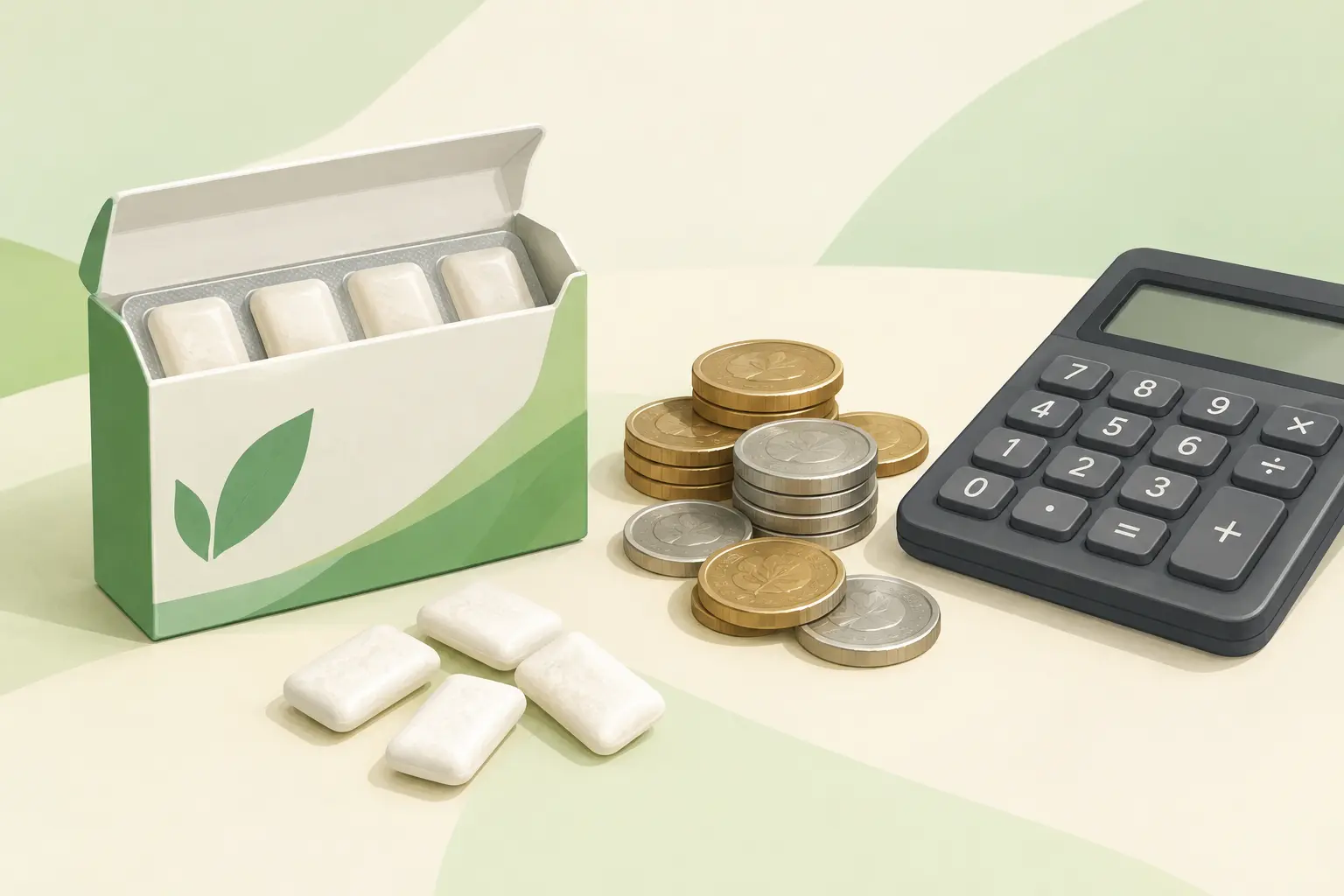
How much is nicotine gum? In a dated October 2026 snapshot, a box of brand-name gum cost about 40 cents a piece and a store-brand box about 23 to 28 cents. This guide turns those prices into cost per day, the cost of a full 12-week course, and a comparison with a pack-a-day habit, so you can budget before you buy.
How Much Is Nicotine Gum? The Short Answer
On Target.com on October 11, 2026, a 160-piece box of Nicorette gum was listed at $66.99, which works out to about 42 cents a piece. A store-brand 170-piece box from the same retailer was listed at $38.99, about 23 cents a piece. Those two numbers frame most of the market: brand-name gum near 40 cents a piece, store-brand gum near 23 to 28 cents a piece, and small trial packs and newer brands costing more per piece.
What that means per day depends on how much gum you chew, and the label sets the floor. The directions on a store-brand nicotine gum label on DailyMed say: “to improve your chances of quitting, use at least 9 pieces per day for the first 6 weeks.” At nine pieces a day, the per-day figure in the examples below runs from roughly $2.06 to $3.77.
Treat every number here as a dated snapshot. Retail prices change often, promotions come and go, and the snapshot covers only the first page of one retailer’s results. Use the arithmetic to check your own receipt: pack price divided by pieces in the pack, multiplied by the pieces you chew in a day.
Nicotine Gum Price by Pack Size
Pack size changes the price per piece more than most buyers expect. The table below comes from Target.com search results for nicotine gum on October 11, 2026. It shows the first page of 206 results, so it is a sample and not a full market survey. Per-piece figures are our own division of the listed price by the pack count, rounded to the nearest cent, because the listings did not show a per-unit price for any nicotine gum.
| Product | Pack | Listed price | Per piece (our math) |
|---|---|---|---|
| Nicorette 2 mg or 4 mg gum (fruit, spearmint, cinnamon flavors) | 160 pieces | $66.99 | $0.42 |
| Nicorette 2 mg or 4 mg gum, Original | 170 pieces | $66.99 | $0.39 |
| up&up (Target store brand) 2 mg fruit-coated gum | 160 pieces | $37.99 | $0.24 |
| up&up 2 mg or 4 mg mint gum | 170 pieces | $38.99 | $0.23 |
| up&up coated 4 mg cool mint gum | 100 pieces | $28.49 | $0.28 |
| Blip 4 mg gum (mint or fruit) | 100 pieces | $49.99 | $0.50 |
| Blip 4 mg gum (mint or fruit) | 20 pieces | $13.99 | $0.70 |
Three patterns stand out. First, the bigger box is cheaper per piece in every brand where we saw two sizes: the 20-piece Blip pack costs about 20 cents more per piece than the 100-piece pack. Second, the store brand undercuts the brand name by a wide margin. Third, the same listed price covered both the 2 mg and the 4 mg version of a given Nicorette product, so strength did not change the price in this sample.
Strength is a medical choice and not a way to save money. The store-brand label says to use the 4 mg gum if you smoke your first cigarette within 30 minutes of waking, and the 2 mg gum if your first cigarette comes more than 30 minutes after waking. Choose by that rule, not by the price tag.
Brand Name vs Store Brand
On this snapshot, the 160-piece Nicorette box cost $66.99 and the 160-piece up&up box cost $37.99. That is $29.00 less, or about 43 percent less, for the same number of pieces. The two products are different brands from different manufacturers, and flavors, coatings and the feel of the chew can differ, so the real question is whether you will actually use the cheaper one.
That is a fair question, and the answer is personal. Some people find a store-brand gum harder to chew or less pleasant, and then chew fewer pieces than the schedule asks for. If a cheaper gum makes you skip pieces, it is not a saving. A sensible approach is to buy a small pack of the store brand first, and move to the larger box only once you know you can tolerate it.
For a deeper look at how brands compare on flavor, strength options and chewing feel, see our best nicotine gum comparison, and for the same question applied to patches, store-brand vs branded NRT covers whether the cheap version holds up.
What Nicotine Gum Costs Per Day
The per-day figure is the number most people want, and it is simple arithmetic: price per piece times pieces per day. The nine-piece row matches the label’s stated minimum for the first six weeks. The other rows show what happens if you chew more, since the same label allows up to 24 pieces a day (“do not use more than 24 pieces a day”).
| Pack | 9 pieces | 12 pieces | 16 pieces | 20 pieces |
|---|---|---|---|---|
| Nicorette, 160 pieces at $66.99 | $3.77 | $5.02 | $6.70 | $8.37 |
| up&up mint, 170 pieces at $38.99 | $2.06 | $2.75 | $3.67 | $4.59 |
| Blip, 100 pieces at $49.99 | $4.50 | $6.00 | $8.00 | $10.00 |
Notice how the gap widens as you chew more. At 20 pieces a day, the brand-name box costs about $8.37 a day against $4.59 for the store brand, a difference of nearly $3.80 a day. Most people use fewer pieces as the weeks pass, which is exactly what the schedule in the next section builds in.
What a 12-Week Course Costs
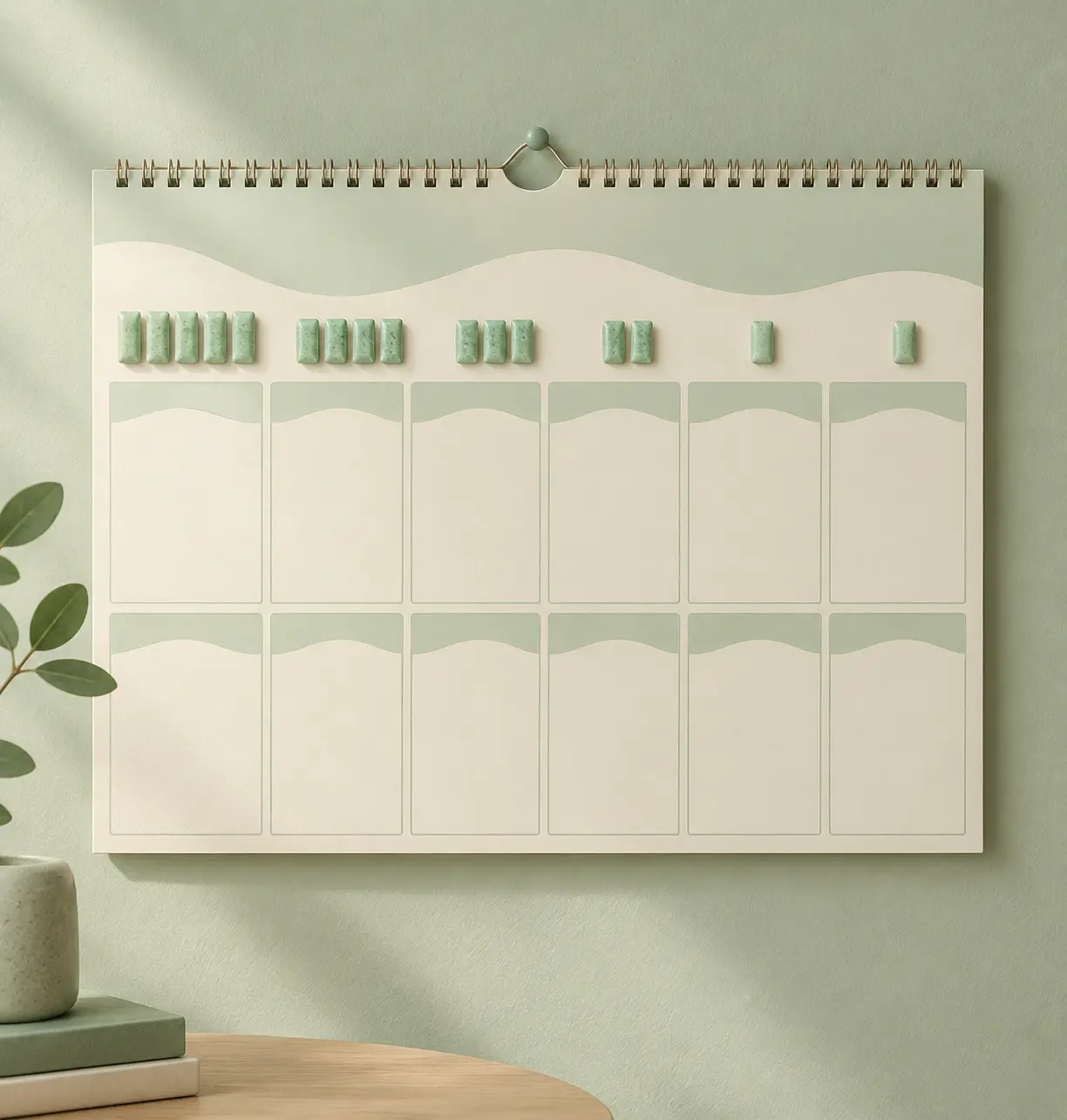
Nicotine gum is not meant to be chewed forever. The store-brand label gives a 12-week schedule: weeks 1 to 6, one piece every 1 to 2 hours; weeks 7 to 9, one piece every 2 to 4 hours; weeks 10 to 12, one piece every 4 to 8 hours. The label adds that “it is important to complete treatment,” and that if you feel you need the gum for longer, you should “talk to your health care provider.” You can read the full wording on the DailyMed label for store-brand nicotine polacrilex gum.
The label gives hours between pieces and a nine-piece minimum for the first six weeks, but not a piece count for the later stages. So the total below rests on an assumption of ours. We used 9 pieces a day for weeks 1 to 6 (378 pieces), 6 a day for weeks 7 to 9 (126 pieces) and 3 a day for weeks 10 to 12 (63 pieces), a total of 567 pieces. Your own use will differ, so replace those counts with your own.
| Pack | Cost of 567 pieces (per-piece math) | Cost if you buy whole boxes |
|---|---|---|
| Nicorette, 160 pieces at $66.99 | about $237 | 4 boxes, $267.96 |
| up&up mint, 170 pieces at $38.99 | about $130 | 4 boxes, $155.96 |
| Blip, 100 pieces at $49.99 | about $283 | 6 boxes, $299.94 |
On those assumptions, a full course of store-brand gum lands around $130 to $156, and a brand-name course around $237 to $268, before taxes or shipping. That is a rough guide for budgeting, not a quote. If you plan to taper afterward, our guide to tapering off nicotine gum explains the step-down in more detail.
Gum vs Cigarettes: A Monthly Comparison
The honest comparison depends on what you pay for cigarettes, and that varies by state and brand. So the table uses three example pack prices of our own choosing: $8, $10 and $12. These are not quoted prices. Swap in the price you actually pay. We assume a pack a day of 20 cigarettes and a 30-day month.
| Item | Monthly cost (30 days) |
|---|---|
| Pack a day at an example $8 a pack | $240 |
| Pack a day at an example $10 a pack | $300 |
| Pack a day at an example $12 a pack | $360 |
| Nicorette gum, 9 pieces a day (160-piece box prices) | about $113 |
| Store-brand gum, 9 pieces a day (170-piece box prices) | about $62 |
Even the most expensive gum row sits well below the lowest example pack price. Remember that gum is a temporary bridge and cigarettes are an open-ended cost. The gap is also a motivator in its own right. For a fuller picture of what you keep when you stop, see how much money you save when you quit.
Gum is one option, not the only one. Smokefree.gov lists the main forms of nicotine replacement and notes that NRT “can more than double your chances of quitting” by reducing withdrawal symptoms and cravings. Its table shows gum as available over the counter, so no prescription is needed to buy it.
A Quick Video on Using the Gum Properly
Cost only matters if the gum is used correctly, because wasted pieces are wasted money. This short video from the HSE in Ireland shows how to chew and park a piece.
The label describes the same method: chew the gum slowly until it tingles, then park it between your cheek and gum, and repeat for about 30 minutes. It also says not to eat or drink for 15 minutes before chewing a piece or while chewing one.
Ways to Pay Less for Nicotine Gum
- Compare unit price, not box price. Divide the price by the number of pieces. A bigger, pricier box is often the cheaper way to buy each piece.
- Try the store brand. In our snapshot it cost roughly 40 percent less than the brand-name box of the same count.
- Buy one size up once you know you tolerate it. Start with a small pack, then buy the large one.
- Check whether your insurance or quitline helps. Coverage rules differ widely by plan and state; our guide to insurance coverage for quit aids explains what to ask.
- Compare with other aids. Patches are often priced per week rather than per piece; see the cheapest place to buy patches, and the cheapest way to quit prices every method side by side.
One caution: the cheapest price is not the right price if it tempts you to stretch the schedule or skip pieces. The label’s advice to complete treatment is part of what you are paying for.
Prices Outside the United States
This guide does not quote UK, Canadian or Australian gum prices, because pharmacy and supermarket prices in those countries change often and vary by store. Use the same arithmetic on the shelf label or the website where you shop: price divided by pieces in the pack gives the cost per piece, and cost per piece times your daily pieces gives the cost per day.
The schedule above comes from a US label, and labels differ by country and by product, so follow the leaflet in your own box and ask a pharmacist if anything is unclear.
Tracking What You Save
Once the gum is cheaper than the cigarettes it replaces, the gap becomes a number worth watching. iQuit is free on Google Play and the App Store, and its money dashboard shows money saved in your own currency against a savings goal you choose. The total updates as the days pass, which makes the weekly gum purchase easier to see as an investment. On a bad craving, iQuit’s SOS tools and craving log are there between pieces.
Frequently Asked Questions
How much does a box of nicotine gum cost?
On Target.com on October 11, 2026, Nicorette 160-piece boxes were listed at $66.99, and store-brand 160 to 170-piece boxes at $37.99 to $38.99. Prices change often, so check the current listing and divide by the piece count (Target.com, October 11, 2026).
How much does nicotine gum cost per day?
At the label minimum of 9 pieces a day, the Target.com prices above work out to about $2.06 a day for a store-brand 170-piece box and $3.77 for a Nicorette 160-piece box. Chewing more pieces raises the per-day cost in proportion (our arithmetic).
How many pieces of nicotine gum should I chew a day?
A store-brand label on DailyMed says to use at least 9 pieces per day for the first 6 weeks and not more than 24 pieces a day. Follow the leaflet in your own box and ask a pharmacist if unsure (DailyMed).
How long does one box of nicotine gum last?
At 9 pieces a day, a 160-piece box lasts about 17 to 18 days and a 100-piece box about 11 days. Use is higher early and falls over the 12-week schedule on the label, so boxes last longer later (our arithmetic, DailyMed label).
Is store-brand nicotine gum as good as Nicorette?
The two are different brands, and flavor and chew can differ. The store-brand label on DailyMed carries a 12-week schedule and 2 mg and 4 mg options. If you will use it as directed, it can cost far less per piece (DailyMed).
Do I need a prescription to buy nicotine gum?
In the United States, no. Smokefree.gov lists nicotine gum as available over the counter. Rules differ by country, so check locally. Prescription-only aids are a different category and need a clinician (Smokefree.gov).
Is nicotine gum cheaper than smoking?
On the example pack prices in this guide ($8 to $12 a pack, a pack a day), a month of gum at 9 pieces a day cost roughly $62 to $113 against $240 to $360 for cigarettes. Your own numbers will differ (our arithmetic).
Can I get nicotine gum for free?
Some programs and insurance plans offer nicotine replacement at no cost, but availability varies by state, employer and plan. Ask your insurer, your state quitline or your doctor what is on offer before you buy (see our insurance guide).
Watch the Money You Keep Add Up
iQuit is free on Google Play and the App Store. Track days smoke-free and money saved against a savings goal you choose.
Download iQuit Free on Google Play
Download on the App Store