

Fertility clinics don’t ask about smoking to make you feel guilty — they ask because it changes your odds, and how to quit smoking before IVF has a real, biology-based answer with a specific timeline attached to it. Unlike general “quit whenever you’re ready” advice, IVF gives you a hard deadline and a clear reason: your treatment cycle start date.
This guide covers what smoking actually does to egg and sperm quality, why about 90 days is the window that matters most, what your clinic will ask or test for, whether nicotine replacement therapy (NRT) is safe to use during treatment, and a 90-day plan you can map directly onto your own cycle start date.
How much smoking lowers IVF success (both partners)
The American Society for Reproductive Medicine’s patient fact sheet on smoking states that women who smoke and undergo IVF have 30% lower pregnancy rates compared with women undergoing IVF who do not smoke, and that infertility rates in both male and female smokers are about twice the rate of infertility found in nonsmokers. The same fact sheet notes that female smokers may require more ovary-stimulating medication during IVF and can still have fewer eggs at retrieval time.
This isn’t a one-sided effect. ASRM also states that male smokers can suffer decreased sperm quality, with lower counts and motility and increased numbers of abnormally shaped sperm — all factors your clinic measures directly in a semen analysis before treatment. Because IVF combines both partners’ cells, smoking by either partner can lower the odds of the cycle succeeding, which is why most clinics ask about both partners’ smoking status, not just the person carrying the pregnancy.
Our broader guide on how cigarettes affect conception covers the general fertility mechanism if you want more background before diving into IVF-specific timing.
Mayo Clinic’s fertility specialists walk through the broader conception picture that smoking sits inside:
| Factor | Effect of smoking | Partner affected |
|---|---|---|
| IVF pregnancy rate | 30% lower than women in IVF who do not smoke | Female |
| Eggs retrieved per cycle | May need more ovary-stimulating medication and still have fewer eggs at retrieval | Female |
| Sperm count, motility, shape | Lower counts and motility, more abnormally shaped sperm | Male |
| Overall infertility rate | About twice the rate found in nonsmokers | Both |
| Age at menopause | Occurs 1 to 4 years earlier in women who smoke | Female |
Why about 90 days is the window that matters for sperm
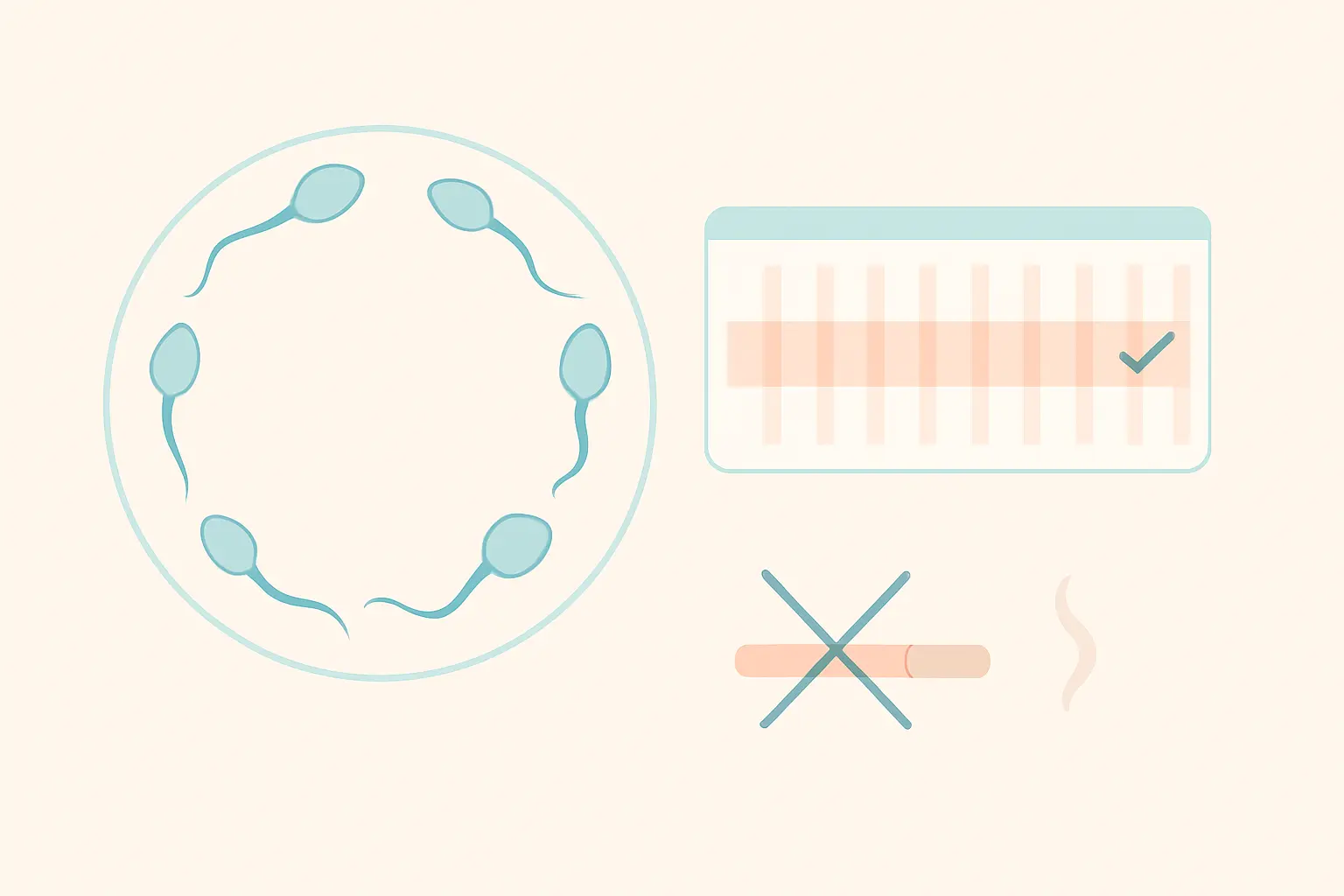
Unlike eggs, sperm are made continuously, and a full round of production and maturation takes roughly two to three months from start to finish. That is the whole logic behind the 90-day target: quit three months out and, by the time your cycle begins, most of the sperm available for treatment will have developed after you stopped smoking rather than during it. Quitting later still helps — there is no cut-off after which it stops being worth it — but the closer you get to a full three-month window, the larger the share of your sperm population that developed without tobacco’s oxidative and DNA-damaging effects.
This is a rare case in quit-smoking advice where the biology gives you a concrete number to plan around, rather than a vague “sooner is better.” If your clinic has already given you a treatment start date, counting back 90 days from that date gives you your actual quit deadline. If your clinic hasn’t set a date yet, treat this as extra reason to quit now rather than waiting for a firm appointment — every week you’re smoke-free before a date is set is a week you don’t have to make up later under time pressure.
Egg quality, ovarian reserve and earlier menopause
Egg quality works differently from sperm. Eggs are not continuously regenerated — as ASRM puts it, once eggs die off they cannot regenerate or be replaced — so accelerated loss of ovarian reserve caused by smoking cannot be undone once it has happened. The clearest evidence of how much smoking accelerates that clock is the age at which menopause arrives: ASRM’s fact sheet states that menopause occurs 1 to 4 years earlier in women who smoke compared with non-smokers.
What quitting accomplishes is stopping any further acceleration of that decline. That matters even inside a single treatment cycle, because the number of eggs you have is only part of the picture — the response to stimulation medication and the environment those eggs mature in are both affected by continued smoking, and both are things you can still influence in the months before a cycle.
This is also why cycle cancellations (stopped before egg retrieval, usually due to poor response to stimulation medication) are a more common conversation among smokers: a poor response tends to be flagged before committing to a costly, physically demanding retrieval, rather than proceeding with a cycle unlikely to succeed.
What your clinic will ask and test for
Most fertility clinics ask directly about current and past smoking status for both partners as a standard part of intake, since it affects protocol decisions (like stimulation medication dosing) and informs the honest odds conversation before you commit financially and physically to a cycle. A semen analysis for the male partner will show count, motility, and morphology — all of which smoking can affect — and some clinics may discuss cotinine testing (a nicotine metabolite marker) if smoking status is unclear or disputed.
Being upfront about smoking status, rather than underreporting it, lets your clinic actually adjust the plan around your real starting point — including recommending the 90-day window described above if there’s still time before your cycle. Clinics that specialize in fertility treatment have generally seen every version of this conversation before; there’s little practical upside to underreporting, since it only risks a protocol built around inaccurate assumptions.
Is NRT allowed during treatment?
This is a question for your clinic, not for a general guide — but it helps to know how the evidence is usually framed. A 2022 narrative review of NRT safety in pregnancy in the International Journal of Environmental Research and Public Health concluded that NRT is not completely harmless for the fetus or for the mother, but that if an adequate assessment of the risk-benefit balance is made, its use during pregnancy to aid in quitting smoking does seem appropriate. That is a more careful position than “NRT is safe,” and it’s the right frame for fertility treatment too: the comparison is against continued smoking, which carries the clearer and better-documented harm.
Practically, that argues for using the lowest effective dose, treating NRT as a short bridge rather than a long-term substitute, and choosing the format that fits your craving pattern from the nicotine replacement options compared here. Always raise NRT specifically with your fertility clinic before starting a cycle — they can weigh continued smoking against short-term NRT use in the context of your protocol, which a general quit-smoking guide can’t do for you. Our guide on how to talk to your doctor about quitting smoking has a useful question list to bring to that conversation.
A 90-day quit plan mapped to your cycle start
- Days 90–75: Set your quit date immediately, using the method in our guide to setting a quit date that actually sticks. If both partners smoke, aim to quit on the same date for mutual accountability.
- Days 74–45: This is the window where sperm maturing from your quit date are developing free of tobacco exposure. Treat slips seriously here and get straight back on plan rather than letting one become a return to daily smoking.
- Days 45–15: Book or confirm pre-cycle testing (semen analysis, any ovarian reserve testing) now that you’re well into your smoke-free window, so results reflect your improved status rather than your pre-quit baseline.
- Days 15–0: Final run-up to cycle start — this is a high-stress period for many couples, so plan craving support for high-stress stretches specifically for appointment days and injection days, which often carry extra anxiety on top of ordinary triggers.
If your cycle start date moves, as fertility timelines often do, don’t treat that as license to relax the quit — the 90-day window is about total time smoke-free, not a strict calendar countdown, so any extra weeks smoke-free before your cycle only help.
If your cycle is less than 90 days away
Plenty of people find this article with six weeks to go, not thirteen. A short runway changes the emphasis, not the answer: quitting now is still clearly worth doing, and the honest framing is that you’ll get a partial version of the benefit rather than none of it.
- 6–12 weeks out: Quit now and you’ll still capture a meaningful share of a full sperm-production cycle, and you remove smoking’s ongoing effect on the female partner’s stimulation response during the exact weeks it matters. Start NRT on day one rather than trying cold turkey under deadline pressure — this is the worst possible moment to gamble on the hardest method.
- 2–6 weeks out: The sperm benefit will be partial, but carbon monoxide clears from your blood within a day or two and general circulation improves quickly, both of which matter for the pregnancy that follows a successful cycle. Tell your clinic your quit date so they have accurate information.
- Cycle already started: Don’t abandon the quit because you missed the window — the pregnancy you’re working toward is the bigger reason to stop, and quitting before conception avoids the much harder problem of quitting while pregnant.
One thing not to do: delay your treatment purely to hit a tidy 90 days, without discussing it first. Age and ovarian reserve are moving targets too, and that trade-off belongs to your clinician, not to a calendar rule from an article.
Quitting together as a couple during treatment

When both partners smoke, quitting together tends to work better than one partner quitting alone — shared accountability removes the awkward dynamic of one person smoking around another who’s actively withdrawing, and it means household triggers (a shared smoking spot, a shared routine) disappear for both of you at once rather than remaining a temptation for the partner who hasn’t quit yet.
It’s also worth agreeing in advance on how you’ll each track progress, since IVF already involves a lot of shared tracking (medication schedules, appointment dates), and folding smoke-free tracking into that same shared effort tends to stick better than treating it as one partner’s separate project. Couples going through treatment together often find that framing the quit as part of the same team effort as the treatment itself, rather than a separate personal challenge, makes it easier to support each other through both at once.
One caution worth naming: fertility treatment is stressful, and stress is the most common reason a quit attempt collapses. Decide now — while things are calm — what you’ll each do on a bad results day, and agree that a slip gets talked about rather than hidden. A slip discussed openly usually stays a slip; a slip hidden from the person going through treatment with you tends to become a relapse.
Fertility quit FAQ
How long before IVF should I quit smoking?
Aim for about 90 days for the male partner, since a full round of sperm production and maturation takes roughly two to three months. Female partners should quit as early as possible, since further egg-reserve decline from smoking cannot be reversed, only halted.
Does smoking really lower IVF success rates?
Yes. The American Society for Reproductive Medicine states that women who smoke and undergo IVF have 30% lower pregnancy rates than women in IVF who do not smoke, and that infertility rates in both male and female smokers are about twice the rate found in nonsmokers.
Is nicotine replacement therapy safe during IVF treatment?
A 2022 narrative review concluded NRT is not completely harmless for the fetus or mother, but that with an adequate risk-benefit assessment its use to aid quitting does seem appropriate. Discuss it with your fertility clinic before your cycle, since the comparison that matters is against continued smoking.
Will my clinic test whether I’ve actually quit smoking?
Some clinics may use cotinine testing (a nicotine metabolite marker) if smoking status is unclear, though most rely on direct disclosure as part of standard intake. Being upfront lets your clinic adjust stimulation dosing and timing around your real starting point.
Can egg quality recover after quitting smoking?
Eggs that have already been lost cannot be replaced — ASRM notes that once eggs die off they cannot regenerate. Quitting stops further acceleration of that decline, and it removes smoking’s ongoing effect on how you respond to stimulation medication during a cycle.
Should my partner and I quit smoking together before IVF?
If both partners smoke, quitting on the same date generally works better than one quitting alone, since it removes shared triggers and avoids one partner smoking around the other during withdrawal. Agree in advance how you’ll handle a slip so it gets discussed rather than hidden.
Does smoking affect when menopause starts?
Yes. The American Society for Reproductive Medicine states that menopause occurs 1 to 4 years earlier in women who smoke compared with non-smokers, which reflects how smoking accelerates the natural decline of ovarian reserve.
My cycle starts in six weeks — is it too late to quit?
No. You’ll capture part of a sperm-production cycle rather than all of it, and you remove smoking’s ongoing effect during the exact weeks that matter. Start NRT from day one rather than attempting cold turkey under deadline pressure, and tell your clinic your quit date.
Count down to your cycle start date, smoke-free
iQuit’s health milestones and predictive craving forecasts help you hold a 90-day window, with SOS breathing tools for appointment-day stress and a craving log that shows you exactly which hours need a plan. Free to start on Android and iPhone.


