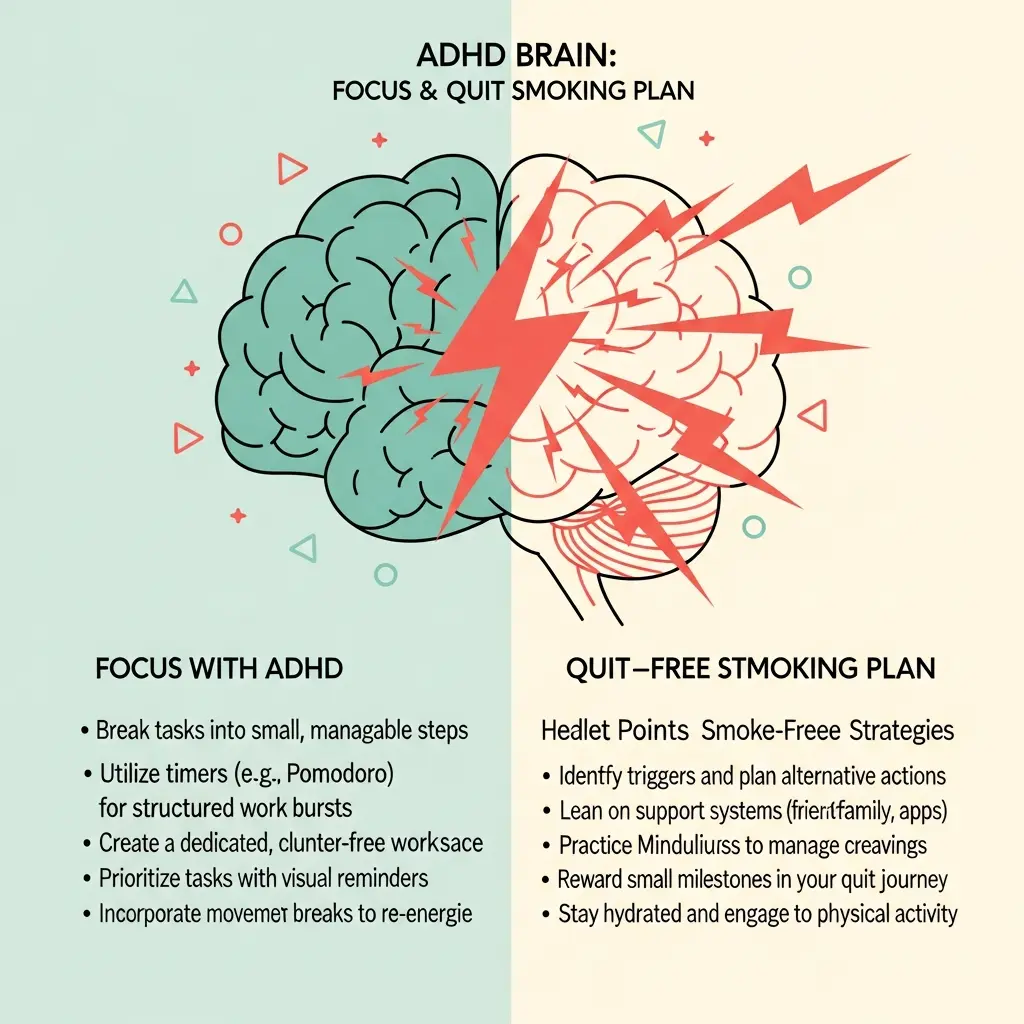
How to Quit Smoking With ADHD: A Step-by-Step Plan That Works With Your Brain (2026)
Quitting smoking is hard for everyone — but if you have ADHD, the challenge comes with an extra layer of difficulty that has nothing to do with willpower. Research consistently shows that people with ADHD begin smoking earlier, smoke more heavily, and have significantly higher rates of nicotine dependence than their non-ADHD peers — studies have reported notably elevated comorbidity between ADHD and nicotine dependence. The leading explanation is the self-medication hypothesis: nicotine temporarily improves attention, working memory, and impulse control — all areas where ADHD creates daily challenges.
This does not mean quitting is impossible. It means a generic quit plan will not work as well as one designed with your brain’s wiring in mind. This guide builds a step-by-step approach around ADHD-specific obstacles: impulsivity, working memory challenges, boredom sensitivity, and difficulty with long-term planning.
Why ADHD and Nicotine Are So Strongly Linked
Nicotine binds to acetylcholine receptors and indirectly boosts dopamine — the same neurotransmitter pathway that stimulant ADHD medications target. For people with ADHD whose dopamine regulation is atypical, nicotine can feel like it “fixes” a daily deficit. Researchers note that individuals with ADHD are more likely to begin smoking as an attempt to manage attention and concentration deficits, and to find quitting harder once dependence sets in.
This self-medication effect is real in the short term. But nicotine dependence creates a cycle: the brain downregulates its own dopamine production in response to regular nicotine, deepening the underlying deficit and making both ADHD symptoms and cravings worse over time. Quitting breaks this cycle — but first, you go through a period where both the nicotine withdrawal and the unmedicated dopamine gap feel acute.
Knowing this helps you approach withdrawal with understanding rather than alarm. When your concentration feels terrible in week one, it is temporary. Your brain is recalibrating.
Step 1: Talk to Your Prescriber First
Time estimate: One appointment | Difficulty: Low
Before you set a quit date or start any cessation medication, have a conversation with the clinician who manages your ADHD. This matters for several reasons:
- Bupropion (Wellbutrin/Zyban) is a licensed smoking cessation aid that also has some evidence for ADHD. However, it is contraindicated in people with seizure disorders, eating disorders, or who are taking monoamine oxidase inhibitors (MAOIs). Do not start it without prescriber guidance.
- If you take stimulant medications (methylphenidate, amphetamine salts), your prescriber may want to monitor your blood pressure if you also use certain cessation medications
- Your prescriber can flag if your ADHD medication dose needs adjusting during the quit period, when attention difficulties temporarily increase
- Varenicline (Champix/Chantix) is generally safe for ADHD patients — discuss it as an option
Step 2: Understand What You Are Actually Quitting
Time estimate: 15 minutes of reading | Difficulty: Low
Many ADHD smokers have never fully untangled what smoking does for them day-to-day. Before your quit date, spend time identifying your specific smoking functions:
- Concentration aid: You smoke to focus before tasks, during breaks, or to reset attention
- Boredom relief: Waiting, queuing, transitions, and downtime prompt automatic reaching for a cigarette
- Emotional regulation: Cigarettes calm irritability, overwhelm, or frustration — common ADHD emotional states
- Impulsive smoking: Unplanned cigarettes that happen without conscious decision
Each function needs a replacement strategy. Concentration breaks can be replaced with breathing exercises or brief physical movement. Boredom smoking needs sensory substitutes. Emotional regulation needs an alternative coping technique. This is not generic — it is specific to your ADHD profile.
Step 3: Build External Structure for Your Quit Plan
Time estimate: 1 hour of setup | Difficulty: Moderate
ADHD working memory challenges mean that a quit plan only in your head will not hold up under stress. Externalise everything:
- Write your quit date on a card and stick it somewhere visible (bathroom mirror, phone background)
- Set calendar reminders for: quit day, first NRT dose, week-one GP call, two-week milestone
- Create a “craving card” — a physical or phone note listing three things to do instead of smoking, so you do not have to think in the moment
- Tell two or three people your quit date and ask one to check in with you daily in week one
- Use a tracking app with notifications to keep your quit front-of-mind
This is not about distrust of yourself — it is about building an environment that makes the right behaviour easier for any brain, and especially one that under-responds to low-salience future rewards.
Step 4: Set a Quit Date and Target Impulsive Smoking
Time estimate: Decision in 5 minutes | Difficulty: Moderate
Set your quit date within the next two weeks and make it concrete. For ADHD smokers, particularly important to address before quit day are impulsive cigarettes — the ones that happen without deliberate decision. These account for a surprising proportion of daily consumption and are driven by habit and opportunity rather than conscious craving.
Reduce impulsive smoking in the days before your quit date by:
- Keeping cigarettes in an inconvenient location (not in your pocket)
- Adding a small deliberate pause — 2 minutes — before every cigarette
- Noting in your phone what you were doing when you reached for each cigarette
This builds self-awareness and reduces automatic smoking without requiring cold turkey willpower.
Step 5: Start NRT With Reminders Built In
Time estimate: Quit day and ongoing | Difficulty: Moderate
NRT is effective for ADHD smokers and should be used from quit day. The most important ADHD-specific instruction is this: set phone alarms for every NRT dose or patch change. Missed doses are a common cause of NRT failure, and ADHD makes missed doses more likely.
Cochrane meta-analysis data shows NRT meaningfully increases the chance of quitting — roughly increasing quit rates by 50–70% compared with unaided attempts. Combination NRT — a 24-hour patch for background coverage plus fast-acting gum or lozenge for breakthrough cravings — is more effective than a single form alone.
See our full guide on managing nicotine withdrawal symptoms step by step to understand each symptom and what to do when it peaks.
Step 6: Manage Boredom and Stimulation-Seeking
Time estimate: Ongoing, most critical weeks 1–4 | Difficulty: High
Boredom is a particularly potent trigger for ADHD smokers. The ADHD brain actively seeks stimulation — when understimulated, it reaches automatically for the fastest available hit, which has historically been a cigarette.
Build a “stimulation menu” of fast, accessible alternatives:
- Chew strong-flavoured gum (mint, cinnamon) — delivers oral sensation and flavour hit
- Five-minute movement: walk to a different room, do ten push-ups, step outside briefly
- A puzzle, game, or audiobook loaded on your phone for waiting moments
- Cold water — the sensory shock is a genuine craving interrupter
- Craft or fidget items for hands-and-mouth restlessness
The goal is not to suppress stimulation-seeking (impossible) but to redirect it. For more craving tools, see how to stop smoking cravings instantly.
Step 7: Use ADHD Strengths — Hyperfocus on Your Goal
Time estimate: When motivation is high | Difficulty: Low for most ADHD individuals
ADHD is not only about difficulties. Hyperfocus — the capacity for intense, sustained attention on something personally compelling — is a genuine strength that many ADHD people can direct toward their quit attempt.
Channel hyperfocus into:
- Researching your health recovery milestones and reading the nicotine withdrawal timeline in depth
- Designing a visual rewards tracker for milestones (24 hours, 1 week, 2 weeks, 1 month)
- Setting up the iQuit app with personalised milestones and daily check-in prompts
- Joining an online quit community where your activity and engagement sustain motivation
The early weeks of quitting, when novelty is high and motivation is fresh, are often when ADHD smokers do best. The harder period is weeks 3–6 when the initial drive fades and routine sets in. Plan additional accountability for that window.
Step 8: Plan for Relapse With Self-Compassion
Time estimate: Preparation before quit day | Difficulty: Moderate
People with ADHD tend to have higher relapse rates than the general population, largely because impulsivity makes resisting a craving in a high-pressure moment harder. This is not a character flaw. It means that relapse planning is not pessimism — it is responsible preparation.
Write down, before your quit date:
- “If I smoke one cigarette, I will — ” (your specific response, e.g., contact your support person, use your craving card, reset the clock rather than abandoning the quit)
- Who you will call immediately if you have a slip
- What triggered the slip and what you will do differently
Most successful quitters have attempted to quit multiple times before achieving long-term success. Each attempt builds self-knowledge. A slip is information, not proof of failure.
CHADD: Cigarettes and ADHD — A Robust Relationship
Evidence summary from CHADD (Children and Adults with ADHD) covering the self-medication pattern, why adults with ADHD quit at lower rates, and cessation strategies.
chadd.org ↗
Frequently Asked Questions
Why is it harder to quit smoking with ADHD?
People with ADHD tend to begin smoking earlier, smoke more heavily, and show higher nicotine dependence than non-ADHD smokers. Nicotine temporarily improves attention and working memory, creating a self-medication pattern. Impulsivity makes resisting cravings harder, and working memory challenges make maintaining a quit plan more difficult — especially in week three and beyond when novelty fades.
Can bupropion help with both ADHD and quitting smoking?
Bupropion is a licensed smoking cessation aid and is sometimes used off-label for ADHD. Cochrane evidence finds it significantly increases quit rates compared to placebo. However, it is contraindicated in seizure disorders, eating disorders, and with MAOI use — and requires prescriber oversight, especially if you take other ADHD medications. Always discuss with the clinician managing your ADHD care before starting.
Will quitting smoking make my ADHD symptoms worse?
Temporarily, yes — many people with ADHD notice increased difficulty concentrating during the first 2–4 weeks of quitting, because nicotine was providing a short-term cognitive boost. This is nicotine withdrawal, not a permanent change. For most people, concentration returns to or above baseline once nicotine is fully out of the system. Inform your ADHD prescriber so they can support you through this period.
Should I tell my ADHD prescriber about my quit attempt?
Absolutely yes. ADHD medications and cessation medications can interact, and your prescriber may want to adjust your ADHD treatment during the cessation period if concentration difficulties become significant. Transparency with your whole clinical team gives you the best possible support during your quit.