How to Quit Smoking When You Already Have COPD: A Step-by-Step Plan (2026)
If you have been told you have COPD and you are still smoking, you already know the conversation — your doctor mentions it at every appointment, you feel guilty every time you light up, and you may have tried to quit before only to find withdrawal feels even harder when breathing is already difficult. Here is what you need to hear: quitting smoking is the single most effective intervention available to anyone with COPD. According to GOLD 2025 guidelines, it is recommended for every patient at every stage of disease severity. And it is possible — even now, even with your lungs the way they are today.
This step-by-step plan is built specifically for people with COPD. It covers which nicotine replacement products are safe alongside oxygen therapy, how to coordinate your quit attempt with your GP or pulmonologist, and what to expect in your airways during the first weeks.
Why COPD Makes Quitting Both Harder and More Urgent
COPD — chronic obstructive pulmonary disease — causes irreversible airflow obstruction. The most common causes are long-term tobacco smoking and exposure to pollutants. Nicotine dependence is particularly strong in many COPD patients; some research suggests a biological link between the inflammatory pathways of COPD and heightened craving responses.
The landmark Lung Health Study, which followed nearly 6,000 smokers with mild-to-moderate COPD, found that continuing smokers lose lung function (FEV1, forced expiratory volume) roughly twice as fast as those who quit and stay quit — an annual decline of about 62 ml per year in continuing smokers versus about 31 ml per year in sustained quitters. This does not mean lost lung function returns — existing damage is permanent — but the trajectory of decline changes meaningfully, with fewer exacerbations, fewer hospital admissions, and longer survival.
The GOLD 2025 guidelines are unambiguous on this point: smoking cessation is the intervention with the greatest capacity to influence the natural history of COPD and slow its progression. That is the foundation of this plan.
Step 1: Book a GP or Pulmonologist Appointment
Time estimate: 1–2 weeks to appointment | Difficulty: Low
Before you set a quit date, have a medical conversation. Your COPD medications — bronchodilators, inhaled corticosteroids — do not interact with NRT, but your doctor needs to know about your quit plan so they can:
- Review whether your current inhaler regimen needs adjustment (some people with controlled symptoms can step down after quitting)
- Discuss whether varenicline (Champix/Chantix) or bupropion is appropriate for you given your full medication list
- Refer you to a Stop Smoking Service or pulmonary rehabilitation programme
- Document a COPD exacerbation plan so you know what to do if breathing worsens during withdrawal
Bring a list of all your current medications to this appointment.
Step 2: Create Your COPD Action Plan
Time estimate: Completed at GP appointment | Difficulty: Low–Moderate
A COPD action plan is a written document that outlines your normal symptoms, what to do if they worsen, emergency contacts, and — now — your quit date and cessation strategy. Ask your GP to help you fill one out or download a template from your national respiratory charity (e.g., Asthma + Lung UK, American Lung Association, Lung Foundation Australia).
Include in your plan:
- Your quit date (aim for within the next two weeks)
- Your chosen NRT or medication and dosing schedule
- Who to call if withdrawal triggers an exacerbation
- Your rescue inhaler instructions during week one
Step 3: Choose an Oxygen-Safe NRT Form
Time estimate: Decision made at GP appointment or pharmacy | Difficulty: Low
All licensed NRT forms — patches, gum, lozenges, and inhalators — are safe to use alongside supplemental oxygen therapy. NRT is well-established as effective and well-tolerated in people with chronic lung disease, and Cochrane meta-analysis data show that NRT meaningfully increases the chance of a successful quit — roughly increasing quit rates by 50–70% compared to unaided attempts.
The critical oxygen safety rule is this: never smoke near oxygen equipment due to fire risk. By using NRT instead of cigarettes, you eliminate that danger entirely while still satisfying nicotine withdrawal.
| NRT Form | Best For | COPD Note |
|---|---|---|
| Patch (24hr or 16hr) | Background steady craving control | Excellent first choice; no inhalation |
| Gum or lozenge | Managing breakthrough cravings | Combine with patch for better results |
| Inhalator (mouth, not lungs) | Replacing the hand-to-mouth habit | Safe; absorbed in mouth, not airways |
| Nasal spray | Fastest-acting option | Can cause nasal irritation; discuss with GP |
GOLD 2025 guidelines endorse combination NRT (a patch plus a fast-acting form) as more effective than a single product alone.
Step 4: Map Your Smoking Triggers
Time estimate: One to two days of observation | Difficulty: Low–Moderate
Triggers are the situations, emotions, and habitual cues that prompt a craving. People with COPD often identify breath-related anxiety — the feeling of breathlessness itself — as a powerful smoking trigger, because nicotine temporarily relieves the sense of panic. Recognising this pattern is essential.
Keep a simple log for 48 hours before your quit date. For each cigarette, note: time, location, emotion, and what you were doing. Common COPD-specific triggers include:
- Morning mucus clearance (the first cigarette “helps” cough up phlegm — it does not; your cilia will recover faster without it)
- Breathlessness anxiety (nicotine temporarily blunts the anxiety, not the breathlessness)
- Post-nebuliser or inhaler routine (paired habit)
- Boredom during rest periods
For each trigger, write one alternative response — for example, breathing exercises (pursed-lip breathing) instead of a cigarette during a breathlessness moment.
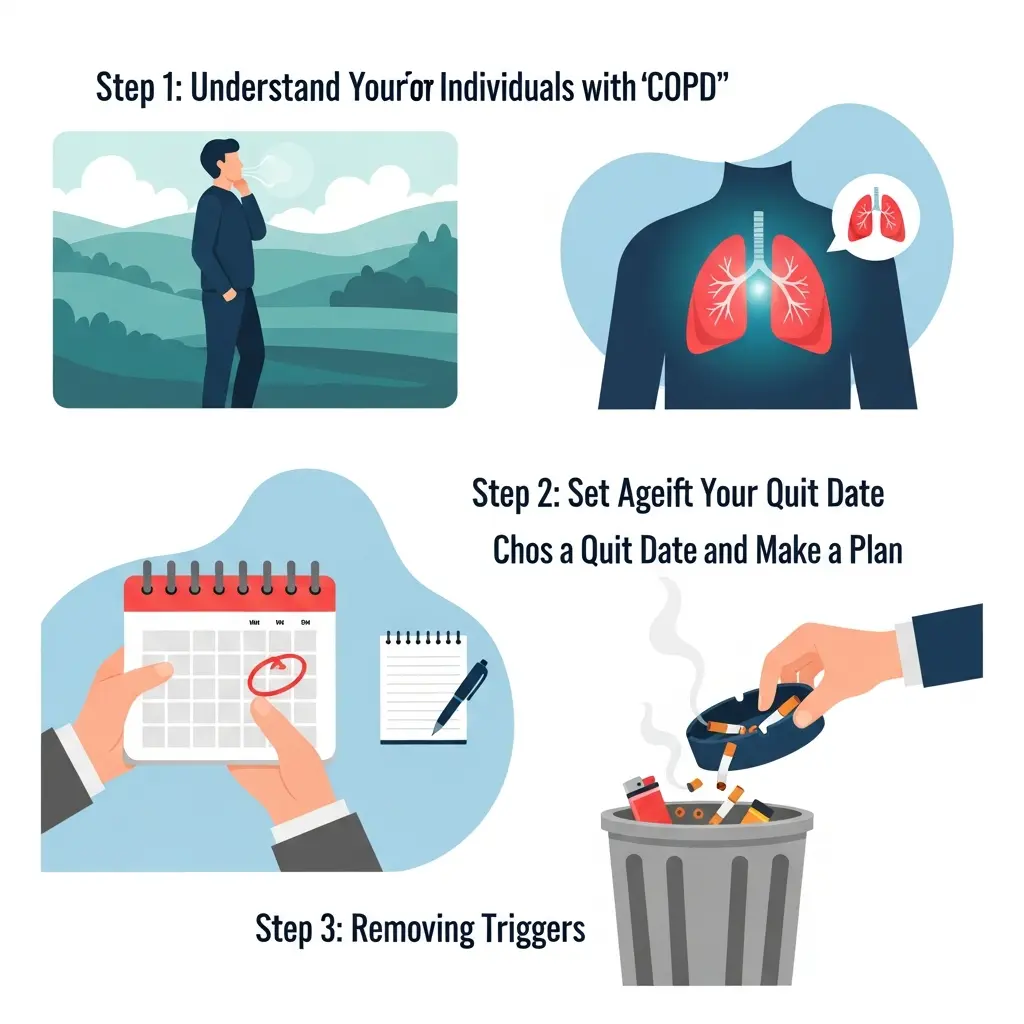
Step 5: Set Your Quit Date and Prepare Your Environment
Time estimate: 15 minutes of preparation | Difficulty: Low
Choose a date within the next 14 days. Research consistently shows that setting a specific quit date rather than “someday soon” significantly improves success rates. On quit day eve:
- Remove all cigarettes, lighters, and ashtrays from your home
- Wash clothing and bedding that smell of smoke
- Stock up on NRT and sugar-free gum or mints for oral urges
- Tell your household — whether family or carers — your quit date so they can support you
- Download a quit-smoking tracking app to log your milestone hours
Step 6: Enrol in Pulmonary Rehabilitation
Time estimate: 2–4 weeks to start after GP referral | Difficulty: Moderate
Pulmonary rehabilitation (PR) is a supervised programme combining exercise training, breathing techniques, and education for people with chronic lung conditions. Most PR programmes run for 6–8 weeks. It is one of the most evidence-based interventions in respiratory medicine, shown to improve exercise tolerance, reduce breathlessness, and improve quality of life.
PR programmes also frequently include smoking cessation support and peer groups, making them doubly valuable during a quit attempt. Ask your GP for a referral — PR is available on the NHS in the UK, through Medicare in the US, and via Lung Foundation Australia’s network. If waiting lists are long, ask about home-based exercise programmes as a bridge.
See our full guide to COPD and smoking cessation: lung recovery after quitting for more on what to expect from your airways month by month.
Step 7: Manage Withdrawal Symptoms Safely
Time estimate: Peaks days 2–5; mostly resolved by week 3–4 | Difficulty: High
Withdrawal when you have COPD requires some extra attention. In the first one to two weeks, your cilia — the tiny hair-like structures that sweep debris out of your airways — begin to recover. This produces more coughing and mucus than usual. This is a sign of healing, not damage. However, it can feel alarming.
For standard withdrawal symptoms, see our detailed guide on how to deal with nicotine withdrawal symptoms. Key COPD-specific strategies:
- Pursed-lip breathing: Inhale through the nose for 2 counts, exhale through pursed lips for 4 counts. Reduces breathlessness anxiety without nicotine.
- Maintain inhaler schedule: Do not skip bronchodilators because you feel a craving. Your inhalers and NRT work on different systems.
- Stay hydrated: Water helps thin and clear mucus as cilia recover.
- Avoid craving triggers: Refer to the map you made in Step 4.
Step 8: Track Progress and Prevent Relapse
Time estimate: Ongoing | Difficulty: Low–Moderate
Schedule a four-week follow-up with your GP to review your lung function and NRT dose. Many people with COPD need NRT for longer than the standard 12 weeks, and clinical guidance supports continued NRT use where it helps someone stay abstinent — always under your GP’s review.
Most relapses happen in the first four weeks. Common high-risk moments for COPD patients include exacerbation episodes (when breathlessness peaks and the urge to smoke returns as a perceived relief) and hospital stays. Prepare for these in advance:
- Have a craving plan for exacerbation days — NRT at the ready, a person to call
- Tell any hospital ward you are admitted to that you are a non-smoker managing NRT
- Use the nicotine withdrawal timeline to understand what stage you are at and that cravings do diminish
The iQuit app tracks your smoke-free hours, calculates health milestones, and provides a 24/7 AI coach to help you through breakthrough cravings — particularly useful at 2am when your doctor’s surgery is closed.
Frequently Asked Questions
Is it safe to use NRT if I am on supplemental oxygen?
Yes — all licensed NRT forms (patches, gum, lozenge, inhalator) are medically safe with oxygen therapy. The critical safety rule is to never smoke near oxygen equipment due to fire risk. NRT eliminates that danger while still relieving nicotine withdrawal.
Will my COPD improve if I quit smoking?
Quitting will not reverse existing COPD or fully restore lost lung function, but evidence from the Lung Health Study shows that the annual rate of FEV1 decline roughly halves after quitting — from around 62 ml per year in continuing smokers to about 31 ml per year in sustained quitters. You will experience fewer exacerbations, better exercise tolerance, and improved survival odds. This is the most impactful change you can make for your COPD.
Can I use varenicline (Champix/Chantix) with COPD?
Varenicline is generally considered safe for COPD patients and is endorsed in GOLD 2025 guidelines as a cessation aid. Always discuss with your GP first, particularly if you have a history of depression or psychiatric conditions, as monitoring is recommended.
Why is my cough worse after I quit smoking?
In the first one to two weeks after quitting, cilia begin recovering and actively clearing accumulated mucus from your airways. This temporarily increases coughing and mucus production — it is a sign your lungs are healing. It typically peaks around days 3–7 and then gradually settles. If it is accompanied by fever or a sharp drop in breathing capacity, contact your GP.
What is pulmonary rehabilitation and can it help me quit?
Pulmonary rehabilitation is a supervised programme of exercise, breathing techniques, and patient education for people with chronic lung disease. It improves breathlessness, exercise capacity, and quality of life. Many PR programmes include smoking cessation support, making them a powerful combined resource. Ask your GP for a referral.