Working from home removes almost every external rule that used to shape your smoking, and most quit plans assume those rules are still there. If you are looking for how to quit smoking working from home, the problem is not willpower. It is that nobody is watching, the door is three steps away, and there is no fixed break for you to move.
The fix is to rebuild the structure the office used to impose, deliberately and in advance. This guide maps the home-working day, replaces the breaks that used to be smoke breaks, and gives you a one-week schedule to start from.
Why home is harder than the office
An office quit is difficult for social reasons: colleagues who smoke, a designated spot, the invitation to come outside. Our guide to managing workplace cravings is built around exactly that problem. Home is the opposite problem, and it needs the opposite solution.
Four things change when the office is a spare room:
- Access has no friction. In an office a cigarette costs a lift, a lobby and a walk. At home it costs standing up.
- There is no fixed break structure, so smoking becomes the thing that marks time instead. Many home workers discover they are not taking breaks at all; they are taking cigarettes.
- Nobody sees you. Accountability that used to be accidental has to become deliberate.
- Work and home triggers overlap. The NHS lists both taking a break at work and watching TV or relaxing at home as routine triggers. At home they happen in the same chair.
One more thing worth knowing before you start, because it catches home workers in particular. The NHS points out that many smokers mistake withdrawal symptoms for everyday stress: nicotine gives a short burst of calm, and as it leaves your system it produces irritability and anxiety that feel exactly like a hard working day. When your desk is also the place where you feel that, it is easy to conclude the job is the problem.
Mapping your real trigger hours
Do this for one working week before your quit date, and do it against your calendar rather than from memory.
For each cigarette, record the time, what you were doing in the ten minutes before, and how strong the urge was out of ten. Then lay it over your work diary. Most home workers find their cigarettes cluster around three or four repeating events rather than spreading evenly: the first coffee, the end of a meeting block, the pre-lunch gap, and the point in the afternoon where concentration drops.
The NHS list of routine smoking triggers is a useful checklist while you do this, because several of them apply differently at home:
| NHS trigger | What it looks like in an office | What it looks like at home |
|---|---|---|
| Drinking coffee | One or two, at set times, away from your desk | All day, at the desk, each one an invitation |
| Taking a break at work | A fixed break with other people | No fixed break, so the cigarette becomes the break |
| Being on the phone | Usually indoors and observed | Camera off, nobody watching, a hand free |
| Finishing eating | A canteen or a shared kitchen | Lunch at the desk, straight into the doorway afterwards |
| Watching TV or relaxing at home | Happens after work, elsewhere | Happens in the same room as work, hours earlier |
This short film from a state quitline program covers how to spot your own triggers rather than borrowing someone else’s list.
Logging in the moment is the hard part when nobody is prompting you. iQuit records each craving with its trigger and intensity and shows the pattern back as your risky hours, which is exactly the map this step is trying to produce. It is free on Google Play and the App Store. Set your date first, though: our step-by-step on setting a quit date that actually sticks covers how to fix one when there is no external deadline forcing it, and our two-week Stoptober run-up is the same idea with the date already chosen for you.
Replacing the step outside
Here is the central move of the whole plan: you are not removing a break, you are replacing one. Home workers who simply delete the cigarette usually end up working four hours straight, getting more irritable, and reaching for the packet at hour five.
The NHS advice for break-linked cravings is specific: take your break at a different time, or go for a walk instead. Both work better at home than in an office, because nobody is timing you.
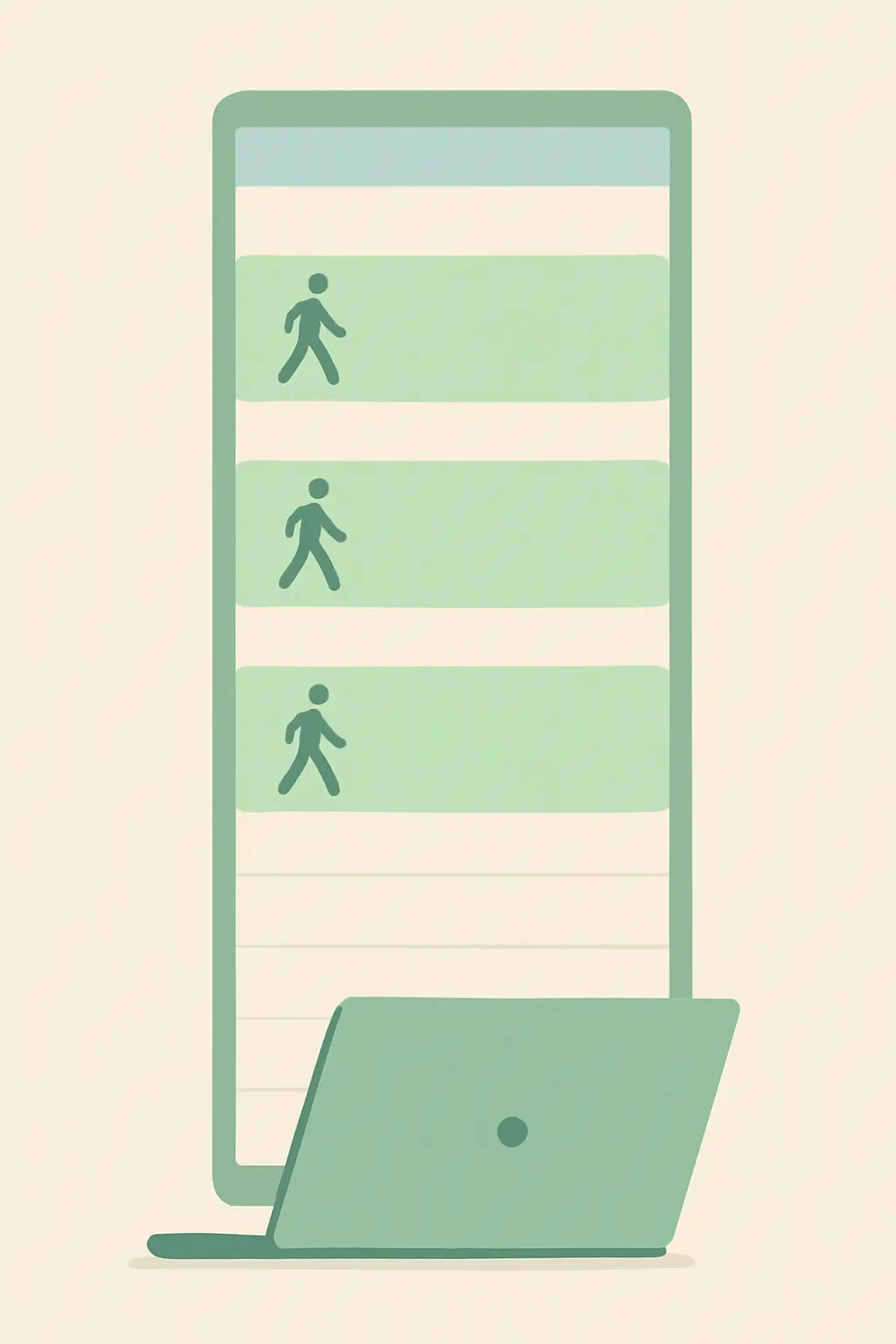
- Put three breaks in the calendar as real entries, at the times your log showed clusters. Ten minutes each, marked busy.
- Make each one physical and outside the room. Around the block, into the garden, up and down the stairs. The point is leaving the chair, not exercise.
- Move the time by fifteen minutes from where the cigarette used to sit, so the break is not a straight substitution of one ritual for another.
- Leave your phone behind on at least one of them. A scrolled break does not feel like a break, so you will want another one.
If a craving arrives between breaks and you cannot leave the desk, use something that fits into two minutes. Our guide to grounding exercises that calm cravings in minutes covers techniques short enough to do between calls, and the NHS itself recommends deep breathing, mindfulness and light physical activity for exactly this.
The desk and the doorway
Two pieces of geography decide more than any amount of resolve.
The desk
Take the ashtray, lighter and anything smoking-shaped off the desk and out of the room before your quit date. Then change the drink. The NHS suggests swapping coffee for something else, and it matters more at home, where coffee is continuous. Keep a large glass of water within reach and make the coffee a thing you get up and leave the room for.
Give your hands something. A stress ball, a pen, a fidget object, or fast-acting nicotine replacement in the place the packet used to sit. The hand-to-mouth habit is separate from the nicotine, and at a desk it is the part that resurfaces first.
The doorway
If there is one specific doorway, step or balcony where you smoked, make it stop being that place. Put a plant there, move a chair, use a different door for the first fortnight. This is the one piece of office-quit advice that transfers directly: change the setting and the cue weakens.
It helps to deal with the smell at the same time. Smelling cigarette smoke is on the NHS list of situation triggers, and in a house you lived in as a smoker it is in the soft furnishings. Our guide to clearing the smell from your home, car and clothes covers what actually works.
The afternoon slump
Almost every home-working log has a hole in it somewhere between two and four in the afternoon. It is the point where concentration drops, the next task is unappealing, and a cigarette used to reset the day.
The NHS lists trouble concentrating and restlessness among nicotine withdrawal symptoms, which means the slump gets worse before it gets better. It also tells you how long to plan for: after your last cigarette, withdrawal can start within a few hours, symptoms are usually strongest in the first week and especially the first 3 days, and on average last 3 to 4 weeks, though some people feel them for longer.
So treat the first three weeks of afternoons as a scheduling problem:
- Move the hardest work earlier. Put the thinking in the morning and the admin after two o’clock, for three weeks only.
- Book the walk at the slump, not after it. Once the craving has arrived you are negotiating; ten minutes earlier you are just going outside.
- Eat something at the desk. Hunger and a craving are easy to confuse, particularly when lunch was a sandwich at the keyboard.
- Do not add caffeine to fix it. More coffee at the desk reinstates the trigger you just removed.
The same page is worth quoting on the payoff: the NHS says that once you reach 28 days smoke free, you are 5 times more likely to stay quit for good, and that cravings are hardest in those first 28 days as your body adjusts.
Working in the room where you used to smoke
If you smoked at your desk, or in the room your desk now sits in, you have a harder version of this problem, because the strongest cue in your day is the place you spend eight hours.
Rearrange rather than redecorate. Turn the desk ninety degrees, move it to the other wall, change which window you face. It sounds trivial and it is the single most effective thing in this section, because the cue is the view and the position, not the room.
If the room cannot change, change what happens in it. No eating at the desk, no relaxing at the desk in the evening, and a hard stop where the laptop closes and you leave. Splitting work from downtime is good practice for home working anyway; while you are quitting it is also craving management.
Housemates and partners who still smoke
At home, being around another smoker is not an occasional social event. It is the whole working day. The NHS lists being with other smokers at home, seeing other people smoke and smelling cigarette smoke as three separate situation triggers, and a housemate who smokes gives you all three on repeat.
What to agree, ideally before your quit date:
- Where. Outside, and not at the door you walk past.
- Storage. Not on a shared surface, not in the room you work in.
- The offer. Ask them not to offer, and not to ask if you want to come out for one. The NHS suggests having a ready reply prepared, such as no thanks, I do not smoke any more.
- The first fortnight. Be explicit that the early weeks are the hard ones, so the rules are tightest then.
Our guide to quitting when you live with a smoker goes through the conversation in more detail, including what to do when they are not willing to change much.
A one-week home-office quit schedule
This is the first working week after your quit date. Adjust the times to your own log.
| Time | What you do | Why |
|---|---|---|
| On waking | Patch on before coffee; get dressed and step outside for five minutes | Waking up is an NHS-listed routine trigger, and the first cigarette is usually the strongest |
| Start of work | Water at the desk, coffee made in the kitchen and drunk away from it | Breaks the desk-and-coffee pairing the NHS suggests swapping |
| Mid-morning | Ten-minute walk, booked in the calendar, phone left behind | Replaces the mid-morning step outside with a real break |
| Lunch | Away from the desk, then brush your teeth or chew gum | The NHS suggests minty gum or brushing instead of the after-meal cigarette |
| Early afternoon | Second walk, booked before the slump, plus a snack | Pre-empts the concentration dip rather than reacting to it |
| Mid-afternoon | Admin tasks; fast-acting NRT if a craving spikes | Lowers the cognitive load during the hardest hour |
| End of work | Close the laptop, leave the room, change something about the space | Separates work from home so the desk is not also the evening chair |
| Evening | Mark the day off, and tell one person it went | The NHS recommends a habit tracker and a quit buddy; at home you have to create the accountability |
One thing home working makes easier, for once: support does not require leaving the house. The NHS says local stop smoking services are free and that where you cannot attend in person you may be able to join sessions by phone or online. Book that in the same week.
Quitting While Working From Home FAQ
Is it harder to quit smoking when you work from home?
It is a different kind of hard. You lose the social pressure of an office, but you also lose the friction that made a cigarette a ten-minute expedition, and you lose the fixed breaks that used to mark the day. The fix is to rebuild breaks deliberately rather than relying on willpower.
How do I take a break without smoking?
Book it as a calendar entry, make it physical, leave the room and shift it fifteen minutes from where the cigarette used to sit. The NHS names taking your break at a different time and going for a walk instead as specific tactics for break-linked cravings (NHS).
How long will the afternoon cravings last?
The NHS says withdrawal can start within a few hours of your last cigarette, is usually strongest in the first week and especially the first 3 days, and lasts 3 to 4 weeks on average, though some people feel it for longer. Cravings are hardest in the first 28 days (NHS).
Should I move my desk?
If you smoked at or near it, yes. Turning the desk, moving it to another wall or facing a different window changes the view and position that cue the habit, and it costs nothing. Changing the setting is the NHS approach to routine triggers applied to the room you cannot leave.
I keep telling myself work is too stressful to quit right now. Is that true?
It is worth testing. The NHS says many smokers mistake withdrawal symptoms for everyday stress, because nicotine leaving your system produces irritability and anxiety that feel like a hard day. It also says stopping smoking reduces anxiety, depression and stress once you are past the withdrawal stage (NHS).
Can I get NHS stop smoking support without going anywhere?
Often, yes. Local stop smoking services are free, and the NHS says that where you cannot attend in person you may be able to join sessions by phone or online. Your GP or pharmacist can refer you, or you can phone the service directly (NHS).
My partner smokes and we are both home all day. What do I do?
Agree three things before your quit date: where they smoke, where cigarettes are kept, and that they will not offer or invite you. The NHS lists being around other smokers, seeing people smoke and smelling smoke as separate triggers, so distance and ventilation both matter.
I had one during a bad afternoon. Do I start again?
Keep going, and treat the cigarette as information about which hour needs a better plan. The NHS is blunt that even one cigarette can pull you back into the cycle of cravings and withdrawal, so the next step is to tighten that specific time slot rather than to write the week off.
Give your working day a structure again
iQuit logs cravings with their triggers and intensity so you can see which hours of your home-working day are the risky ones, tracks days smoke-free and money saved, and gives you SOS craving tools between meetings. Free on Google Play and the App Store.
Download iQuit Free on Google Play
Download on the App Store