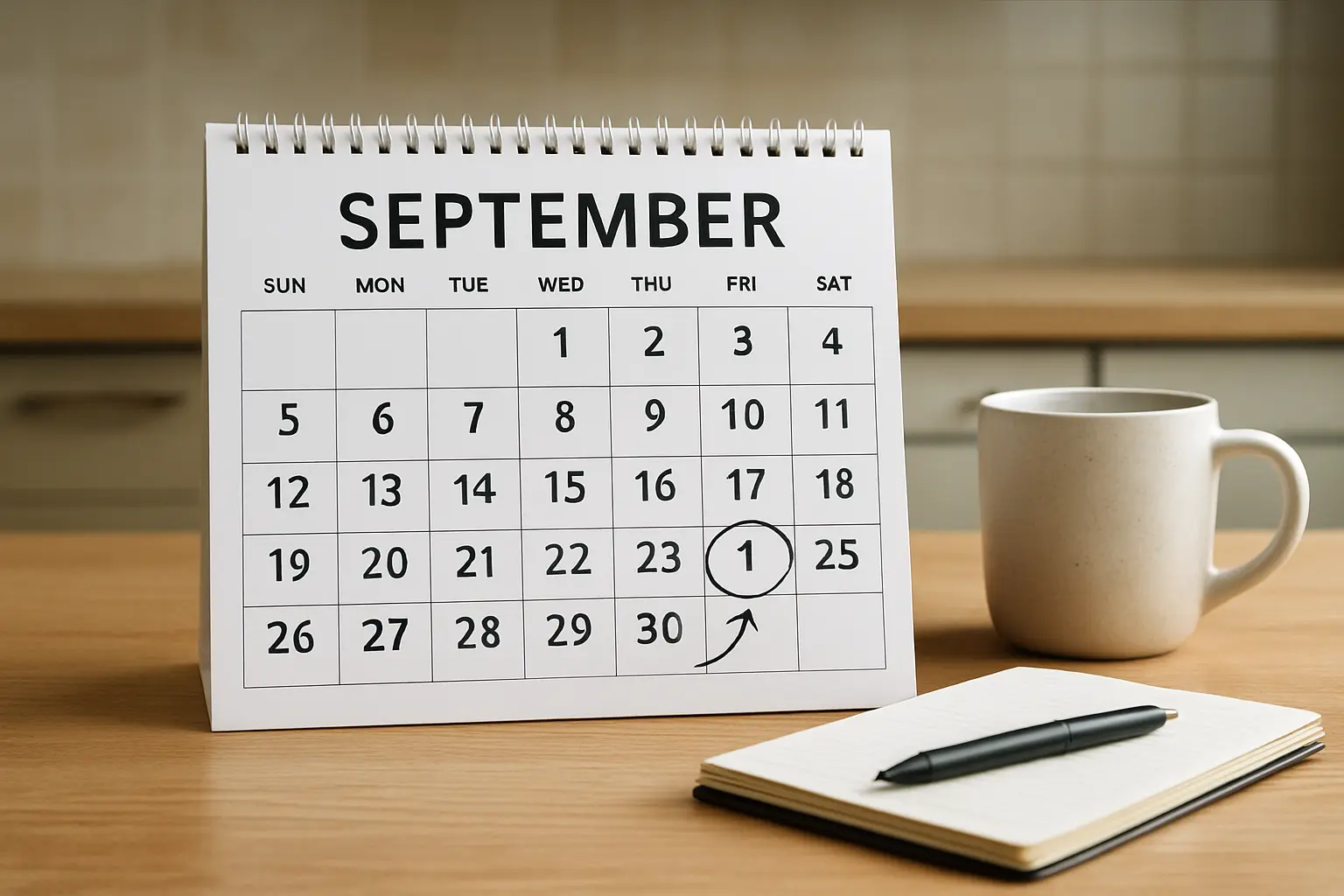
Stoptober asks you to stop smoking on 1 October and stay stopped for 28 days. Almost everything that decides whether that works happens before the first, which is why how to prepare for Stoptober matters more than anything you do on day one. The fortnight in front of the campaign is where you count your real smoking, pick a method, get treatment into your hands, and take the cigarettes out of your house.
This is a dated run-up. Each block maps onto the calendar between 17 September and the morning of 1 October, so you can work through it in the window it describes. It is the run-up, not the month itself, so it sits in front of the 28-day Stoptober plan itself.
Why the fortnight before decides the month
Stoptober is built around a single number. The Department of Health and Social Care says the campaign is based on evidence that people are 5 times more likely to quit for good if they make it to at least 28 days smoke free. The NHS puts it in shorter words: reach 28 days and you are much more likely to quit for good.
That target is reachable. What sinks people is starting on 1 October with no treatment in the house, no plan for the 11am break, and a full packet in a coat pocket. Two weeks is just enough to fix all three, because an appointment with a stop smoking service and a supply of nicotine replacement therapy is not a same-day errand. A mass quit date only helps if you arrive at it ready, rather than treating 1 October as a deadline you dread. Our guide to why October works as a quit month covers the psychology of quitting alongside other people; this article is the logistics.
What Stoptober actually offers this year
One honest note before the plan. In mid-September 2026 the NHS had not published a separate Stoptober page for this year: the old campaign address redirects to the main NHS Better Health quit smoking hub, and GOV.UK carries no new Stoptober release. Rather than repeat a theme or a sign-up total nobody has announced, here is what is definitely live and free right now:
- The Personal Quit Plan, described by the NHS as a free 8-step plan built from a few questions, designed to help you prepare for your quit date, show how much money you can save, and give tips for managing triggers.
- Local stop smoking services, free, which the NHS says can improve your chances of quitting for good.
- The NHS Quit Smoking app, free, for tracking progress and daily support.
- Helplines. England 0300 123 1044, Scotland 0800 84 84 84, Wales 0800 085 2219.
Everything below uses those, not a campaign page. If Stoptober materials appear before 1 October, they sit on top of this rather than replacing it.
Earlier campaign figures are worth knowing, as long as you read the date on them. In its September 2023 Stoptober release, the Department of Health and Social Care reported a Censuswide survey of more than 3,000 adults in England, run between 23 and 31 August 2023, in which 95% of ex-smokers saw positive changes as early as 2 weeks after quitting — most often more energy (45%), feeling healthier (42%) and breathing better (42%). That release put the average saving at about £38 a week, and quoted the Deputy Chief Medical Officer for England saying Stoptober had helped over two and a half million people quit in its first 12 years.
Days 14 to 10: baseline your real smoking (17 to 21 September)
Do not change anything yet. For five days the only job is measurement, because almost nobody knows their own pattern accurately: people underestimate the total and misremember which cigarettes are hard to skip. Record four things for every cigarette — the time, where you were, what you were doing, and how badly you wanted it out of ten. By day 10 the list sorts itself into three groups.
| Group | How to spot it | What to do about it in October |
|---|---|---|
| Anchor cigarettes | Same time every day, craving rated 8 to 10 (first of the morning, after meals, with alcohol) | These need a planned replacement action, not willpower |
| Habit cigarettes | Tied to a place or an activity, craving rated 4 to 7 (the drive, the break, the phone call) | Change the setting and most of these go quietly |
| Filler cigarettes | Boredom, someone else lit one, craving rated 1 to 3 | Usually disappear once the packet is gone |
The total matters too, because it decides your nicotine replacement strength. Patch labels split people by whether they smoke more or fewer than ten cigarettes a day, so an honest count now saves an under-dosed first week later.
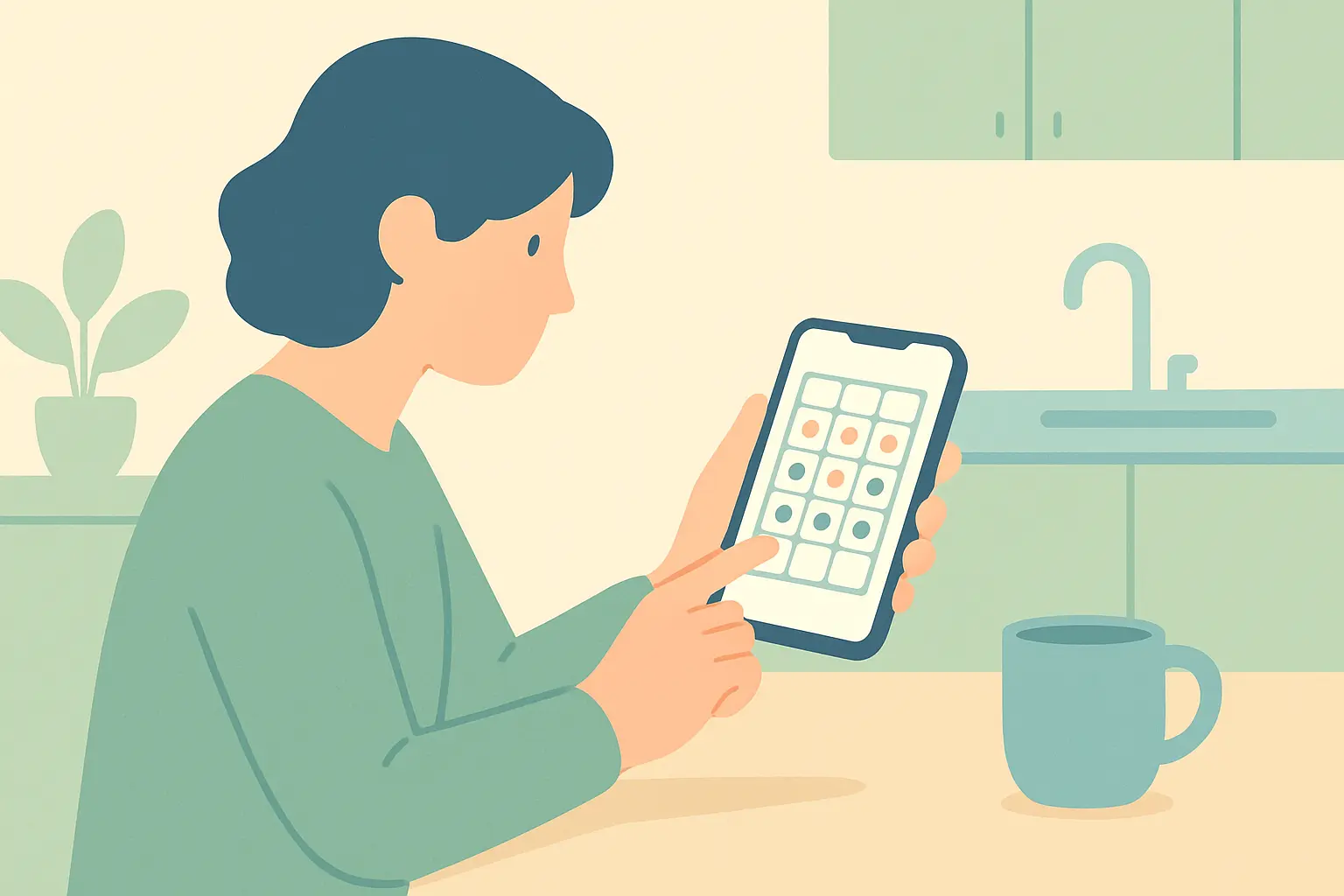
A phone does this better than a notebook, because you log in the moment rather than reconstructing at night. iQuit records each craving with its trigger and intensity, then shows the pattern back as your risky hours. It is free on Google Play and the App Store, and starting a fortnight early means it already knows your shape before day one. Fill in the NHS Personal Quit Plan on day 14 too: it forces the same questions a stop smoking adviser will ask you next week.
Days 9 to 7: choose one method and commit (22 to 24 September)
Three days, one decision. The commonest preparation failure is arriving at 1 October still undecided between cold turkey, patches, a vape and tablets, then defaulting to nothing.
The NHS list of what stop smoking services offer is short and specific: nicotine replacement therapy including patches, gum, lozenges, inhalators and mouth and nasal sprays, plus the tablets varenicline, cytisinicline and bupropion. E-cigarettes cannot be prescribed on the NHS because they are not licensed medicines, though the NHS notes some local services offer a free e-cigarette starter pack. Two practical rules for this block:
- Prescription-only options need the earliest action. Varenicline, cytisinicline and bupropion are started before your quit date under medical supervision, so if you want one, the appointment has to be booked in this block, not the next one.
- If you pick NRT, pick two products, not one. A patch for background cover and a fast-acting product for the spikes is the standard pairing.
If you are torn, our walkthrough on choosing a quit method sorts the options by how you actually smoke, and what the success rates say gives the comparison figures behind the choice. Write the method down when you pick it: a decision you have not written down is still a shortlist.
End the block by fixing the date so it survives a bad Tuesday. It is 1 October, but the technique is the one in our guide to setting a quit date that actually sticks: tell three people, put it where you will see it, and decide in advance what the date does not move for.
Days 6 to 4: get treatment physically in your hands (25 to 27 September)
This is the block people skip, and the one that predicts the month. By the evening of 27 September, whatever you are going to use on 1 October should be in your house.
Book the stop smoking service appointment
The NHS states that local stop smoking services are free and can improve your chances of quitting for good. Your GP, pharmacist or health visitor can refer you, or you can phone the service directly. Appointments can be one-to-one, group, drop-in, or by phone and online where you cannot attend in person.
At the first session you talk about why you smoke and why you want to quit, decide a quit date, and take a breath test measuring carbon monoxide. That reading is quietly the best reason to book early: taken before 1 October, it becomes the number you watch fall. Services usually support people for up to 12 weeks, and the NHS says each meeting brings a supply of or prescription for your treatment, a carbon monoxide measurement, and an emergency out-of-hours number for cravings.
Get the NRT itself
Whether your service supplies it or you buy it over the counter, do it now, and check three things: the strength matches your log, you have enough for the first fortnight, and you have a fast-acting product as well as a patch. Our side-by-side on NRT options compared covers which pairings suit which smoking patterns.
The following short film from an NHS trust explains the 28-day target that the whole campaign is built on.
Tell the people who need to know
In the 2023 Stoptober survey, 29% of respondents rated family and friends a key motivator and 21% rated talking to other ex-smokers. Telling people now rather than on the day gives them time to be useful: the colleague who stops asking you outside, the partner who smokes elsewhere, the friend who quit last year and answers a message at 9pm.
Days 3 to 2: strip the house, the car and the routine (28 to 29 September)
Now you change the environment, not the behavior. You are still smoking, so this is deliberately easy.
- Remove every spare. Glovebox, rain coat, kitchen drawer, work bag. Cigarettes you forgot about are the ones that end quits.
- Bin the hardware. Ashtrays, lighters, the saucer on the balcony.
- Wash the smell out. Car interior, the chair you smoke in, coats. The smell is a trigger in its own right, and a car that smells clean on 1 October is a different car.
- Redesign the smoking spot. A plant, a chair facing the other way, anything that stops the step or window being a smoking spot.
- Plan replacements for your anchor cigarettes. Take the three highest-rated from your log and write the replacement action beside each. In the 2023 survey the top self-reported tactics were keeping hands busy, changing routine and going for walks, each named by 37% of respondents.
One more job for day 2: work out your own saving. Your daily count multiplied by your own pack price is far more persuasive than an average, and it makes a better savings goal when it is attached to something specific.
Day 1: the last-day rules (30 September)
The last day has a bad reputation, mostly because of the farewell binge. Chain-smoking through 30 September does not get nicotine out of the way, and it tends to make the first morning worse. Four rules for the day:
- Smoke normally. Not more, and no ceremonial last packet.
- Buy nothing. Whatever is in the house at breakfast is what you have.
- Set up the first morning tonight. Patch on the bedside table, gum or spray in the bag, water bottle filled, alarm moved fifteen minutes earlier so the first hour is not a rush.
- Get the cigarettes out of the building before bed. Not in the outside bin, not in the car. Out.
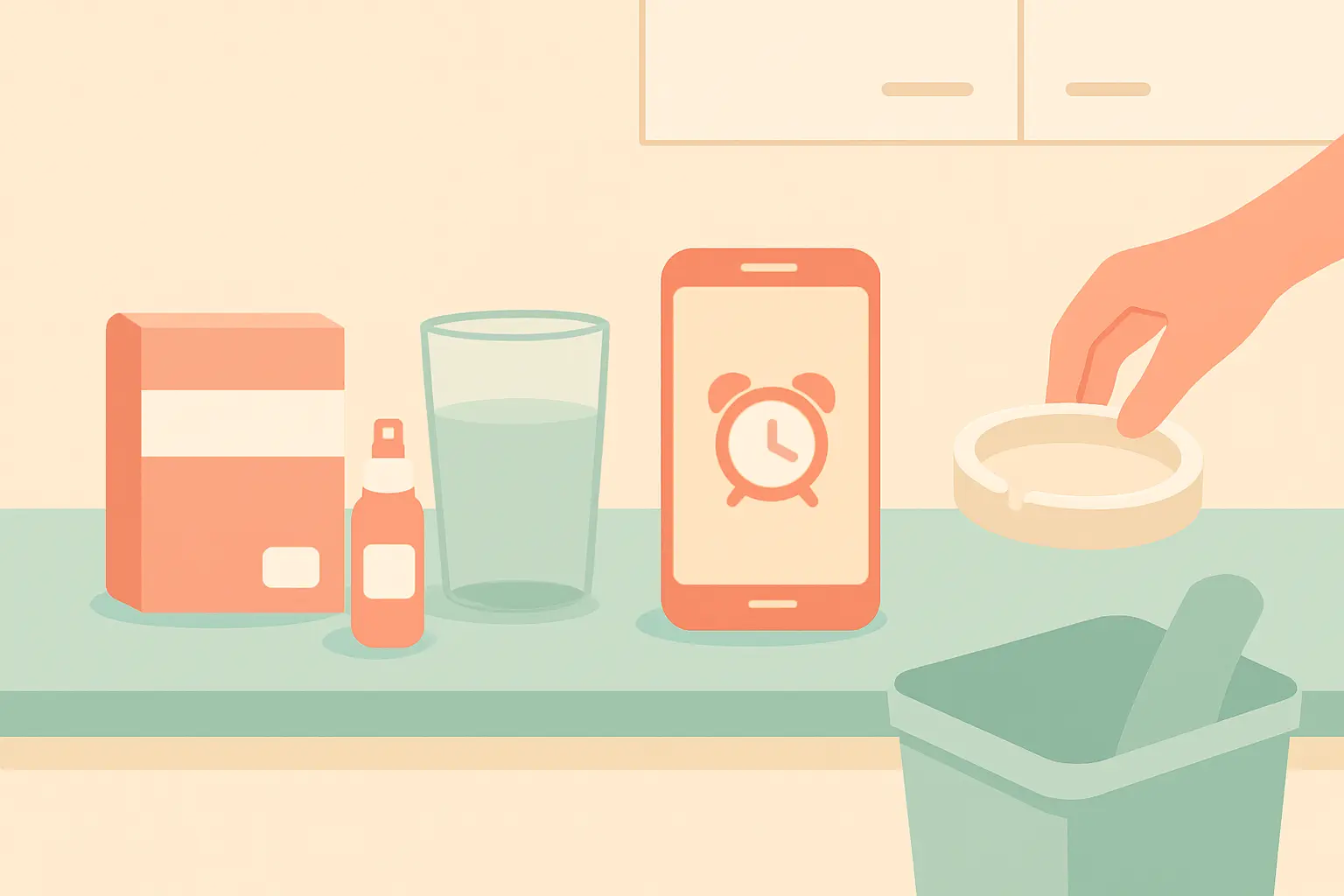
If you are using a patch, check the label for when to apply the first one, and follow your stop smoking adviser’s instructions where they differ.
The morning of 1 October
You are prepared, so keep the first morning boring. Apply the patch before anything else, eat breakfast somewhere you did not usually smoke, leave the house five minutes early so the first walk is not one you would have smoked on, and put the fast-acting NRT in the pocket that used to hold the packet, so your hand finds something.
Expect an uneventful morning and a harder late afternoon, where most logs show a cluster; your baseline already told you when yours is. Everything from here is the 28-day plan rather than the run-up, and the recovery starts at once: the NHS puts carbon monoxide at half its level after 8 hours and down to a non-smoker’s level after 48 hours, with taste and smell already improving by then.
If you slip during the run-up
You cannot slip before 1 October, because you have not stopped yet. That sounds obvious, but plenty of people abandon the plan in late September after a heavy weekend, deciding they have already failed at something they have not started. Two things genuinely do derail the run-up, and both have a simple fix:
- You stopped logging after two days. Start again from wherever you are. Three honest days beat fourteen imagined ones.
- Your appointment falls after 1 October. Keep the date anyway, start on over-the-counter NRT, and bring your log to the appointment. The date is worth more than a perfect start.
And if the fortnight got away from you entirely, 1 October still beats an unspecified day in November. Start with whatever you have, and book the service for the first week of October.
Stoptober Preparation FAQ
When does Stoptober start in 2026?
Stoptober’s mass quit attempt runs from 1 October, as it has in previous years. As of mid-September 2026 the NHS had not published a separate Stoptober page for this year, and the old campaign address redirects to the Better Health quit smoking hub, so check that hub for this year’s materials (NHS Better Health, GOV.UK).
How long before Stoptober should I start preparing?
Two weeks is the practical minimum, because it covers the two things that take real time: five days of honest smoking records, and an appointment with a free NHS stop smoking service so your treatment is in your hands before 1 October rather than after it (NHS).
Why is 28 days the Stoptober target?
The Department of Health and Social Care says the campaign is based on evidence that people are 5 times more likely to quit for good if they can make it to at least 28 days smoke free. The NHS repeats the same message on its Better Health quit smoking pages (GOV.UK, NHS).
Should I cut down before 1 October or stop all at once?
Either can work, and the choice belongs in the days 9 to 7 block rather than being left open. Cutting down without deciding is what hurts, because the last week becomes an improvised reduction with no end point. Ask a stop smoking adviser which fits your pattern.
Can I get free nicotine replacement therapy for Stoptober?
Local NHS stop smoking services are free and make treatments easy and affordable, with support usually lasting up to 12 weeks and a supply or prescription given at each meeting. What you pay for the medicine itself depends on where in the UK you live and whether you pay prescription charges (NHS).
What should I do on 30 September, the day before?
Smoke normally rather than bingeing, buy no more cigarettes, lay out your patch and fast-acting product for the morning, and take everything smoking-related out of the house before bed. A farewell binge does not clear nicotine out of your system and tends to make the first morning worse.
What if I miss 1 October?
Start on 2 October. The date matters because a fixed one is easier to prepare for and because thousands of other people are doing it at once, but nothing about the evidence behind a 28-day target requires the month to begin on the first. Keep the 28-day counter and move the start.
How much money will I save?
The 2023 Stoptober campaign release put the average saving in England at around £38 a week, roughly £2,000 a year. Your own figure is your daily count multiplied by your local pack price, which is a more useful number to set as a savings goal during the run-up (GOV.UK, 2023).
Start your Stoptober run-up today
iQuit logs every craving with its trigger and intensity so your five-day baseline builds itself, counts down to your quit date, and tracks days smoke-free and money saved from 1 October. Free on Google Play and the App Store.
Download iQuit Free on Google Play
Download on the App Store