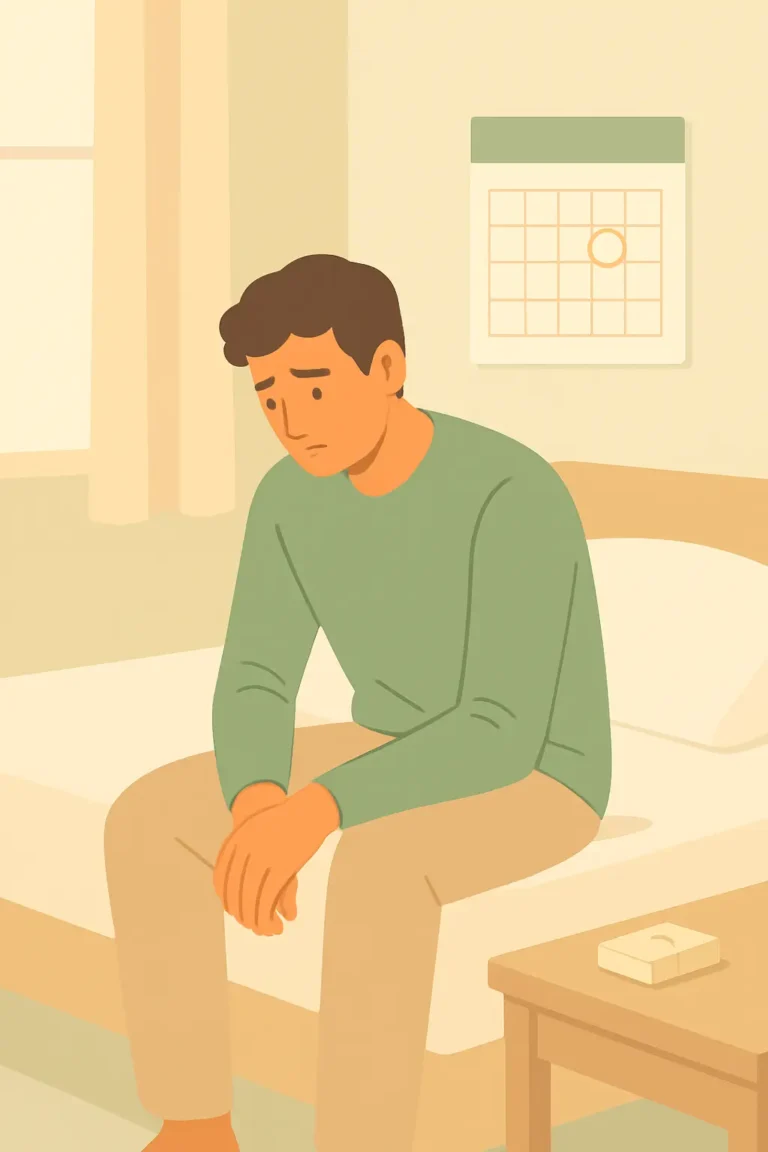
The date you picked is today, and you woke up feeling exactly the same as yesterday. No resolve, no clarity, just the same pack and a lot of reasons to move it to next Monday. If your quit date arrived and you are not ready, readiness was never the entry requirement, and the cost of postponing is measurable. This is a decision guide for the next thirty minutes, not a pep talk.
Nobody Feels Ready, and the Data Barely Cares
The belief doing the damage this morning is that quitting has a starting condition and that the condition is a feeling. It does not, and the research points the other way.
Interviews with 146 smokers and ex-smokers in a family practice found that 51.6 percent of their most recent quit attempts were unplanned, meaning a sudden decision rather than a date set in advance. Among the ex-smokers specifically, 67.1 percent of attempts had been unplanned, against 36.7 percent among people who were still smoking (Larabie, Tobacco Control, 2005). A later online survey of 900 smokers and 800 ex-smokers in the United States found 39.7 percent of recent attempts involved no preplanning, and that the odds of an unplanned attempt lasting six months or more were about twice those of a planned one, 71.7 percent against 45.6 percent, adjusted odds ratio 2.62 (Nicotine & Tobacco Research, 2009).
Both are self-report studies, and people remember successful attempts more vividly than failed ones, so read them as a corrective rather than as a reason to throw away your plan. The corrective: a large share of people who stopped for good did it on a day they had not prepared for. Whatever is missing this morning, it is not a prerequisite.
The video below is from the Oklahoma Tobacco Helpline, a state quitline, and covers the specific problem of getting through the first morning.
If what you are feeling is closer to fear than to indifference, that is a different problem with a different answer, and our piece on the fears that stop people quitting deals with it directly.
The 30-Minute Start-Anyway Protocol
Do these six things in the next half hour. None requires you to feel motivated, which is the point.
- Smoke nothing else first. Not a last one. The last one has a way of becoming the first of a normal day.
- Put the nicotine replacement on now if you planned to use it. A patch goes on at the start of the day, not when the first bad craving lands. Gum, lozenges or spray go in the pocket you reach into automatically.
- Deal with the pack. See the next section. Two minutes, and it removes the likeliest cause of a lapse before noon.
- Send one message. One person, one sentence: today is my quit date, do not offer me one. You do not need a support network by lunchtime, only one witness.
- Write down the first three hard moments you expect today. The NHS lists waking up, coffee, driving, work breaks and finishing a meal among the routine triggers (NHS Better Health). Name yours and decide now what happens instead.
- Set the horizon at tonight. Not a year, not a month. You are deciding about today, and you can renew it tomorrow morning.
If you are reading this the day before, our guide to setting a quit date that actually sticks is the preparation version of the same list.
What to Do With the Pack in Your Pocket
There are three options and only one of them survives contact with a real afternoon.
- Keep it as a test of willpower. This is the one that fails. A pack within reach turns every craving into a live decision, and you will get that decision right perhaps twenty times before you do not.
- Give it away or leave it behind. Better, though a shop is not much of a barrier on a bad evening. Still far better than carrying it.
- Destroy it now, with the lighter. Run it under the tap and bin it. The point is not ceremony; it is that replacing it takes a deliberate trip you will notice yourself making.
Do the same with the spares: the glovebox, the drawer, last winter’s coat. Anything you find at 9pm will be found at exactly the wrong hour.
Getting Through Hours 1 to 6
The NHS says withdrawal can begin within a few hours of your last cigarette and is strongest in the first week, especially the first three days (NHS Better Health). Today is the steepest part of that, which means the difficulty is front-loaded rather than permanent.
Two things make these hours manageable. An individual craving is short: it arrives, peaks and passes, and the job is to be doing something else meanwhile. And most of today’s cravings are attached to a routine rather than to nicotine alone, so changing the routine changes the craving.
- Move the coffee. Drink it somewhere you never smoked, or switch to tea for a week. The pairing is the trigger, not the caffeine.
- Change what you do in the car. Clean the ashtray out at the first stop, open a window, put something on that occupies the attention that used to go to smoking.
- Take the break, lose the location. Do not skip your work break, because resentment builds fast. Take it somewhere the smokers do not go.
- Eat properly and early. Finishing a meal is itself a listed trigger, so plan the ten minutes after it.
- Use a grounding exercise when a wave arrives. Our guide to grounding exercises for smoking anxiety has the two-minute versions.
The iQuit app is built for this window. SOS craving support gives you breathing exercises, grounding and a craving timer to start when a wave hits, and the virtual cigarette gives your hands something to do while it passes. Logging each craving with its trigger and intensity makes tomorrow’s hard hours predictable.
What the day does not require is heroic willpower. Our summary of apps versus willpower alone is worth reading if you plan to do this unaided.
The One Legitimate Reason to Move the Date

Almost every reason that presents itself this morning is the craving arguing. There is one real exception, and it is narrow: something genuinely destabilising landed in the last day or two and will take all of your attention for a short, bounded period. A bereavement. A hospital admission. A crisis at work that runs three days and ends.
Notice what is not on that list. General stress is not, because if stress disqualified a quit date nobody would ever have one. A holiday next week is not, because there will be another. A wedding or a party is a planning problem, not a reason to postpone. Our guide on the arguments people talk themselves out of quitting with covers the rest.
Keep the exception narrow because delay has a measurable cost. In a secondary analysis of a large randomized trial, 1,848 participants chose their own quit date between zero and ninety days out. After adjustment, the probability of confirmed abstinence at six months fell sharply the further away that date sat.
| Quit date chosen for | Abstinent at 6 months |
|---|---|
| Week 1 | 39.6% |
| Week 5 | 22.6% |
| Week 10 | 10.9% |
| Week 13 | 4.3% |
This is an observational pattern inside a trial, not proof that waiting causes failure; people who pick a distant date may differ from people who pick tomorrow (Journal of Behavioral Medicine, 2017). It is still the clearest available answer to next Monday, or maybe after Christmas.
How to Reschedule Without Losing It
If you have decided the exception genuinely applies, there is a way to move the date that does not quietly become an abandoned attempt.
Move it by days, not weeks. In a study of 5,793 adults given a workshop and five weeks of nicotine patches, quit dates were grouped by how long people waited. Compared with those who quit within a day, people who set their date two to six days out were no less likely to have quit at five weeks or six months. People who waited seven to nineteen days, and those who waited twenty to thirty-one days, did significantly worse, even after adjusting for confidence, dependence, how important quitting was to them and how many patches they used (Psychology of Addictive Behaviors, 2017). A few days appears to be free. A few weeks is not.
Name the new date out loud, today. Not soon, not after this is over. A day, on a calendar, told to the same person you told this morning. If the new date lands near 1 October, our guide to preparing for Stoptober two weeks out covers what to do with the gap.
Cut down in the meantime, but not as the plan. Fewer cigarettes today beats the same number. It is not a substitute for a date.
Use the gap for the thing you said you had not done. Order the nicotine replacement. Book the stop-smoking service appointment. The NHS notes that combining a nicotine-free stop-smoking medicine with nicotine replacement therapy makes you over five times more likely to quit for good, which is a genuine use of three days.
If You Smoke by Lunchtime
This is where the day is usually lost, and it is lost to the interpretation rather than the cigarette. The NHS is explicit that a single cigarette or puff is a lapse rather than a relapse, and that the right response is to shrug it off and keep going. Going back to smoking regularly is the relapse, and the advice then is to set a new quit date, ideally within two weeks (NHS Better Health).
So the rule for this afternoon: the quit date does not reset. You smoked one at 12:40 and your quit date is still today. Note the hour and what preceded it, then carry on with the same attempt.
There is a reason not to write the day off. A London stop-smoking clinic followed 1,172 people who reached four weeks of biochemically confirmed abstinence, comparing those who stopped completely on their target quit date with those who took longer. In the subsample followed for a year, one-year relapse was 53 percent among the immediate quitters and 77 percent among the delayed ones, and the gap held after adjustment (Nicotine & Tobacco Research, 2022). The delayed group differed at the start, smoking earlier after waking and having less confidence, so this is not proof the delay caused the relapses. It is a good argument for making today the actual day rather than the day you started tapering.
What Day Two Actually Feels Like
Worse than you hoped and better than you feared. The NHS puts the peak of withdrawal in the first three days, so day two often feels harder than day one, when adrenaline did some of the work. Irritability, restlessness, poor concentration and disturbed sleep are the common symptoms, lasting three to four weeks on average.
Three things help more than they sound like they should.
- Expect the dip and label it. A symptom you predicted is a symptom, not evidence that quitting is failing.
- Keep the horizon at one day. You renewed the decision this morning. Renew it again tomorrow.
- Count to 28. The NHS notes cravings are hardest in the first 28 days, and that reaching 28 days smoke-free makes you five times more likely to stay quit for good. That target is visible from here.
How you feel today has almost nothing to do with how this ends. Our collection of motivation that holds up on a flat day is for the evenings, and the full symptom map is in the stages of nicotine withdrawal.
Frequently Asked Questions
Should I postpone my quit date if I do not feel ready?
Usually not. Feeling ready is not a prerequisite: interviews with 146 smokers and ex-smokers found 51.6 percent of recent quit attempts were unplanned, and that share was higher among people who had actually stopped (Larabie, Tobacco Control, 2005). Postpone only for a genuine short-term crisis, and then move the date by days rather than weeks.
How much does delaying a quit date actually cost me?
In a secondary analysis of a large randomized trial, the adjusted probability of confirmed abstinence at six months was 39.6 percent for people who set a quit date in week one, falling to 22.6 percent at week five and 4.3 percent at week thirteen (Journal of Behavioral Medicine, 2017). That is an observational pattern rather than proof of cause, but it is a strong argument against next month.
Is a few days delay as bad as a few weeks?
Apparently not. Among 5,793 adults given a workshop and nicotine patches, people who set a quit date two to six days out did no worse than those who quit within a day, while those who waited seven to nineteen days or twenty to thirty-one days did significantly worse after adjustment (Psychology of Addictive Behaviors, 2017). If you must move it, a few days is the size of move the evidence supports.
How long will the first day actually be hard for?
Withdrawal can start within a few hours of the last cigarette and is strongest in the first week, especially the first three days, lasting three to four weeks on average (NHS Better Health). Individual cravings are much shorter than that and pass on their own. The NHS also notes cravings are hardest in the first 28 days and ease afterwards.
I smoked one this afternoon. Has my quit date failed?
No. The NHS calls a single cigarette or puff a lapse rather than a relapse and advises shrugging it off and continuing. Do not restart the clock or move the date. Note the hour and what preceded it, then carry on with the same attempt, because that information is what makes tomorrow easier to plan.
Is it better to cut down first instead of stopping today?
Cutting down is better than not changing anything, but it is not a substitute for a date. Clinic data show people who only stopped completely some time after their target quit date had higher one-year relapse than those who stopped on the day, although the two groups also differed at baseline (Nicotine and Tobacco Research, 2022). If you cut down, set the full stop date at the same time.
Get Through Today With Something in Your Pocket
iQuit is built for the first twenty-four hours. SOS craving support gives you breathing exercises, grounding and a craving timer to run down while a wave passes, and the virtual cigarette gives your hands something to hold. Log each craving with its trigger and intensity so tomorrow’s hard hours are predictable, watch days smoke-free, cigarettes avoided and money saved add up from hour one, and let streak shields and slip recovery handle a bad afternoon without ending the attempt. Free on Google Play and the App Store.