
Deciding to quit is the first choice. The second — which quit smoking method to actually use — is the one most guides skip past with a shrug, usually landing on a binary “cold turkey or gradually” debate that leaves out two options a lot of smokers are better suited to: scheduled reduction and harm reduction. Which one fits you depends less on willpower and more on how dependent you actually are.
The Decision Matrix: Dependence Score to Recommended Method
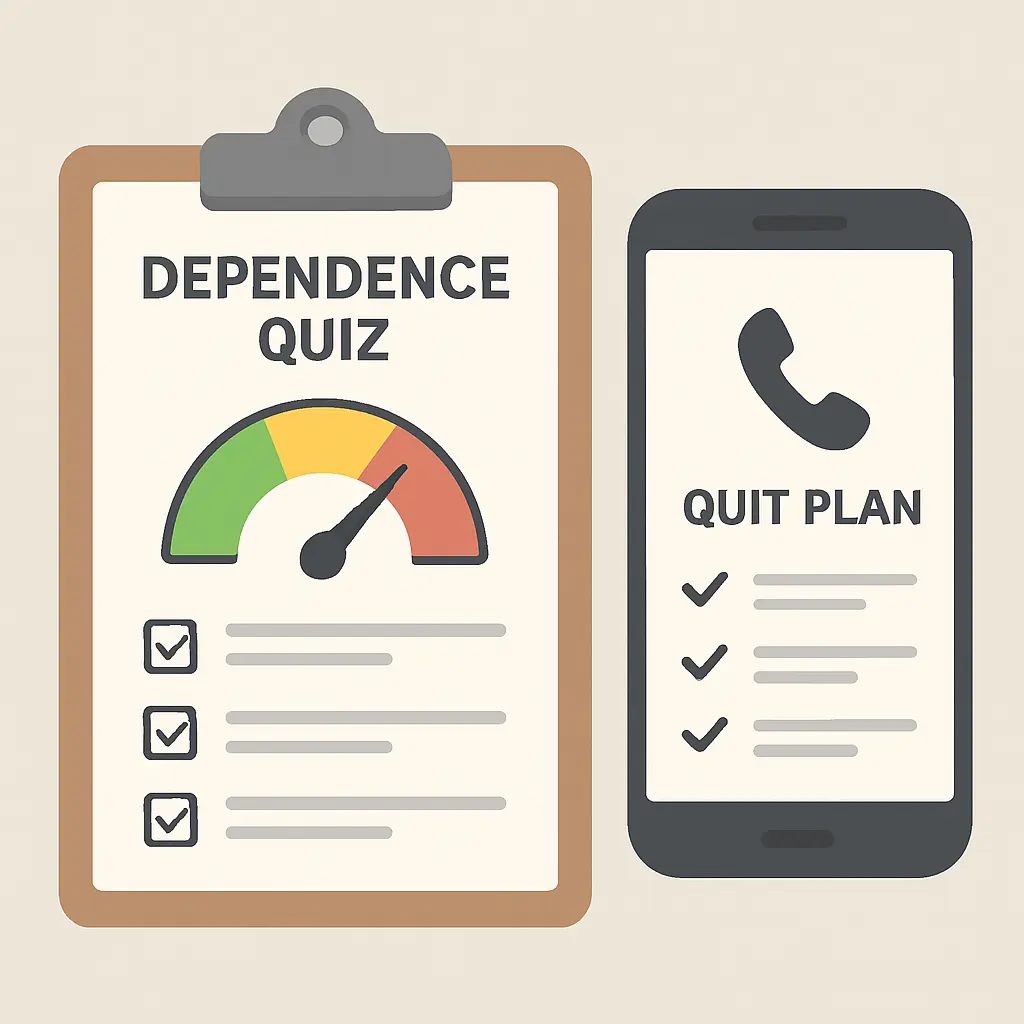
The Fagerström Test for Nicotine Dependence is the standard clinical tool for measuring how physically dependent you are, built mainly around two questions: how many cigarettes you smoke per day, and how soon after waking you smoke your first one — a single-question marker we cover in more depth in measuring your dependence level by time-to-first-cigarette. It produces a 0–10 score.
| Fagerström score | Dependence level | Recommended method |
|---|---|---|
| 0–2 | Very low | Cold turkey, minimal or no NRT needed |
| 3–4 | Low | Cold turkey, short-course NRT for the first 1–2 weeks |
| 5 | Medium | Cold turkey with NRT, or scheduled reduction |
| 6–7 | High | Gradual or scheduled reduction with NRT/varenicline, medical input recommended |
| 8–10 | Very high | Gradual reduction or harm reduction with close medical support |
Two other factors shift the recommendation regardless of score: prior failed attempts (each one is data — if cold turkey failed twice, a reduction-based method is worth trying instead of repeating the same approach) and medical context (pregnancy, certain mental health conditions, or cardiovascular disease can change which NRT products or medications are appropriate, which is a conversation for a doctor, not this article). The NHS stop smoking service is a good free starting point if you want that conversation without a prescription visit first.

Cold Turkey
What it is: Stopping all cigarette use on a chosen date, with no tapering period beforehand.
Who it fits: Lower-dependence smokers (Fagerström 0–4), and anyone who has found gradual approaches drag out withdrawal without reducing its eventual intensity.
Quit rates: A 2016 randomized noninferiority trial published in Annals of Internal Medicine (Lindson-Hyland and colleagues) found 22.0% of abrupt quitters were still smoke-free at six months versus 15.5% of gradual quitters. That single trial favors abrupt quitting, but the wider evidence is more even-handed: the 2019 Cochrane review of reduction versus abrupt cessation, pooling 22 studies and 9,219 participants, found no meaningful difference in quit rates between the two approaches (risk ratio 1.01). Cold turkey is a strong default rather than a proven winner — see our full cold turkey vs. gradual comparison for the deeper evidence breakdown.
Failure mode: Withdrawal symptoms are more concentrated in the first 3–5 days, which is exactly when unsupported quit attempts most often collapse. Cold turkey without any craving-management plan has a high early relapse rate — the method’s strength (speed) is also its main risk.
Gradual Reduction
What it is: Progressively cutting the number of cigarettes smoked per day over one to several weeks before reaching zero, often self-paced rather than on a fixed timetable.
Who it fits: Higher-dependence smokers, and people for whom the idea of a single hard quit date feels overwhelming rather than motivating.
Quit rates: Cochrane’s 2019 review found cutting down before quitting achieves quit rates comparable to quitting all at once — but with an important condition: people who reduce while using a fast-acting NRT product (gum, lozenge) or varenicline do meaningfully better than those who cut down unsupported. Reduction without medication support is the weaker version of this method.
Failure mode: It is easy to stall at a reduced-but-nonzero number of cigarettes indefinitely, especially without a firm end date. Gradual reduction needs either a hard stop date or fast-acting NRT to actually convert into full abstinence rather than becoming a permanently lighter smoking habit — for the step-by-step version of this method, see our gradual reduction method guide. If you are combining reduction with NRT, combining two NRT products often outperforms a single product for higher-dependence smokers specifically.
Scheduled Reduction
What it is: A more structured version of gradual reduction — a predetermined schedule that increases the time between cigarettes (rather than just lowering the daily count loosely), often combined with pre-cessation NRT.
Who it fits: People who respond well to explicit structure and tracking, and higher-dependence smokers who want more scaffolding than open-ended gradual reduction provides.
Quit rates: Outcomes are strongly tied to how much reduction is actually achieved and how closely the schedule is followed. Trials of reduction-based quitting consistently find abstinence rates rise sharply among participants who hit their largest reduction targets and stay very low among those who reduce only slightly — which makes compliance, not the schedule itself, the variable that decides the outcome.
Failure mode: Compliance is everything. Without a tool actively tracking and reminding you of the schedule, most people drift off it within the first couple of weeks, which is also the window in which sticking to the plan most strongly predicts the eventual result.
Harm Reduction
What it is: Reducing the health harm of nicotine use without necessarily aiming for full abstinence immediately — for example, switching entirely to NRT products or committing to a substantially lower, stable cigarette count as an interim goal rather than a route to zero.
Who it fits: People who are not currently ready or willing to commit to full cessation but want to reduce harm now, and very high-dependence smokers for whom an immediate full quit attempt has repeatedly failed.
Quit rates: Harm reduction is not designed to be measured the same way — the goal is reduced exposure, not necessarily abstinence on a fixed timeline — though reduction is often documented as a step that increases the odds of a later full quit attempt succeeding.
Failure mode: The main risk is dual use — continuing to smoke cigarettes alongside a reduced-risk product rather than substituting one for the other, which blunts most of the harm-reduction benefit. Harm reduction only works if it actually reduces how much you burn, not just adds a second product.
iQuit supports all four of these paths rather than pushing one, free on Google Play — or read our guide to how digital tools are transforming cessation for the broader shift toward personalized, method-flexible quitting.
Switching Methods Mid-Quit Without Treating It as Failure
Starting with cold turkey and finding it unbearable by day 3 is not a failed quit — it is data that tells you to switch to gradual or scheduled reduction with NRT support, not that you cannot quit at all. The reverse is just as valid: starting with gradual reduction, hitting a plateau at 5 cigarettes a day for three weeks, and then setting a hard stop date to finish the job is a legitimate use of both methods in sequence, not a sign you did gradual reduction “wrong.”
The evidence above is about averages across large groups, not a guarantee for any individual. If your chosen method is not working after a genuine, supported attempt (not just a single hard afternoon), changing method is a strategy adjustment, not a relapse — treat it the same way you would treat any other setback in a quit attempt, as information rather than verdict.
How iQuit’s Four Quit Modes Implement Each Method

iQuit supports all four of the methods above — cold turkey, gradual, scheduled reduction, and harm reduction — as selectable quit modes, so the method you land on after reading this article is one you can actually set up rather than approximate. In practice each mode changes which of the app’s free tools do the heavy lifting:
- Cold turkey leans on the days-smoke-free counter and the SOS toolkit — box breathing, 4-7-8 and belly breathing, 5-4-3-2-1 grounding, the virtual cigarette, and craving surfing — for the intense early days.
- Gradual reduction leans on craving logging with triggers and intensity, so you can see progress in how often and how hard cravings hit even before you reach zero.
- Scheduled reduction leans on the predictive craving forecasts, which learn your risky hours and nudge you minutes before — the feature that most directly addresses this method’s compliance problem.
- Harm reduction leans on the same craving and mood tracking without requiring a zero-cigarette streak, plus streak shields and slip recovery, built on the principle that a slip is data, not defeat.
Because your method can change mid-quit, it helps that the tools do not reset when your approach does — see the iQuit Premium breakdown for how the paid tier’s custom quit-plan generation adapts to whichever approach you land on, and if it’s the raw numbers behind quitting that matter most to your decision, this lifetime cigarette calculator shows what any of the four methods is working to prevent.
Why Method Matters Less Than Pairing It With Support
Every method above outperforms itself when paired with some form of ongoing support — NRT, a coach (human or AI), a quitline, or a community — and underperforms when attempted completely alone. The Cochrane evidence is consistently clearer about “supported versus unsupported” than it is about “cold turkey versus gradual” in isolation, and the CDC’s guidance on quitting makes the same point. If you take one thing from this article, let it be this: spend less time optimizing which of the four methods is theoretically best, and more time making sure whichever one you pick has real support attached — that is the variable the evidence weights most heavily. For the full comparison of methods ranked by success rate, see our complete guide to every quit method ranked by success rate and the full evidence-based guide to quitting for the step-by-step version of whichever method you choose.
Frequently Asked Questions
Is cold turkey or gradual reduction more effective for quitting smoking?
The best available evidence says they are close. A 2016 randomized trial in Annals of Internal Medicine found 22.0% of abrupt quitters smoke-free at six months versus 15.5% of gradual quitters, but the 2019 Cochrane review pooling 22 studies and 9,219 participants found no significant difference between the two approaches (risk ratio 1.01). Pairing reduction with fast-acting NRT closes most of the gap (source: Cochrane, 2019).
How do I know if I have high or low nicotine dependence?
The Fagerström Test for Nicotine Dependence is the standard measure, scored 0–10 based mainly on cigarettes per day and how soon after waking you smoke. Scores of 0–4 indicate low dependence, 5 medium, and 6–10 high to very high dependence (source: Fagerström Test for Nicotine Dependence).
What is scheduled reduction and how is it different from gradual reduction?
Scheduled reduction follows a predetermined timetable that systematically increases the time between cigarettes, rather than an open-ended lower daily count. It is more structured than informal gradual reduction and its success depends heavily on how closely the schedule is followed.
Is harm reduction a legitimate way to quit smoking?
Yes, particularly for people not currently ready for full abstinence or with a history of repeated failed full-quit attempts. It aims to reduce health harm and total exposure rather than achieve immediate zero-cigarette status, and can be a stepping stone to full cessation later.
Can I switch quit methods partway through if the first one isn’t working?
Yes. Switching from one method to another (for example, cold turkey to gradual reduction with NRT) after a genuine attempt is a reasonable strategy adjustment, not a failure. The evidence on quit methods is about population averages, not a guarantee for any individual approach.
Does using nicotine replacement therapy count as one of these methods?
NRT is a support tool that can be layered onto any of the four methods rather than a method itself — it is used alongside cold turkey, gradual reduction, or scheduled reduction, and evidence shows it improves outcomes for all three, particularly for higher-dependence smokers.
Does the quit method matter more than having support during the quit?
Evidence consistently shows supported attempts (with NRT, coaching, or a quitline) outperform unsupported attempts using the same method more than any one method outperforms another. Pairing your chosen method with real support matters more than which of the four methods you pick.
Get Matched to Your Quit Method
iQuit supports cold turkey, gradual, scheduled reduction, and harm reduction — pick the one that fits, and switch whenever your quit changes shape.