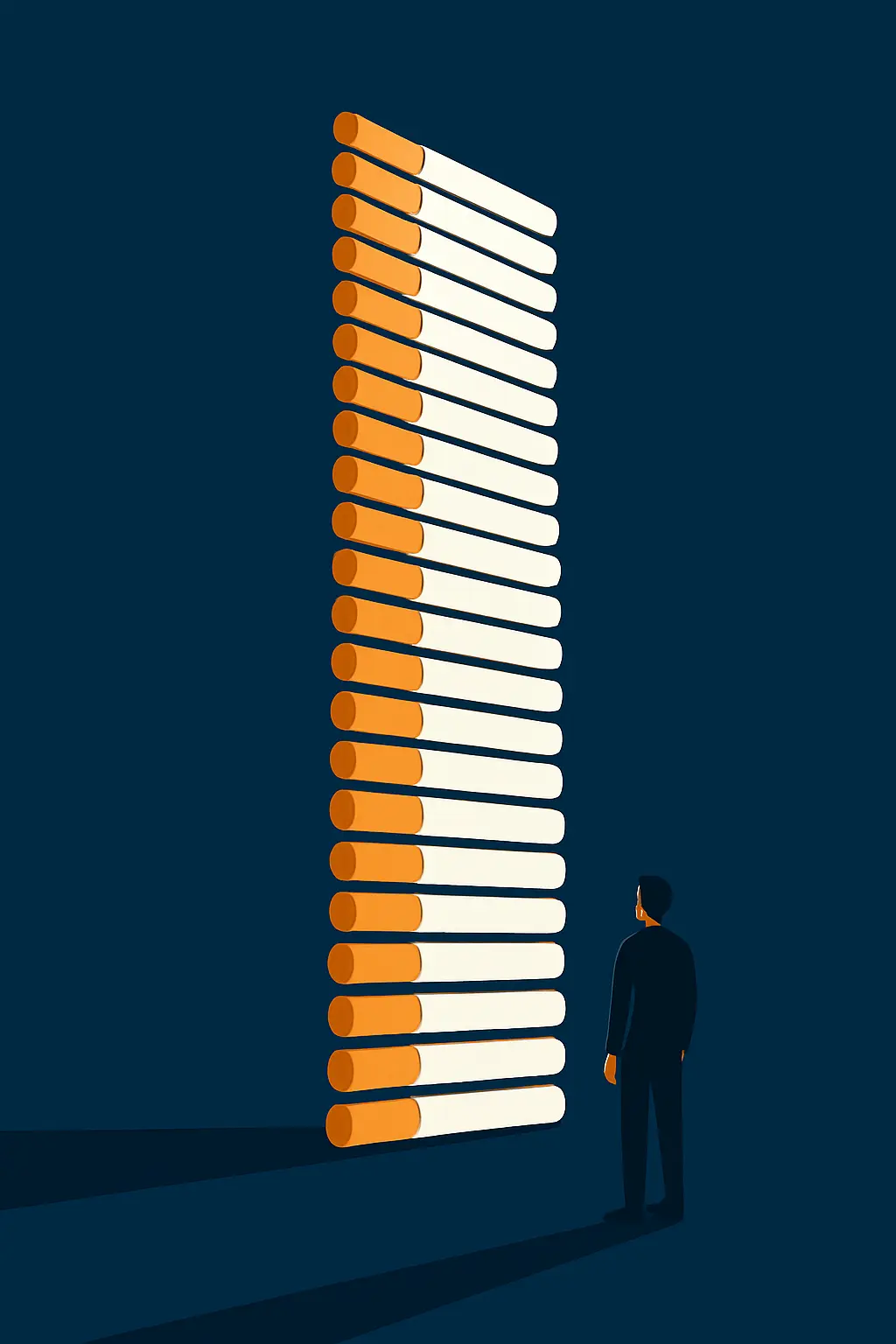
Take your daily cigarette count, multiply it by the days you have smoked, and the number that comes out is usually bigger than people expect. How many cigarettes have you smoked in your life? For a pack-a-day smoker of 20 years, the answer is around 146,000 — and that single number reframes a daily habit into a lifetime total most people have never actually calculated. It takes thirty seconds of arithmetic to turn “I’ve smoked for a while” into an exact figure, and that figure is usually the more useful of the two.
Why the Number Feels So Much Bigger Than People Expect
Smoking is a habit measured in single cigarettes — one after a meal, one during a break, one with coffee — which makes it almost impossible to feel the cumulative total while you are living it day to day. Nobody experiences smoking as “146,000 cigarettes”; they experience it as today’s pack, repeated so consistently that the running total stays invisible unless someone actually does the multiplication. This is the same reason a daily expense (a coffee, a subscription) can feel negligible until you see the annual total in one number — smoking is that effect at a much larger scale, because the “daily expense” is also a health exposure with its own compounding cost.
That gap between the felt experience (one cigarette at a time) and the actual total (tens or hundreds of thousands over a smoking history) is exactly why this calculation is worth doing deliberately rather than leaving as an abstraction. It is not meant to shame — it is meant to make an invisible number visible, the same way a bank statement makes small daily purchases visible as a monthly total.
How to Calculate Your Lifetime Cigarette Total
The formula is simple: cigarettes per day × 365 × years smoked = lifetime total. It uses 365 days per year as a simplification — most smokers do not skip days, so this is close enough for a meaningful estimate without needing to track exact daily variation.
| Cigarettes/day | Years smoked | Lifetime cigarettes | Packs | Pack-years |
|---|---|---|---|---|
| 10 | 10 | 36,500 | 1,825 | 5 |
| 20 (1 pack) | 10 | 73,000 | 3,650 | 10 |
| 10 | 20 | 73,000 | 3,650 | 10 |
| 20 (1 pack) | 20 | 146,000 | 7,300 | 20 |
| 20 (1 pack) | 30 | 219,000 | 10,950 | 30 |
| 40 (2 packs) | 20 | 292,000 | 14,600 | 40 |
Find your own row (or interpolate between them) using your actual daily count and years smoked — the formula scales linearly, so doubling either number simply doubles your total.

Converting to Pack-Years, and Why Doctors Use It
Pack-years is the clinical shorthand for cumulative exposure: (cigarettes per day ÷ 20) × years smoked. It is not just an academic measure — it is the exact number used to decide who qualifies for lung cancer screening. The U.S. Preventive Services Task Force recommends annual low-dose CT screening for adults aged 50–80 with a 20 pack-year history who currently smoke or quit within the past 15 years.
Looking at the table above, that 20 pack-year threshold is reached by a pack-a-day habit at 20 years, half a pack a day for 40 years, or two packs a day for just 10 years — the same cumulative exposure by three very different daily patterns. Pack-years, not “how long you’ve smoked” alone, is what actually determines this kind of risk-based eligibility.
This is also why two people who both “smoked for 20 years” can have very different medical conversations with their doctor. Someone who smoked five cigarettes a day for 20 years has 5 pack-years — well under the screening threshold. Someone who smoked two packs a day for the same 20 years has 40 pack-years — double the threshold. The years-smoked number alone hides that difference; pack-years does not.
What Your Total Means in Money

Cigarette prices vary enormously by state, country, and brand, so any lifetime figure is a rough model rather than a receipt. Using a working U.S. figure of about $8 a pack, the packs column above translates into lifetime spend like this:
| Scenario | Packs | Lifetime spend |
|---|---|---|
| 10/day × 10 years | 1,825 | $14,600 |
| 20/day × 10 years | 3,650 | $29,200 |
| 20/day × 20 years | 7,300 | $58,400 |
| 20/day × 30 years | 10,950 | $87,600 |
| 40/day × 20 years | 14,600 | $116,800 |
Substitute your own local pack price for a more accurate figure — the numbers run considerably higher in high-tax states like New York or California, and in countries such as Australia and the U.K. For a deeper breakdown of ongoing (rather than lifetime) spending, see real numbers on how much money you save when you quit and the money-saved calculator for your own ongoing numbers. A long smoking history also has a quieter cost worth knowing about: see how a smoking history affects life insurance premiums for how insurers price this same cumulative exposure.
What Your Total Means in Minutes of Life
Using the commonly cited BMJ-derived estimate of roughly 11 minutes of life lost per cigarette smoked — a population average, not a personal measurement — the totals above convert to a meaningful chunk of time:
| Scenario | Lifetime cigarettes | Estimated life lost |
|---|---|---|
| 10/day × 10 years | 36,500 | ~279 days (0.76 years) |
| 20/day × 10 years | 73,000 | ~558 days (1.53 years) |
| 20/day × 20 years | 146,000 | ~1,115 days (3.06 years) |
| 20/day × 30 years | 219,000 | ~1,673 days (4.58 years) |
| 40/day × 20 years | 292,000 | ~2,231 days (6.11 years) |
This is a population-average estimate, not a personal prognosis — individual outcomes vary widely by genetics, overall health, and when (if ever) someone quits. It is a way to make an abstract statistic concrete, not a countdown clock.
What Your Total Means in Cumulative Exposure
Every cigarette in your lifetime total also represents a dose of tar and carcinogens deposited in lung tissue, which is exactly what pack-years is a proxy for in clinical risk models. This is why the pack-years number above matters more medically than the raw cigarette count on its own — it is the number a doctor will actually ask for, and the one tied to real screening decisions, not just an interesting total. The CDC’s overview of smoking and health sets out which conditions that exposure is causally linked to.
It is worth being precise about what this total does and does not measure. It is a proxy for cumulative exposure, not a direct readout of damage already done — two people with identical pack-year totals can carry meaningfully different actual risk depending on genetics, other health conditions, and the specific products smoked. What the total reliably tells you is the scale of exposure your body has processed, which is exactly the input a clinician uses alongside your age and other risk factors, not a number to interpret in isolation.
iQuit’s free dashboard runs all three of these numbers for you — cigarettes avoided, money saved, and life regained — from the day you set a quit date. If disease risk, not just the raw total, is what you are trying to understand, our full guide to smoking disease risk across 11 conditions goes further than pack-years alone, and our honest breakdown of iQuit Premium covers what the paid tier adds if you want extra coaching support.
The Flip: From Your Quit Date, the Counter Runs Backward

Every number above only runs in one direction while you are still smoking. From your quit date, the same arithmetic reverses: cigarettes avoided, money saved, and minutes of life regained all start climbing instead. iQuit’s free dashboard runs exactly this calculation in reverse — the same daily-rate math from the tables above, now counting up cigarettes avoided and money saved from the day you quit, alongside the app’s 15 health milestones and money tracker. The 11 minutes of life you lose per cigarette becomes 11 minutes of life regained for every one you don’t smoke, and that reversal is really the point of calculating the lifetime total in the first place — not to dwell on the past total, but to see the same math start working in your favor. For the age-adjusted version of what that adds up to over the long run, see years of life regained by quit age, and if nicotine dose per cigarette is part of what you’re trying to understand, how much nicotine is in one cigarette covers that piece of the picture.
Frequently Asked Questions
How do I calculate how many cigarettes I’ve smoked in my life?
Multiply the number of cigarettes you smoke per day by 365, then by the number of years you have smoked. A pack-a-day (20 cigarettes) habit for 20 years works out to roughly 146,000 cigarettes.
What is a pack-year and how is it different from my lifetime cigarette count?
Pack-years is (cigarettes per day divided by 20) multiplied by years smoked. It is a standardized clinical measure of cumulative exposure used for medical decisions like lung cancer screening eligibility, whereas your raw lifetime cigarette count is just the total number smoked (source: USPSTF, standard clinical pack-year formula).
How many pack-years qualify for lung cancer screening?
The U.S. Preventive Services Task Force recommends annual low-dose CT screening for adults aged 50 to 80 with a 20 pack-year smoking history who currently smoke or quit within the past 15 years (source: USPSTF, 2021 recommendation).
How much money does a lifetime of smoking actually cost?
Modeled at a U.S. working figure of about $8 per pack, a pack-a-day habit over 20 years costs approximately $58,400; over 30 years, approximately $87,600. Prices vary widely by state and country, so substitute your own local pack price for a closer estimate.
Is the “11 minutes per cigarette” life-lost estimate accurate?
It is a widely cited population-average estimate derived from cohort mortality data, not an individual prognosis. It is useful for making an abstract lifetime total concrete, but actual life expectancy impact varies by individual factors including overall health, genetics, and when a person quits.
Does the lifetime total change once I quit smoking?
Your historical total stays fixed, but the same daily-rate math reverses from your quit date forward — cigarettes avoided, money saved, and minutes of life regained all begin accumulating instead, which is the calculation apps like iQuit track automatically.
Why don’t two people who “smoked for 20 years” have the same risk?
Because years alone don’t capture intensity. Someone smoking 5 cigarettes a day for 20 years has 5 pack-years; someone smoking 40 a day for the same 20 years has 40 pack-years — an eightfold difference in cumulative exposure despite an identical number of years smoked.
Is it useful to calculate my lifetime cigarette total, or is it just discouraging?
Most people find it clarifying rather than discouraging, especially paired with the reverse calculation from a quit date. It converts an abstract daily habit into a concrete number, which for many people is more motivating than either ignoring the total or dwelling on it without a next step.
Run the Numbers in Reverse
iQuit’s free dashboard tracks cigarettes avoided, money saved, and minutes of life regained automatically from the day you quit. Android, on Google Play.