
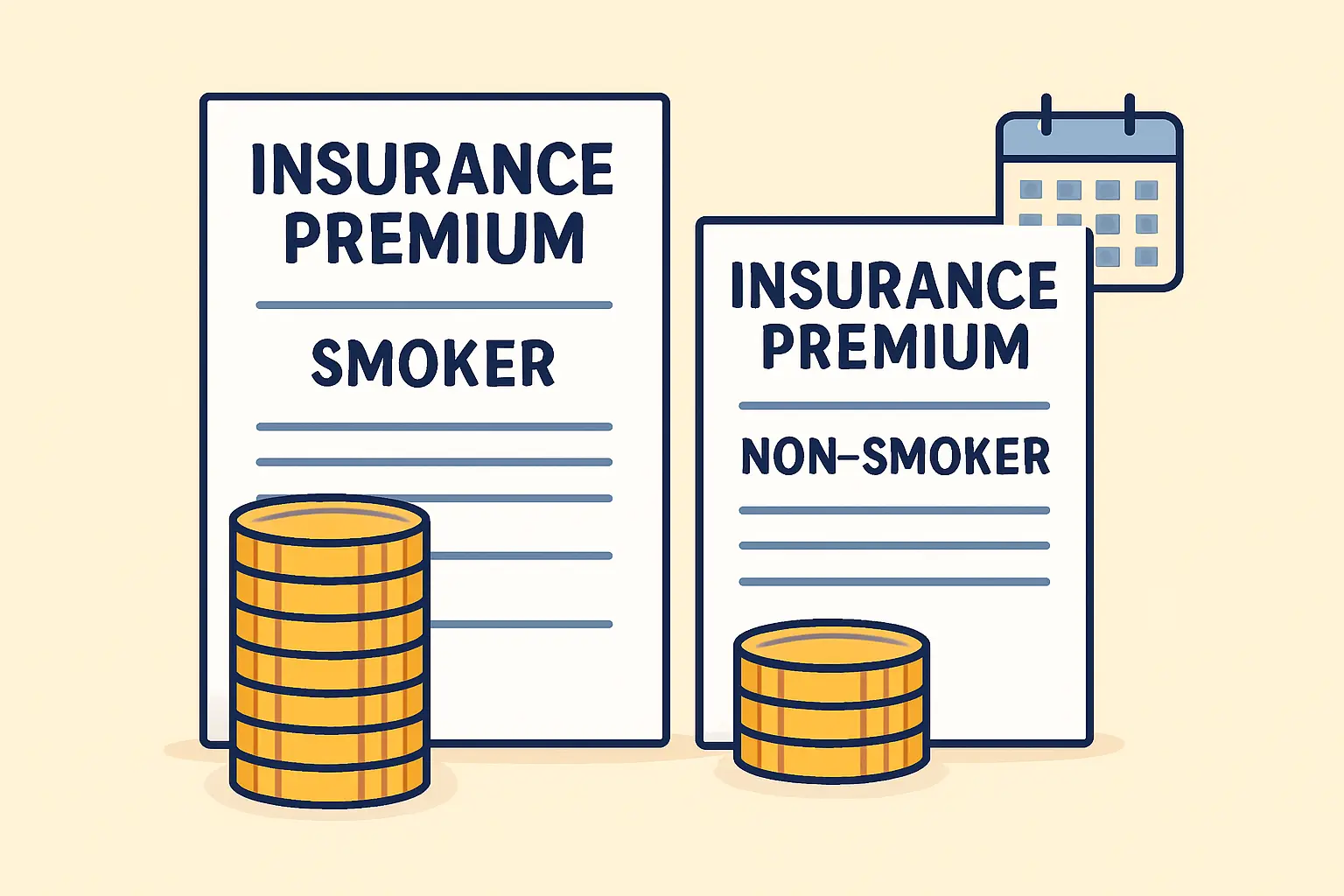
Smoker life insurance cost 2026 data shows a gap that catches most applicants off guard: smokers routinely pay substantially more than non-smokers for the same term life policy — commonly cited across the industry as roughly two to three times the premium — and the surcharge applies whether the nicotine comes from a cigarette, a vape, or a nicotine pouch. This page breaks down how insurers actually define “smoker,” the widely used 12-month rule for reclassifying to non-smoker rates, and why insurers verify it with a lab test rather than a question.
1. The Smoker Premium Gap
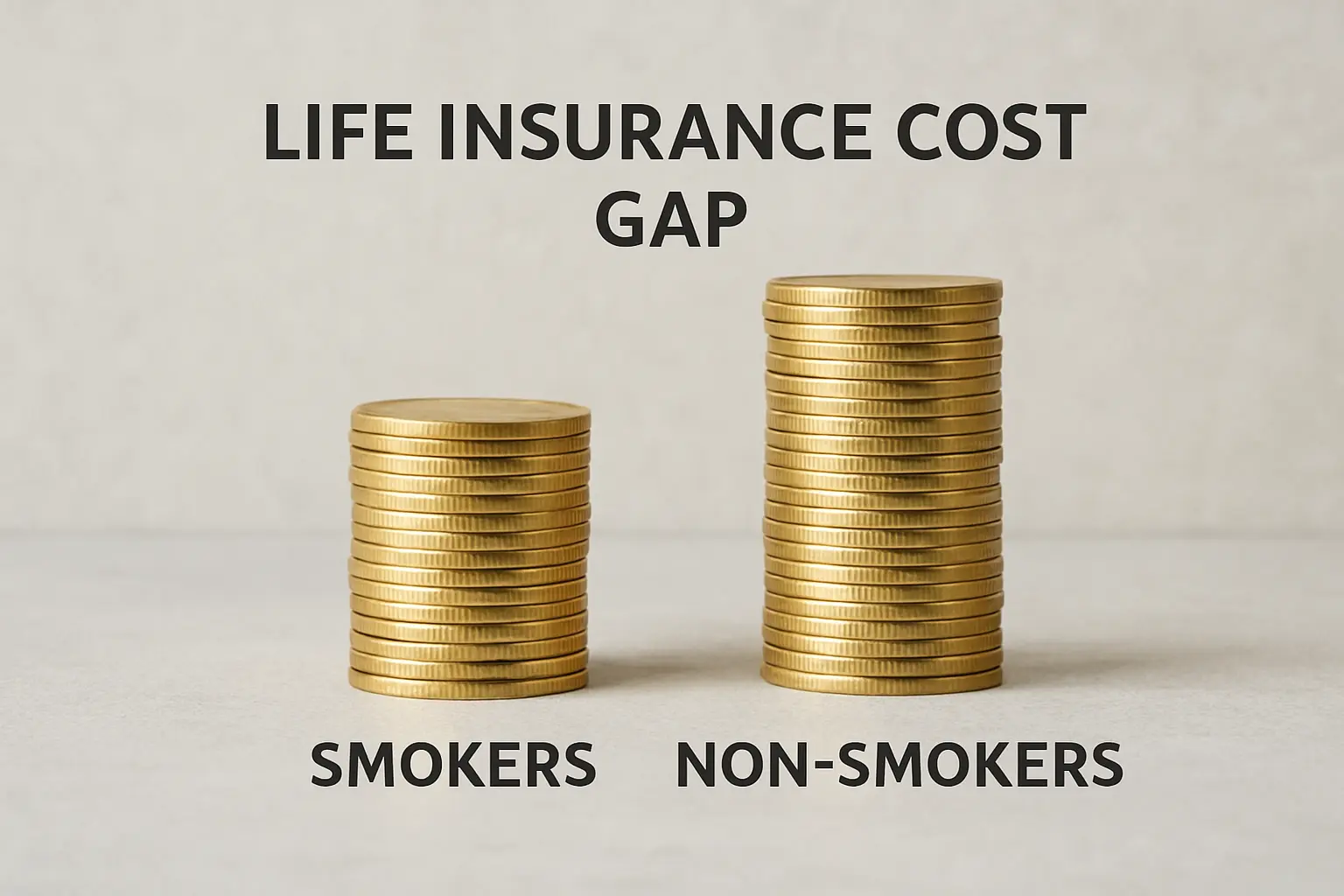
Across the term life insurance market, smoker rate classes are consistently priced well above non-smoker classes for the same age, coverage amount, and health profile. Insurers rarely publish a single headline multiple — pricing varies by carrier, age band, health class, term length, and country — but the pattern reported across US, UK, Canadian and Australian consumer guidance is a premium roughly two to three times the non-smoker rate for comparable term coverage. Treat that as a typical industry range, not a quotable figure for any specific policy.
- Typical industry pattern: smoker premiums roughly two to three times the non-smoker rate for comparable term coverage
- Pattern by age: the dollar gap between smoker and non-smoker premiums widens with age, even where the percentage multiple narrows, since both rate classes rise with baseline mortality risk
- Why no single number exists: insurers price rate classes internally and do not publish comparable rate tables, so any precise multiple you see quoted is an aggregation across a limited sample of quotes
- What is consistent: every major carrier maintains a separate, higher-priced tobacco or nicotine rate class
For the underlying spending this compounds with, our data on what smokers actually spend per year by country covers the direct cigarette-purchase side of the ledger that this insurance surcharge sits on top of, alongside our broader look at smoking-related healthcare costs statistics, which covers the systemic economic burden this personal premium gap reflects.
2. Why Smoking Moves the Needle So Much for Insurers
Life insurance pricing is built on mortality tables — actuarial estimates of how likely someone in a given health and lifestyle category is to die within the policy term. Smoking is one of the single largest lifestyle inputs into that calculation, because it is independently associated with elevated risk across nearly every major cause of death insurers price for: cardiovascular disease, stroke, most cancers, and chronic respiratory disease. Unlike a one-off risk factor, smoking’s mortality effect compounds with age and years of exposure, which is part of why insurers treat it as a structural rate-class variable rather than a minor rider adjustment.
- Why the multiple is so large: smoking-attributable mortality risk touches multiple major disease categories simultaneously, rather than one isolated condition
- Why it doesn’t shrink much with a “healthy” smoker profile: underwriters price the rate class on population-level smoking risk, not on an individual applicant’s current fitness or other biomarkers, so a smoker in excellent shape still lands in the smoker rate class
- Term length matters: longer-term policies (20-30 years) carry more cumulative smoking-risk exposure priced in than shorter 10-year terms, which can widen the effective dollar gap further
The scale of that mortality effect is visible in the underlying health data — our 2026 smoking and stroke risk statistics show one of the risk categories insurers are pricing for, and the 2026 smoking cessation statistics hub covers how quickly several of those risks fall after a quit date.
3. How Insurers Define “Smoker”
The detail that surprises most applicants: insurers generally do not distinguish between cigarettes, cigars, vaping, or nicotine pouches when classifying someone as a smoker. Progressive’s own consumer guidance states that life insurance companies “may categorize you as a smoker if you smoke cigarettes or cigars, vape tobacco or marijuana, or chew tobacco, even if only on occasion” — and adds that nicotine patches or gum can also trigger smoker classification, “as they can result in nicotine being present in your body during your health exam” (Progressive, Life Insurance for Smokers).
- Products that typically count as “smoking” for underwriting: cigarettes, cigars, pipe tobacco, vaping/e-cigarettes, chewing tobacco, and nicotine pouches
- Nicotine replacement therapy: patches and gum can also produce a positive nicotine result at the medical exam, so NRT users should disclose their use and ask how the carrier treats it
- Occasional use: “even if only on occasion” is the operative phrase — occasional and social use is often enough for smoker classification, though some carriers carve out very infrequent cigar use
- Lookback window: varies by carrier, commonly framed as the past 12 months of nicotine use, with some carriers using longer windows
- Why this surprises people: switching from cigarettes to vaping or pouches does not avoid the smoker surcharge at most insurers, since the underwriting question and the verification test target nicotine broadly, not cigarettes specifically
4. Cotinine Testing: How Insurers Verify It
Insurers rarely take an applicant’s word for it. Most policies above a modest coverage threshold require a paramedical exam that includes a blood, urine, or saliva sample tested for cotinine, a nicotine metabolite. Cotinine has a longer detection window than nicotine itself, which is exactly why insurers test for it rather than nicotine directly — a single cigarette, vape session, or pouch can be detectable for several days, and regular use extends the detection window further.
- What’s tested: cotinine, a nicotine breakdown product, via blood, urine, or saliva
- Why cotinine and not nicotine: cotinine stays detectable longer, making it a more reliable marker of recent use
- Detects all nicotine sources: the test cannot distinguish cigarettes from vaping, pouches, or nicotine replacement therapy — any nicotine source can trigger a positive result
- Consequence of a mismatch: applying for non-smoker rates while testing positive for cotinine typically results in reclassification to smoker rates, or a declined application for misrepresentation
Readers curious about how long nicotine itself, versus cotinine specifically, stays detectable in other contexts should see our guide on how long nicotine and cotinine stay in your system.
5. The 12-Month Non-Smoker Clock
The widely cited rule of thumb — 12 months smoke-free qualifies you for non-smoker rates — is a genuine industry pattern, but it is a floor rather than a guarantee, and it is rarely automatic. Progressive’s guidance describes needing to be “nicotine-free for at least a year or more” and tells applicants they will “likely need to wait 1-2 years before you qualify for non-smoking rates.” Where a carrier does allow reclassification at 12 months, “consider” typically means submitting a new application or a formal reclassification request, often with a fresh paramedical exam and cotinine test, rather than an automatic rate change.
| Time Nicotine-Free | Typical Insurer Treatment |
|---|---|
| Under 12 months | Still classified as smoker at most insurers |
| 12 months | Common minimum threshold to be considered for standard non-smoker rates |
| 1-2 years | The wait applicants are most often told to expect in practice (Progressive) |
| 2 years or more | Often required by carriers for their best (“preferred” or “elite”) non-smoker rate tier |
Because reclassification usually requires proactively requesting it, and often a new cotinine test, quitters with an existing policy should not assume the discount applies automatically at the 12-month mark — contacting the insurer directly is the only way to confirm eligibility and start the process. Marking the date is worth doing: it is one of the few quit milestones with a direct, recurring cash value attached.

6. Worked Example: Premiums Plus Cigarette Spend
Combining the insurance surcharge with direct cigarette spending shows the full financial picture. A smoker paying, say, roughly double a non-smoker’s premium on a mid-sized term policy is layering that extra insurance cost on top of an already substantial annual cigarette bill — previously documented on this site at roughly $2,300-$5,500 per year for a US pack-a-day smoker, or around £4,400 (about $5,600) per year for a 20-a-day UK smoker, depending on local cigarette prices and state or regional taxes.
- Direct cigarette spend (US, pack/day): roughly $2,300-$5,500 a year, depending on state
- Direct cigarette spend (UK, 20/day): around £4,400 a year (about $5,600)
- Additional insurance surcharge: the smoker-rate premium difference, typically described as a two-to-three-times multiple on the policy itself
- Combined effect: a smoker’s true annual cost of the habit includes both figures — cigarettes plus the ongoing insurance premium gap — compounding for as long as smoking continues
For the full detail on what quitting actually returns financially, see our real numbers on money saved after quitting smoking, try the money-saved calculator to see your own figures, and check how many cigarettes you’ve smoked in your life for the cumulative version of the same arithmetic. iQuit‘s free dashboard tracks money saved in real time from the day you quit, which is a useful companion once an insurance reclassification date is also on the calendar.
7. Methodology and Sources
This page deliberately uses ranges and typical-practice language rather than precise premium figures. Life insurers price rate classes internally and do not publish comparable rate tables, so no verifiable universal multiple exists; the two-to-three-times figure quoted here reflects widely repeated consumer guidance across US, UK, Canadian and Australian markets and should be treated as an approximation, not a quote. The definition of “smoker,” the inclusion of vaping, pouches and nicotine replacement therapy, and the one-to-two-year nicotine-free wait for non-smoker rates are drawn from Progressive’s published consumer guidance on life insurance for smokers, which is representative of major-carrier practice. The cotinine-testing description reflects standard paramedical underwriting practice. Cigarette-spending figures are drawn from prior cost-of-smoking data already published on this site. Readers seeking a specific insurer’s exact current rates and reclassification rules should confirm directly with that insurer, since underwriting guidelines are updated periodically and vary meaningfully between carriers.
Frequently Asked Questions
How much more do smokers pay for life insurance?
Insurers do not publish comparable rate tables, so there is no single verified figure. Consumer guidance across major markets typically describes smoker premiums as roughly two to three times the non-smoker rate for comparable term coverage. The actual gap depends on carrier, age, health class, term length, and coverage amount, so treat that as an approximate range.
Does vaping count as smoking for life insurance purposes?
Yes, at most major insurers. Progressive states that carriers may categorize you as a smoker if you smoke cigarettes or cigars, vape, or chew tobacco, “even if only on occasion.” Nicotine pouches fall under the same nicotine-use definition, and the cotinine test used for verification cannot distinguish which product the nicotine came from.
How do insurers test whether you smoke?
Most policies above a modest coverage amount require a paramedical exam that includes a blood, urine, or saliva test for cotinine, a nicotine metabolite with a longer detection window than nicotine itself. A positive cotinine result typically leads to smoker-rate classification regardless of which nicotine product was used.
How long do I need to be smoke-free to get non-smoker life insurance rates?
Twelve consecutive nicotine-free months is the most commonly cited minimum, but it is a floor rather than a guarantee. Progressive tells applicants they will likely need to wait one to two years nicotine-free before qualifying for non-smoking rates, and carriers often require longer for their best “preferred” tiers. Reclassification usually requires a new application or request, often with a fresh cotinine test.
Will my life insurance premium automatically drop after I quit smoking?
No. Reclassification to non-smoker rates almost always requires the policyholder to proactively contact their insurer and request it, generally after 12 or more nicotine-free months, and often involves a new medical exam or cotinine test. The discount does not apply automatically just because time has passed.
Does nicotine gum or a patch count as smoking for underwriting?
It can. Progressive notes that using nicotine patches or gum may result in smoker classification because they can put nicotine in your body during the health exam. If you are using nicotine replacement therapy as part of quitting, disclose it and ask the carrier how it treats NRT before applying.
Does occasional or social smoking still count as being a smoker for insurance?
Often, yes — insurer guidance explicitly covers use “even if only on occasion,” which can capture social smokers and vapers, not just daily users. Some carriers make a limited exception for very infrequent cigar use. Anyone unsure how their pattern of use will be classified should ask the insurer directly before applying.
Why do smokers pay so much more for life insurance specifically?
Life insurance pricing is based on mortality tables, and smoking is independently linked to elevated risk across several major causes of death insurers price for at once, including cardiovascular disease, stroke, and multiple cancer types. Because that risk compounds with age and years of exposure, insurers treat smoking as a structural rate-class variable rather than a small adjustment.
Start the Clock on Your Insurance Reclassification
iQuit’s dashboard tracks your smoke-free days and money saved in real time, so you have a clear, dated record ready when you contact your insurer about non-smoker rates.