If your dentist has told you to stop smoking before implant surgery, the question you want answered is how long to stop smoking before a dental implant, and the honest answer is that no single published figure covers every case. Your surgeon sets the window. What the research tells you clearly is why the instruction exists: smokers lose implants roughly twice as often as non-smokers, and the difference is largest in the upper jaw.
This guide covers the evidence behind the instruction, the two windows that matter, why vaping and pouches are not a loophole, and how to build a quit around a surgery date that is probably weeks away.
The short answer
Three things are well supported, and one is not:
- Well supported: smoking is associated with a substantially higher risk of implant failure, most strongly for early failure and in the upper jaw, and stopping appears to close most of that gap.
- Not well supported: any specific number of days or weeks. The classic study of a structured cessation protocol did not publish its length in the abstract, and no national dental body publishes a universal window.
The practical rule: ask your surgeon for the window in writing, stop earlier if you can, and treat the healing period afterwards as the non-negotiable part.
Why implants fail more often in smokers
An implant works because bone grows onto and around the fixture, a process called osseointegration. It is a healing process, and it depends on blood supply reaching the site. The numbers are consistent across two decades of research.
| Study | What it pooled | Result |
|---|---|---|
| Journal of Dentistry, 2024 systematic review and meta-analysis | 32 observational studies, 59,246 implants, 14,115 patients | Early implant failure, implant level: odds ratio 2.59 (95% CI 2.08 to 3.23) for smokers vs non-smokers |
| Same review, by jaw | 3 studies | Maxilla odds ratio 5.90 (95% CI 2.38 to 14.66); mandible 3.76 (95% CI 1.19 to 11.87) |
| Same review, individual level | 30 cohort studies | Odds ratio 2.00 (95% CI 1.43 to 2.80) |
| PLoS ONE, 2013 meta-analysis | 51 studies, more than 40,000 implants | Implant failure, pooled relative risk 1.92 (95% CI 1.67 to 2.21) |
The 2024 review, which searched five databases up to June 2024, concluded that smoking was significantly associated with early dental implant failure, particularly at the maxillary location, and that its findings suggest smoking cessation is a crucial factor in reducing that risk. The upper-jaw difference is worth noticing if your implant is a front tooth: that is where the effect was largest.
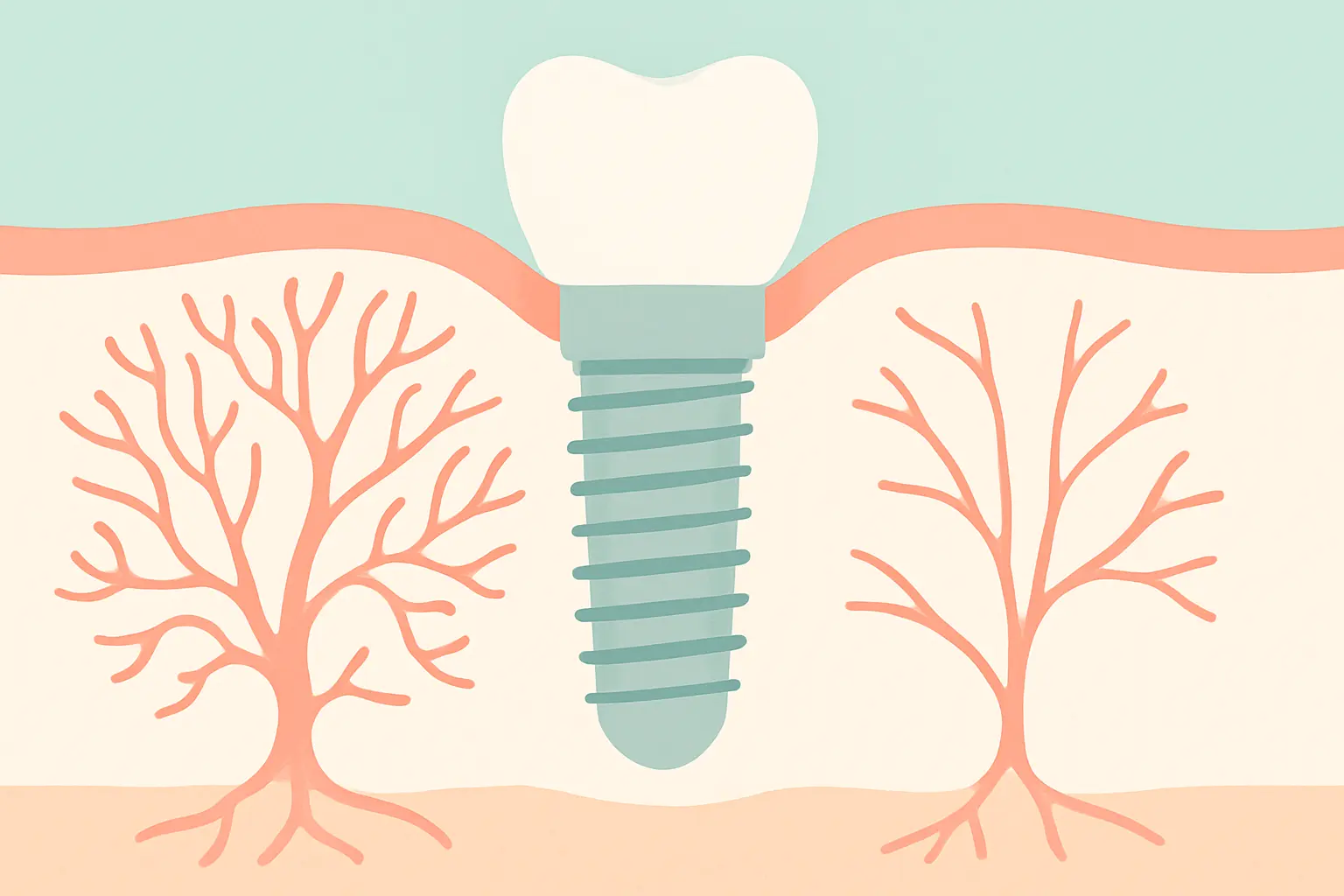
A 2025 review of peri-implant outcomes offers the likely mechanism in one phrase: bone loss, plaque accumulation and inflammation despite reduced bleeding, which the authors attribute to nicotine-induced vasoconstriction. Less bleeding sounds like a good thing and is not; it is a narrowed blood supply to tissue trying to heal.
This short film from a university dental school covers what smoking does to the mouth more broadly.
What about peri-implantitis?
Peri-implantitis is inflammation and bone loss around an implant that has already integrated, and here the evidence is genuinely mixed, which is worth saying rather than hiding. A 2015 systematic review of seven studies found a higher risk at implant level but no significant difference at patient level, and concluded there was little evidence. A 2016 review found insufficient data to judge. By 2023, a review of seven prospective studies covering 702 patients and 1,959 implants reported a patient-level relative risk of 2.79 (95% CI 1.42 to 5.50), with moderate certainty by GRADE. The direction of travel is toward smoking being a real risk for long-term problems, not just early failure.
Gum health around the implant matters for the same reason. The NHS names stopping smoking among the first things a dentist advises in the early stages of gum disease, and lists not smoking in its prevention advice. Our guide to gum healing after quitting smoking covers what changes once you stop.
How long before: what the evidence supports
Here is where to be careful, because the internet is full of confident numbers with nothing behind them. The study everyone is quoting is a 1996 prospective study of 223 implants in 78 patients, which split people into non-smokers, smokers who followed a structured cessation protocol, and smokers who carried on. Failure rates differed significantly between non-smokers and continuing smokers, and between the protocol group and continuing smokers, but not between non-smokers and the protocol group. In other words, following a cessation protocol appeared to bring smokers back to non-smoker outcomes. A later paper reviewing that work notes only that the original recommendations appear to suggest that long periods of abstinence are required.
What that supports in practice:
- Ask for your surgeon’s window in writing, before and after, at the consultation rather than the week of surgery.
- Start earlier than the window. Nothing in the evidence suggests that stopping sooner is worse, and a quit that is already three weeks old on surgery day is far more robust than one that started on Monday.
- Do not treat the window as the finish line. The protocol that worked covered the healing period, not just the run-up.
- Tell the surgical team honestly. They are not going to lecture you, and it changes how they plan and how they follow you up. Some practices will not place an implant in a continuing smoker at all.
If you have surgery of any kind coming up, our wider perioperative guide to quitting before surgery covers the general principles, and this article is the dental-specific version.
How long after: the window that matters more
Most people focus on the days before surgery. The evidence points the other way: the failure measured in these studies is early failure, meaning the bone failing to integrate with the implant, and that happens in the weeks after placement. Practically, this means three things:
- The healing window is the one to protect. Whatever your surgeon says about the weeks after placement, that is the number to hold.
- The first cigarette after surgery is the dangerous one, and it usually comes in the first 48 hours, when you are sore, bored and at home. Plan for it like any other high-risk moment.
- Suction and heat are separate problems from nicotine. If you had an extraction at the same appointment, follow the instructions you were given about the socket.
Our guide to how long after a tooth extraction you can smoke covers the extraction side of that, which frequently happens in the same visit.
Vaping, waterpipe and pouches count too
Switching to a vape for the healing period is the most common workaround, and the peri-implant literature does not support it as a free pass.
A 2025 systematic review and meta-analysis comparing cigarettes, waterpipe and vaping looked at peri-implant outcomes across all three. Marginal bone loss was greater in every user group than in non-smokers: cigarettes by 2.16 mm, waterpipe by 1.9 mm, e-cigarettes by 0.83 mm. The authors described a risk gradient of cigarette, then waterpipe, then e-cigarette, then non-smoker, and noted all of them promoted bone loss, plaque accumulation and inflammation despite reduced bleeding.
A 2023 systematic review looking only at e-cigarettes pooled four cross-sectional studies covering 327 men and found a mean difference in marginal bone loss at distal implant surfaces of 0.89 mm (95% CI 0.67 to 1.11) between e-cigarette users and people who had never smoked.
Two honest caveats. The e-cigarette evidence base is small, cross-sectional and mostly in men, and both reviews say so. And a gradient is still a gradient: if the realistic alternative is continuing to smoke, that is a conversation for your surgeon rather than a decision to make alone. What the evidence does not support is a vape being neutral around a healing implant.
Nicotine replacement during the healing window
This is the question people are most nervous about asking, so here it is plainly. Nicotine replacement therapy delivers nicotine without the combustion products of cigarette smoke, and it is what NHS stop smoking services supply: patches, gum, lozenges, inhalators and mouth and nasal sprays, alongside the tablets varenicline, cytisinicline and bupropion. Those services are free, usually support people for up to 12 weeks, and measure the carbon monoxide in your breath at each meeting, which is a useful objective record to bring to your dental appointments.
The harm the implant literature describes is attributed partly to nicotine-induced vasoconstriction, and none of the reviews above tested NRT during osseointegration. So the honest position is that NRT is far preferable to continuing to smoke and is the standard tool for getting through a quit, but whether and how to use it across your healing window is a question for your surgeon. Ask about timing rather than a yes or no. Our comparison of NRT options compared helps you arrive with a specific question.
A plan built backwards from your surgery date
Most people reading this already have a date booked, often four to eight weeks out. Work backwards from it.
| When | What to do |
|---|---|
| As soon as you have the date | Ask the surgeon for the before and after windows in writing. Book a free NHS stop smoking service appointment the same day. |
| 4 or more weeks before | Set your quit date now rather than at the deadline. Prescription-only tablets have to be started before the quit date, so this is when to ask. |
| 2 to 3 weeks before | Stop. This gets the hardest days of withdrawal, which the NHS says are usually the first 3, well clear of surgery day. |
| The week before | Clear the house, car and routine. Plan the first 48 hours after surgery in detail, because that is the highest-risk window. |
| Surgery day | Follow the pre-operative instructions exactly. Take your fast-acting product with you if your surgeon has agreed to it. |
| The healing period | Hold the line for the whole window you were given, not the part that feels necessary. Keep your stop smoking appointments through it. |
| After the review appointment | Do not restart. See the section below. |
Setting your own quit date is the step people skip, because the surgery date feels like it counts as one. It does not, quite: our step-by-step on setting a quit date that actually sticks covers how to fix one around an external deadline, and our guide to immune recovery after quitting covers what improves and when.
Through the healing window, the small practical stuff matters more than usual, because you are bored, sore and at home. iQuit counts your smoke-free days, logs each craving with its trigger so you can see which hours of recovery are the hard ones, and gives you SOS craving tools for the moments you cannot leave the sofa. It is free on Google Play and the App Store.
Turning a forced pause into a permanent quit
A surgical quit has a built-in flaw: it comes with an end date, and a lot of people restart the week after the review appointment. Three things make it stick:
- Move the finish line before you reach it. If your healing window is eight weeks, decide in week four that you are going to twelve. The NHS says that once you reach 28 days smoke free you are 5 times more likely to stay quit for good, and the healing window usually takes you past that on its own.
- Keep the stop smoking service after the dentist stops asking. Services usually run up to 12 weeks, so support is there past the point where surgery stops being the reason.
- Change the reason. The implant is done, so the motivation has to become the rest of your teeth, the money, the breathing. An implant is an expensive object to put into a mouth you keep exposing to the thing that took the last tooth out.
Withdrawal is mostly behind you by then. The NHS says symptoms are strongest in the first week, especially the first 3 days, and last 3 to 4 weeks on average. If you stopped two weeks before surgery and held through an eight-week healing window, the hard part is a long way back.
Smoking and Dental Implants FAQ
How long should I stop smoking before a dental implant?
Follow the window your surgeon gives you, and stop earlier if you can. No published dental body sets one universal figure, and the classic study of a structured cessation protocol did not state its length in its abstract. What the evidence does support is that following such a protocol brought smokers back to non-smoker failure rates.
How much more likely is an implant to fail if I smoke?
A 2024 systematic review and meta-analysis of 32 studies covering 59,246 implants found smoking associated with an odds ratio of 2.59 for early implant failure at implant level and 2.00 at individual level. A 2013 meta-analysis of 51 studies found a pooled relative risk of 1.92 (Journal of Dentistry 2024; PLoS ONE 2013).
Is it worse for an implant in the upper jaw?
The 2024 meta-analysis reported a larger effect in the maxilla, with an odds ratio of 5.90 (95% CI 2.38 to 14.66) compared with 3.76 in the mandible, though this came from only three studies so the confidence intervals are wide. Treat it as a reason to be stricter, not as a precise multiplier.
Is the time after surgery more important than the time before?
The failure these studies measure is early failure, which is the bone failing to integrate with the implant in the weeks after placement. That makes the healing window at least as important as the run-up. Follow the post-operative instructions your surgeon gives you for the full period.
Can I vape instead while the implant heals?
The peri-implant evidence does not treat vaping as neutral. A 2025 review reported greater marginal bone loss in e-cigarette users than non-smokers and a risk gradient from cigarettes down to vaping, and a 2023 review found a mean difference of 0.89 mm in bone loss at distal implant surfaces. The evidence base is small, so discuss it with your surgeon.
What about nicotine pouches or heated tobacco?
There is much less implant-specific evidence for these than for cigarettes, and none of the reviews cited here tested them. Since the harm these reviews describe is attributed partly to nicotine-induced vasoconstriction, and pouches sit directly against gum tissue, tell your surgeon exactly what you are using rather than assuming it does not count.
Can I use nicotine patches while my implant heals?
Ask your surgeon, and ask about timing rather than a yes or no. Nicotine replacement delivers nicotine without smoke and is what NHS stop smoking services supply, but no review cited here tested it during osseointegration, so this is a decision for the clinician who is placing the implant.
Should I tell my dentist I smoke?
Yes. It changes how the case is planned, how you are followed up and what you are told to watch for, and some practices will not place an implant in someone who is still smoking. Hiding it does not protect the implant, and a carbon monoxide reading from a stop smoking service is objective evidence you have stopped.
Does smoking cause problems years later, not just at the start?
Possibly. Peri-implantitis is inflammation and bone loss around an integrated implant, and the evidence has shifted: reviews in 2015 and 2016 found little or insufficient evidence, while a 2023 review of seven prospective studies found a patient-level relative risk of 2.79 with moderate certainty (Clinical Oral Implants Research).
Get through the healing window
iQuit counts your smoke-free days from the date you set, logs each craving with its trigger so you can see which hours of recovery are hardest, and gives you SOS craving tools for the days you cannot leave the house. Free on Google Play and the App Store.
Download iQuit Free on Google Play
Download on the App Store