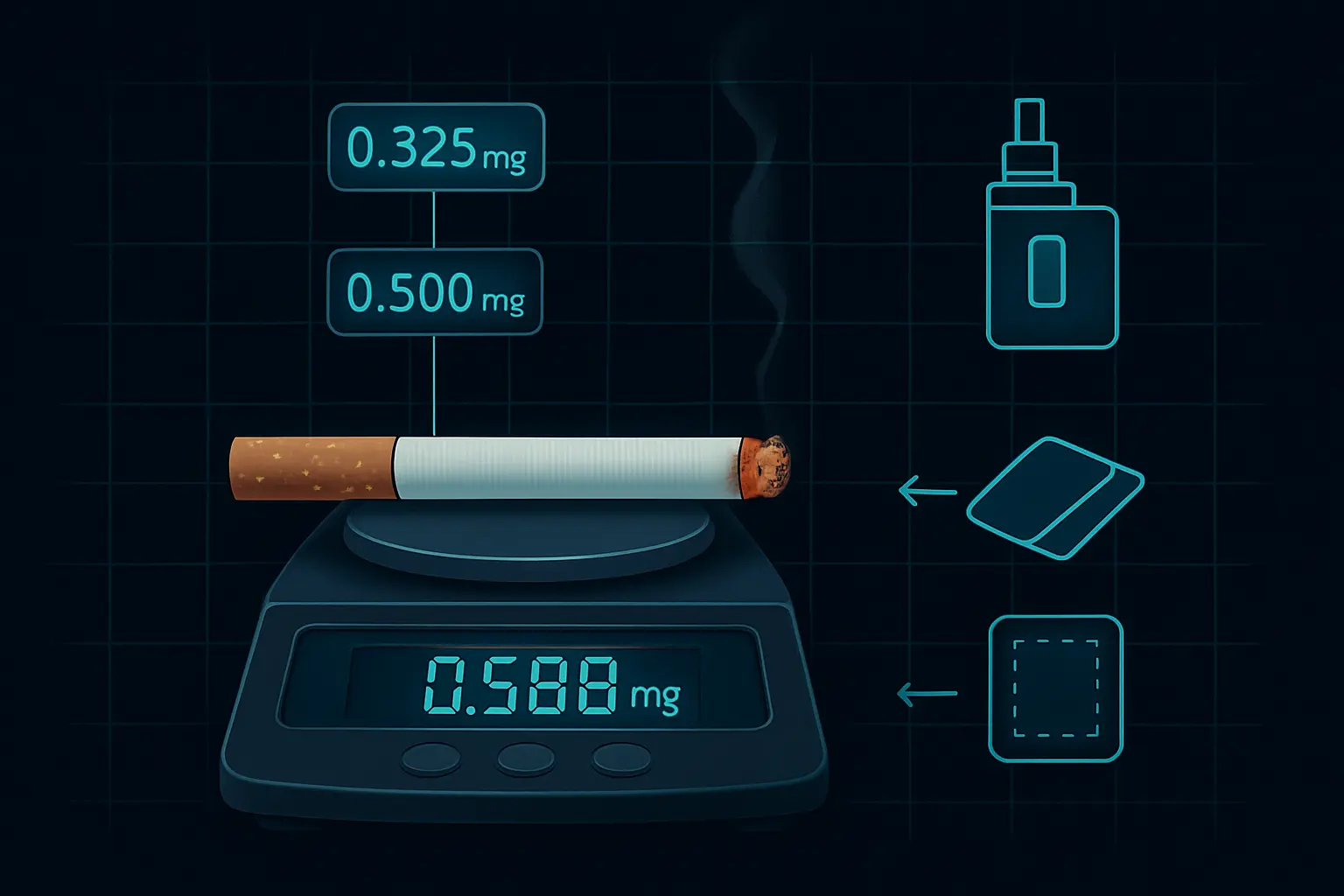
The tobacco in one cigarette holds 10–14 mg of nicotine. Your body gets 1–2 mg of it. The rest burns off, drifts away as sidestream smoke, or never leaves the butt. That tiny absorbed dose — delivered to the brain in ten seconds, twenty times a day — is the entire engine of the world’s most successful addiction. Here are the numbers behind the hit, and what they mean if you’re planning your exit.
Content vs delivery: the two numbers people confuse
| Measure | Typical value | What it means |
|---|---|---|
| Nicotine in the tobacco | 10–14 mg | Total content before burning |
| Absorbed per cigarette | ~1–2 mg | What actually reaches your blood |
| Pack-a-day daily intake | ~20–40 mg | In 20 fast spikes, not one slow dose |
| Time to brain | ~10 seconds | The speed that makes it addictive |
The delivery pattern matters more than the milligrams: 30 mg dripped in slowly (a patch) is far less addictive than 30 mg in twenty arterial spikes. Speed is the drug — the mechanism the dopamine-loop article unpacks.
The “light cigarette” deception, in numbers
Light cigarettes scored lower on smoking machines — humans aren’t machines. Smokers unconsciously compensate: deeper drags, faster puffing, fingers over the filter’s ventilation holes, an extra cigarette here and there — reliably extracting their accustomed 1–2 mg regardless of the label. Blood cotinine studies showed light-cigarette smokers absorbing essentially the same nicotine as regular smokers, which is why “light” and “mild” labels are banned as deceptive across the EU, US and beyond. If you smoked lights for years believing you were tapering: the machines were tapering; you weren’t.
How other products compare (absorbed dose)
- Vape (typical modern pod): highly variable — a 2% (20 mg/ml) pod delivers nicotine efficiently; heavy vapers can absorb more daily nicotine than pack-a-day smokers, minus the combustion toxins, plus the maintained addiction.
- Nicotine gum (2/4 mg): ~1–2 mg absorbed per piece, slowly, via the cheek — deliberately spike-free, which is why it aids quitting instead of deepening dependence.
- Patch (7–21 mg/24h): the slowest drip of all — steady blood levels, zero ritual, lowest addiction potential of any format.
- Pouches (3–12 mg): a wide and lightly-regulated range; the strong ones out-dose cigarettes.
What the numbers mean for quitting
Three practical readings. Your dependence is calibrated in spikes, not milligrams — which is why time-to-first-cigarette beats pack count as a dependence measure, and why NRT dosing starts from how soon you smoke after waking. NRT isn’t “still smoking”: the same molecule without the spike or the 7,000-chemical vehicle is a fundamentally different risk object. And the daily arithmetic flips at quit time: 20–40 mg a day your receptors expect, gone in 72 hours — the short, loud detox described in how long nicotine stays in your system, after which every craving is memory, not molecule.
Count what matters instead
The free iQuit app runs the arithmetic in the direction that helps: cigarettes not smoked, milligrams not delivered, money not spent, and 11 minutes of life regained per cigarette avoided — your dose data, inverted into a scoreboard.
FAQ
How much nicotine is in one cigarette?
10–14 mg in the tobacco; ~1–2 mg absorbed by the smoker.
How much does a pack-a-day smoker absorb?
Roughly 20–40 mg daily, in twenty ten-second spikes.
Were light cigarettes really lower in nicotine?
Only for machines — humans compensated to full dose, which is why the labels were banned.
Is NRT nicotine the same risk as cigarette nicotine?
Same molecule, opposite delivery: slow and spike-free, without combustion — designed to end dependence, not deepen it.
Turn the milligrams into a scoreboard: download iQuit free on Google Play.