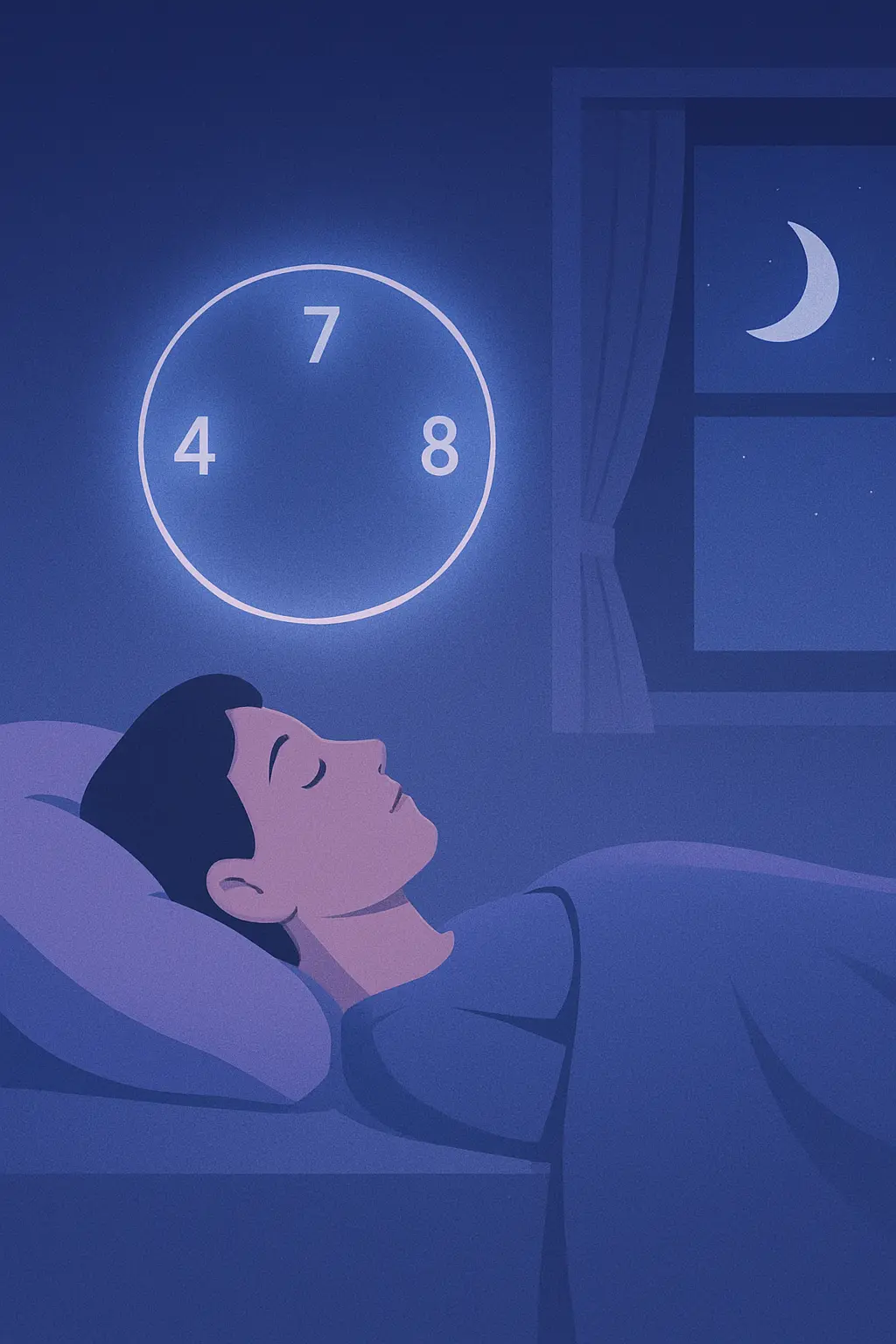
If box breathing is the daytime tool, 4-7-8 is the night shift. Inhale through your nose for 4 seconds, hold for 7, exhale through your mouth for 8 — four cycles. The disproportionately long exhale is the active ingredient: it leans on the parasympathetic “rest and digest” response harder than any equal-count pattern, which is exactly what a quitter’s wired, nicotine-free evenings need. For the weeks when withdrawal wrecks your sleep and the bedtime cigarette’s ghost still knocks, this is the technique built for the job.
Why quitters specifically need a night technique
Two problems collide at bedtime in early quitting. First, withdrawal disrupts sleep architecture — harder to fall asleep, more fragmented nights — a documented and temporary effect covered in the post-quit insomnia guide. Second, the last-cigarette-of-the-day ritual was, for many smokers, the day’s most sacred: the punctuation mark that told the brain “done now.” Remove it and bedtime feels unfinished. 4-7-8 replaces both functions at once — it sedates the nervous system and gives the evening a closing ritual.
The exact steps
- Set the tongue. Tip resting against the ridge behind your upper front teeth, where it stays for the whole exercise (Dr. Andrew Weil’s original protocol; it shapes the exhale).
- Empty out. Exhale completely through your mouth with a soft whoosh.
- Inhale — nose, 4 counts. Quiet, unforced.
- Hold — 7 counts. Gentle hold, loose jaw. This is the longest-feeling part; let the count carry you.
- Exhale — mouth, 8 counts. Slow, audible, complete. If eight seconds feels impossible at first, keep the ratio (4:7:8) and shrink the counts — 2:3.5:4 — then grow them.
- Repeat ×4. Four cycles takes about two minutes. Cap at eight cycles; more isn’t better, sleepier is better. Feeling drowsy mid-count is success, not failure — stop counting and let go.
4-7-8 vs box breathing: which, when
Box breathing (4-4-4-4) holds you alert and calm — symmetric, stabilizing, ideal for daytime cravings when you still need to function afterward. 4-7-8’s long exhale tips you toward sedation — ideal for bedtime, 2am wake-ups, and the wind-down hour, but not what you want before a meeting. Simple rule: sun up, box; sun down, 4-7-8.
The 2am wake-up protocol
Waking mid-night with a craving is common in week one — nicotine’s absence is loudest during your longest gap. Don’t negotiate horizontally: sit up, sip the water you left bedside, then run 4-7-8 lying back down. The craving’s peak passes inside your second cycle, and the technique’s sedation carries you back under — the full night-craving playbook is in why cravings are worse at night.
Guided, so you don’t have to count
Counting 7-second holds while sleep-deprived and craving is genuinely hard. The free iQuit app includes 4-7-8 as one of its three guided breathing exercises — a visual pacer expands and contracts so you just follow, no arithmetic — reachable from the SOS button even at 2am with one eye open. Practice it once at a calm bedtime and it’ll be there, automatic, on the rough nights.
FAQ
How many cycles of 4-7-8 for sleep?
Four to start, up to eight maximum. Drowsiness mid-count means it’s working — stop and drift.
Can’t hold for 7 — am I doing it wrong?
Shrink the counts but keep the 4:7:8 ratio (try 2:3.5:4) and build up over a week.
Is 4-7-8 better than box breathing?
For sleep, yes — the long exhale sedates. For daytime cravings, box breathing keeps you calm and alert.
How long until quit-related insomnia ends?
Usually two to four weeks; 4-7-8 bridges the gap rather than fixing the chemistry.
Nights are the hard shift — bring a tool: download iQuit free on Google Play for guided 4-7-8 one shake away.